“There is no surer way of evading the world than by art;and no surer way of connecting to it than by art.“
“Nothing is more terrible than ignorance in action.“
Johann Wolfgang von Goethehas always been shortchanged in the English-speaking world, and one Stanford alum (he got his PhD in 2000) wants to do something about it. Tino Markworth has also studied in Bielefeld (Germany) where he taught in the University of Bielefeld’s Philosophy Department, in London and in Washington, D.C. He also studied in the History of Consciousness program at the University of California, Santa Cruz, and taught in the English Department at Stanford.
His new website, Goethe Global, is here. He says it offers “bite-sized pieces of wisdom” that show that his writing is still relevant to our lives today. “My hope is that these quotes will motivate people to find out more about him and ultimately engage further with Goethe’s longer texts.”
“On the website, you can find Goethe quotes in English, often newly translated, with the German original and the exact source,” he wrote me. “In addition, there are links to free versions of some of Goethe’s works in English and to online resources about Goethe in English.”
Here are a few of the quotes:
… we are forced to forget our century if we want to work according to our convictions.
***
The excellent is rarely found, more rarely valued.
***
Beauty and Genius must be removed if you don’t want to become their servant.
***
Happy birthday, sir.
… the spirit and the senses so easily grow dead to the impressions of the beautiful and perfect, that the ability to feel it should be preserved by every possible means
Goethe is not Markworth’s only passion. He organized the first international conference on Bob Dylan in 1998 at Stanford, which attracted more than 400 people.
Here’s another passion: he also has a thing for Johann Gottfried Herder, the German philosopher, theologian, poet, and literary critic who was born on this very day in 1744: “All our science calculates with abstracted individual external marks, which do not touch the inner existence of any single thing.”
(P.S. I found this on my internet travels: if you want to read an interview with Goethe, go here.)
Postscript: Neil Silberblatt, who runs the “Voices of Poetry” Facebook page, is a Herder fan, too. Inspired by this post, he reposted a birthday tribute from my own alma mater, “Herder and the Idea of a Nation,” here.
Postscript on August 28: I didn’t realize Goethe’s birthday would come so soon! “Why look for conspiracy when stupidity can explain so much?” ~ Johann Wolfgang von Goethe, born on this date in 1749
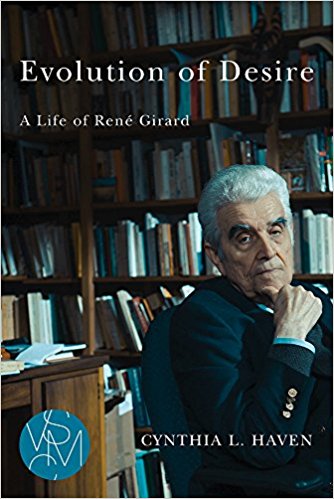
Summertime is slow in Russia, but fortunately that hasn’t been the case for sales of Evolution of Desire: A Life of René Girard. Reviews of the brand-new Russian edition, out with the eminent Moscow publisher New Literary Observer last spring, have been slow in reaching sunny California (though we excerpted a terrific article by Alexey Zygmonthere, which concluded “it’s hard to wish for a better biography of Girard”).
In English
Hence, I’m reliant on my Russian friends for news. One of them is the eminent poet and publisher Maria Stepanova, who reassured me. “Yes, it is a big hit here – and there have been rave reviews,” she wrote. “I’m so glad it has such a good following.”
One data point, she said, is Moscow’s leading bookstore, Falanster (Фаланстер) – where it’s the #6 bestseller. Note the photo above that is featured on Falanster’s Facebook page. Count six from the left – there. That’s me, with the grey-and-orange spine.
The Falanster cat
Don’t believe me still? Check out the list below, and find out the other books Muscovites are reading, too. I hope my reviews for my book on the French theorist create a larger worldwide audience for the man who wrote about human nature, human history, and human destiny.
I’d love to visit Falanster in person – it’s been too many years since I’ve been in Russia. Meanwhile, I send my love to Moscow, and, as Maria wrote: “Moscow loves ya back!”
Editor-in-chief Boris Dralyuk of the Los AngelesReview of Books may be a celebrated poet and translator now, but he had a brief, humiliating, all-too-youthful stint hawking maps to the homes of the film industry luminaries decades ago. An excerpt from his blog:
For exactly one Saturday, in the summer of 1996, I stood on the corner of Sunset Blvd. and Ogden Dr. hawking maps to the movie stars’ homes. Earlier in the week, six of us, all immigrants from the former USSR, had been rounded up for the job by a Fagin-like fellow — stringy, squinty, coils of white hair sticking out like fried electrical cords from the back of his baseball cap. I don’t remember whether I had my mother sign a minor’s work permit or simply forged her signature, but I do remember that I sold exactly one map.
Unforgettable too was the look of disgust on our Fagin’s face as he peeled a fiver off his soggy roll of bills at 5 pm: my salary. The pay was piddling, the task demeaning. There was little shade on the corner, and I was too easily wounded by the reactions of some of my potential customers, their rude sneers and pitying frowns. To this day I accept every flyer handed to me on the street with a smile, recalling my own unhappy turn as a peddler.
Sellers of star maps were ubiquitous during my early years in Hollywood, but something drove them off them off the streets in the 2000s. I suppose it was the double threat of the internet, which made celebrity addresses free and easy to find, and reality television, which fed viewers the illusion of round-the-clock access to certain celebrities’ private lives: why drive around in the hope of spotting a star in the distance when you can sit at home and watch them squabble in their own kitchens? Read the whole thing here.
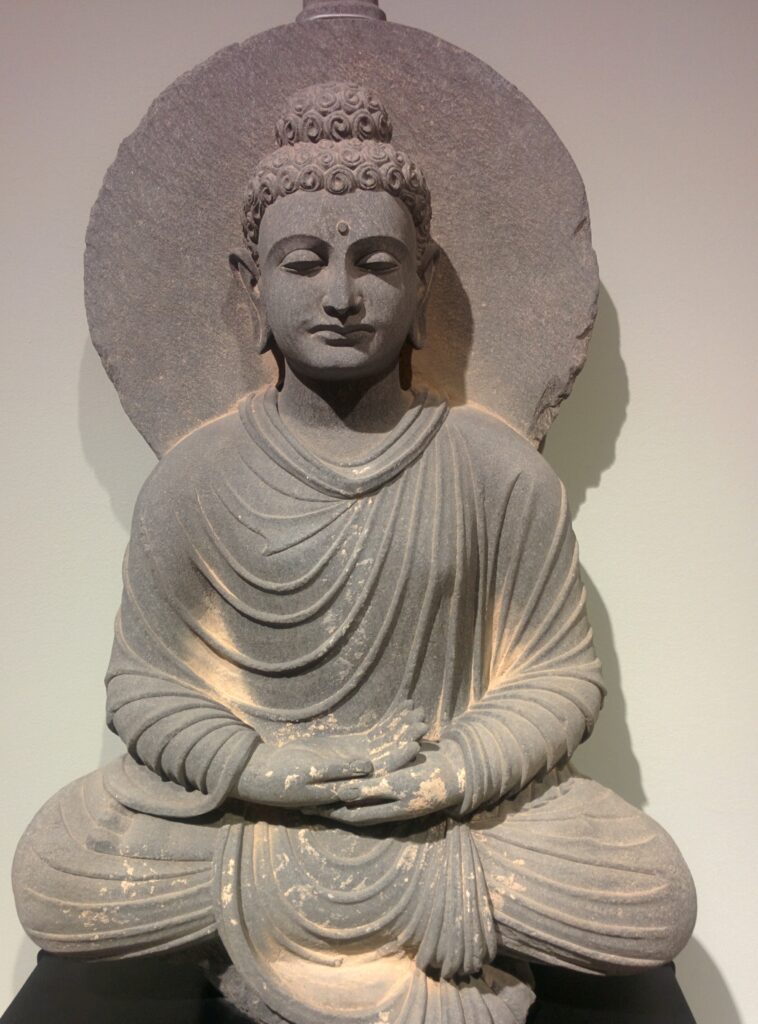
Jeff Bezos had it wrong. You don’t have to pay hundreds of thousands of dollars to leave this planet. All you have to do is go to 2120 Oxford Street in Berkeley to see the current (through October 3) Berkeley Art Museum and Pacific Film Archive (BAMPFA) exhibit, “Beyond Boundaries: Buddhist Art of Gandhara.” It was my own birthday choice (and a gift) a few weeks ago, and it was an out-of-this-world experience. (UPDATE: This exhibit has been extended through March 13, 2022.)
From the exhibit website: “The Gandhara region of northern India served as a crossroads of power, culture, and Buddhist art from the second to ninth centuries AD. Presenting rare images of the Buddha and his life story, this exhibition demonstrates through thirty-six sculptural examples from public and private collections the important cultural exchanges between the Hellenistic world of Greek and Roman art and the native artistic traditions of India. Artisans of this region took a new, humanistic approach to depicting the Buddha in clothing and settings drawn from the West and combined them with descriptive tales of the life and teachings of the Buddha.”
The BAMPFA showing is the first substantial collection of Gandharan Buddhist art in an American museum in some time. And a chance to make some new friends … My own favorite, I think, is the mysterious gentleman at the bottom of this page, from a private collection. Whatever attribute he once held in his left hand has disappeared. So we can’t know for certain who he was intended to be. But the going bet seems to be a Bodhisattva Maitreya, a Buddha of the Future – and a quick Google search suggests he has a lot of brothers of the same name, who look just like him, in other museums.
Listen to a 47-minute virtual tour or get real-life tickets at the website here. Meanwhile, enjoy my photos below.
This 14th century gilt bronze Tibetan Buddha touches the earth, and so demonstrates his victory over the temptations of the demon Mara. He calls upon the earth to testify to his struggles over millennia to achieve perfection. This Shakyamuni Buddha looks to an era when his teachings will be accepted and understood. Note the trendy blue curled hair!
This 3rd century Buddha makes the classic meditation posture, cross-legged in lotus position, with his hands gracefully in his lap.
A seated Buddha making a gesture of reassurance with his raised right hand, 3rd – 5th century AD. In the middle of his palm, the wheel of dharma. He holds the hem of his robe in his left hand.
My guy. If he held a flask or a pot, we could be more certain that he was a Bodhisattva Maitreya, a buddha of the future. What attracts me to him? His slightly wild aspect, with thick curls cascading to his shoulders, the heavy earrings that feature winged lions, the slightly barbaric necklace with monsters on it. What else to like? The ropes of ornament looping around his right shoulder and the armplate on his bared arm. The curled and carefully styled moustache over the sensual mouth, under the serene half-closed eyes. He seems to have a distant Persian cousin to me, but hey, what do I know?
It’s a pleasure, always, to have a guest piece from my former Los Angeles Times Book Review editor … whoops! now he’s head of Heyday Books and my very own publisher … Steve Wasserman. Here’s what he wrote remembering the occasion of the 1979 death of the eminent film director, screenwriter, actor, producer and author Jean Renoir.
Here’s the story of how the Los Angeles Times finagled an obituary from Orson Welles.
My old friend Peter Biskind, Hollywood historian extraordinaire, has rescued from Henry Jaglom‘s jumbled closet the hours upon hours of table-talk Jaglom recorded during his years of lunches with Orson Welles. As I hoovered up these edited transcripts of the higher gossip, I thought fondly of my own encounter with Welles – an encounter that would lead to irregular meals (and something of a friendship) with the great man at his favored table at “Ma Maison.”
The story begins with the death of Jean Renoir in Beverly Hills in early 1979. I was then deputy editor of the Los Angeles Times Sunday Opinion section. The Times, in its infinite wisdom, had consigned news of Renoir’s demise to an AP wire story buried on page nineteen of the Sunday paper. I was beside myself with unhappiness. Here was one of the great directors of the twentieth century, dying in our backyard, as it were, banished to an ignominious squib on the paper’s inside pages instead of being ballyhooed prominently on the front page.
He deserved better than “an ignominious squib.”
The honor of the paper was at stake, I felt. We needed to act immediately to commission a proper piece, honoring Renoir’s life and legacy, to publish in the next Sunday’s paper. Only Orson Welles, I felt, could do right by Renoir. But how to contact him? I knew only that Welles made a habit of eating lunch every Wednesday at “Ma Maison,” but I would need his piece, should he agree to write it, by Wednesday, or Thursday at latest, in order to make the Sunday paper. I remembered that Welles had some years before been the voice of the Paul Masson Winery, intoning “no wine before its time.” I called the winery and was referred to an ad agency in New York and was, in turn, given the name of Welles’s Manhattan agent. I rang and explained my purpose.
“So you want to reach Orson Welles, do you? Well, a lot of people want to reach him. Listen, kid, here’s what I’ll do. I’m gonna give you his office number. It’s a local number. Area code two-one-three. You’re unlikely to reach him, but if you do, will you do me a favor? Will you tell him to call his agent, for cryin’ out loud?”
I dialed the number. It rang and rang and rang. Finally, the receiver was slowly lifted off its cradle and what can only be described as an extraordinarily fey voice drawled hello. It was Welles’s assistant. I asked to speak to Welles. “I’m sorry, but Mr. Welles isn’t in.” “Do you expect him back soon?” “I do not know when he’ll be back. You see, Mr. Welles almost never comes in.” “Might I leave a message?” “Yes, if you must,” the voice said in tones of great exasperation. “But do understand that when Mr. Welles deigns to come into this office, he very often sees the stack of messages piled high on the desk and he sweeps them to the floor.”
The next morning, I got to work early. Already at my desk was my boss, Anthony Day, editor of the paper’s editorial pages. He was clutching my phone. “Yes, yes. I see him now, just coming in.” Cupping the receiver, he looked at me and stammered, “Steve, it’s. . .it’s Orson Welles. For you!”
I got on the horn and heard, in his inimitable voice, “Mr. Wasserman, this is Orson Welles. I did not know until I received your kind message that my great and good friend, Jean Renoir, had passed away. What, pray tell, would you have me do?”
I told him of the embarrassing and all but invisible notice that Renoir’s death had occasioned in the paper and that we had an obligation to do what we could to remove the stain of shame. Would he write a piece?
“So you want to reach Orson Welles, do you?”
“How long? How about two-hundred-fifty words?” he offered. Given the length of Renoir’s life and his considerable achievement, I said a thousand might be better.
“Let’s split the difference and agree to five hundred.”
As for deadline. . .he boomed, “I know, I know: You needed it yesterday.”
“For you, Mr. Welles, the day after tomorrow would be fine.”
As for compensation … he cut me off: “Let us not sully art with talk of money. I count on you to do the right thing. You will do that, won’t you?”
I said I’d do my level best.
Wednesday came and went. No piece. We were keeping space open on the front page of the Opinion section. By noon on Thursday, we began to sweat. My phone rang. It was Gus, the paper’s receptionist-cum-security guard who manned the front desk in the paper’s art deco lobby, worthy of The Daily Planet, at the center of which slowly revolved a globe boasting national boundaries not redrawn since the collapse of the Austro-Hungarian Empire. A man saying he was from Mr. Welles’s office was waiting for me.
I hurried down. And there, greeting me, was an apparition straight out of Sunset Boulevard. A man, kitted out in livery, replete with leather driving gloves, handed me a manila envelope, bearing Welles’s piece.
As I walked slowly up the stairs to my second-floor office, I read what Welles had written. It wasn’t five hundred words; it was nine pages, 2,000 words, typed double-spaced on an Underwood Five typewriter, and edited in Welles’ hand with a blue felt tip pen, the last page of which bore his signature. Every sentence had oxygen in it. The lede was unforgettable: “For the high and mighty of the movies a Renoir on the wall is the equivalent of a Rolls Royce in the garage. Nothing like the same status was accorded the other Renoir who lived in Hollywood and who died here last week.”
The essay was perfect, all about the uneasy intersection of art and commerce and, as I read it, I realized it was, of course, as much about Welles himself as it was about Renoir. It was about the trials and tribulations of neglected genius. It was, in a way, a kind of manifesto, a credo of artistic aspiration and principle.
The ending, too, was a doozy: “I have not spoken here of the man who I was proud to count as a friend. His friends were without number and we all loved him as Shakespeare was loved, ‘this side idolatry.’ Let’s give him the last word: ‘To the question “Is the cinema an art?” my answer is “What does it matter?. . .You can make films or you can cultivate a garden. Both have as much claim to being called an art as a poem by Verlaine or a painting by Delacroix. . .Art is ‘making.’ The art of love is the art of making love. . .My father never talked to me about art. He could not bear the word.'”
There was nothing to edit. Only to publish it as written. It was the last piece Welles ever wrote. It appeared in the Los Angeles Times on Feb. 18, 1979. I kept the signed original manuscript. It is among my most treasured possessions. That and the memory of the meals we later shared in the years before his death in 1985.
The subject is dear to my heart: the importance of literature in our everyday lives, as an additional lens to recognize, interpret, and understand the world we see around us. I’ve written about ithereandhere, among other places.
Editor extraordinaire: Rosemary Johnsen
Rosemary Johnsenis of the same mind: “Literary criticism has the potential not only to explain, but to actively change our terms of engagement with current realities.” She is Professor of English, Associate Provost, and Associate VP of Academic Affairs at Governors State University in University Park, Illinois. (She’s also the author of Contemporary Feminist Historical Crime Fiction – more on that here.)
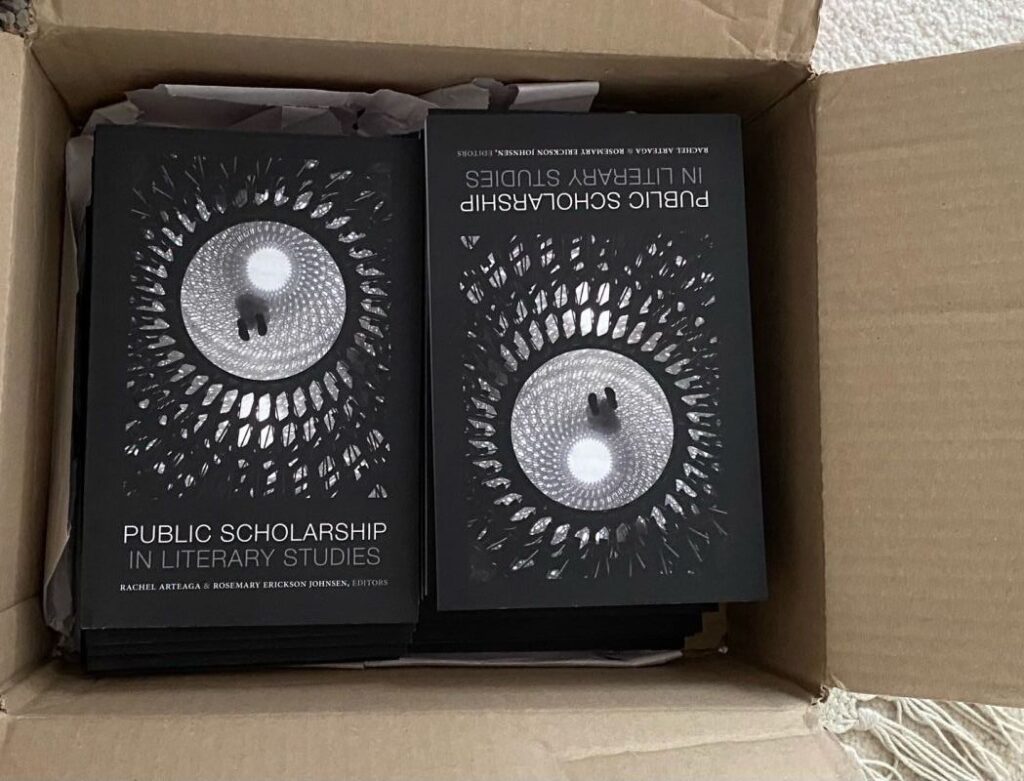
She joined forces with kindred spirit Rachel Arteaga of the University of Washington’s Simpson Center for the Humanities. Arteaga writes that she was inspired by a 2009 Daedalus article on the future of the humanities. What would public literary scholarship mean? What would public literary criticism look like? The result result of their partnership is a book, co-edited by both: Publish Scholarship in Literary Studies, just out with Amherst College Press. The book is available at Amazon here. Or you can get the book via open access here.
My humble self was invited to contribute, and so I did, with an essay titled “What Lasts,” discussing my own work with The Book Haven, Another Look, and Entitled Opinions. In the conclusion to the volume, Johnsen says the chapter “demonstrates the impact of her work, grounded in the practices of literary criticism.” Let’s hope so. I try. My position statement in the book:
Rachel Arteaga: Asking important questions
“The task of making the case for literature, and the humanities more generally, has never been more urgent. Great literature is endless. Nevertheless, it has become the province of a shrinking coterie who prefer solitary insight to Snapchat, something with a metaphysical bite rather than bytes. Quo vadis? Some years ago, the Polish poet Adam Zagajewski outlined one option for the future during our interview: ‘We’ll be living in small ghettos, far from where celebrities dwell, and yet in every generation there will be a new delivery of minds that will love long and slow thoughts and books and poetry and music, so that these rather pleasant ghettos will never perish— and one day may even stir more excitement than we’re used to now.’ It may come to that. I’ll opt for a less exclusive option: we may still learn to make a persuasive case for literature to a wider public, opening the essential world of literature across lines of class, race, and ethnicity.”
The book also tips its hat to the National Endowment of the Humanities for its creation of a “Public Scholars program,” in its “long-term commitment to encourage scholarship in the humanities for general audiences,” Johnsen notes. (Careful Book Haven readers will remember I am one of the program’s recipients; I wrote about that here.)
From Johnsen’s conclusion:
“The power of literature to enrich and inform understanding is well known to literary scholars. Increasingly, however, that foundational truth is disregarded or actively attacked. Literature, like much of the humanities, is often spoken of as a luxury or, even worse, as useless. Bringing literary study into the realm of public scholarship can help counter those misperceptions, working both individually and collectively to restore some confidence in what we do as scholars of literature. Public scholarship becomes the means to share what literary scholarship offers, but also to chip away at the presence of anti-intellectualism in contemporary society. Our ability to serve as intermediary between text and audience—the kinds of work we routinely do in our classrooms and at campus events— positions us to contribute beyond campus and our scholarly communities and to learn from the perspectives and insights available from those who do not inhabit our campuses. Public scholarship often takes forms recognizably similar to teaching and learning, but it can also serve as advocacy. We need that now more than ever.”