Last week I received some great news for me – and some terrific news for Czesław Miłosz: A California Life (Heyday Books), too! We’re both finalists for the Northern California Book Awards, in the non-fiction category (I am definitely non-fiction; so is the book). And that’s an honor, too, whatever happens at the event!
So join all of us celebrating on Sunday, September 11, 2022, 2:00 pm, when the 41st annual Northern California Book Awards recognize the best published works of 2021 by Northern California authors and California translators state-wide, presented by the Northern California Book Reviewers, Poetry Flash, and San Francisco Public Library, with community partners Mechanics’ Institute Library, Women’s National Book Association-San Francisco Chapter, and Pen West. Book sales and signing will take place in the lobby of Koret Auditorium at the San Francisco Public Library on Larkin Street.
The event is free and open to the public. And I’ll be signing books, too!
More good news: I have an interview with economist Tyler Cowen of Marginal Revolution fame (we wrote about his interview with Ted Gioiahere.) Go to the podcast here. It’s been getting lots of traction on Twitter. Check that out, too.
Tyler has done lots of interviews – I’m #157. Collect the whole set here.
So lots to celebrate all around, as summer slowly winds to a close.
I’ve written about the Milton Cottage, John Milton‘s only surviving residence in the world, here and here. And I’ve also written about Stanford’s one day-long celebration fourteen years ago, to coincide with the poet’s 400th birthday by reading Paradise Lost, here.
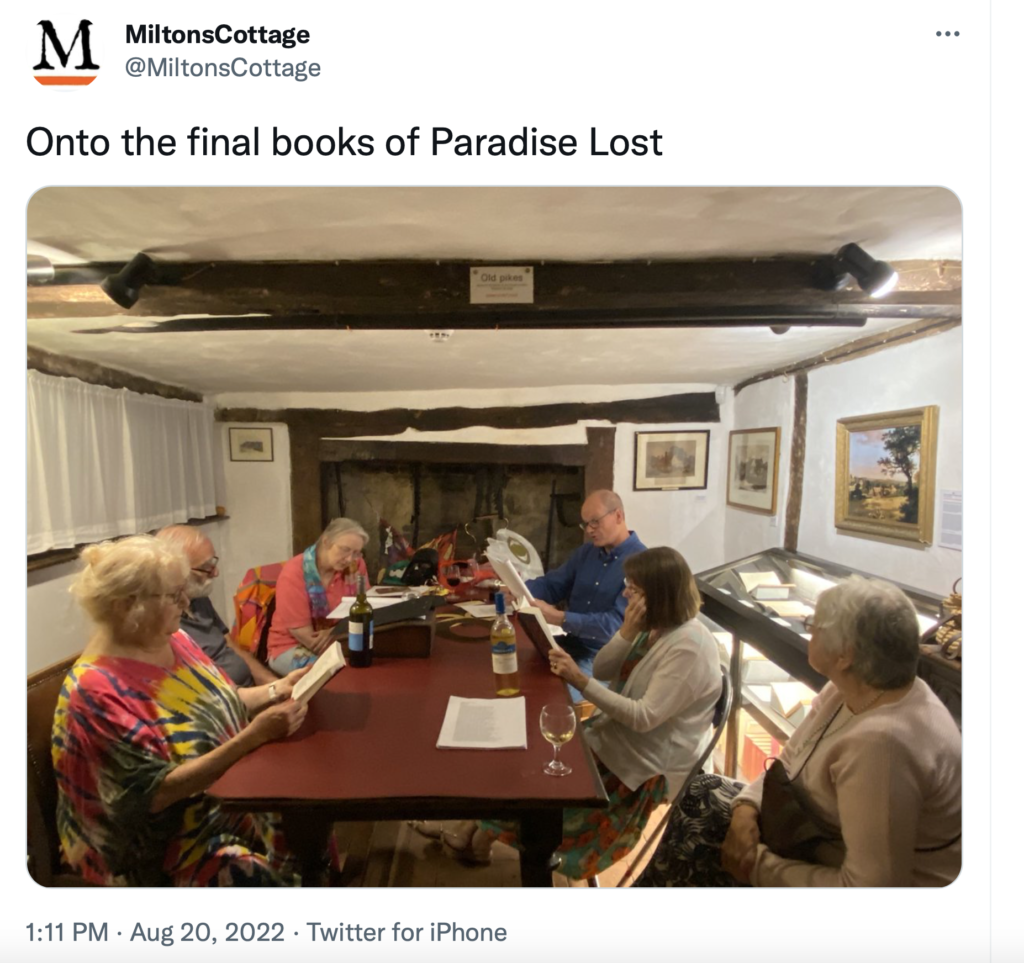
But why not just celebrate the season in beautiful Buckinghamshire? Paradise wasn’t lost at all today in Chalfont St. Giles, where Milton had a short sojourn in 1665-66. Milton fans gathered in the cottage to read Paradise Lost, beginning to end, all 10,550 lines of it, and commemorated the event on Twitter (@miltoncottage). And now we share it with you – the morning, afternoon, the evening, when they finished the last lines fortified with a few glasses of wine, as Adam and Eve are expelled from Eden:
Some natural tears they dropt, but wiped them soon; The world was all before them, where to choose Their place of rest, and Providence their guide: They, hand in hand, with wandering steps and slow, Through Eden took their solitary way.
The Lithuanian poet Tomas Venclova, one of Europe’s leading poets, has been a correspondent of mine for many years – since, in fact, the Czesław Miłosz centenary celebrationsl in Kraków, 2011, where we met. I have to admit I haven’t been a very good one. Tomas comes from the era of letters – I come from the era of the Tweet. Nonetheless, I treasure him and his emails, whenever we exchange them. (I’ve written about him here and here and here, among other places.)
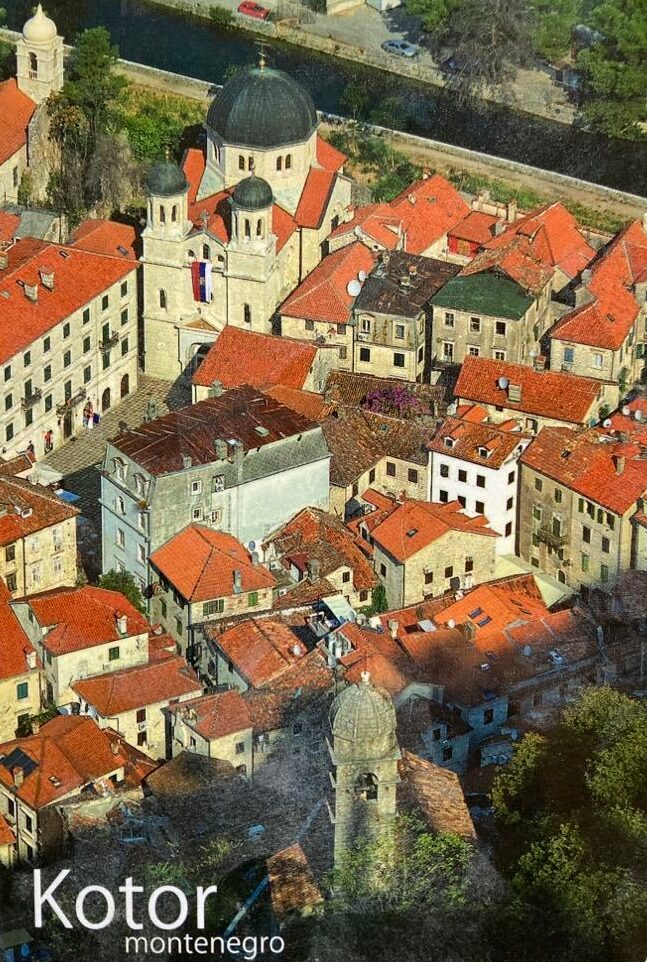
Sometimes I’d get a postcard or two when he was vacationing in Kotor, Montenegro, one of his favorite cities. Two of them have been pinned to my dresser mirror for ages, so I thought I’d share them with you, along with a short note about Kotor on a third.
The streets of Kotor, on a postcard
I’ve always been eager to make Tomas Venclova better known outside Europe, so I was pleased to mediate the correspondence that brought two of his most recent poems into English and to the West, with the help of poet and translator Ellen Hinsey. They’re in the a recent edition of the Los Angeles Review of Books here.
From the introduction, written by his translator Rimas Uzgiris:
“A human rights activist and an outspoken opponent of the Soviet regime — having spent, thanks to that, almost half his life in exile — Venclova has remained a cosmopolitan humanist, a skeptical lyricist whose poetry is guardedly hopeful. He holds tight to his ethical convictions — especially the sanctity of the individual life — and to the beautiful image, the music of the line, the logic of a complexly developed thought.”
The first poem “On Both Sides of Alnas Lake,” recalls the lake where the young Czesław Miłosz used to swim. It is set in Montenegro, on the Bay of Kotor, with its Venetian fortifications dating from the 15th century).
The second poem, “Before the Fort,” also recalls Kotor:
Before the Fort
Whatever else, speak. Verse hardly holds what is pressed Over time into the hardening clay of consciousness. There, we find contrasts of colors and fine detail, The ocean’s gleam, shame, wonder, and our travail. Maybe after death. But the plane rolls down the runway. Maybe when you won’t exist. But a sentence has no fate. Over the horizon’s line, by the switchback — a medley Of roofs. The citadel casts its shadow by Gurdich Gate.
Greet the scorched grasses, whose dry clumps lock up The stretch of bay where nameless towns of stone Age and decay. Thunderstorms slip along the strand On the other side of the well-burnished slope. Clouds. An untamed motorboat stirs the current alone And from bay bottom raises Mediterranean sand. Now, in the darkening mirror, you don’t meet you. A lamp, a keyboard, a dictionary. That much came true.
On the windward side of storms, at Europe’s deaf edge, Where you’ve been taken by fate or divine caprice, You will lodge in darkness, as others have found a place Beyond horizon’s brushstroke or the switchback’s ledge. The keyboard flickers, a presence hovers that you but feel. The mirror fades. Age enfetters the fatigued body alive. You can’t begin from the start, no matter how you strive. Whatever else, now speak. There is nothing more real. Read the whole thing in the Los Angeles Review of Bookshere.
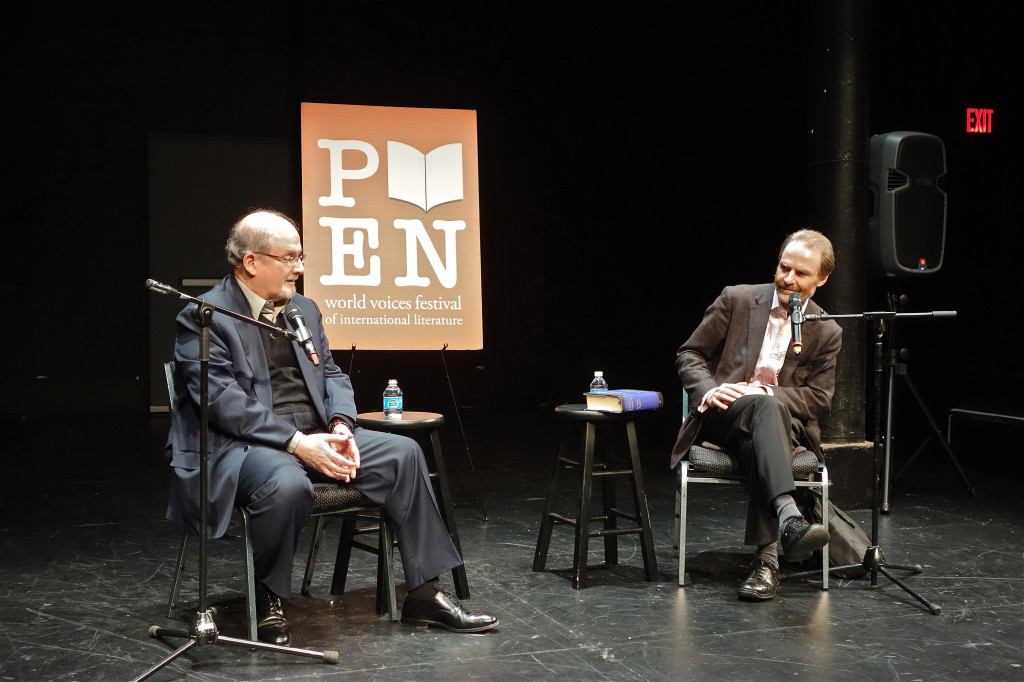
Salman Rushdie in conversation with Timothy Garton Ash in 2014. (Photo: Zygmunt Malinowski)
Last night’s Twitter feed was dispiriting. A surprising number of tweeters from the Middle East came out of the woodwork to pray for the death of Salman Rushdie,who was attacked yesterday. Even many Americans didn’t seem to understand that “free speech” protects speech that you don’t like or find offensive. That’s the point. Other speech doesn’t need protection.
Douglas Murray posted “The Best Response to Salman Rushdie’s Stabbing” over at The Spectator. You can read the whole thing here. An excerpt:
Sontag: No surrender
In his 2012 memoir – Joseph Anton – Rushdie wrote about the fatwa years. The book is a detailed chronicle of all the people who let him down: the MPs who promised support and then whipped up mobs; the political figures of left and right who said that while the Ayatollah may have caused an offence so had the novelist; the authorities who allowed Muslims in Bradford and others on television to call for a British subject´s murder with impunity.
But it is also a chronicle of the people who supported him, the friends who stood by him and the public figures who stood up for him. One of them was the American writer Susan Sontag, who helped organise a public reading of Rushdie´s work in New York. As Sontag said, the moment called for some basic ‘civic courage’. It is striking how much of that civic courage has evaporated in recent years. Today no one would be able to write – much less get published – a novel like The Satanic Verses. Perhaps nobody has tried. From novels to cartoons a de facto Islamic blasphemy law settled across the West in the wake of the Rushdie affair. The attack today will doubtless exacerbate that.
So apart from willing, wishing or praying for Rushdie´s recovery, the only other thing that can be done now is to display that civic courage that Sontag called for three decades ago. The Satanic Verses is a complex but brilliant novel. It includes an hilarious and devastating reimagining of the origins of the Quran. I hope that people will read it, and read from it, more than ever. Because what happened in New York today cannot be allowed to win. The illiterate cannot be allowed to dictate the rules of literature. The enemies of free expression cannot be allowed to quash it. The attacker should get exactly the opposite of the response he will have hoped for. Not just hopefully a failure to silence Rushdie, but a failure to limit what the rest of us are allowed to think, read, hear and say.
Update on August 13, from Google: “The Satanic Verses reached No. 1 in contemporary fiction on Amazon’s best-sellers list on Saturday, in the wake of the stabbing attack on the author the day before.“
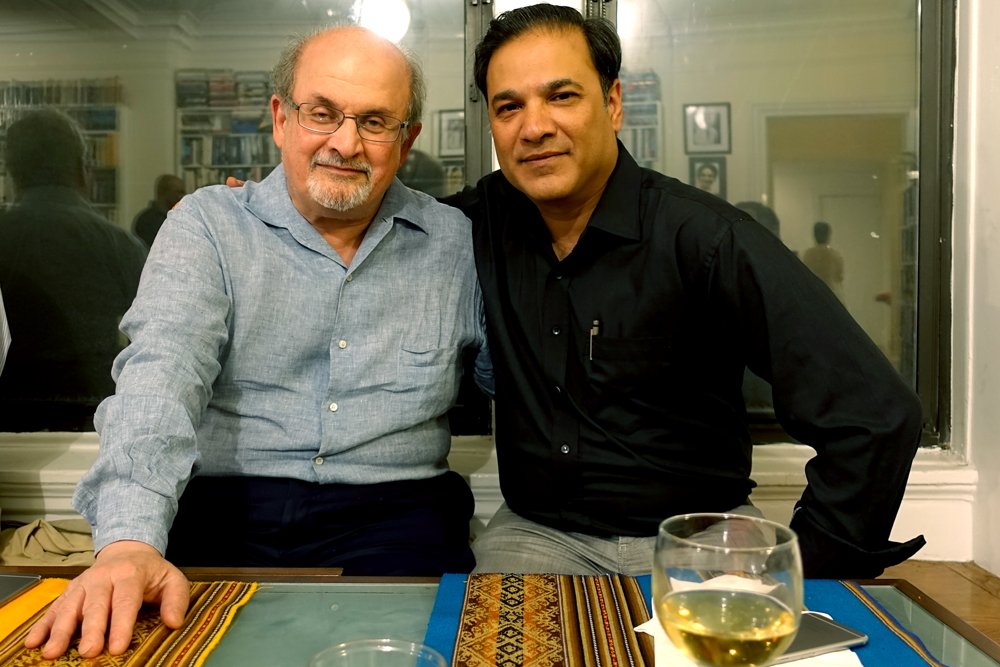
Salman Rushdie and Abbas Raza, at his the latter’s home in northern Italy.
For most of us, Salman Rushdie is only a name in the news, a man famous for his books and his marriages. To some of my friends, including Abbas Raza, founder of 3QuarksDaily (we’ve written about it here), he is more than that. Rushdie is a personal friend, and a friend of his extended Pakistani family.
Hence, Karachi-born Abbas Raza wrote on Facebook today about the attempted murder of the renowned Indian writer: “He is in critical condition with much blood loss. Apparently an artery in his neck was severed. I hope he comes back from this roaring. Let us all, in this dangerous moment, renew our commitment to always supporting free speech, especially speech we hate. Otherwise there’s no hope at all.”
On 3QD, he remembered Valentine’s Day 1989, when the fatwa was issued. In a 3QD post, he wrote: “… I knew in my gut that this was the opening salvo in what would become a massive internationalization of an Islamic war on freedom of speech and expression. After all, the government of Iran was threatening and planning to murder a British citizen, and even encouraging other Britons to murder him by putting a bounty on his head, with the enthusiastic approval of a large proportion of Muslims everywhere.
“And although, thank goodness, Rushdie remains safe, the Islamists have largely been winning this war since. They have successfully intimidated a very large number of writers and artists and journalists and film-makers all over the world into silence (and many live in exile because of threats to their safety), and within Muslim countries they have in addition used blasphemy laws to persecute their enemies and basically make any discussion of religion impossible.
“All this while religious apologists continue to proclaim to CNN and the BBC that their religion stands only for peace. Tell that to the tens of thousands of victims of religious violence in Pakistan alone. “Oh, the number of extremists is very small; most Muslims are peace-loving people.” The number of actual terrorists is always small. The problem is that too great a proportion of Muslims sympathize with these people, which is why it is impossible to eliminate them. Let us stop fooling ourselves with this nonsense. People need to stand up for free speech unequivocally, and against this barbarity, and especially Muslims need to. The battle must be joined now, in every way possible.”
Postscript from Abbas Raza: “I have written something about Salman Rushdie every year on Valentine’s Day since 1989, so for 33 years now. Here is what I wrote most recently: ‘Oddly enough, Valentine’s Day has become inextricably conflated in my mind with Khomeini’s fatwa against Salman Rushdie. I can clearly remember where I was on this day in 1989: at my desk in the U.S. Department of Labor just off the mall in Washington, D.C., where I was working as a young engineer. I was shocked and dismayed to hear the news and revolted by the murderous threat issued by Khomeini. Of course, things have only gotten worse with religious bigots responsible for killing hundreds of thousands of people in the quarter century since that day. One can be thankful for Salman’s continued safety but, at least in my estimation, the damage done to free expression in the arts has been immense. I know for a fact (because they have told me) that writers practice a kind of self-censorship in the aftermath of the Rushdie affair because they do not wish to be killed. Sad. But happy Valentine’s day!’ I hope he will make it through this fine. But the world will still remain a darker, scarier place than it was yesterday. And free speech is under attack everywhere now.”
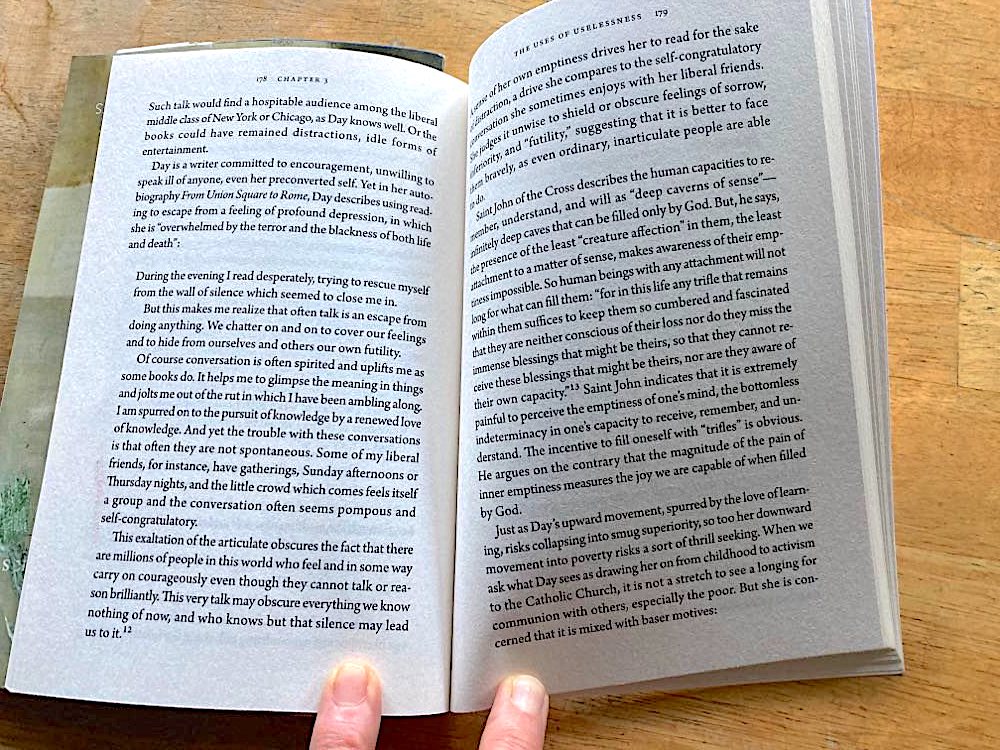
Zena Hitz: seeking silence and contemplation in a noisy and confused world
“The exaltation of the articulate obscures the fact that there are millions of people in this world who feel and and in some way carry on courageously even though they cannot talk or reason brilliantly. This very talk may obscure everything we know of now, and who knows but that silence may lead us to it.”
So writes Zena Hitz, author of Lost in Thought: The Hidden Pleasures of an Intellectual Life(Princeton University Press). It’s one of many thoughtful and brilliantly expressed ideas her quest for contemplation and connection in an increasingly fragmented, superficial, overloaded, and technological world.
What more beautiful defense of the humanities is there than this? “If intellectual life is not left to rest its splendid uselessness, it will never bear its practical fruit.” According to Stanley Fish, it’s an ancient thought, “but one that must be relearned, especially at times like ours when a passion for social justice is the new idol to which disinterested contemplation is being sacrificed.”
Here’s another passage, chosen almost at random, about how the fruits of contemplation are being suborned when social climbing appropriates intellectual terroir.
“As Pierre Bourdieu argued in Distinction, matters of taste and culture enforce social boundaries; it is part of their nature to indicate social status. But if there is nothing else to intellectual life, it is only sophisticated pleasure held in place by whatever supports a high-status lifestyle, then it cannot change us. It remains a form of entertainment rather than a means of self-examination or personal transformation. Nor can it be a refuge when the conditions for wealth and comfort collapse, or if the institutions that support us in our lifestyles fall apart, or if we fail to meet their conditions, or if we are the victims of dramatic political or economic change. (Would artisanal toast or single-source coffee be such a refuge?)
“The enemies of intellectual life are not simply yokels enmeshed in practical tasks who cannot understand sophisticated forms of inquiry. A real yokel, as we’ve seen, is not a simple rustic but someone who pursues wealth and status no matter the cost. We are ourselves the yokels. Inordinate desires for wealth and status are easier for the intellectually inclined to see when they are sought by those outside intellectual life, like Strepsiades [in Aristophanes‘s Clouds]. They are far more difficult for us to discern when they become deeply bound up with a specifically intellectual mode of being. The love of learning becomes fused with the love of wealth or status when we view intellectual pursuits as a way to join a superior race of beings, whether that is a higher economic class or an elite superior still.”