
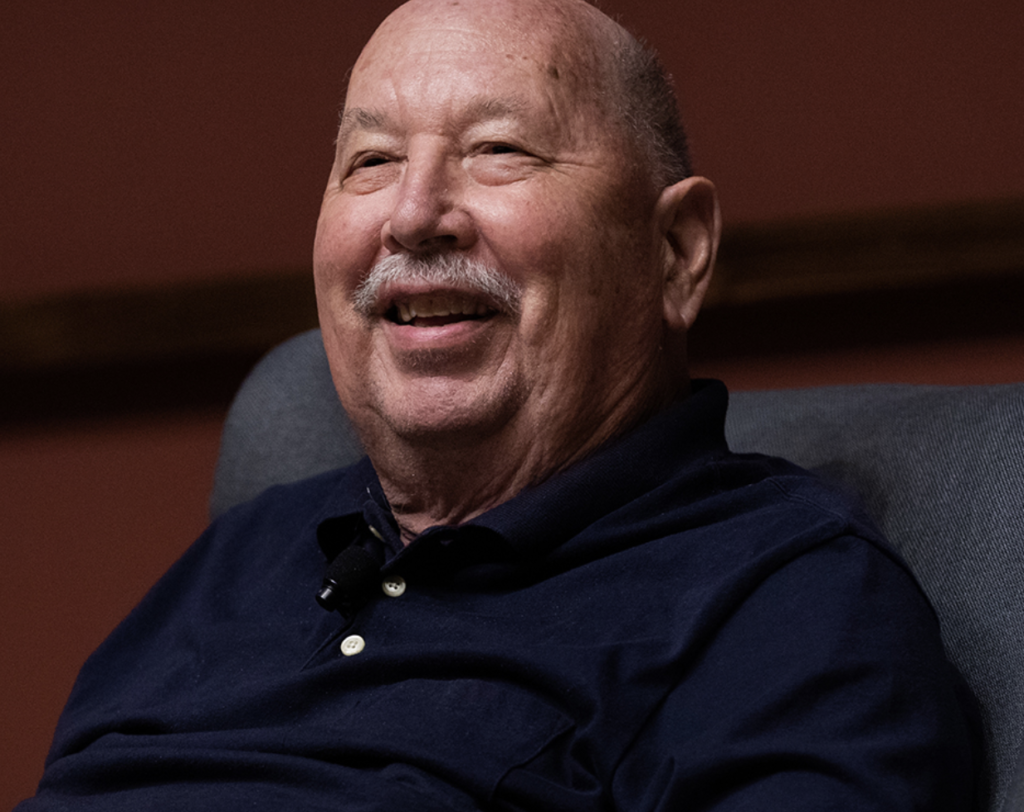
John Hollander would have turned 93 today.
Friday, October 28th, 2022


Reason #1 to visit the New York Public Library: Charles Dickens‘ writing desk, chair, and lamp from his home at Gad’s Hill Place. At this desk, this author wrote Hard Times and sections of Great Expectations, and much of his correspondence, too. “As a fan of Dickens, this took my breath away,” says Prof. Martha Reineke of the University of Northern Iowa, who took the photo. There will be a few more reasons to visit NYPL in future posts.


Literary conferences are not a place I usually associate with excitement – given the number of them, the world would not be able to bear so much stimulation. Nevertheless, you should always be ready for surprises. For example, earlier this month, I attended a University of Dallas literary conference (I gave a talk on Nobel poet Czesław Miłosz, another on French theorist René Girard, and a non-fiction workshop) and among the many readings of poetry and prose, certainly one of the most memorable was Glenn Arbery reading the epilogue of his Boundaries of Eden, the story of a boy who doesn’t know his name when he appears near an abandoned country home. The novel was published by Wiseblood in 2020. It was a tense moment at the conference: the power had just gone out, and everyone was leaning forward expectantly as Arbery read the epilogue, which takes place during a visit to Yellowstone’s Old Faithful geyser. Here’s an excerpt:
Along the Firehole River and over Craig Pass, he remembered a dream of a melting road and wheels full of eyes. He had dreamed it in the time when he forgot who he was, the time of the Name. Whenever he thought of the Name, inner peace and outer disconnection came over him, as though everything he saw with his eyes were a great illusion. He watched the cars ahead of them, not knowing what to expect.
They turned off the Grand Loop Road toward the Old Faithful Visitors’ Center. Traffic was heavy, and the parking lot at Old Faithful, big enough for a football stadium, set his father on edge—huge tour buses, swarms of people from everywhere. They went slowly up and down the lot, row by row, and they were starting their second run through it, his father growing increasingly critical of the human race, when finally, a car full of Japanese tourists pulled out in the row nearest the geyser. Everyone in their car was holding up a cell phone, and a girl leaned far out of the front passenger window with a selfie stick.

“The real world now exists as material for smartphones,” said his father. “Look at it—the reduction of
reality itself to a set of images you can put in your pocket. Seized and possessed. The final conquest of the
modern project.”
“Dad! Geez. Give it up!” cried Magdalena. “We’re in Yellowstone.”
“Really, Walter. It’s a just way of seeing things,” his mother said.
“It destroys memory,” said his father.
“So you remember everything without it?”
They had their usual argument as they all got out of the car, but they were unusually playful about it.
The bleachers for watching the geyser were empty. They had missed the last eruption by fifteen minutes,
and the next one wasn’t for another ninety minutes or so. His father wanted to go for a jog, which was a new
habit, and he quickly disappeared up the asphalt walkway.
“We’ll be in the visitor’s center,” his mother said. “Are you okay poking around by yourself, Jacob?”
“Sure.” It was the first time she had remembered to call him that. As Magdalena walked with her, he
could follow the ripple of male attention that surged after her like the wave at a football game.
There were signs everywhere warning visitors not to stray from the trail. The appearance of solid ground
could be deceiving; the lava crust could give way, and you could be plunged into boiling water or mud. He
loved reading about it, even though it was sometimes gruesome. He had read about some young employees at
the Park who had gone out one night to drink beer or whatever teenagers do and had ended up falling through.
He imagined the sudden scalding drop. He didn’t even want to picture them. They came from somewhere; they
had names.
He wandered up the shorter way, thinking about his new name. Jacob, who wrestled with God. Who changed his name, too, not to Jacob but from Jacob to Israel.
Crossing the bridge over the Firehole River, he stopped and looked at the water weirdly flowing over white encrustations. He imagined the magma hunched far down under them like a trapped giant waiting to stand up, hundreds of cubic miles of rock liquified by heat. This whole place was an inevitable disaster—and the crowds swarmed over it happily, sure it wouldn’t be today. Not today, not today with its ice cream and pretty girls and new baseball caps.

He moved on from the bridge up the trail. Everything looked like it was going to stay, but everything was really going away, even what you thought was still. Even these mountains were going in God’s time. Maybe the faith that moved mountains was a way of talking about God’s time. The time of the Name. In God’s time, mountains rose stretching upward and turned over and shook themselves out and got old and lay down like dogs too tired to stir, and then other ones sprang up, and the seas silted down, and rocks rose and the daylight was full of what the old seas had let drift down for millions of years. Everything was going. Life rose and ages passed and you were born and like the flicker of an eyelash you were gone and the going kept going right past you.
A big family came by, talking and pointing, and he stepped off the path to let them pass. A double stroller, two fat little babies whose parents spoke French.
Babies came into the going. He remembered when his father had told him that he couldn’t be alive now if he had ever been dead. But the going you came into wasn’t you when you were born, not the you you were conscious of. It was the going that would eventually be you. Meanwhile it ate and made a mess in its diapers and cried and slept until finally you started to show up at three or four. You grew and then you were convinced you were the going, because you had a name, you were Buford or Jacob, but you were never the going itself.
You couldn’t even explain your own body’s going. You rode in it and thought I think therefore I am but that was crazy because the going was more the am than you were. You fell into the going without any say-so, and when it stopped, the going didn’t stop, it was just you that stopped and maybe not even you. You died, and another kind of going took over what had been you, and you became another kind of going. …
It all came clear to him for a moment and he stopped. You could say I but God was the I AM in the going of everything, including you. And everything was going, not just things that were alive. Rocks, trees, mountains, clouds. Everything was going.
Read more about the book here.
In the August edition of Kyiv’s Krytyka, a review of my Evolution of Desire: A Life of René Girard:

Євген Мінко, рецензючи книжку Синтії Гейвен «Еволюція бажання: життя Рене Жирара», зазначає, що для Жирара наука була полем передчуттів і осяянь, інструментом вивчення ефемерних, але фундаментальних елементів людського буття: бажання, відчуття сакрального, непереборного потягу до насильства.
In other words, (which is to say, English ones): Evgeny Minko, reviewing Cynthia Haven‘s book The Evolution of Desire: The Life of René Girard, notes that for Girard, science was a field of premonitions and insights, a tool for studying ephemeral but fundamental elements of human existence: desire, the feeling of a sacred, irresistible urge to violence.
Evgeny Minko is a writer, journalist, and psychoanalyst. The title of his article is “У полі передчуттів і осяянь,” in English, “In the Land of Premonition and Visions.” It begins, in translation:
One of the most enigmatic philosophers of the 20th century, René Girard, died in the fall of 2015, and three years later his first biography was published. Literary critic Cynthia Haven was friends with Girard during the last years of his life and de facto started work on the book with his participation: in Evolution of Desire conversations between the author and the hero are quoted abundantly. The result is a kind of hybrid of biography and memoir, and the requirements of distancing the researcher from the object of research for the sake of objectivity aren’t met. However, this fits perfectly into the coordinate system of thought created by Girard. Science — history, literary studies, anthropology — was for him a field of premonitions and revelations. A tool of careful (as if by the hands of an entomologist) study of ephemeral but fundamental elements of human existence: desire, feeling of sacred, irresistible urge to violence.
The “desire” in the title of the book for the reader, who is not familiar with Girard’s work, will primarily be a desire to understand who, in fact, we are talking about. After all, in the imaginary philosophical canon of modern times, Girard’s place is quite marginal, as it often happens (should happen!) with truly interesting and original phenomena.

René Girard was born in France in 1923, received a history education, and in 1947 emigrated to the United States, where he spent the rest of his life teaching literature at leading universities. A successful career path of a scientist, without upheavals and disasters.
However, a formal career does not convey the ambition of Girard’s entire life: to create a comprehensive system for explaining human behavior. Like the one created by Freud. And this system became his mimetic theory.
Read the whole thing here in Ukrainian. Otherwise, it’s off to Google Translate for you.

Paul R. Gregory, an economist and Slavic scholar, is a research fellow at the Hoover Institution. He is also Cullen Professor Emeritus in the Department of Economics at the University of Houston. He is the author are Women of the Gulag: Portraits of Five Remarkable Lives (Hoover Institution Press, 2013), Politics, Murder, and Love in Stalin’s Kremlin: The Story of Nikolai Bukharin and Anna Larina (Hoover Institution Press, 2010), Lenin’s Brain and Other Tales from the Secret Soviet Archives (Hoover Institution Press, 2008). Now he is the author of The Oswalds: An Untold Account of Marina and Lee, out on Nov. 15 with Diversion Books.
Book Haven readers will remember his earlier account of the events of 1963 in The New York Times Sunday Magazine here. We’ve also written about his account of Lenin’s brain here. And his account of Women of the Gulag here and here. And Politics, Murder, and Love in Stalin’s Kremlin here.
He recalls, “remarkably, Lee’s actions on November 22, 1963, did not surprise me. Rather, it was as if the pieces of a puzzle were falling in place as I saw him brought handcuffed and bruised into the Dallas police station.”
This is his first book-length discussion of his relationship with Lee Harvey Oswald and his Russian wife Marina. He has offered the Book Haven an introduction to the book and some short excerpts:
As a 21-year-old college student, I returned to my hometown of Ft. Worth for the summer of 1962. At the same time, an ex-marine defector to the USSR returned the Ft. Worth with his wife and infant daughter. I was thus thrown into the life and troubled marriage of Lee and Marina Oswald, as Lee struggled to fulfill his dreams of fame and Marina was introduced to a new life in the United States. Through the pretext of Russian language practice, I became a frequent visitor as they settled into their run-down Mercedes Street duplex. As their only visitor besides Lee’s brother, I got hints of Lee’s visions of grandeur, abuse of Marina, and her scornful dismissal of her “loser” husband. It was through my initiative that we introduced the couple to the “Dallas Russians,’ who took an immediate dislike to Lee, as they became determined to free Marina from her unfortunate husband.
I returned to college, and the Oswalds moved to Dallas. Other than reports from Dallas of Lee’s outrageous behavior, I did not hear or see them until shortly before Thanksgiving, as Lee used me as a pawn to get Marina to move back in with him. My last image of Lee and Marina was them running to the Dallas bus at the Ft. Worth bus station on Thanksgiving Day 1962. My next image was November 22, 1963, as a bruised Lee was dragged into Dallas police headquarters to my shock and horror. Sitting in front of a TV screen at Norman, Oklahoma, I immediately understood that Lee had done it, and why, and that he had done it alone. I had ample opportunity to express my reasons before the US Secret Service and the Warren Commission. I was picked up early morning the day after the assassination as a ”known associate” of one Lee Harvey Oswald.
This book combines my experiences with Lee and Marina with the testimonies found in the tens of thousands of pages of the Warren Commission report, a reading to Lee’s largely unknown writing on socialism and communism, and Oswald’s KGB file. Some of the most important insights come from my father’s account of translating for Marina at a hideout arranged by the Secret Service in the week following the assassination as the FBI and Secret Service clashed and Lee’s mother went off the rails.
I largely refrained from writing on my experiences with the Oswalds because my parents both considered our association with a Marine deserter and communist to be shameful and best not talked about. Virtually everyone I write about is now gone; so it is time to tell the story.
***
That the Warren Commission’s lone assassin—Lee Harvey Oswald—was an unaccomplished, poorly educated misfit continues to feed the public’s skepticism. Nonentities do not change history. By this line of reasoning, we should be leery of the lone gunman conclusion unless we can explain with firsthand detail and confidence how Oswald could gun down the world’s most heavily guarded figure using only his own meager devices. And that’s what this book is about. It asks whether our “intimate” portrait of Oswald conveys in him the motive, resources, cunning, and killer instinct to have indeed changed our history as he fired on the president’s motorcade passing below him.
I would not be writing this book had I not known Lee Harvey Oswald personally. From June through mid-September of 1962, I was the sole companion of Lee Harvey and Marina Oswald outside of Lee’s immediate family. I visited this young married couple often in the duplex where they settled after Lee’s return from his defection to the USSR.
***

At 2:01 p.m., an excited reporter, located at Dallas police headquarters, shouted out on camera: “They are bringing in a suspect!” The TV showed a short man, disheveled in a white, V-neck tee shirt and dark trousers. He was surrounded by police officers. His face was bruised, and one eye was black. I stared in utter and stunned disbelief. It was clearly Lee Harvey Oswald! I muttered mainly to myself in shock: “I know that man.”
***
MR. JENNER (Warren Commission Deputy Counsel): Now, you were seeking to report to us the friends and acquaintances of your brother and your sister-in-law subsequent to their return to the United States in June of 1962. Now, who next in addition to Paul and [his father] Peter Gregory?
MR. OSWALD: None, sir.
MR. JENNER: None?
MR. OSWALD: None.
***
The army of assassination buffs are wasting their time on missing bullets, Oswald doppelgangers, and Soviet, Cuban, or Mafia assassinations. We need to look no further than Oswald himself. We must ask how this “little man” with megalomaniacal ambitions mustered the wherewithal to kill the ideal target for someone who wanted to go down in history books.
***
As someone who has worked professionally with Soviet state and party documents for over a decade, the Yeltsin documents appear authentic to me. We learn that Oswald’s case was dealt with at the highest levels of the Politburo and KGB—not by the local passport office as I had previously thought. The original USSR counterattack eventually implicated the Gregorys in a “White Russian Conspiracy.”
This Soviet version remains an active thread in the JFK conspiracy portfolio. I guess Pete and Paul Gregory are still under suspicion of some kind in some quarters.
Agent Nielson bored in on whether Lee could have been part of an organized conspiracy. I answered that I had no evidence pro or con, but I volunteered that if I were to organize such a heinous crime, the last person on earth I would include in the conspiracy would be Lee Harvey Oswald. I stated that Oswald marched to his own drummer. He could not be relied upon, and he would not take kindly to orders from others. This personal opinion somehow did not make it into the official transcript of my remarks, but I am sure I said it.
***
The Book Haven is proudly powered by
WordPress
Entries (RSS)
and Comments (RSS).
© Stanford University. 450 Serra Mall, Stanford, California 94305. (650) 723-2300. Terms of Use | Copyright Complaints
