Language, memory, and the poems of Robin Coste Lewis

May 4th, 2018

Share

She came to the Sierra festival thanks to an unusual invitation. (Photo: Radu Sava)

At the Dodge Poetry Festival two years ago, Los Angeles poet laureate and National Book Award winner Robin Coste Lewis was one of the honored guests. She sat at a table to perform the inevitable ritual of signing books for her many fans.

But one of the people in the queue was much more than a fan: she was the mother of Jeanne-Marie Crowe, the midwife who had delivered Lewis’s son. “It felt like meeting the grandmother of an angel,” she said. A visitation, she said, because “doors opened in so many directions in my heart and mind.”

Judy Crowe was also a member of Nevada County Arts Council’s Literary Arts Committee, and so she invited Robin Coste Lewis to be the keynote speaker at this year’s Sierra Poetry Festival, which took place last weekend. “I’m southern,” said Lewis. “There’s nothing you can say to your midwife’s mother other than, ‘Yes ma’am.’”
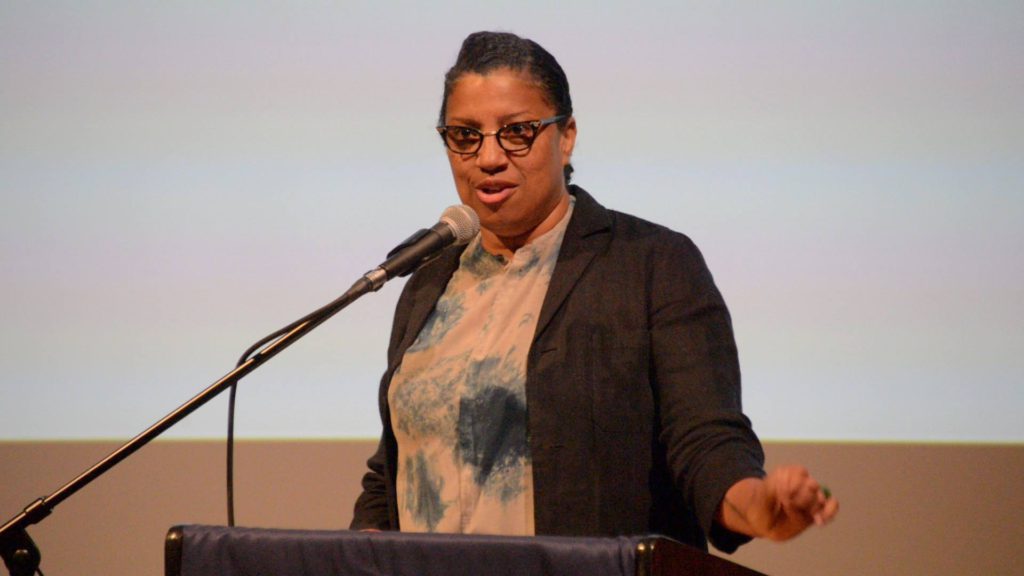
Memory is “a tricky thing” for the African diaspora. (Photo: Radu Sava)

Lewis has a masters degree in Sanskrit and comparative religious literature from Harvard University’s divinity school, and PhD from the creative writing and literature program at the University of Southern California. She used to be ancient language professor. She now teaches at a low residency MFA program in Paris, which sounds like heaven to me. When she won the National Book Award for her 2015 collection, Voyage of the Sable Venus, however, her life changed.

“One of the things I’ve learned on tour for a year-and-a-half straight,” she said. “I became a public servant, using poetry to do that.”

She was welcomed by Shelly Covert, spokesperson for the Nisenan and Executive Director, California Heritage Indigenous Research Project, and also a singer, a songwriter, musician, and storyteller.  The Nisenan are part of the southern Maidu tribe that had been native to the Nevada County region.

The gesture was particularly moving for Lewis who, as poet laureate, has launched a truth and reconciliation effort for Los Angeles. “It occurred to me that I have been waiting for centuries for our country to have Truth and Reconciliation Commission for Native Americans,” she said. “I’m hoping to create model for other communities.”

She applauds the movement to “reclaim the language and culture that had been wiped away,” she said. “It’s a dream come true.”

She opened her reading with another “indigenous language” – an entrancing, babbling poem called “Dog Talk.” (You can read it here, if you scroll down a bit.)  “All the kids in the neighborhood spoke this language, to the chagrin of our parents. It’s a statement of gall and tenacity of children to live anyway – and retain cultural agency.”

“What we’re starting to learn is that children are the arbiters of cultures almost as much as adults” – as revealed in architecture, sculpture, and the games children carved into stone at foot of temple stairs.

She also read a “riddle poem” recalling her parents “reading the newspaper in bed when I was tiny,” while she was cuddled between them until she was sent to her own bed. She remembers her father’s riddles and jokes, and her poem, “Red All Over,” recalls his frequent repetition of the old saw, “What’s black and white and red all over?” The answer to the ancient joke is, of course, the newspaper…or is it?

This was the ’60s, and the deaths of black people was very much in the news. “What he was talking about was blood and segregation,” she later realized. “The laughter was more sinister.”  The poem is here.

But always her conversation returned to language and memory, the latter “a tricky thing” for the African diaspora, she said. But sometimes the two come together. She noted the vegetable okra, popular in the American south is called “gumba” in Senegal – almost identical to “gumbo,” the famous stew of the U.S. South in which okra is a crucial ingredient. “So some things remain.”

“Judy, are you happy?” she called out. I suspect that Judy was.

“I became a public servant, using poetry to do that.” (Photo: Radu Sava)
A masterpiece? Or tosh? The greats that you hate.

May 2nd, 2018
Share

Jane’s not her thing.

She’s tried. She’s tried again and again. But she cannot love Jane Eyre. 

Author Kim Culbertson was the moderator for my onstage discussion of “literary citizenship” with David Kipen, my former editor when I was a critic for the San Francisco Chronicle and afterwards literary director for the National Endowment for the Arts. The occasion was last weekend’s Sierra Poetry FestivalI have tried to love it many, many times,” she pleaded. “And I hope I make up for it by loving James Joyce and Jane Austen.”

At the opening night festivities the night before, we discussed of the books we’re ashamed we didn’t “get” or didn’t love even if we did. She also warned me of the wide literary disparities in the audience I would be addressing. Some, she said, were intimidated by “critics” – they didn’t yet have confidence in their own literary judgment.

Well, nobody should. Our tastes sharpen and deepen as we read more, think more, feel more. The book we dismissed in our twenties acquires a different meaning in our forties. Half of it is the willingness to voice your opinion, listen to challengers, argue, reread, and maybe admit that you changed your mind.

The classics obviously don’t change; we do. Hence, a few years ago I rediscovered Stendhal‘s The Red and the Black, a book that left me cold when I read it in my teens. Maybe I should even give Don Quixote another go, since I read it first during those same years. But then again, maybe not…

Revered author of a single joke?

Here’s what A.N. Wilson had to say about that august novel. I’ve been reading his biography of John Milton, but though he has incandescent praise for that bard’s epic, the Spanish author leaves him cold: “It is a one-joke book, and it goes on for hundreds of pages.”

“The joke is that a silly old man keeps mistaking events and characters around him, because inside his head, he is living in the romances of Amadis de Gaul. Great amusement is had, both by characters in the book who take delight in mocking, tricking and deriding the silly old man; and by the author, who plainly expects us to join in the sadism.”

The quote is from a recent article in The Spectator, “The Greats We Hate,” that I shared with Kim and others.

Cervantes isn’t the only one who takes a beating. Charles Dickens, Jane Austen, Henry James all get their comeuppance. Take this example, from critic and satirist Craig Brown:

Which classic work do you think this comes from? ‘Her teeth were white in her brown face and her skin and her eyes were the same golden tawny brown. She had high cheek-bones, merry eyes and a straight mouth with full lips. Her hair was the golden brown of a grain field that has been burned dark in the sun but it was cut short all over her head so that it was but little longer than the fur on a beaver pelt.’ Jeffrey Archer? Jackie Collins? Lee Child? I’ll give you one more clue.

Perhaps she needed one, too.

After another 150 pages, the hero finally gets to roll in the heather with the brown-skinned, brown-eyed, brown-haired woman with the straight mouth and the hair like a beaver pelt, ‘and all his life he would remember the curve of her throat with her head pushed back into the heather roots and her lips that moved smally and by themselves’.

Well, my lips move smally and by themselves, and I imagine yours do, too, unless you’re the dog (‘Oh, yuss!’) on the Churchill insurance ad, but it’s not something we boast about. The writer is, in fact, Ernest Hemingway, and the book For Whom the Bell Tolls. It’s described on the cover, by the Observer, as ‘one of the greatest novels which our troubled age will produce’ but it strikes me as soapy old tosh.

In fact the word “tosh” comes up more than once in the piece, though Jane Eyre does not. But Charlotte’s sister Emily Brontë does, with her acclaimed masterpiece Wuthering Heights. Says Executive Director of the Forward Arts Foundation Susannah Herbert, “the sexiness of Heathcliff is much overplayed. He needs a good bath.”

P.D. James, Susan Hill, and many others weigh in. Read the whole thing here.

TONIGHT: Philip Larkin’s early novel “A Girl in Winter” at Stanford!

April 29th, 2018
Share

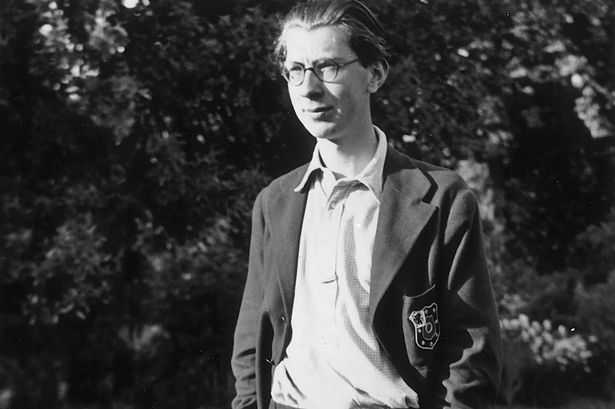
Portrait of the poet as a young man… Philip Larkin

 .

Robert Harrison

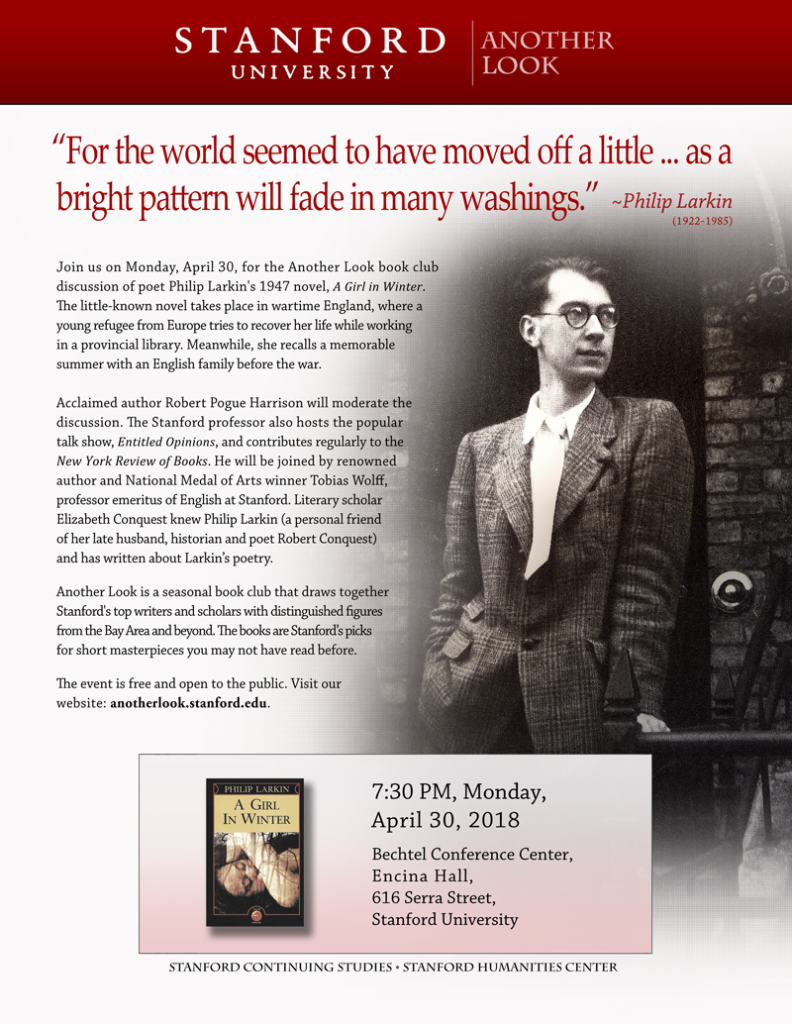
Philip Larkin is one of England’s most eminent postwar poets, but few know of his early forays into fiction. All that changes tonight, Monday, April 30, when Another Look considers Larkin’s little-known 1947 novel that takes place in wartime England, where a young refugee from the Continent attempts to recover her life while working in a provincial library. Meanwhile, she recalls an idyllic summer with an English family before the war. Please join us! The event is free and open to the public. Come early for best seats.


Tobias Wolff

When, where, who …

The Larkin event will take place at the Bechtel Conference Center at 7:30 p.m. on Monday, April 30. Panelists will include Another Look Director Robert Harrison, who will will moderate the discussion. The Stanford professor and author also hosts the popular talk show, Entitled Opinions. He will be joined by renowned author Tobias Wolffthe founding director of Another Look, and literary scholar Elizabeth Conquest. “Liddie” Conquest knew Philip Larkin—a close friend of her late husband, historian and poet Robert Conquest and has written about Larkin’s poetry.

Liddie Conquest

.

Elizabeth Conquest in the Wall Street Journal

As we wrote in the Book Haven last week, “Liddie” Conquest was featured in an article in the Wall Street Journal. The article is available to subscribers here. The article is excerpted on The Book Haven here
 
.
Directions
 .
The Bechtel Conference Center hosts all of Another Look’s events – a map is here. The nearby Knight parking structure, underneath the nearby Graduate School of Business, has plenty of room for free parking (see here for a map). In addition, parking is available on Serra Street and in front of Encina Hall itself.
 .
In keeping with the Another Look mandate, this book has been pretty much forgotten in 20th century literary history. Help us jump-start a public conversation of this overlooked work. 
.

“Lynching Qaddafi”: an anthropologist’s p.o.v.

April 26th, 2018
Share

Mark Anspach is an anthropologist and author of  Vengeance in Reverse. The Book Haven recently published a Q&A about the book here. We also posted about an earlier piece he wrote on mass murderer Anders Behring Brevik here. Mark is the editor of Oedipus Unbound: Selected Writings on Rivalry and Desire by René Girard (Stanford, 2004). He is a contributor to Mimesis and Science: Empirical Research on Imitation and the Mimetic Theory of Culture and Religion, edited by Scott R. Garrels (MSU, 2011). 

The story Mark tells here is new and old. It was originally published online in November 2011, but disappeared. We had hoped to republish it here in 2016, but held off in the upheaval after the elections. The story of lynching, however, is “evergreen” – and so we publish it today:

An on-camera lynching

“I’m good at killing people,” President Obama said. While claiming a proficiency at targeted assassinations is not the usual boast of a Nobel peace prize winner, it signals a change.  “We came, we saw, he died,” said Hillary Clinton at the death of Muammar Qaddafi. 

With everyone agreeing Qaddafi was a monster, the outcry over the way he died caught the Libyan rebels by surprise. A member of the National Transitional Council shrugged off criticism. “They beat him very harshly and then they killed him,” he said. “This is a war.”1

When videos showed rebels brutalizing their dazed and bloody prey, Libya’s new rulers bowed to demands for an investigation, but the impression remained that they didn’t really grasp what all the fuss was about.

Call it a cultural misunderstanding. Is it the Libyans’ fault if they don’t see what’s wrong with an old-fashioned lynching? Maybe we should turn the question around and ask why the images of Qaddafi’s final moments make us so uneasy.

A comment from the first Western journalist on the scene holds a hidden clue.  Describing cell phone footage of Qaddafi’s capture on the outskirts of Sirte, he wrote that the aging dictator who had once dreamed of uniting Africa “no longer bore any resemblance to a self-styled ‘king of kings’.”2

At first glance, this assertion seems self-evidently true. But is it?

Mark on mic

 Let’s forget Libya for a moment and imagine the following scene. Soldiers swarm around a prisoner, strip him of his clothes, mock and torment him and finally put him to death. The victim of the execution is a pitiable figure, bloodied and helpless to resist his captors – and yet, 2000 years later, his followers still call him the King of Kings.

The centrality of this story in our culture has trained us to be suspicious whenever we see someone treated the way Jesus was at the hands of Roman soldiers. That is true no matter who the victim is or what he may have done to deserve his fate.

Obviously, no one would mistake Muammar Qaddafi for a Prince of Peace, but that’s not the point. The very fact of lynching, in and of itself, is what we find unacceptable. As cultural theorist René Girard has long contended that the crucifixion of Jesus gave lynching a bad name.

That is not to say that Western societies have been immune to mob violence – far from it. We know that in our own country, between the late 1800’s and the 1960’s, thousands of black citizens were lynched. And we have been culpably silent today in the face of persistent reports from Libya that blacks have been attacked by rebel mobs.3

Nevertheless, in our culture, the crucifixion story is there to serve as a template for opposition to any kind of lynching. African-American writer Gwendolyn Brooks expresses this idea forcefully in the closing lines of her poem “The Chicago Defender Sends a Man to Little Rock – Fall, 1957”:

The lariat lynch-wish I deplored.
The loveliest lynchee was our Lord.
 .

In younger days, 1970s (Photo: Stevan Kragujevic)

The rest of the poem emphasizes the disarming ordinariness of the people in a Southern town where black children faced racist violence when they tried to attend a white school. For the visiting reporter from a Northern black newspaper, this ordinariness is a “puzzle”:

The biggest News I do not dare
Telegraph to the Editor’s chair:
“They are like people everywhere.”

Throughout history, people everywhere have been prone to outbursts of violence like those that have marked the civil war in Libya. The real puzzle, perhaps, is how the human race ever managed to survive at all.

For René Girard, the answer lies in the paradoxical capacity of violence itself to reconcile people by bringing them together in a joint assault on a common victim or scapegoat. The cathartic elimination of an individual thought to embody all the evils afflicting the group temporarily restores unity and makes possible the founding of a new order.

“All the evils have vanished from this beloved country,” proclaimed transitional premier Mahmoud Jibril upon announcing the killing of Qaddafi. “It’s time to start a new Libya, a united Libya, one people, one future.”5

However much evil Qaddafi may have wrought, he cannot have been the only wrongdoer in the country. To claim otherwise is to make a scapegoat of him. In fact, despite what one might think, a scapegoat doesn’t have to be innocent. On the contrary, the guiltier he is, the more convincingly he can stand in for all other guilty parties and be sacrificed in their stead.

“It is important to cultivate the future victim’s supposed potential for evil, to transform him into a monster of iniquity,” writes Girard. This explains certain mysterious African royal rituals where the future king must commit forbidden sexual acts or violent crimes: the ruler himself is being set up as a scapegoat who must appear “worthy” of punishment.

In later days, 2009 (Wikimedia Commons)

The scapegoat king unites his subjects around him by uniting them against him. Insulted by the crowd during the installation ceremony, he may even face a mock attack by the royal army. Although he is not actually killed at the beginning of his rule, he often is killed at the end. Originally, the “king reigns only by virtue of his future death,” Girard writes. He is “no more and no less than a victim awaiting sacrifice.”6

In an earlier article on the Arab revolts, we argued that the fall of rulers like Mubarak restores them to the immemorial role of scapegoat kings. The photograph illustrating our text showed a placard in Tahrir Square that depicted Mubarak, Qaddafi and other Arab dictators as sheep awaiting sacrifice.

In the case of the Libyan leader, the photo proved prophetic. Through a chance twist of fate, Qaddafi was ultimately tracked down in a culvert that “opened next to a clutch of empty sheep pens.”7 By treating him like a sacrificial lamb,8 his captors briefly returned him to the central position he had gradually lost in the course of the war.

After his shirtless corpse was put on display in Misurata, thousands of Libyans from near and far made the pilgrimage to the rebel stronghold. To paraphrase Shakespeare’s Richard II, they were eager to see “undecked the pompous body of a king” – and to capture the image on their cell phones, carrying it away with them as the high-tech equivalent of a holy relic.

For four days, the endless procession of onlookers filed past Qaddafi’s mortal remains. One reporter called the scene “a grim parody of the lying in state typically accorded to deceased leaders.”9 Even when Qaddafi’s one-time subjects came to curse him, it was hard to avoid the thought that they were also paying him a perverse kind of homage.

He figured it out.

The ambiguity of the situation is rooted in the dual nature of the scapegoat. If his death seems to make every evil vanish, then he has performed a miracle for which the people can only be grateful. By drawing all hatred to himself, he has become a mystical source of unity. For this reason, Girard suggests, we should not be surprised to find him transformed into “a sort of cult object” and “surrounded by a quasi-religious aura of veneration.”10

The owner of a house where Qaddafi’s body was exhibited like a cult object said, “This was the opportunity of my life. If I die tomorrow, I’m happy.”11 But knowledgeable observers fear the joy of Libyans will be short-lived. Their homeland is “shot through with rivalries, jealousies and blood debts,” notes Tarak Barkawi of Cambridge University. “Now it has lost the one thing that united much of the country: hatred of Colonel Gaddafi and his regime.”12

Already, the problem of how to dispose of the Colonel’s body caused unseemly bickering behind the scenes. In the end, the solution found was straight out of Leviticus: like the biblical scapegoat, the dead dictator was sent away into the desert. But he can hardly have taken the country’s ills with him.

Today the would-be “king of kings” rests peaceably in an unmarked grave. Yet the deep-seated conflicts that divide Libya – between East and West, between rival tribes, between Arabs and blacks – are likely to come roaring back. They will not be so easy to bury under the sand.

Footnotes below the fold…
.

Read the rest of this entry »

The second Sierra Poetry Festival this weekend – with Robin Coste Lewis, David Kipen, and me

April 24th, 2018
Share

Angeleno David Kipen will be in the Sierra foothills for an onstage convo this weekend.

Another gig this weekend. I’m heading to the hills to be (I’m told) a “celebrity presenter” at the 2018 Sierra Poetry Festival on Saturday, April 28, which will be held at Sierra College in Grass Valley. Ever so tiny a celebrity, I should think – a National Book Award winner Robin Coste Lewis, is the keynote speaker, after all. And as always, Executive Director of Nevada County Arts Council Eliza Tudor is the magnificent organizer and visionary behind the event. You can hear her discuss the event (with poet Marcelo Hernandez Castillo) over here.

I wrote about the Sierra festival in its inaugural year, 2017, when California poet laureate Dana Gioia was the keynote speaker. He gave a terrific talk – read about it here.

Last year’s poetry festival, with Dana Gioia and Moi (Photo: Mary Gioia)

Said Eliza of this year’s program: “We chose our theme, Ordinary Light, as a nod to our brand new United States Poet Laureate, Tracy K. Smith, for the title of her award-winning memoir.” We’ve written about the poet, a Stanford alum, here.

I spent about a dozen years in the foothills of the Sierra Nevada, “Gold Country.” The twin cities – Grass Valley and Nevada City – are the best and largest souvenirs of the Gold Rush period in California history, and have a growing tourist industry. (Both cities are now under state designation with the California Cultural District program.)

That’s one enticement. Then there’s the company. Consider this an invitation to come and join me. It’s an all-day one-day event. I’ll be having an onstage conversation with David Kipen at 3:30 p.m.

David, born and raised in Los Angeles, is the former literature director of the National Endowment for the Arts, during the time it was under the chairmanship of a fellow Angeleno … Dana Gioia. Since then, David opened the Boyle Heights bookstore and lending library Libros Schmibros in 2010.

He is also the former book editor/critic of the San Francisco Chronicle, which is where I encountered him in the late 1990s. I was a critic at that time for the august San Francisco institution.

However, he was for the most part telecommuting from Los Angeles. So we only had one brief encounter, years later, at an event for the National Book Critics Circle we both attended. He moved through the room like the sun, and his conversation is engaging and lively.

The conversation will be moderated by author Kim Culbertson, who will try to rein in David and me. Our topic: “What does it mean to be a literary citizen?”

She’s back: U.K.’s Mel Pryor (Photo: Radu Sava)

I don’t think the type on the poster is quite readable when reduced to blog size (bel0w), but you can go and see the full line-up and more legibly here. You can also register for the event online here.

The highpoint: Keynote Speaker Los Angeles Poet Laureate Robin Coste Lewis will speak at 9:30 a.m.

From The Guardian:

At age six, Robin Coste Lewis told her aunt that she wanted to be a writer. This, she thought, meant being a novelist.

“I thought that if one wanted to be a writer, one had to write novels because I didn’t know that one could be a poet,” says Lewis, whose debut collection Voyage of the Sable Venus won this year’s National Book Award for poetry. She believed this in middle school, high school, college, graduate school, and afterward while teaching, and trying to write fiction. She believed it when she published She Has Eight Arms But Only Shows Me Two in the Massachusetts Review, a work that she thought was a short story, “even though all my poet friends at the time were like, ‘Girl, that’s a prose poem.’”

To the marrow … National Book Award winner Lewis

Things changed after she was in an accident that caused permanent brain damage and kept her in bed for two years.

The recovery was difficult. Lewis had to do speech-language therapy and stop reading and writing. “My neurologist told me, ‘You can only write one sentence and read one sentence a day,’” she says. “I decided, ‘OK, if it’s one line a day, it’s going to be a goddamned good line.’” …

“I am an artist through to my marrow,” she says, though adding, “which might be a curse and not necessarily a good thing.”

And poet Mel Pryor will be flying in from England – as she did last year – to attend. Closer to home is Nevada City poet Molly Fisk.  But read the schedule here, and the list of presenters here. Tickets are here.

See you there.

“Notoriously tricky territory”: Elizabeth Conquest on the literary legacy of Robert Conquest, a long marriage, and lots of letters

April 22nd, 2018
Share


A marriage that was a “long conversation” … and plenty of papers, too. (Photo: L.A. Cicero)

We’ve written about historian and poet Robert Conquest before – most notably for the Times Literary Supplement here, but also here and here and here, among other places. About his widow Elizabeth Conquest – a.k.a. “Liddie” Conquest – we’ve said comparatively little. That’s about to change. She will be one of the panelists at the Another Look book club on Monday, April 30, discussing Philip Larkin‘s early novel A Girl in WinterBut you might also turn to the pages of the Tunku Varadarajan‘s article in this weekend’s Wall Street Journal, titled:  “The widow of historian and poet Robert Conquest talks about his legacy – which includes three books still forthcoming”.

Liddie Conquest in London.

Robert Conquest was the first historian to chronicle Stalin’s murderous havoc. His book “The Great Terror,” published in 1968, was among the 20th century’s most influential works of investigative history. Yet Conquest was also a seriously accomplished poet and a prolific letter-writer. His correspondence includes letters to Amis and Larkin (880 pages to the latter alone), as well as to the novelist Anthony Powell and poets including D.J. Enright, Thom Gunn, Vernon Scannell, Wendy Cope and others …

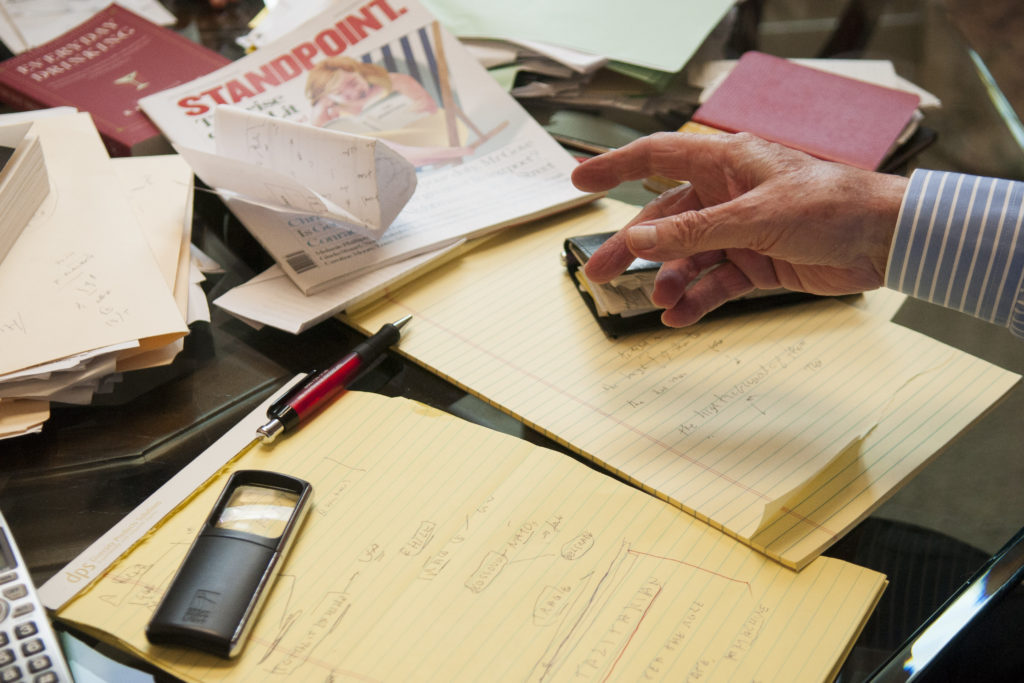
Banker boxes full of papers cover practically every flat surface in the Conquest household. Sideboards, tables, floors and shelves—all heave with typed and scribbled sheaves. Not only is Mrs. Conquest readying “The Great Terror” for its 50th anniversary edition this fall, she’s editing his complete poems—more than 400, some never published—for publication next spring. She’s also editing his memoirs—he died with one chapter unwritten—as well as a fat volume of his correspondence.

“There are thousands of pages of letters that he wrote,” Mrs. Conquest says. “Bob warmed up before a day’s work by writing letters. He would sit at his typewriter and he’d fire off.” Toward the end of his life, he would dictate email messages to Mrs. Conquest, who sent them from their shared account. “He was never really fond of trying to figure out the computer.”

The lot of a literary widow, Mrs. Conquest says, “is not a happy one, for she must master the management of her husband’s literary estate.” But she doesn’t sound grumpy when explaining that she has a veto over the use of his writings, including the power to say yea or nay to any requests to reprint them. This is all “notoriously tricky territory,” Mrs. Conquest concedes, and such widows have “long been caricatured in writerly circles as pantomime villains”—the younger wife who “single-mindedly devotes her remaining decades after her celebrated husband’s death to championing his artistic legacy and slaying those who dare to question it.”

One of the many comments the combox: “Mrs. Conquest seems to be an absolutely wonderful woman.” We couldn’t agree more. Read the whole thing here.

More papers: Conquest at work. (Photo: L.A. Cicero)


<<< Previous Series of PostssepNext Series of Posts >>>