The owl of Minerva flies at dusk…

April 21st, 2018
Share

.The writer’s desk has acquired a sort of mystique in the popular imagination, although it generally attaches to writers more famous and celebrated than my humble self. Nevertheless, I snapped a photo of a corner of my work space the other day, and the reason was the watchful gaze of this small, solitary owl.

My mother’s totem was the owl. So she collected them, everywhere she could find them, from all parts of the world. And somehow I inherited the menagerie when she died thirty years ago. I have no room for them in my current digs, and so they are packed away in a box in the garage.

Nevertheless, during a major household upheaval, I rescued one of them from long hibernation. A tiny one, less than two inches high, from Denmark. And now it sits in a cubbyhole in my huge oak roll-top desk, watching me, guarding me, perhaps judging me, as I work well into the wee hours. My brain buzzes faster closer to midnight. So it’s a fitting totem for me, too, night owl that I am.

Ah well, as Hegel observed, the owl of Minerva flies at dusk. And somehow landed here…

Postscript on 4/22: But I also confess a particular partiality for the Hegelian owl at left, stooping slightly to read the small print on the spine of a neighboring book. This fellow normally sits on a bookshelf next to Gorbanevskaya and Cavafy. He rests atop a block of white marble, and was sculpted and cast in bronze by my father, as an owlish gift to my mother. One of our long family legacy of owls…

“Evolution of Desire” launch party is literally unforgettable, thanks to Leah Garchik of the “San Francisco Chronicle”

April 20th, 2018
Share

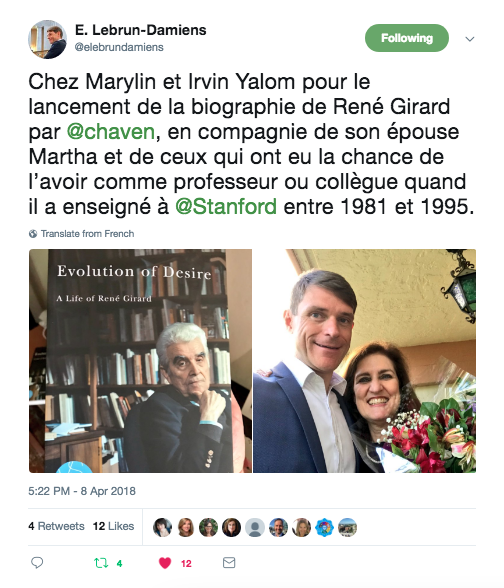
The tweeting consul et moi.

I wrote about the launch party for Evolution of Desire: A Life of René Girard, hosted by arguably the most hospitable couple at Stanford, Marilyn and Irvin Yalom, a while ago here. It cast a spell over all of us, I think. A few guests have drifted up to me since and said dreamily: “Wasn’t that a looovely party?”

Of course, I would assert that any party that had buckets of French (real French) champagne was well on the way to being unforgettable. But that would underrate the considerable charm of the gracious Yaloms, as well as their beautiful Palo Alto home.

Both are Stanford authors, but he is also a leading existential psychotherapist; she is one of the founders of feminist studies at Stanford. She also has the privilege of being René Girard‘s first graduate student.

The columnist..

It would also undersell the caliber of the guests, especially the high-octane presence of our French consul general from San Francisco, Emmanuel Lebrun-Damiens.

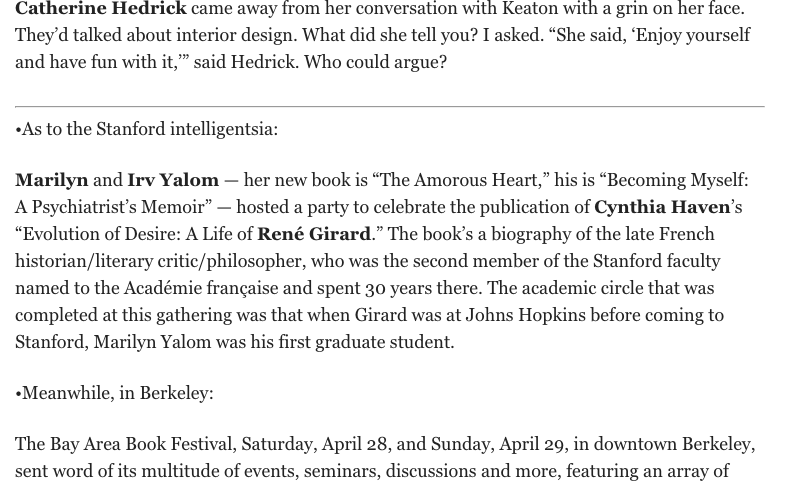
But it was Leah Garchik of the San Francisco Chronicle who made sure the party is literally unforgettable – as long as cyberspace and the Library of Congress endure – by including a brief notice in her popular column. We don’t get top billing, but one notch below a Diane Keaton book-signing ain’t bad.

Read the snippet in yesterday’s paper here. Or in the screenshot below:

***

***

Never heard of her? A poet who endured illness, poverty, and the “snotty standards of British reviewing.”

April 18th, 2018
Share

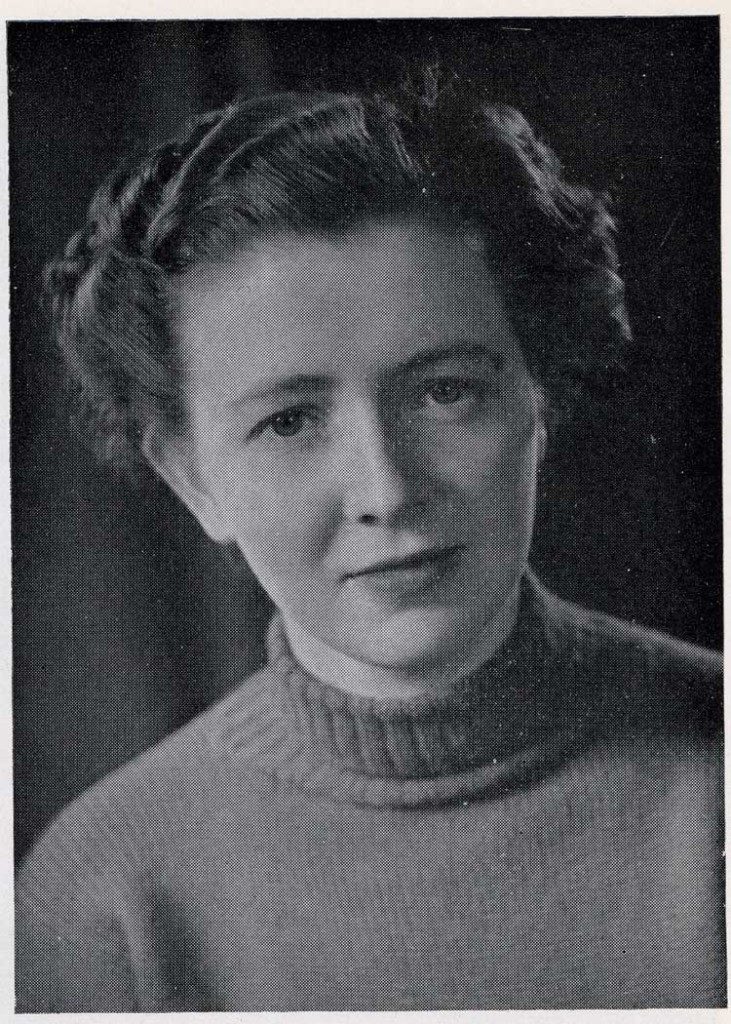
Elizabeth Jennings – rediscovered.

Dana Gioia has a superb essay over in First Things, “Clarify me, please, God of the galaxies,” about Elizabeth Jennings, the only woman in the “Movement” poets of the U.K. (We’ve regularly written about a few of the others – Philip Larkin, Robert Conquest, Thom Gunn.) She echoes the Movement credo, with a soupçon of Christian mysticism perhaps, when she writes: “Only one thing must be cast out, and that is the vague. Only true clarity reaches to the heights and the depths of human, and more than human, understanding.”

Never heard of her? “Although mocked by the press and neglected by scholars, Jennings enjoyed a popular readership in the U.K.,” Dana writes. “Her Selected Poems (1979) sold more than 50,000 copies. Her poems became A-level texts for secondary schools. Her steadfast publisher, Michael Schmidt of Carcanet, claims she became his bestselling author—’the most unconditionally loved’ poet of her generation.”

She lived her life almost entirely in Oxfordshire, where she experienced mental breakdown and subsequent hospitalization, under-employment and unemployment, and shabby poverty, but nevertheless earned many awards and much recognition. When she received the Commander of the Order of the British Empire (C.B.E) at Buckingham Palace in 1992, the press criticized her for looking like a “bag lady.” She died in 2001, at 75.

“Jennings was not a great poet. Greatness had no appeal to her. She admired epic visionaries, such as Dante, Milton, and Eliot, who offered sublime visions of civilization and belief. She recognized, however, that her muse was lyric. Jennings’s ‘great’ subject was how the individual—fragile, isolated, but alert—worked her way through life’s difficulties and wonders. Her sensibility was romantic, but her style was neoclassical. The characteristic Jennings poem presents the ache and exhilaration of romantic yearning expressed in exquisitely controlled rhyme and meter. She acknowledges her own confused romantic longings—emotional, artistic, and religious—but subjects them to lucid analysis. Her goal is not to resolve the contradictions but clarify them.”

Dana says there are two ways to introduce the public to an unfamiliar poet. The first is to describe particular qualities of the work. He opts for Door Number Two:

“The second way to introduce a poet is simpler. Quote the work. Here is the opening of ‘I Feel.’

I feel I could be turned to ice
If this goes on, if this goes on.
I feel I could be buried twice
And still the death not yet be done.

I feel I could be turned to fire
If there can be no end to this.
I know within me such desire
No kiss could satisfy, no kiss.

The poem’s language is direct, musical, and intense. The strict form feels less like an abstract framework than a cauldron barely able to contain its scalding emotions. The poem’s impact is so immediate and tangibly personal that it is easy to miss its quiet but profound engagement with the Catholic literary tradition. The paradoxical combination of ice and fire imagery goes back at least as far as Petrarch. More interesting, however, is the poem’s connections to Christian mysticism. Although “I Feel” initially seems an expression of erotic longing poisoned by despair, close examination reveals it can also be read as a tortured expression of spiritual hunger, the mystic’s excruciating desire for rapturous union with God.

Dana with Doctor Gatsby. (Photo: Star Black)

She was prodigiously productive, and produced great poems at every stage of her life. Yet her Catholic religion set her apart as much as being being a woman did: “Jennings’s literary reputation never surmounted the limits imposed on women of her generation. By the time of her death in 2001, the situation for female writers had become less grim, but her Catholicism isolated her from the feminist vanguard leading the cultural change. In her later years, reviewers often treated her with condescension and hostility. One young critic mocked her as a ‘Christian lady’ and ’emotional anchorite’ inhabiting a world of ‘shapeless woolens, small kindnesses and quiet deaths’ —an odious remark even by the snotty standards of British reviewing. Jennings understood the dilemma and bore it, but not without a touch of bitterness. (Few Catholic poets extend the concept of redemptive suffering to include their own bad reviews.)”

Read the whole thing here.

“A Company of Authors” is back! An exciting afternoon of lively authors, fascinating books, and “Evolution of Desire”!

April 16th, 2018
Share

See the second name from the top on the poster above? That’s Humble Moi. You can call me “Moi” for short. And I am personally inviting you to come to “A Company of Authors,” Prof. Peter Stansky‘s celebration of recent books by Stanford authors at the Stanford Humanities Center – this Saturday, April 21, from 1 to 5:15 p.m. (I know, I know… the poster above says 5 p.m. Keep reading…)
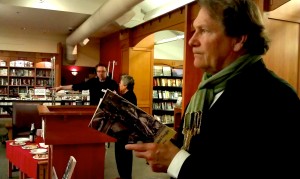
Patrick Hunt at the Stanford Bookstore.

Like the Another Look book club, it’s Stanford’s gift to the community. It’s free, and all members of the community are welcome. I’ve written about previous years here and here and here and here. Usually, I moderate the panel for poets; a few years ago, I gave a pitch for Another Look instead (my comments here), and seven years ago I presented my book, An Invisible Rope: Portraits of Czesław Miłosz. This year, I will be attending as an author, discussing my brand-new Evolution of Desire: A Life of René Girard.

Here’s the thing: you can drop by to hear the twenty-one authors discuss their event (schedule of speakers below or here) at any time during the afternoon, and leave when you wish. Some people stay the whole afternoon. Some people come late. Some people come at the beginning and leave early. Please don’t do that! Gaze at the schedule below. I am the very last speaker. Please, please stay to the very end! Wait and talk to me afterwards! I want to meet you! I want to sign your books! (Oh, and the Stanford Bookstore attends, too, selling all the books at a discount. We want you to buy lots.)

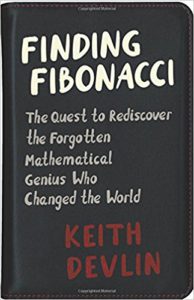
Moreover, the last panel has a terrific team, presenting some memorable characters: Stanford archaeologist Patrick Hunt presenting his new book, Hannibal. And Stanford mathematician Keith Devlin discussing thirteenth-century Leonardo da Pisa, the subject of his Finding Fibonacci: The Quest to Rediscover the Forgotten Mathematical Genius Who Changed the World .  And I will discuss on a very modern hero, Stanford’s René Girard, the French theorist who wrote about human imitation, envy, violence, and scapegoating.

Peter Stansky, author of many volumes on modern British history, assures me that the final spot to anchor the day is a position of honor. So please come see me crowned in glory. I’ll be waiting for you. And I’ve highlighted and hyperlinked some of the other authors who have been featured in these pages on the schedule below (please note: Steve Zipperstein has had to cancel his attendance).
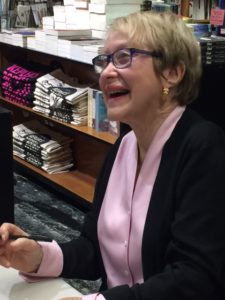
Marilyn Yalom signing books

Now you will ask why does the poster that was used in publicity list the event as ending  at 5 p.m., yet the schedule below ends at 5:05 p.m., and elsewhere it says 5:15 p.m. That’s because we noticed that the last panel was five minutes short, and that means we’d all be talking awfully, awfully fast. So the panel ends at 5:05. But after that, we expect you’ll all want to head into the lobby, drink more tea and eat more cookies, buy more books, and many of the authors will be chatting and lingering and longing to sign your books till 5:15 or so. In fact, the hubbub and conversation in the lobby after it’s all finished is one of the funnest things of all.

Come when you can. Stay as long as you can. It’s always lively, informative, and thought-provoking.

SCHEDULE

1:00 pm Welcome (Peter Stansky)

1:05 pm – 1:35 pm The Wide Range of History
Peter Stansky, Chair
Nancy Kollmann, The Russian Empire 1450–1801
Mikael D. Wolfe, Watering the Revolution: An Environmental and Technological History of Agrarian Reform in Mexico
Thomas S. Mullaney, The Chinese Typewriter: A History

1:40 pm – 2:10 pm Killing and Controlling the Population
Paul Robinson, Chair
Carolyn Chappell Lougee, Facing the Revocation
Philippa Levine, Eugenics

2:15 pm – 2:45 pm Considering Life
Tania Granoff, Chair
Peter N. CarrollAn Elegy for Lovers
Irvin D. YalomBecoming Myself: A Psychiatrist’s Memoir

2:50 pm – 3:20 pm Life and Love
Edith Gelles, Chair
Aiko Takeuchi-Demirci, Contraceptive Diplomacy
Karen Offen, The Woman Question in France, 1400–1870
Marilyn YalomThe Amorous Heart: An Unconventional History of Love

3:25 pm – 3:55 pm The Former British Empire
Kristin Mann, Chair
Jack RakoveA Politician Thinking: The Creative Mind of James Madison
Priya Satia, Empire of Guns: The Violent Making of the Industrial Revolution
Aidan Forth, Barbed-Wire Imperialism: Britain’s Empire of Camps, 1876–1903

4:00 pm – 4:30 pm The Many Worlds of Stanford
Larry Horton, Chair

4:00 pm – 4:30 pm The Many Worlds of Stanford
Larry Horton, Chair
Tom DeMund, Walking the Farm
Peter Stansky et al., The Stanford Senate of the Academic Council
Robin Kennedy on behalf of Donald Kennedy, A Place in the Sun: A Memoir

4:35 pm – 5:05 pm Rich Lives
Charles Junkerman, Chair
Patrick HuntHannibal
Keith Devlin, Finding Fibonacci
Cynthia Haven, Evolution of Desire: A Life of René Girard

This event is co-sponsored by Stanford Continuing Studies and the Stanford Humanities Center, with special thanks to the Stanford Bookstore.


Marilynne Robinson: “The absolute discovery we make is that we are radically solitary.”

April 14th, 2018
Share

“The world we think we know is what we’re losing.”

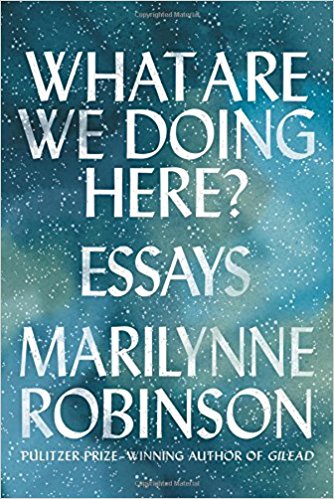
Pulitzer Prize-winning author Marilynne Robinson is considered one of the defining writers of our time, a treasure in contemporary American literature, in both her fiction and her non-fiction. Her novels explore mid-20th century Midwestern life and faith; her essays roam the boundaries between faith and science. She is perhaps best known for her novels Housekeeping (1980) and Gilead (2004). Her newest collection of essays, What Are We Doing Here? was published this year. Her Entitled Opinions conversation is the newest listing over at the Entitled Opinions channel at the Los Angeles Review of Books here.

The Entitled Opinions conversation with Robert Harrison explores John Calvin’s vision of an immanent God, Original Sin, and the influence of both ideas on Lincoln’s national vision and also on foundational American writers such as Emerson, Whitman, Dickinson, and Poe. Harrison and Robinson discuss grief, loss, history, science, Freudianism, and what it’s like to live in a universe of a hundred billion galaxies.

In his introduction, Harrison praises “her perception of ordinary reality, which is anything but ordinary when perception becomes truly attentive and thoughtful.” Then he cites her own words: “Ordinary things have always seemed numinous to me. One Calvinist notion deeply implanted in me is that there are two sides to your encounter with the world. You don’t simply perceive something that is statically present, but in fact there is a visionary quality to all experience. It means something because it is addressed to you. … You can draw from perception the same way a mystic would draw from a vision.”

Potent quotes:

“The world we think we know is what we’re losing. My characters experience grief because they love the world.”

“The absolute discovery we make is that we are radically solitary. … This relationship is essential, indestructible, primary.”

“You learn the value of things in losing them.”

“It’s just spectacular: this planet is disappearingly small, by any model of the galaxy and anything beyond it, and yet at the same time, its knowledge, its capacity for knowing, passes through billions and billions of light years of void.”

“It would be trivial to be a large planet in the middle of a small universe. It’s absolutely brilliant to be a small planet in an endless universe.”


Eugene Ostashevsky: “Blessed be the undiscovered person whose language is his.”

April 12th, 2018
Share


“An outcast whose language is all his own.” (Photo:Kritzolina/Wikimedia)

You know how it is. The stack of books piles up by the bedside. With the best of intentions, you commit to reading it all. But you’re already reading and writing all day and all night long, and you’ve long since given up any kind of a normal life so that you can do both… and you still can’t catch up…

So it has been with Eugene Ostashevsky’s The Pirate Who Does Not Know the Value of Pipublished by one of my favorite houses, New York Review Books. I’ve been meaning to read it for quite some time, but the backlog is formidable. Fortunately, fortunately, we have people like Boris Dralyuk (we’ve written about him here) over at The Los Angeles Review of Books who goes forth to read for us. Here’s what he has to say about Ostashevsky’s glorious treasure: 

From Homer to the relative merits of Ginger and Mary Ann in Gilligan’s Island, nothing is lost on Eugene Ostashevsky, the Russian-American poet and translator who’s hatched The Pirate Who Does Not Know the Value of Pi. This “poem-novel” is a seriocomic linguistic performance the likes of which we rarely see, in any tongue, but it wasn’t plucked out of thin air. Ostashevsky, whose two preceding collections are titled, tellingly, The Life and Opinions of DJ Spinoza (Ugly Duckling Presse, 2008) and Iterature (UDP, 2005), has been developing his patchwork technique for years, stitching high theory onto deliriously playful, Edward Learian rhymes, in an effort to make each element pull more weight than it would in isolation, but also to loosen things up. Hierarchies be damned; the pursuit of wisdom is a free-for-all, a real “pirate party, so shake your booty”: “Never mind The Groundwork / For the Metaphysics of Morals — / Shimmy with your scimitar and uncorral some quarrels.”

The Pirate has his forebears. Lear is one, as are Lewis Carroll, the Dadaists, Joyce, and the loopier representatives of Oulipo, but few of Ostashevsky’s predecessors have plumbed the philosophical depths of nonsense with the aplomb of Daniil Kharms (1905-1942), Alexander Vvedensky (1904-1941), and the other members of the short-lived Soviet avant-garde group OBERIU (“The Union of Real Art”). It’s not by chance that Ostashevsky has dedicated so much of his creative energy to introducing the work of the “Oberiuts” to a broad Anglophone audience, editing OBERIU: An Anthology of Russian Absurdism (Northwestern University Press, 2006) and co-editing and co-translating, with Matvei YankelevichAlexander Vvedensky: An Invitation for Me to Think (NYRB Poets, 2013). Like The Pirate, the Oberiuts’ writings are perched (AARGH, is there no escaping the psittacine puns?) above a chasm of meaninglessness. Their delightfully comic gestures always point to the failings of language, its propensity to undermine itself, and, hence, to the impossibility of communication. The matter of incommunicability should concern us all, but it’s especially pressing for an émigré poet. And this brings us back to the pirate’s confession:

I suddenly became frightened — I don’t really know of what — that I wouldn’t be able to represent any of this in language
and the experience would vanish from the sensory world but at the same time take root inside me

unformulated; ineffable; and therefore not even truly a thing; certainly not truly mine
yet also no one else’s but mine; mine exclusively, inalienably

and so locking me at once inside and outside itself
although always in solitary confinement…

He concludes: “And yet, it is a beautiful song, broadcast by an outcast whose language is all his own: ‘Blessed be the undiscovered person whose language is his…'”

Read the whole thing here. By the way, the book is currently on sale, here.


<<< Previous Series of PostssepNext Series of Posts >>>