“This is the hardest class you will ever take,” the kids were told. And the course filled up within minutes.

April 10th, 2018


Share

Auden knew what he was doing.

Kids are lazy little buggers who opt for easy courses, right?

Wrong.

Some time ago I wrote about W.H. Auden‘s syllabus during his time at the University of Michigan in the 1940s, a copy of which had been sitting in my files for decades. I can’t remember how I found it in the archives of the Rackham Graduate School, but occasionally I would run across it again, take it out, and stare at it, as at a marvel.

The reading list for his course, “Fate and the Individual in European Literature,” included: The Divine Comedy in full, four works by Shakespeare, Pascal’s Pensées, Horace’s odes, Volpone, Racine, Kierkegaard’s Fear and TremblingMoby-DickThe Brothers KaramazovFaust, Baudelaire and Rimbaud, Kafka, Rilke, T.S. Eliot. Also, nine operas. (Auden loved opera – and assigned three of Wagner‘s Teutonic masterpieces.) That’s more than 6,000 pages total. For a single course.

At the University of Oklahoma, three brave men – Kyle Harper, a classicist and the university’s provost; the historian Wilfred McClay; and David Anderson, a professor of English – decided to team-teach a year-long course, modifying Auden’s syllabus a little – to include, for example, Milton.

“This is the hardest class you will ever take.”

The result, according to Mark Bauerlein writing in the Chronicle of Higher Education:

When enrollment opened last semester, the unexpected happened. The course filled up within minutes. Harper had already warned his students, “This is the hardest class you will ever take.” The syllabus was posted online in advance, so that students knew exactly what they were getting into. The course meets a general-education requirement at Oklahoma, but so do many other courses with half the workload. To accommodate the unexpected demand, the class was expanded from 22 to 30 students, the maximum number that the assigned classroom could hold.

I sat in on a class in October. McClay lectured on Inferno. The atmosphere was genial but focused. You can tell after five minutes whether a class has an esprit de corps — no sullen faces, no eyes drifting to windows and cellphones, even the bad jokes get a laugh. McClay slid from Augustine to Bonaventura to Jesus, Jonah, Exodus, and the prodigal son before taking up Paolo and Francesca, and then the suicides, sodomites, murderers, and frauds in Dante’s torture zones.

The historian was game.

After class, about half of the students and I headed over to the dining room at Dunham College, one of Oklahoma’s graceful new residential colleges, for lunch. There, without the professors present, I asked the key question: Why did they sign up for Western-civ boot camp?

One fellow grumbled that he had to do three times as much work as he did in his other classes. The rest nodded. But you could hear in his words the self-respect that comes from doing more work than the norm, from climbing the highest hill while your peers dog it. Another student said that the page-count of the syllabus had flattered her, that it showed the professors respected her enough to demand that she take on a heavy load of historic literature.

The English prof was game, too.

“This is what I came to college for,” another said. One more chimed in, “This class is changing my life.”

They acknowledged, too, the distinctiveness of the works they read, one student calling them a “foundation” for things they study elsewhere. They admired the professors, to be sure, but the real draw was the material. When I asked what they would change about the course, they went straight to the books: add The Iliad and some of the Bible.

Read the whole thing here.

A postscript of 4/14 from John Murphy of the University of Virginia: “On my way out the door of higher ed and toward opportunities, both teaching and otherwise, elsewhere, one of my thoughts – in line with the program described here – is one way to revive the humanities might be to make the whole enterprise an honors curriculum or honors college within larger institutions. That would allow for a recuperation of the rigorous and seriousness that has long been lost within college and university humanities courses and it would also raise the value of a humanities degree as a credential. The implicit message would be “real college for real students” and it would be mark of distinction to have taken the more difficult and selective course of study, even if you went on to purse a “practical” career after that. It would be a sign to “practical” employers that a graduate had really hit the books during college and not taken the easy way out. Young people will work very, very, very hard at things that ultimately don’t matter as much as curricular education – i.e. athletics. So maybe foregrounding the aspect of difficulty might tap some kind of competitive spirit. ‘Auden College: No Pain, No Gain.'”
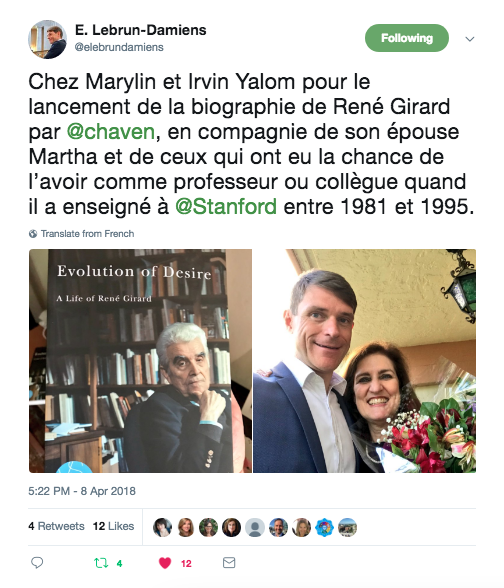
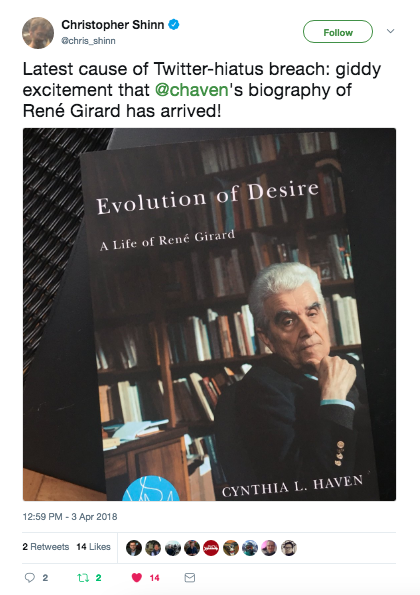
A book is born! A party launches Evolution of Desire: A Life of René Girard – and the French consul was there, too!

April 8th, 2018
Share

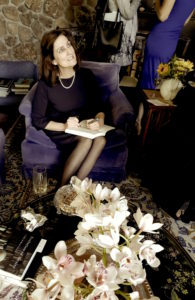
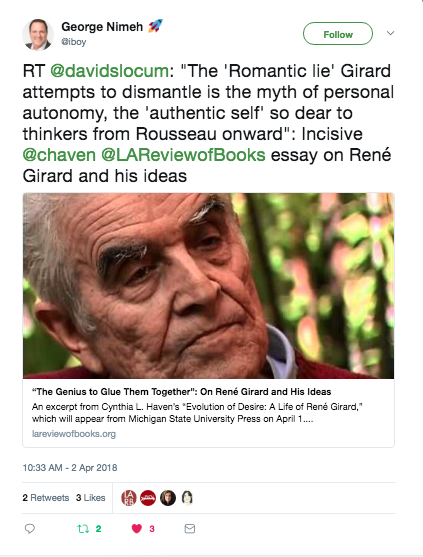
Above, the tweet from the French consul Emmanuel Lebrun-Damiens today at my book launch party at the gorgeous home of Marilyn and Irvin Yalom. The event was celebrated with plenty of champagne – the French, not Californian, kind. As Emmanuel noted above, René Girard‘s wife, Martha, and daughter Mary, attended. So did others who have featured on these pages: Ewa Domanska, Marie-Pierre Ulloa, Inge Pierson, Robert Pogue Harrison, Elena Danielson, Aleta Hayes, Elaine Ray, Trevor Cribben-Merrill, and others – that’s three chevaliers in the group altogether, by my count. Pas mal. Jean-Pierre Dupuy was in Paris, but made his presence felt via an email to the gathering, and addressed to René himself, who died in November 2015.

Here are the words of Jean-Pierre:

A voice from Paris…

Mon cher René,

En ce jour où nous te célébrons, je ne peux m’empêcher de penser ceci. Si le Dieu d’amour existe, quelles que soient la ou les religions qu’Il a inspirées, alors tu l’as rejoint, car mieux que tout autre prophète, tu nous as donné une idée de son essence.

Ni le temps ni l’espace que nous connaissons ne peuvent situer ta rencontre avec Dieu. Elle n’est ni dans le passé ni dans l’avenir, car le temps est probablement une illusion liée à notre finitude. Elle n’est ni dans l’infiniment petit ni dans l’infiniment grand, car l’espace est comme Dieu selon Pascal, « une sphère dont le centre est partout et la circonférence nulle part. »

La superstition consisterait à penser que de là où tu es, tu peux nous voir et nous adresser des messages. Ton esprit est en dehors de l’espace et du temps. Il est dans la conscience de chacun d’entre nous, vivants promis à la mort, nous qui t’avons lu, t’avons entendu et t’avons aimé.

Fortunately for many of you, my words were in English, and brief:

“René’s first book in 1961 made his reputation as a literary theorist; his final book took him to the end of the world: terrorism, the tit-for-tat arms race, and nuclear proliferation. And it was all rooted in human imitation and desire – not fashionable when René began his career. Yet within decades research from many fields would put it at the forefront, especially now, with cyberbullying, the mob behavior of our politics, our social media.

Signing books…

His critics sometimes say that his observations are “obvious.” Certainly René agreed. He said, “There’s nothing Mallarméan about the interpretive sequence that dominates my work: it is terribly commonsensical and down-to-earth… It rests on the obvious, and it seeks the obvious. Not everything obvious interests me, to be sure, only those observations that should have been made long ago and yet never were.” Obvious, perhaps, but hard to practice. Anyone who has tried to do so – by refusing to echo one’s enemies, not even in a gesture or sneer – knows how hard that can be.

From the beginning, I felt he needed a bigger audience. So when Bill Johnsen invited me to develop a book proposal for Michigan State University Press, I suggested I weave together the life and the work in a narrative targeted for the educated non-specialist – the New York Times reader, for example.

I have had 280 pages to do precisely that. Now I happily and gratefully yield the floor to others…”

Solidarity…

And so I did. Marilyn Yalom delivered the words from Paris, and spoke as René’s first graduate student (she received her doctorate in 1963). Martha Girard spoke warmly about my humble efforts to portray her beloved husband. Trevor read my Kirkus Review (we discussed that here). Bill Johnsen’s words about my book were generous and what any author would have been deliriously happy to hear. Ewa Domanska spoke of reading René in Poland during the Solidarity years, and of meeting him at Stanford. And one person spoke passionately, eloquently, brilliantly. But more of that talk later.

Meanwhile, my first Amazon review is one sentence, five stars. We’d like to keep that proportion. Thank you, reviewer, whoever you are. And some more tweets below:


Lena Herzog on lost languages: “We are floating on an ocean filled with the silence of others.”

April 6th, 2018
Share

Photographer Lena Herzog at work.

Our post a few days ago about lost languages evoked some interesting responses – one of them from photographer Lena HerzogLena has made an occasional appearance in the Book Haven, and I interviewed her for Music & Literature here. She was a guest panelist at the Another Look book event on Dostoevsky, and her Entitled Opinions interview got record traffic.  

As a result of our conversation, she offered us a guest essay on the origins of “Last Whispers/Oratorio for Vanishing Voices, Collapsing Universes, and a Falling Tree,” which was mentioned on the post several days ago. “I got addicted to these vanishing voices,” she writes:

At the age of six I decided to learn English so that I could understand a puzzle in a Sherlock Holmes story. I had to know how the detective had decoded a death threat to his client’s wife in The Adventure of the Dancing Men. The key to that puzzle was the recognition of the recurring definite article “the”—a mysterious notion to me then since articles do not exist in Russian. I grew up in the Urals, on the western border of Siberia, where very few people spoke foreign languages. I picked up Sir Arthur Conan Doyle’s original in English, along with a dictionary and a grammar text book, and struggled through the entire book line by line. Later, also prompted by the desire to read literature in the original, I studied French and Spanish and, worked as a proof-reader at a printing press in Saint Petersburg, next to the compositors that were busily nestling letters into words, words into sentences, and sentences into novels at a staggering speed, throwing proofs over to me like hot bread. So it made sense to me that when I went to Saint Petersburg University, the door plaque of my faculty read philology φιλολογία—including the original Greek, which means “love of the word.” However, all my plans to become a Russian novelist were upended by a complete linguistic dislocation to American English at age twenty, when I moved to the United States. The sense of personal language loss was concrete and overwhelming, alerting me to a far more universal and dire fate for most languages.

The idea for a project specifically on the mass extinction of languages came to me more than two decades ago. My old failed 2003 Guggenheim application was titled “Vanishing Cultures” and was at first, in part, a photographic project. I’d planned to take large-format portraits of the last speakers of various languages and place them in a room filled with their whispering voices. The concept of sounding vanished voices by broadcasting them as a muffled chorus was already central and clearly articulated in my description of the project back then.

I realized that indigenous communities give up their languages and switch to dominant ones under pressure from the forces of globalization. My next natural iteration of this idea involved shedding the images of the speakers and having only voices in a forest. When a tree falls in a forest and no one hears it, does it make a sound? This old philosophical trope, the basic epistemological exercise, seemed handy. What is our sense of the unobserved, unheard worlds? I have come to think of this old exercise as one in empathy: Does it matter that trees and universes collapse all around us? Somewhere, between our obliviousness to others and our own oblivion, rest the scales of some brutal justice.

The British Museum installation of “Last Whispers.”

My team and I began amassing a giant library of recordings of extinct and endangered languages on loan from international archives, working closely with many collections, linguists, and anthropologists in the field. Our main collaborator was the Endangered Languages Documentation Programme, a project of SOAS University of London that is headed by Mandana Seyfeddinipur. When I went through their archives online, I realized there would be no point in just “stacking” languages back-to-back to form a single piece. Because these recordings were already public, generously so, it would have been possible to perform this kind of compilation just by clicking “next” on their website, and that would have been too obvious a gesture for the work I had in mind.

While working in my studio and darkroom, I created a setup that randomly played thousands of these recordings, one after another. I marked those that felt right for the oratorio I was planning and began narrowing down the library. The extraordinary researcher Theresa Schwartzman, in Los Angeles, and her counterpart in London, Eveling Villa, began reaching out to archives, linguists, and indigenous communities (when this was possible) to obtain rights and permissions for the recordings. Sometimes there was no community to reach. We went beyond the letter of the law, which held that the copyright resided with the linguists and the archives, and tried to reach those who claimed heritage to the language. Sometimes last speakers changed their minds, turning us down mid-composition and mid-film, and we had to redo the work from scratch. Each case had a story, most often a tragic one. We began to publish some of them on our website.

Mandana Seyfeddinipur and Lena Herzog

Every dialogue with a linguist, no matter how banal, brought insight. The professionals who travel and live among these last speakers are the unsung heroes in this story; they are the ones who collect, preserve, and help revitalize endangered languages. In my dealings with them, they were the advocates for the last speakers’ rights. One might think that they would number enough to form an army, but there are barely enough of them for a battalion. Most work alongside volunteers and language enthusiasts. And all of them, at least those that I have met, are on the side of indigenous peoples. To put it in espionage terms, linguists of endangered languages almost always “go native.” They are the ones who hear the trees falling in the forest. Our long list of credits names both the speakers and the linguists—meticulously.

The polyphonic global chorus that I heard had the makings of an astonishing oratorio, and to bring it into a public space beyond the form of the archive, I needed music and imagery that would reveal it in a condensed form. This form had to be invented organically; it had to come from the recordings, from the voices themselves.

Marco Capalbo and Mark Mangini, who work fluidly in both sound design and composition, joined the team, and we began to shape the oratorio from our already-narrowed library. My concept was multilayered and concrete: it included the use of sounds of Russian bells, forest noises, wind, interpreted gravitational waves from outer space registered by the Laser Interferometer Gravitational-Wave Observatory (a.k.a. “the Listening Ear”), and the specific parameters for the source library itself. In my first brainstorming session about the work, I wrote to Marco and Mark:

Lena Herzog’s team Marco Capalbo, Mark Mangini and British Museum curator David Sheldon during the installation

What is the balance of the piece? What holds it together?

The “founding idea” of making the work is based on the recordings of languages that had already vanished or are well on their way to extinction. The parameters within which the selection was made for the source library—I have defined. This is clearly a glue as the overall idea and basic building blocks. … Using cosmic sounds of the universe within the composition expands the arc. Gives us “eternal” time. … I really love the opening with the bell. The end will have to be a giant chorus that builds and builds and then abruptly vanishes—in an exhale.

Shifting from fragmentation to a lyrical cradling of the voices, then back to fragmentation, and ending with a finale of interwoven harmony and dissonance were key to the piece I was constructing with my team.

Listening to the sounds of the voices and the first sketches by Marco and Mark, the photographer Tomas van Houtryve and I mapped a precise choreography of drone footage. Animator Amanda Tasse and I decided to create a new topography for the world that would have no “real” geography. We collected NASA images of hurricanes, cut out their edges, and sewed them together, forming something like a digital quilt to cover the earth. I thought that the edges of these vortices textured the continents and islands well, lighting the globe like a strange marble.

There is lamentation and melancholy in the oratorio. How can it be otherwise? And yet it is not a requiem—it is an invocation of languages that have gone extinct and an incantation of those that are endangered. I myself got addicted to these vanishing voices. I listen to them all the time now. They remind me that despite the deafening noise of our own voices, we are floating on an ocean filled with the silence of others.

The Devil and John Milton in Chalfont St. Giles: did my residency inspire a poem?

April 4th, 2018
Share

Was R.S. Gwynn was with us in Chalfont St. Giles, in spirit at least? He sent a short poem, “Near Milton Cottage,” obviously inspired by the recent posts on my all-too-brief stay at the only extant Milton residence in Britain.

Sam denies it: “Actually, I’ve never been to Chalfont St. Giles. This was inspired by a trip to a Marks & Spencer (my first) near Salisbury. There’s really nothing in the U.S. like these stores – a sort of cross between Trader Joe’s and Macy’s, but on a smaller scale. I could have spent half a day in this one, sitting on sofas, trying on jackets, eating free cubes of cheese. I saw at least a dozen kinds of sausage I’d like to have tried. How Satan got in there, God only knows, but he does seem to prefer hanging with the upper middle class.” Marks & Spencer upper middle class? We think not. Try Harrods for that.

Sam Gwynn

He continued: “I did use the meter of ‘L’Allegro,’ by the way. It alternates full trochaic tetrameters with catalectic ones. The rhymes on the odd lines were fun, especially pitchfork and which pork. I’ve rarely used trochaic. It has a tendency to be lead-footed if you’re not careful.”  Wish I had his breezy facility. 

Here goes:


Near the Milton Cottage

Satan shops at Marks & Spencer
With a trolley heaped with cake,
Shedding, like a swinging censer,
Whiffs of brimstone in His wake.

Everything there sports one label
(At a fair though upscale price).
Swarthy stockboys shout in Babel,
Keeping picnic things on ice.

Stabbing goodies with His pitchfork
— Capons, capers, casual clothes—
He slows down to ponder which pork
Sausage most excites His nose.

Loosed upon their shops by Milton,
Now, midst sprats and Mozart tinned,
He unveils a putrid Stilton
To remind them how they’ve sinned.

He wolfs down endangered species,
Grills with Amazonian wood,
Chips the poles for ice with ease;
He’s got a credit line. It’s good.

Satan, consummate consumer,
Thrives in both the boom and bust.
See Him give a housewife room!
Herself ahead, He swells with lust.

Is He Tory? Is He Labour?
Are His economics planned?
Do thy best to do thy neighbour
In this green and pleasant land.

“Paper? Plastic?” croons the checkout.
Satan smiles and answers, “Both.”
Mrs. Bean now sticks her neck out
From a slow queue bagged by Sloth:

“Sinful Satan,” cries the woman,
“Are Your actions ever Green?”
Satan nods and smirks to someone,
“Let’s recycle … Mrs. Bean.”

What? Philip Larkin the novelist? Another Look takes on the poet’s 1947 “A Girl in Winter”

April 2nd, 2018
Share

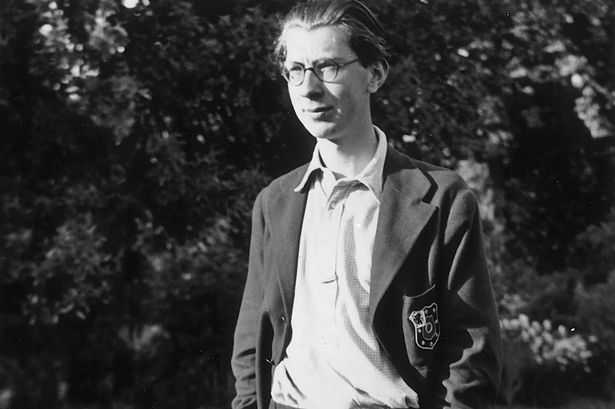
The young poet-to-be, when he looked like this…

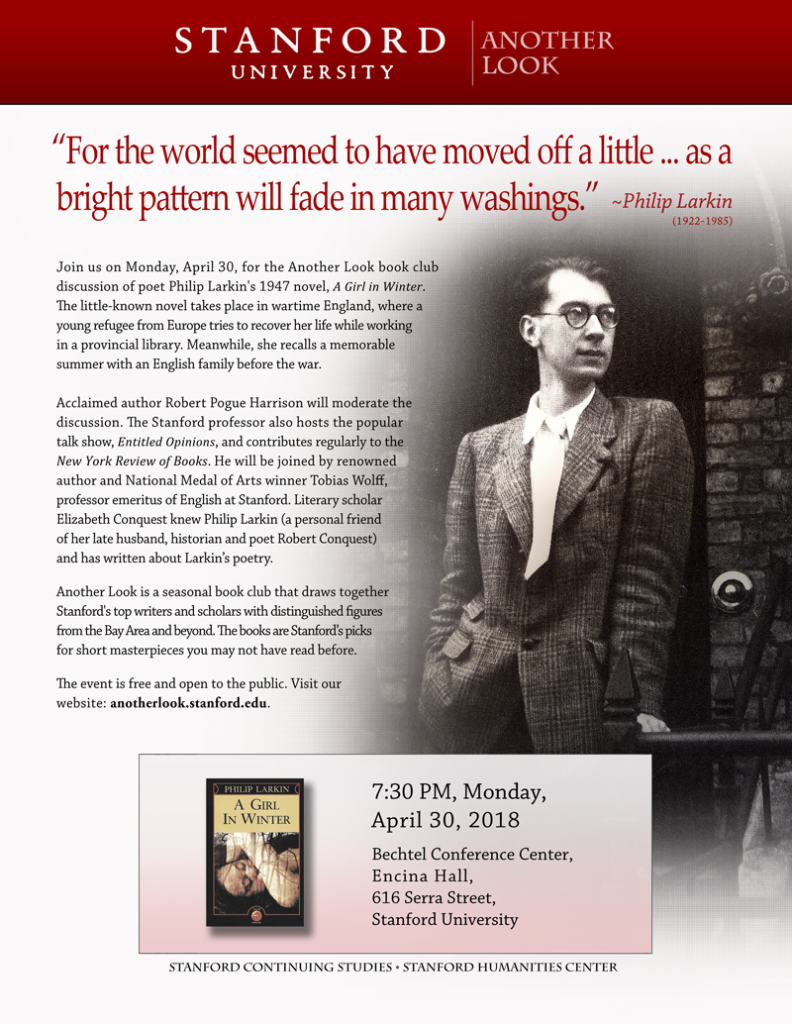
Philip Larkin is one of England’s most eminent postwar poets. But relatively few know of his early sallies into fiction. Hence, the Another Look book club, which takes on overlooked, forgotten, off-the-beaten track novels (or simply ones that haven’t received the attention they merit) is taking on Larkin’s 1947 A Girl in Winter. 

The event will take place at the Bechtel Conference Center at 7:30 p.m. on Monday, April 30. Panelists will include author Another Look Director Robert Pogue Harrison, who will will moderate the discussion. The Stanford professor also hosts the popular talk show, Entitled Opinions, and contributes regularly to the New York Review of Books. He will be joined by renowned author and National Medal of Arts winner Tobias Wolff, professor emeritus of English at Stanford. Literary scholar Elizabeth Conquest knew Philip Larkin—a close friend of her late husband, historian and poet Robert Conquest—and has written about Larkin’s poetry.

If you’d like to know a little more about the book (I always do), Clive James discusses the work here. there’s a 2011 Guardian article by the British poet Carol Rumens here. And also a 1976 discussion of the book by Joyce Carol Oates in The New Republic here. They each have a very different take on the exquisite novel.

A Girl in Winter is going to be a terrific book to end the sixth Another Look season. The book will be available at Stanford Bookstore on the Stanford campus and Kepler’s in Menlo Park.

The book is also available on Kindle, for those of you who prefer that format, and many used copies are on sale at Amazon and Abebooks. Please be aware that there are two editions of the book, listed separately and unlinked on Amazon: One from Faber & Faber here, and the other from Overlook Books here.


“Those who read books own the world.” Lost languages, an Algonquin Bible, the Herzogs, and more

March 30th, 2018
Share

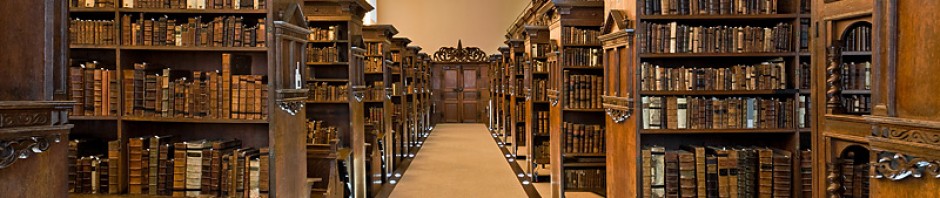
A stroll down the corridors of Cambridge’s treasure house.

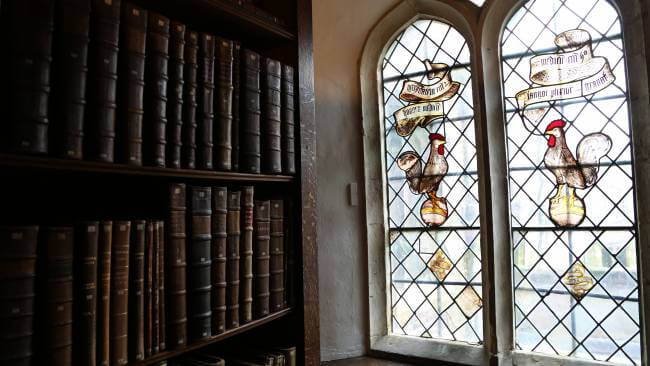
I visited the Old Library at Jesus College, Cambridge, last week. Prof. Stephen Heath gave an enlightening show-and-tell of the library’s incunabula to me and my fellow pilgrims, John Dugdale Bradley and Michael Gioia (Stanford alums, both). He brought out  an astonishing succession of treasures, including Thomas Cranmer‘s Bible, with its triple columns for comparing the original language (Greek, on the pages I saw) to the Vulgate Latin and English.

“What would you like to see last?” he asked me. What could I say? I had no idea what wonders might be in the back rooms. “Surprise me,” I said.

Marvels tucked away in a corner of Cambridge

And so he did. He brought out another Bible, this one from America. It was a 1663 Bible translated phonetically by John Eliot. The Natick dialect of Algonquin had no written form until he gave it one. He inscribed the particular presentation copy under my fingers for his alma mater at Cambridge, Jesus College. Was the Eliot name a coincidence? I remember a prominent New England family that spawned another famous Eliot, also with one “l”. On the other hand, I also knew that spellings of surnames were very fluid even into the 19th century.

When I got back to California, I checked on John Eliot, the Puritan missionary. He is indeed distantly related to T.S. Eliot, from the same Brahmin family in Massachusetts. Both descended from Andrew Eliot, whose family came to America via Yeovil and East Coker, Somerset.

But the Algonquin Bible haunted me for another reason: I recently attended a private screening in San Francisco of photographer’s Lena Herzog‘s Last Whispers, about the mass extinction of languages. I meant to tell her about the Algonquin Bible on my return, but now this blogpost will have to do. Perhaps the Algonquin language, which still has more than three thousand speakers, owes something to Eliot’s efforts.

The coincidences continued: this week, a new friend, Paul Holdengräber of the New York Public Library, sent me the link for his interview several years ago with Lena’s husband, the unconventional filmmaker Werner Herzog. The Q&A, “Was the Twentieth Century a Mistake?”, touches on the same subject – lost languages. (His comments are unrelated to Lena’s project, although their interests on the matter converge.) So here’s a hefty and relevant excerpt from the conversation between the two men:

WH: But, Paul, before we go into other things, I would linger a little on the twentieth century. And one of the things that is quite evident and looks like a good thing in the twentieth century is the ecologists’ movement. It makes a lot of sense, the fundamental analysis is right. The fundamental attitude they have taken is also right, but we miss something completely out of the twentieth century, which is—

Lena Herzog: a lover of language

PH: Culture.

WH: What went wrong in the culture, yes. That is, we see embarrassments like whale huggers, I mean, you can’t get worse than that, or tree huggers, even, such bizarre behaviour. And people are concerned about the panda bear, and they are concerned about the well-being of salad leaves, but they have completely overlooked that while we are sitting here probably the last speaker of a language may die in these two hours. There are six thousand languages still left, but by 2050, only 15 percent of these languages will survive.

PH: So we are paying attention to the wrong things.

WH: No, to pay attention to ecological questions is not the wrong thing, but to overlook the immense value of human culture is. More than twenty years ago I met an Australian man in Port Augusta in an old-age home and he was named “the mute.” He was the very last speaker of his language, had nobody with whom he could speak and hence fell mute, fell silent. He had no one left, and of course he has died since then. And his language has disappeared, has not been recorded. It’s as if the last Spaniard had died and Spanish literature and culture, everything has vanished. And it vanishes very, very fast. It vanishes much faster than anything we are witnessing in terms of, let’s say, mammals dying out. Yes, we should be concerned about the snow leopard, and we should be concerned about whales, but why is it that nobody talks about cultures and languages and last speakers dying away? There’s a massive, colossal, and cataclysmic mistake that is happening right now and nobody sees it and nobody talks about it. So that’s why I find it enraging that people hug whales. Who hugs the last speaker of an Inuit language in Alaska? So it just makes me angry when I look back at the twentieth century, and I’m afraid it continues like that. And we have got into a meaningless consumer culture, we have lost dignity, we have lost all proportion.

“Ah, people. It’s the books that matter!” (Photo: L.A. Cicero)

PH: In terms of preserving culture, preserving language, we can think of this library, which has many millions of books underground, seven floors of books, and it goes under Bryant Park.

WH: Paradise.

PH: Paradise, as you called it, but when we were underground, you asked the librarian: “In the case of a holocaust, what would we do with the precious books?” And the librarian was rather anxious about that question. [laughter] No provisions had yet been made, and I don’t know if they’ve been made since your question. But I remember the librarian wondering how to answer it. And he said, “Well, in the case of a holocaust, maybe we will come here.” And you said, “Ah, people. It’s the books that matter!” Do you remember that?

WH: Yes, it sounds misleading in the context of the previous, but please continue. [laughter]

PH: Well, the books are the repository of our memories and our culture. So that these languages that are disappearing as we are talking now have a place where they’re archived, where they’re kept, even if the culture itself has become mute, it still can be studied.

WH: But most of the six thousand still-spoken languages are not recorded in written form. So then they disappear without a trace. That’s evident. But, yes, books, sure, we must preserve them and we must somehow be cautious and careful with them, because they carry our culture—and, of course, those who read books own the world, those who watch television lose it. So be careful and be cautious with the books.

Tom Eliot has formidable forebears.

PH: And what you do with your time.

WH: Yes, but we do have disagreements of what are the most precious ones that we would keep. Of course, you would go for James Joyce immediately, and I have my objections, because I think he’s—

PH: Who would you go for?

WH: Hölderlin. No, I mean James Joyce isn’t really bad, but—

PH: James Joyce is on a trajectory for you—

WH: Which went somewhere wrong—

PH: Somewhere wrong, starting with Petrarch and then going to someone such as Laurence Sterne.

WH:. Yes, Laurence Sterne is somehow a beginning in modern literature, where literature really became modern but also went on a detour and the result—

PH: A detour from what?

Hardcore?

WH: Detour from what, yes—that’s not easy to say, a detour that leads let’s say to Finnegans Wake, where literature should not end up. It’s a cul de sac, in my opinion, and much of James Joyce is a cul de sac, per se. But at the same time that he was writing, there were also people like Kafka, for example, and Joseph Conrad. I have a feeling there is something hardcore, some essence of literature; and you have it in a long, long tradition and you find it in Joseph Conrad, you find it in Hemingway, the short stories, you find it in Bruce Chatwin, and you find it in Cormac McCarthy.

You can read the whole fascinating interview at the literary journal Brick here. But I can’t help but wonder about something else, related to hugging pandas and kissing whales. This may be the very first era in history where there has been so much sentimentality and affection for animals, and comparatively little for babies and children. (This vegetarian cat-lover pleads guilty, at least a bit.) Why is that? And what does that say for the future of the race?

Meanwhile, enjoy this Huron carol, in a language now extinct. Jean de Brébeuf, a Jesuit missionary wrote this carol in Wendat (Wyandot) sometime before he was martyred in 1649 – fourteen years before Eliot’s Algonquin Bible.


<<< Previous Series of PostssepNext Series of Posts >>>