“When I get a new book, I open and smell it”: An Albanian Kadare fan remembers when books could be dangerous.

March 2nd, 2018

Share

“When I get a new book, I open and smell it.”

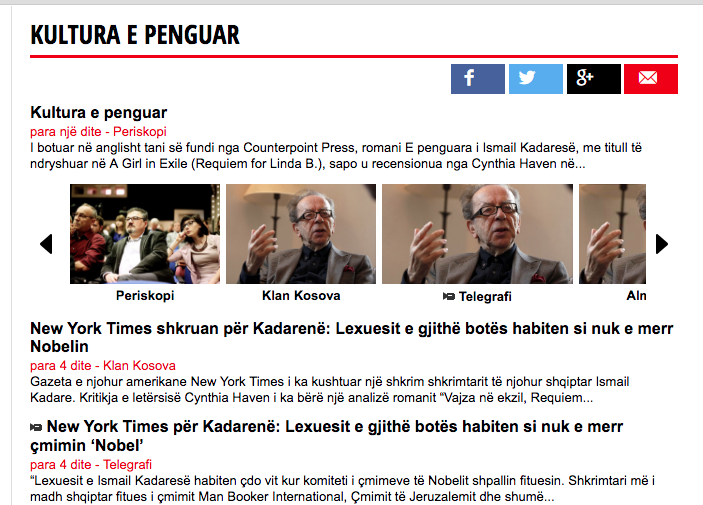
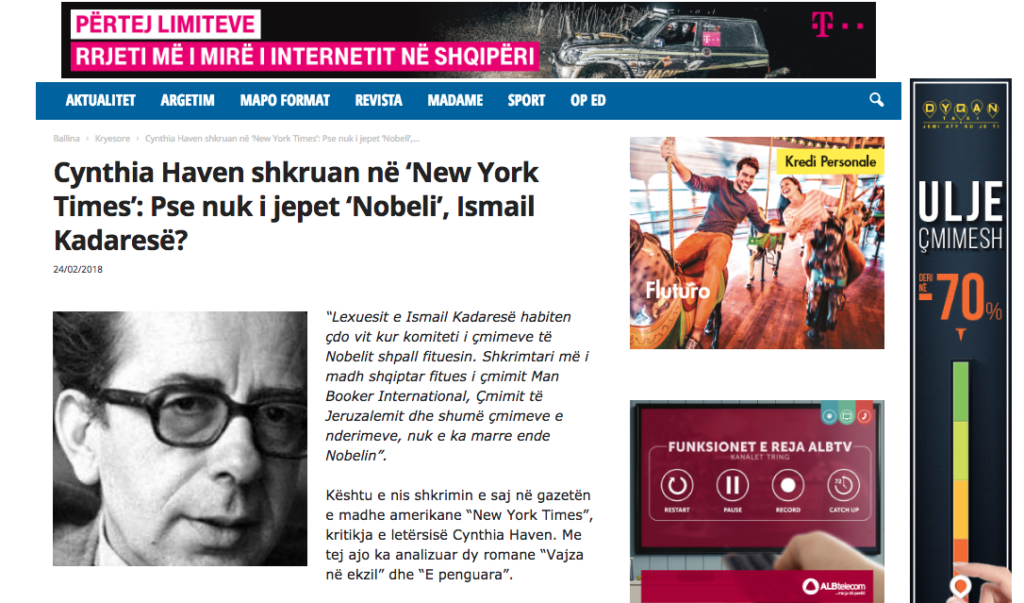
There have been some interesting after-shocks from my New York Times Book Review piece last weekend: First, I made the headlines in Tirana. My contention that Ismail Kadare should have received a Nobel long ago is apparently controversial. Second, I got retweeted by Kadare’s daughter, Besjana Kadare, the Albanian Ambassador of Albania to the UN.  And finally, I received the email below, from Albanian-born Kadri Brogi, a tech manager at Hunter College in New York City. He is obviously a Kadare fan of, and gives some insight into the devotion Albanians have for the language’s first international writer (and I include his second letter below):

Thank you for writing that piece about Ismail Kadare. Your analyses is spot on.

I am originally from Albania and grew up reading his books. It was one of very few things we could look forward to there.  The rest of the literature was just “socialist realism.” He had some of that as well, but he has explained why. As you correctly noted, he has been very much inspired by the ancient Greek literature. Most of his work reflects that.

Protection? Forget it.

I think one of the main reasons why he has not been considered for the Nobel prize has to do with the perception that he has been too close to the communist nomenclature.  He was from the same town as Enver Hoxha, and many think that served as protection. I don’t believe that, because Enver Hoxha did not offer protection to anyone. He murdered is brother-in-law (his sister’s husband) who had paid for Hoxha’s education in France before the war.

About fifteen years ago, Kadare was invited to the Columbia University Rotunda. I was there. He was bombarded with questions about his past, mostly from Albanian immigrants, and he explained everything very well.  He said that he had never pretended to be a dissident. He said he made a compromise in order to survive.

Modeled himself on Dante.

He said that, like Dante Alighieri (his words), he has to build his environment and surrender himself from that reality in order to produce what he did. He was referring to Dante’s status when he had criticized the Pope and was treated very unfavorably. That was the reason (according to Kadare) that Dante created his own isolated reality where he produced great works like The Divine Comedy. Kadare said that he had two options: compromise and continue to write books that we can read or end up with a bullet in back of his head and be a hero.

His writings were very ambiguous in many cases. I read every single book he published before 1990 and went back and read few of them again after 1990. It was then I was able to read between the lines.

I think he will eventually be nominated for the Nobel.

Thank you again for your piece and I look forward to getting your new book.

Kadri gives some insight into Albanian life under the Hoxha regime in a follow-up email:

There were two things you could do in Albania when we were growing up, sports and reading. I wasn’t good at sports so I picked reading.

In elementary school I would read all kind of books. I took some piano lessons then but other kids made fun of me saying that piano is just for girls so I quit. By today’s definition, that would have classified as bullying but not then and there .  One teacher came to my father and expressed concern that I read too much and it might be unhealthy. To this day I read at least 15-20 books a year.
I live in NJ but commute to NYC every day. My phone is filled with audiobooks that I listen while staying on traffic.

Reading was something that helped me grow and develop. I learned English by myself with some old English books called Essentials.

At that time Russian was dominant in schools even though we had broken away from the Eastern bloc a long time ago. We could manage to get some prohibited books at that time (they were called yellow books) that if caught it meant jail.

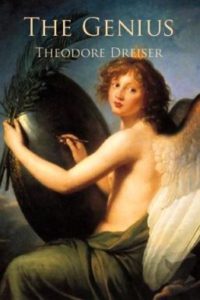
I remember when I read the first American book in 1982. The Genius from Theodore Dreiser. I was mesmerized.

I read pretty much everything, but mostly historical books, memoirs, biographies and military because I served for many years. I was an Early Warning RADAR Engineer.

I teach computer science but try to encourage students to read as much as I can. I feel like many now consider reading as an archaic thing.

My daughters make fun of me because whenever I get a new book, I open and smell it.

Meanwhile, Humble Moi has become famous in Albania. Witness the headlines:
“Vengeance in Reverse”: exchanging pleasantries instead of punches

March 1st, 2018
Share

I met anthropologist Mark Anspach on the internet a few years ago, when I was looking for someone to offer some online insight into the mind and motives of Anders Behring Breivik, the man who murdered nearly eighty young people in Norway in 2011. I posted about it in “Anders Behring Breivik: The Victim of Nobody” here

Mark and I have been penpals ever since, and have even met on a few occasions, for he has been a visiting scholar at Stanford, and still retains connections here – one of them our mutual regard for René Girard, who has been influential on Mark’s  thinking. He is now affiliated with the Institut Marcel Mauss at the École des Hautes Études en Sciences Sociales in Paris. 

His new book intrigued me: Vengeance in Reverse plays on René’s theories about the inevitability of reciprocity. Although violent mimetic behavior (e.g., I hit you, you hit me) gets a bad name, René points out it is still essentially rooted in an impulse that is positive, because it pulls us out of ourselves and towards others: “It is everything. It can be rivalrous; but it is also the basis of heroism, others, and everything,” he has said, in a quote I include in my imminent Evolution of Desire: A Life of René Girard“But whether you exchange compliments, niceties, greetings, or insinuations, indifference, meanness, bullets, atom bombs, it’s always an exchange. You always give to the other guy what he’s giving to you, or you try to do so.”

Mark is considered “one of today’s most important figures in French social theory and cultural anthropology,” according to Mark Cladis of Brown University. So, a few questions to Mark about his new book:

Vengeance in reverse.” Provocative title – can you tell us what it means?

The urge to strike back is very basic, but vengeance is only the negative form of a more general phenomenon: reciprocity. In a blood feud, one side takes a life, then the other side takes a life in return. In positive reciprocity, one side gives something of value, then the other side gives in return. Reciprocal giving is the cornerstone of human interaction.

Mark in action.

As Marcel Mauss showed in The Gift, social life in premodern cultures revolves around gift exchange. I argue that gift exchange is like vengeance in reverse. It’s not just that one is the opposite of the other. There is an actual reversal in orientation. When people trade blows, each looks back to a previous event: you hit me because I hit you before that. With giving, each can look forward to what comes next.

That is, if I give you a gift, I can look forward to receiving a return gift. Right?

Right, whereas nobody looks forward to receiving a return blow! In vengeance, people are not looking to get a return – each side views its action as final, conclusive. Yet each action does provoke a return, so that everyone hurtles on in the wrong direction. Making a gift is a way to reverse course. This is a case where seeing into the future is not so difficult. It doesn’t take a crystal ball.

We know there is a tendency for any act, good or bad, to be reciprocated, so why not take advantage of that? Initiating a sequence of positive reciprocity gives everyone something to look forward to.

Revenge: it didn’t do much for Romeo and Juliet.

Who goes first, though? Someone is sending you anthrax — you reply with chocolates? Isn’t it dangerous to go first?

Whoever struck the last blow has to go first. In a blood feud, the murderer must make an offering to the victim’s group. The same principle holds in everyday life. If someone offends you, they’re the ones who need to send chocolates! People can get caught up in petty feuds over trifles. Often a small gesture will turn things around, and there is usually little to lose by showing oneself to be generous. But you are absolutely right that in a violent conflict, taking the initiative to seek peace can be dangerous. Let me tell you a true story from contemporary Albania.

A young man tried to rape a girl. Her brothers saved her just in time, but the family wanted to take revenge — and I don’t mean by shaming the offender with a nasty tweet! They were going to come after him. But he let a friend tie him up and stand him in a field in front of the girl’s assembled relatives. The friend said, “If you want to kill him, kill him. But then his family will come and kill one of you.” The man whose life was on the line had to be nervous, but in this instance going first worked. Both sides knew that once blood is spilled, the ensuing feud can last indefinitely. Post-communist Albania has seen a resurgence of the kind of vendetta described by Ismail Kadare in his historical novel Broken April.

He figured it out.

I’ve just written a review in the New York Times Book Review about Kadare, so naturally I’m pleased that you use Gjorg from Broken April in your first chapter.

Kadare’s novel was a key source of inspiration for me. Gjorg is a tragic figure. He has no taste for killing, but when his brother is murdered, he must avenge the family honor and become a killer himself. The ancient code of the Albanian blood feud leaves him no choice. Yet killing the killer does not bring closure; it merely triggers a new cycle of revenge. Gjorg’s fate is to be killed by his victim’s kin. When, as custom demands, he attends the funeral meal for the man he killed, he cannot stop looking ahead to the next funeral meal — the one that will be held for him. Gjorg knows very well what will happen next, but he is helpless to change course. Kadare’s protagonists cannot escape the framework of negative reciprocity. Moving from violence to peaceful exchange is extremely tricky.

Like Kadare, you also find precedents in the ancient Greeks, for example, in Homer’s Iliad.

Don’t forget!

Homer offers an example where the framework of the interaction changes. Two enemy warriors, Diomedes and Glaukos, meet in the thick of battle to engage in single combat. When they discover that their forebears had exchanged gifts long ago, a new context is born. Not only do the two warriors decide not to fight, they seal their own friendship by trading coats of armor right there on the battlefield!

The role of gift exchange in peacemaking could not be clearer. The speech Diomedes makes is just as interesting. He doesn’t merely invoke the past; he conjures up a peaceful vision of the future by announcing that he and Glaukos will take turns extending hospitality to each other in years to come. In effect, he says they’re going to be exchange partners tomorrow, so they can’t kill each other today! It’s a gambit that works through impeccably circular reasoning.

It’s a tangled loop, then.

Exactly! Negative and positive reciprocity are equally loopy phenomena. Violence is a vicious circle; peaceful exchange is a virtuous one. There’s no getting away from circularity, but we can do our best to shape the circles in which we find ourselves.

Postscript: On the other hand, given human nature, sometimes even positive reciprocity can backfire.

“The Skin of Our Teeth”: did Thornton Wilder bite off more than he could chew?

February 27th, 2018
Share

Overbite?

The American Interest isn’t generally our thing – we’re hardly policy wonks at the Book Haven – but I was intrigued when Rachel Hostyk, the associate editor for the journal, wrote a thoughtful review of the Constellation Theatre Company‘s recent production of Thornton’ Wilder‘s The Skin of Our Teeth. Fortunately, her discussion of Wilder’s challenging, infrequently performed play popped up in my news feed. I’ve seen the long, allegorical play before, and found it problematic. Doesn’t everyone? The characters are, well, too allegorical to really come to life – a great contrast to his 1938 play Our Town, which finds humanity and meaning in the most trivial gestures of our lives. Wilder finished his ambitious play only a month after Pearl Harbor, and it was first produced in 1942. America was still recovering from the Depression, and had entered the second major war of the century. The play takes the Antrobus family from Adam and Eve, and prehistory, right up to the ever-moving present moment.

A few excerpts from Hostyk’s provocative review:

The first act of the play is its most effective, a gem almost worth the price of admission by itself. We are in mid-Ice Age, the glaciers sweeping across North America and freezing everything in their paths. In the midst of the chaos, Mr. Antrobus keeps trekking to the office every day to invent the wheel and compile the alphabet. (He’s particularly proud of “separating n from m.”) Mrs. Antrobus is a homemaker in charge of two unruly children, a pet mammoth and dinosaur, and a dark secret. Wilder made a clever choice in pairing the archetypal mid-century family, artificial in its own right, with the absurdity of a bureaucracy that invents letters. He emphasizes the rickety foundations of human civilization with sympathy, not condescension. And when deployed against a descending wall of ice, the chin-up attitude of wartime is especially poignant.

***

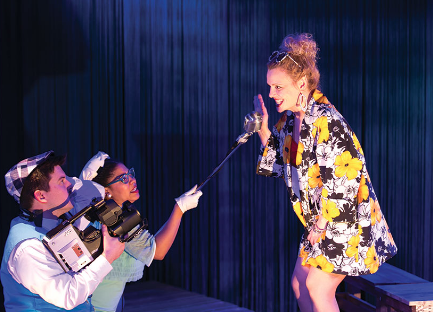
Malinda Kathleen Reese cuddles with her “pet,”  Ben Lauer (photo by Daniel Schwartz)

I can’t help but see the shadow of the 1940s, of a society tired of watching war and poverty ravage people who were no worse or better than their luckier neighbors. It’s a deus ex machina ending without deus. True, blind luck is often what saves people from disaster. Yet there are aspects to the Noah story that inspire even if you don’t believe in God—the fortitude of Noah’s family, their organizational capacity, their craftsmanship, the love and cooperation that see them through the near-total destruction of their world. Deprive the narrative of God, and you deprive humanity of its grandeur in rising to meet God’s expectations. Generally, what we find inspiring amid the carnage and despair of war are those people, religious and not, who prove so much better than their circumstances.

***

The Antrobuses make a choice in the face of certain death, as people freeze on the roads out of town. The glaciers are within sight of their house. Certainly, giving away food that could feed your children for another week or two is heart-wrenching—Mrs. Antrobus is against it at first. Yet selfishness is often borne of hope, and there is none here. Nor are there the logistics of a future to consider. In our times, immigration policy is made by those who face election next year, or who have to reknit a society made up of both newcomers and natives. We should still be kind and merciful, of course, and the Antrobuses’ generosity is inspiring. But the mercy of a new life is much more difficult to offer than the kindness of a last meal. An allegory that doesn’t wrestle with this fact is less useful for all of us. In certain ways, reality is sadder than Wilder lets on—and yet still, people do the decent thing.

***

The maid Sabina (Tonya Beckman) shares the news.

The lesson of this allegory is emphasized with a sledgehammer: Humans have survived and will keep surviving. With the help of books, they will restart society from the worst of ruins (Mr. Antrobus makes sure to save his volumes of Shakespeare). Yet after the initial and rather basic achievements of the wheel and the alphabet, we see nothing more of human inventiveness in action. The great philosophers are analogized to the hours in the day, as if they were simply features of existence like the passage of time. (Homer, the Muses, and Moses wander in with the refugees of the first act, but as humanity is still stuck at “n,” they seem more like natural resources than human achievements.) Yet it’s impossible to understand the great epochs of horror and survival independently of the knowledge gained (or not), or the cultures that endured and perpetrated them.

I can’t help but admire a play of such cleverness and ambition, especially in this splendid production. And perhaps it’s carping to suggest that Wilder bit off more than he could chew; no two-and-a-half-hour play is going to be the final word on human history. You might argue that the Antrobuses are average by definition. But if they are given to feats of cruelty like total warfare, why not other, nobler extremes of human behavior?

Read the whole thing here.

Postscript on 2/27: A comment from journalist Jeff Selbst that is a mini-review in itself: This is one of my favorite plays, a classic of absurdism. Sabina is an unforgettable creation: housemaid, temptress, fatalist, and yet an eternal American sort of optimist. The third act gets a bit heavy with the overt Cain-and-Abel references, but it has Wilder’s sometimes flinty New England scholarly poetics in its blood.”

Early praise for Evolution of Desire: A Life of René Girard: “A penetrating account of an important thinker—and as agile, profound, and affecting as its subject.”

February 25th, 2018
Share

A review of my Evolution of Desire: A Life of Rene Girard was just published in Kirkus ReviewsThe first paragraph, as is customary with Kirkus, describes the book. Then comes this:

Haven was a close friend of Girard’s, and that privileged perch allows her to consider his life both personally and intellectually. Many aspects of his history would be hard to adequately comprehend without this dual perspective. For example, she offers an impressively incisive account of his conversion from atheism to Christianity in 1958 (“It was something no one could have anticipated, least of all himself. ‘Conversion is a form of intelligence, of understanding,’ he said; it’s also a process…and as such would absorb him for the rest of his days”). In addition, her rendering is as panoramic as his thought—she considers a vertiginous array of diverse subjects insightfully, including Girard’s trenchant criticisms of Camus’ The Stranger, the ways in which the French and Americans view each other, and desire’s metaphysical aspects. Furthermore, Haven ably, even elegantly synopsizes the central tenets of Girard’s beliefs, in particular his pioneering views on mimesis—a kind of updated version of Rousseau’s amour propre—the notion that the desires and violent conflicts that often spring from people have their root cause in the gregarious mimicking of others. In this intimate but philosophically searching book, the author’s writing is marvelously clear. She expertly unpacks Girard’s ideas, making them unusually accessible, even to readers with limited familiarity.

A penetrating account of an important thinker—and as agile, profound, and affecting as its subject.

Read the whole thing here. Better yet, you can pre-order the book on Amazon here

Ismail Kadare: “There is real literature, and then there is the rest.”

February 23rd, 2018
Share

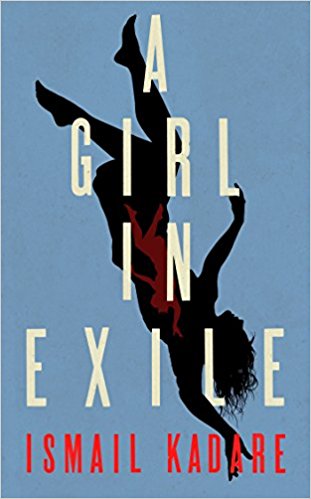
My review is online at The New York Times Book Review today here, and in the print edition this weekend.  The book under discussion: the Albanian maestro Ismail Kadare‘s A Girl in Exile. Every year, the Nobel committee seems to look the other way while a matchless collection of novels, plays, essays pours out from Paris and Tirana, his dual homes.

An excerpt from my review:

Kadare is still mapping out the boundaries of Albanian, a relatively recent literary language, where everything is new and newly sayable. He is the first of its writers to achieve an international standing. But how to describe something beyond words? “Better if you don’t know” is a repeated phrase in the book, along with variations of “it’s complicated.”

The two girls, “daughters of socialism, as the phrase went,” resolve their eternal love triangle with a stunning metaphysical selflessness. And they reply to injustice and repression not by resistance or retaliation, but with an utterly new, unconditioned response that leaves the reader lightheaded, transcending even that which we value as “freedom.” In Kadare’s words, they move “beyond the laws of this world.”

Read the whole shebang here.

Are you listening, Stockholm? (Photo: Lars Haefner)

Kadare’s relationship to his mother tongue intrigued me, especially given its affinities with classical Greek. I googled the language. I reached out to a Albanian Facebook group. I tried phoning the consulate. No joy anywhere. Who could tell me more? The most informative source turned out to be … Kadare himself. So I read more about it over at The Paris Review. “For me as a writer, Albanian is simply an extraordinary means of expression—rich, malleable, adaptable,” he explained to his interviewer, Shusha Guppy, in 1997. “As I have said in my latest novel, Spiritus, it has modalities that exist only in classical Greek, which puts one in touch with the mentality of antiquity. For example, there are Albanian verbs that can have both a beneficent or a malevolent meaning, just as in ancient Greek, and this facilitates the translation of Greek tragedies, as well as of Shakespeare, the latter being the closest European author to the Greek tragedians. When Nietzsche says that Greek tragedy committed suicide young because it only lived one hundred years, he is right. But in a global vision it has endured up to Shakespeare and continues to this day. On the other hand, I believe that the era of epic poetry is over. As for the novel, it is still very young. It has hardly begun.” 

He’s just warming up:

“Listen, I think that in the history of literature there has been only one decisive change: the passage from orality to writing. For a long time literature was only spoken, and then suddenly with the Babylonians and the Greeks came writing. That changed everything.” It’s a bracing interview because of the unexpected turns the conversation takes. He never takes the predictable position, the weathered road.

Faster than a speeding bullet

“For example, they say that contemporary literature is very dynamic because it is influenced by the cinema, the television, the speed of communication. But the opposite is true! If you compare the texts of the Greek antiquity with today’s literature, you’ll notice that the classics operated in a far larger terrain, painted on a much broader canvas, and had an infinitely greater dimension: a character moves between sky and earth, from a god to a mortal, and back again, in no time at all! The speed of the Iliad is impossible to find in the modern author. The story is simple: Agamemnon has done something that has displeased Zeus, who decides to punish him. He calls a messenger and tells him to fly to earth, find the Greek general called Agamemnon and put a false dream into his head. The messenger arrives in Troy, finds Agamemnon asleep and pours a false dream into his head like a liquid, and goes back to Zeus. In the morning Agamemnon calls his officers and tells them that he has had a beautiful dream, and that they should attack the Trojans. He suffers a crushing defeat. All that in a page and a half! One passes from Zeus’s brain to Agamemnon’s, from the sky to earth. Which writer today could invent that? Ballistic missiles are not as fast!”

In sum: “All this noise about innovations, new genres, is idle. There is real literature, and then there is the rest.”

After a few paragraphs to lure you in, the Paris Review interview is behind a paywall … well, I’ve effectively done the same, haven’t I? But my review is free. It’s here.

Postscript on 3/2: Guess what new offering made the top seven books of the week over at the New York Times Book Review? That’s right. Kadare’s Girl in Exile. It’s here.

“The greatest woman poet since Sappho”? Consider the work, not the life.

February 22nd, 2018
Share

Today is Edna St. Vincent Millay‘s birthday. (We’ve written about her here and here and here.) Every so often, someone calls for a revival of her delicious verse, and today it’s Amandas Ong’s turn, over at The Guardian. She notes that Millay is more remembered for her wild and crazy life than lines like these:

What lips my lips have kissed, and where, and why,
I have forgotten, and what arms have lain
Under my head till morning; but the rain
Is full of ghosts tonight, that tap and sigh
Upon the glass and listen for reply,
And in my heart there stirs a quiet pain
For unremembered lads that not again
Will turn to me at midnight with a cry. … (Read the rest here.)
.
An excerpt from Ong’s article (which is online here):

Where should one begin with Millay? She had a famed predilection for Petrarchan sonnets and rhyming couplets, at odds with prominent experimental modernists of the era, such as TS Eliot and Wallace Stevens. But Millay expanded the scope of these poetic forms, presenting a bold, sexually charged vision of the female experience. Her verses serve as a kind of elaborate architecture, housing the fickle, frenetic movements of the heart that falls in love and then out of it. Renascence and other poems (1917), which includes the 200-plus line poem that brought her acclaim, also boasts six sonnets, all of which are outstanding in this respect.

“If I should learn, in some quite casual way, / That you were gone, not to return again —,” she muses in Sonnet V, she would not cry in a public place, like a train; no, she’d “raise my eyes and read with greater care / Where to store furs and how to treat the hair.” This is classic Millay – how else can one grapple with the end of a love affair than to instinctively busy oneself with the mundane?

But Millay never approached love and its vicissitudes with passive melancholy. In “No Rose That in a Garden Ever Grew,” she ponders cynically on the temporal nature of infatuation that drives the stories of women such as Lilith, Lucrece and Helen: “And thus as well my love must lose some part / Of what it is, had Helen been less fair, / Or perished young, or stayed at home in Greece.”

Happy birthday, Edna. You deserve a revival. And a little cake.

<<< Previous Series of PostssepNext Series of Posts >>>