
Tim Steele remembers poet Helen Pinkerton: hardscrabble origins and poems “deeply in the American grain”

January 3rd, 2018

Share

A few days ago, we noted the death of the Stanford poet Helen Pinkerton, who died last Thursday, December 28, 2017, and we cited some earlier words from Los Angeles poet Timothy Steele, a longtime contributor to the Book Haven (here and here and here) and the subject of a number of its posts (here and here). He wrote his own tribute for Helen on Facebook:

Helen Pinkerton rose from hardscrabble origins to become one of the most thoughtful and graceful poets of her generation. She was born in 1927 in Butte, Montana, the home of the Anaconda Copper Mining Company and possibly the roughest and most corrupt town in the country at the time. (Dashiell Hammett portrays it as Personville in Red Harvest.) Pinkerton had to take a circuitous route on her walk to school each day to avoid the town’s large and thriving red light district. Her father worked in the mines and was killed in 1938 in an accident in one of the shafts in Butte Hill—“the richest hill on earth” during the copper boom. After graduating from high school in 1944, Pinkerton moved with her mother to Palo Alto, where they worked in a cannery. She applied and was admitted to Stanford. She later modestly said that she thought she got in because all the young men were off in the Second World War and the university needed students. Originally intending to study journalism, she took a class from Yvor Winters, who recognized and encouraged her talent for poetry and scholarship. After receiving her B.A. from Stanford, she earned a doctorate from Harvard. She married the scholar J. Wesley Trimpi, with whom she had two daughters, and wrote influential studies on modern poetry, the Civil War, and Herman Melville. Melville’s Confidence Men and American Politics in the 1850s (published under her married name, Helen P. Trimpi) is considered a classic in its field.

With Helen and poet Turner Cassity in 2010

But Pinkerton’s greatest work is her poetry. It exemplifies T. S. Eliot’s thesis that fine poems are often a blend of tradition and individual talent. Her “Elegy at Beaverhead County, Montana,” which appears below, draws on the long tradition of elegiac poetry in English. Its metrical-stanzaic form and its pastoral meditation recall Thomas Gray’s “Elegy Written in a Churchyard.” At the same time, Pinkerton’s poem is deeply in the American grain. Its twenty lines touch on so many critical issues in our country and culture—including the cruel manner in which we divide the future from the past and the struggle between those who cultivate the earth and those who would exploit it for wealth. (Pinkerton once noted that Native American observers had been shocked when settlers from the East started extracting minerals from the planet without putting anything back in.) Pinkerton also portrays—with moving sympathy and a daughter’s cautious watchfulness—her strong and disappointed father, a man who had relatively little formal education but who loved music and played the violin.

Pinkerton uses as her epigraph, “Gold and silver,” the motto that Montana adopted in 1865, when it became an official United States Territory. “Love, faith, and poetry” is a motto that her friends and admirers will remember her by.

Elegy at Beaverhead County, Montana

“Oro y plata”

My father fished here summers, scaled and cleaned
His catch by the gray weathered fence that dips
Into the river. Thin as a pine, he leaned
Again to rinse the knife in chilling rips.

The river is Missouri’s western source,
So clear and shallow even stones and sand
Under that sun seem golden in its course.
Men came for gold and, failing, took the land.

Sons of unsettled men sometimes remained
To change the land through labor and design.
He left, rejecting when he might have gained,
But only found another ore to mine.

His quiet lapsed to taciturnity,
Slow anger to hard answers in a glance;
Music alone and its brief gaiety,
His father’s gift, remained from circumstance.

For that rich butte in whose deep shaft he died,
Where I first saw, as silver as the earth,
Another stream flow west from the Divide,
Gave to him nothing of its final worth.

Helen Pinkerton (1927 – 2017)
from Taken in Faith (Athens, OH: Swallow Press/Ohio University Press, 2002)

The poet Annie Finch remembered that Tim had put her in touch with Helen years ago when she was organizing her anthology, A Formal Feeling Comes. She posted the page with Helen’s artistic credo, and the moving elegy on her Aunt Nora:

Stanford celebrates Frankenstein on the bicentennial of its publication – be there on Jan. 24!

January 1st, 2018
Share

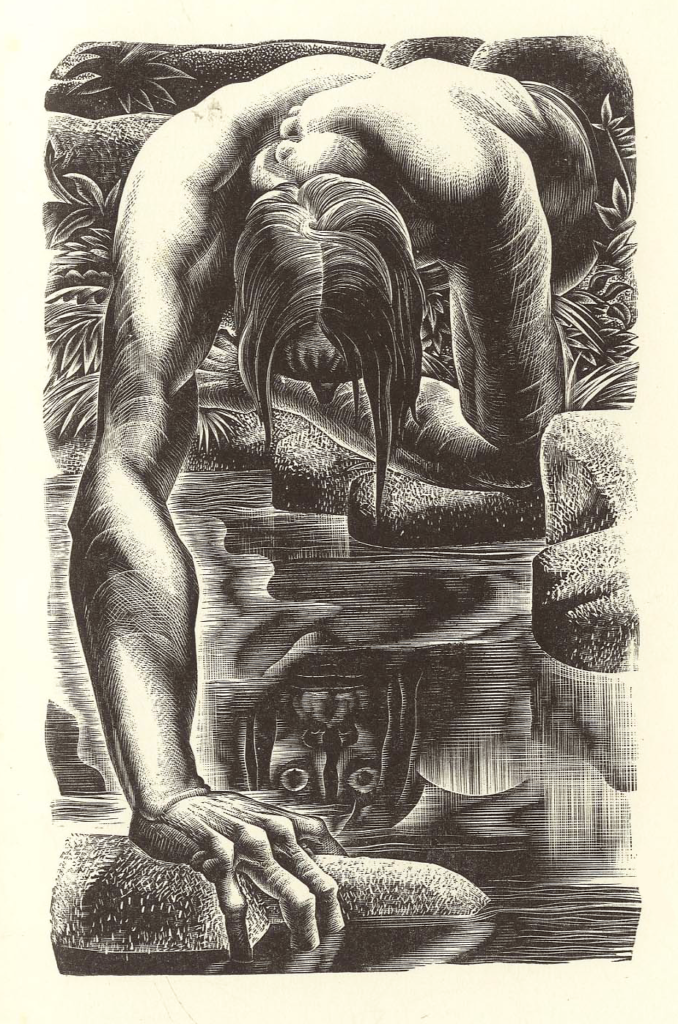
Artist: Lynd Ward, provided by the Estate of Lynd Ward

Today is more than the usual New Year’s Day. It marks the bicentennial of the very day the 20-year-old Mary Shelley published her masterpiece, Frankenstein; or, The Modern Prometheus on January 1, 1818. It was an immediate popular success. The book would rock the world, and inspire films, theater adaptations, television shows, video games, sequels, and spinoffs. But today’s public conception of the hero may owe more to Boris Karloff‘s iconic 1931 film role than to the “the Creature” that Shelley created in her classic, with its complicated and troubling humanity.

Hence, the winter “Another Look” event spotlights Shelley’s Frankenstein. The discussion will take place at 7:30 p.m. on Wednesday, January 24, at the Bechtel Conference Center. Frankenstein will be a special two-hour event with four panelists. So far, we’ve seen a lot of interest in this one from the medical and technology  communities – at Stanford and beyond. We’re bracing for a full house.

Another Look’s winter event on Frankenstein is part of Stanford’s year-long celebration of the bicentennial of the book’s publication. Shelley’s tale has proved timely, even prophetic, given our current concerns about artificial intelligence, stem cells, and animal-to-human transplants. Frankenstein explores the role of conscience in creation, and asks: What does it mean to be human? Is it wise to play God? What are the creator’s moral obligations towards his or her creation?

While the campus-wide Frankenstein@200 will explore the moral, scientific, sociological, ethical and spiritual dimensions of the book, Another Look will focus on the book as a literary work: a flowering of the romantic imagination, as well as a pioneering landmark in science fiction.

According to critic Harold Bloom, “The greatest paradox and most astonishing achievement of Mary Shelley’s novel is that the monster is more human than his creator. This nameless being, as much a modern Adam as his creator is a modern Prometheus, is more lovable than his creator and more hateful, more to be pitied and more to be feared, and above all able to give the attentive reader that shock of added consciousness in which aesthetic recognition compels a heightened realization of the self.”

Acclaimed author Robert Pogue Harrison will moderate the discussion. The Stanford professor who is Another Look’s director writes regularly for The New York Review of Books and hosts the popular talk show, Entitled Opinions. He will be joined by three panelists who have all taught Frankenstein at Stanford: French Prof. Dan Edelstein, Classics Prof. Andrea Nightingale, and former Stanford fellow Inga Pierson.

The panelists will be focusing on the original 1818 version of the novel, rather than the later 1831 edition – and discussing some of the differences between the two. You can find the Oxford edition of the original at the Stanford Bookstore, Kepler’s in Menlo Park, and Bell’s Books in Palo Alto. (But don’t worry if you’ve read a different edition!)

The Another Look book club takes on short classics that have been forgotten, neglected, or overlooked—or may simply not have received the attention they merit. The selected works are short, in order to encourage the involvement of Bay Area readers whose time may be limited. Subscription at anotherlook.stanford.edu is encouraged for regular updates and details on the selected books and events.

All Another Look events are free and open to the public – and please bring your friends!

A New Year’s resolution from Nietzsche: “I do not even want to accuse those who accuse…”

December 31st, 2017
Share

~ From “Sanctus Januarius” in Friedrich Nietzsche‘s Joyful Wisdom (1882). (Krzysztof Michalski‘s interpretation of Nietzsche is here, in “Krzysztof Michalski: Without Death – there is no me.”)

Hat tip to our friend and colleague from the New York Public Library, Paul Holdengraber.

And a very Happy New Year to all Book Haven readers!


“No poet in English writes with more authority”: Requiescat in Pace, Stanford poet Helen Pinkerton (1927-2017)

December 30th, 2017
Share


At left, Helen Pinkerton at a Stanford event in 2010, with poet Turner Cassity at right. I’m in the center.

I met Helen Pinkerton fifteen years ago, when I wrote about her for Stanford Magazine. It was part of my effort to write about all the “Stanford poets” who had been in the orbit, however briefly, of poet-critic Yvor Winters – a circle that is largely unacknowledged and under-appreciated. Helen and I stayed in touch over the years, though not as frequently as either of us would have liked, for she was a indefatigable correspondent with a wide network and I had heavy writing commitments. (I have written about her here and here, among other places.)

En route to the Tucson airport yesterday, I received an email from her daughter Erica Light: “It is with infinite sadness I must let you know of the passing of the poet, scholar, Civil War historian, teacher, and friend to many, my mother Helen Pinkerton Trimpi, at her home in Grass Valley, California, at the age of 90. She made her peaceful transition yesterday, Thursday, December 28, 2017, in the morning with her family close about her.”

I would have written differently about Helen today, but there were nevertheless some good bits in my long-ago article:

“She has written some of the best poems of her generation,” says poet and scholar Timothy Steele, ’70. Pinkerton’s mentor, Yvor Winters, deemed her “a master of poetic style and of her material. No poet in English writes with more authority.” The Oxford Companion to Twentieth-Century Poetry, calling her style “austere,” notes that “her carefully crafted poetry is profoundly philosophical and religious.” …

Meeting Winters turned her aspirations upside-down. “I discovered a whole new world, which was the serious writing of poetry,” she says. She decided she’d rather be a mediocre poet than a first-rate journalist. For Pinkerton, poetry “was a better thing to do—it was more interesting and more valuable. It was a funny choice to make, I must say,” she adds wryly.

A second turning point occurred a few years later, when she read Moby Dick on an ocean liner going to Europe after completing her master’s. It became the subject of her 1987 scholarly work, Melville’s Confidence Man and American Politics in the 1850s—and of a number of her long narrative poems. “I gave a lot of my life to Melville,” she says.

But poetry always came first, she says. “For fifty years, Pinkerton has been writing beautifully crafted poems, but the age has favored flashier and more improvisational talents, and her work has not received the hearing it deserves,” Steele writes in the afterword to Taken in Faith. Flashy and improvisational she’s not—but with a little luck, she may outlast both those trends.

Over at the Weekly Standard, James Matthew Wilson, another of her many friends and correspondents, wrote a retrospective of her work in “It’s a Battlefield”:

Over seven decades, Helen Pinkerton has published a small number of poems admirable for their austere intellectual beauty, such as the newly collected “Metaphysical Song.”

First Principle
Being’s pure act,
Infinite cause
Of finite fact,
Essential being,
Beyond our sight,
Without which, nothing,
Neither love nor light

Like those of her mentor, Yvor Winters, Pinkerton’s lyrics exhibit both philosophical depth and clean, classical lines. She exceeds him in her careful definition of the human condition in terms of its inescapable orientation to the divine “First Principle.” …

Over the years, I have published several articles on Pinkerton, in hopes of bringing her metaphysical lyrics to a wider audience. I see now, however, that I have given short shrift to what may be her most lasting contribution to American letters, her five dramatic monologues in blank verse on the subject of the Civil War. These, I believe, will become classics: miniature epics that, like Virgil‘s Aeneid, draw public history and private tragedy into a poetic whole.

And last but not least, Patrick Kurp of Anecdotal Evidence, wrote a tribute yesterday, “The Spirit’s Breath and Seed,” which includes a long excerpt from their own correspondence. (I believe I can take credit for introducing the two some years ago via email.) From Patrick:

Helen was among the last of Yvor Winters’ students to leave us. With their teacher, they – Helen, [Edgar] Bowers, Thom Gunn, Turner Cassity – along with J.V. Cunningham and Winters’ wife, Janet Lewis, represent the supreme flowering of the art of poetry in the United States.  Helen’s interests always surprised me. She published a book on Melville and another, Crimson Confederates, devoted to the students at Harvard who fought for the Southern cause in the Civil War. Last year, Wiseblood Books published A Journey of the Mind: Collected Poems of Helen Pinkerton 1945-2016.

Only death stopped her. Helen’s collected poems, A Journey of the Mind, was published last year – a late harvest indeed, but that’s not all. Her final poem, “Dialogue,” appears in the Fall 2017 issue of Modern Age. And even her last few days held a surprise: two days before her death, she received the completed and bound copy of her interview from the Stanford Oral History folks, which, according to her daughter,”looks very nice indeed.” The link for the video interview is here.

Requiescat in pace, Helen. Your grace, intelligence, and fine poetic ear will be missed.

Evolution of Desire: A Life of René Girard – in Russia’s high-traffic Colta just in time for New Year’s!

December 29th, 2017
Share

Another excerpt from Everything Came to Me at Once: A Life of René Girard – this time from the chapter called “Mankind Is Not So Kind” (Человечество не очень человечно). The excerpt appears in Colta,  Russia’s online equivalent of the New York Review of Books. Many thanks to editor, publisher, poet and journalist Maria Stepanova (we’ve written about her here and here). And thanks to the skillful translation of Svetlana Panich.

René Girard (1923-2015) began as a literary theorist was fascinated by everything. History, anthropology, sociology, philosophy, religion, psychology and theology all figured in his oeuvre. As I wrote in his obituary here:

International leaders read him, the French media quoted him. Girard influenced such writers as Nobel laureate J.M. Coetzee and Czech writer Milan Kundera – yet he never had the fashionable (and often fleeting) cachet enjoyed by his peers among the structuralists, poststructuralists, deconstructionists and other camps. His concerns were not trendy, but they were always timeless.

In particular, Girard was interested in the causes of conflict and violence and the role of imitation in human behavior. Our desires, he wrote, are not our own; we want what others want. These duplicated desires lead to rivalry and violence. He argued that human conflict was not caused by our differences, but rather by our sameness. Individuals and societies offload blame and culpability onto an outsider, a scapegoat, whose elimination reconciles antagonists and restores unity.

Non-Russian speakers will have to wait for the Englishh edition, which will be out in April (but available for pre-orders here). Meanwhile, for all my Russian friends…

«Линчевание узнается по запаху», — сказал как-то Жирар, походя упомянув в разговоре роман Фолкнера. Эту непривычно жесткую фразу он произнес с несвойственным ему отвращением. Что имелось в виду, не уточнил, но друзья рассказали, что 1952—1953 годы, которые он провел на сегрегированном американском Юге, были для него сущей мукой. Кое-кто полагает, что именно там родилась его идея «козла отпущения», но это явная натяжка, к тому же недооценивающая его гениальную интуицию, которая сплетается со множеством наблюдений и научных находок в мощную теорию, описывающую положение человека и дающую ключ к нашему прошлому, настоящему и будущему. Эти идеи Жирар окончательно сформулировал уже после того, как книга «Обман, желание, роман» заявила о себе в литературном мире. «Я прожил год в Северной Каролине. — вспоминал он позднее. — Это было не худший штат на Юге, но полностью сегрегированный и довольно консервативный». Говорил об этом Жирар без сожаления: его завораживало буйство зелени, однако можно предположить, что роскошная краса этих мест только усиливала когнитивный диссонанс.

Жирар — не «певец природы», поэтому его описания Юга довольно резки. Он честно признавался, что новое место — «окруженная соснами глиноземная местность в центре огромного табачного региона, утыканного просторными сараями, в которых складывали на просушку огромные светлые листья» — доставило ему больше удовольствия, чем Индиана, но удовольствие, по его словам, оказалось сугубо чувственным:

«У меня остались очень яркие воспоминания о первом пребывании на юге Соединенных Штатов: ошеломляющее буйство цветов по весне, райские картинки пригородов, разбросанные пестрыми букетами и окруженные вековой листвой крошечные дома, похожие на новые игрушки, роскошные сады за домами; огромный эркер в гостиной, откуда открывался вид на синевато-зеленое мелколесье… Казалось, что меня, словно в научно-фантастическом рассказе, выбросили в капсуле в сияющий мир, где есть все знакомые нам соблазны, но они гораздо сильнее и лучше упорядочены».

О расовых отношениях он говорит, скорее, иносказательно и обтекаемо:

«Но как только наступало лето, на вас проклятием обрушивалась невыносимая жара. Мучились от нее не только физически; для меня эти страдания были неотделимы от того расового недуга, который всегда терзал эту землю и не стал слабее с тех пор, как о нем рассказали великие писатели Юга, прежде всего, Фолкнер. Я не разделяю склонность некоторых критиков сводить все к чисто литературным конструкциям: достоинство литературы в том, что она улавливает смыслы, которые уже разлиты в мире и не дают покоя именно потому, что большинство людей отказываются над ними думать. Помню, какой скандал разразился в Конгрессе, так и не сумевшем ратифицировать по умолчанию обязывающий на федеральном уровне закон, какой гарантировал бы полную справедливость во всем, что касалось судов Линча».

Read the rest here.

Merry Christmas! A holiday card from Norway, and another from outer space …

December 24th, 2017
Share

Håkan

It’s Christmas, and perhaps our favorite electronic card of the season was from a Swedish friend and poet, currently living in Oslo, Norway. We’ve written about Håkan Sandell before here and here. In the note he sent with it, he addressed Humble Moi this year in terms of Propertius‘s Cynthia, but we reminded him that she was a hell-raiser and a bad ‘un, not like our self-effacing, book-loving self. Moreover, as I recall, she died young. Too late for that, I thought, as I shoveled clothes and papers into suitcases for a trip.

Guy

“Arizona sounds more exotic than Swedish X-mas cards to me,” he wrote, when I asked permission to reprint his card. The occasion for the trek to Tucson? The wedding of a bro. And that brings up the tied frontrunner for the best card of the year.

Another of my tribe of brothers is an astronomer, long associated with the University of Arizona. You might gather that from his Christmas card at bottom, which features his 2017 photo. He also fits in with our literary preoccupations, as he is currently collaborating on two books with his friend and colleague, the renowned astronomer Guy Consolmagno who is featured in the current Newsweek article “God and E.T.: Vatican Astronomer Would Baptize Aliens If They Ask.”

Hard to beat a headline like that. Merry Christmas, Happy New Year, and raising a glass of bubbly to distant friends! We’ll catch up with you from a clime that is less chilly than northern California, and far less chilly than outer space.


<<< Previous Series of PostssepNext Series of Posts >>>