“I should be drinking you from a mug, but I’m drinking you in drops, which make me cough.”

December 22nd, 2017
Share

Beginning on a High C: Marina Tsvetaeva in 1914.

Too few Americans know the oeuvre of Muscovite poet Marina Tsvetaeva (1892-1941) – partly, I think it’s because of the translations. How can one translate her? Where other poems end, hers begin. And her poems typically begin “at the far right – i.e., highest – end of the octave, on high C.”

Those are the words of her admirer, poet Joseph Brodsky, who wrote, “Tsvetaeva is a poet of extremes only in the sense that for her an ‘extreme’ is not so much the end of the known world as the beginning of the unknowable one.”

He continues: “Tsvetaeva is an extremely candid poet, quite possibly the most candid in the history of Russian poetry. She makes no secret of anything, least of all of her aesthetic and philosophical credos, which are scattered about her verse and prose with the frequency of a first person singular pronoun.”

So here are a few of those aphorisms, which have been gathered from her diaries and notebooks from about 1917 to 1922, over at the Paris Review:

I should be drinking you from a mug, but I’m drinking you in drops, which make me cough.

You don’t want people to know that you love a certain person? Then say: “I adore him!” But some people know what this means.

Kinship by blood is coarse and strong, kinship by choice—is fine. And what is fine can tear.

Betrayal already points to love. You can’t betray an acquaintance.

And this one is especially intriguing:

The heart: it is a musical, rather than a physical organ.

There! What a naughty thing I’ve been! I’ve used up six of the ten “aesthetic and philosophical credos” on this post. Find the rest over at the Paris Review here.

R.I.P. Russia’s Arseny Roginsky: “one of the great warriors against forgetting.”

December 20th, 2017
Share

Arseny Roginsky, 1946-2017: “what decency itself sounds like.” (Photo: Radio Free Europe/Radio Liberty)

Every year I have waited for the Nobel Peace Prize, wondering if at last Russia’s Memorial will be honored for its formidable work of retrieving memory of what Russia chooses to forget: the massacres and persecutions of the Soviet era. Memorial has fostered research on the arrests, imprisonments, murders and exiles, and commemorated them, while campaigning for human rights in modern Russia.

If it happens, whenever it happens, the Swedish honor will come too late for its founder, the historian and dissident Arseny Roginsky, who died on Monday at the age of 71. I was preparing to write something on this death for a man whose name too few in the West will recognize, but David Remnick, who knew Roginsky personally, beat me to it. He wrote an excellent tribute in the New Yorker yesterday, and I can do no better than to cite it:

“The struggle of man against power is the struggle of memory against forgetting.” The line comes from one of Milan Kundera’s novels about the totalitarian experience in the twentieth century, The Book of Laughter and Forgetting. Now, in the twenty-first century, as the forces allied against democratic institutions employ historical falsehoods once more as a kind of distorting mirror, it is especially painful to lose Arseny Roginsky, one of the great warriors against forgetting.

Roginsky, who died on Monday, at the age of seventy-one, was a Soviet and Russian dissident in the tradition of Andrei Sakharov, Andrei Sinyavsky, and Nadezhda Mandelstam. He was pure of heart but hardly sanctimonious. And his achievement was immense. In the late eighties, Roginsky helped found Memorial, an organization determined to uncover the truths of Soviet history in defiance of the forces of censorship and repression. He was as brave as any human-rights campaigner I’ve known, but he was also funny, ironic, eternally bemused even in the face of what he had endured and, more, his country’s dark history and forbidding present. When I lived in Moscow, and for years after, I looked forward to our frequent meetings and his expansive monologues; as a blue-gray nimbus of cigarette smoke accumulated around him, he gave seminars not only in matters of historical fact but in what decency itself sounds like.

For that, this unassuming warrior – whose father died in a gulag when Roginsky was nine years old – was harassed, bugged, arrested, and eventually incarcerated, moving from camp to camp for years to keep him from “infecting” other inmates:

In younger, colder days…

When Roginsky finally returned home, in 1985, Mikhail Gorbachev was coming to power with reform in mind. Sensing opportunity on an unprecedented scale, Roginsky joined forces, in 1988 and 1989, with a range of urban intellectuals and pro-democracy forces to start Memorial, one of the most important “informal” organizations in a nascent civil-society movement. Memorial put historical truth-telling at the top of its agenda, but it also served as a free-floating forum for discussion about the future of the intelligentsia and the country itself. On weekend mornings, I often went to meetings of Memorial to listen to speeches, meet with its leaders and younger followers, and, generally, to get a sense of where the movement was headed. Because where Memorial went, Gorbachev was often apt to follow. One of Gorbachev’s most important achievements was to insist that the future depended on an honest assessment of the past; this was the guiding principle of Memorial and Arseny Roginsky.

Here’s what he was working against, in an article, “The Gulag: Lest We Forget,” written by Anne Applebaum a dozen years ago, which illustrates the enormous importance of his work:

And yet in Russia, a country accustomed to grandiose war memorials and vast, solemn state funerals, these local efforts and private initiatives seem meager, scattered, and incomplete. The majority of Russians are probably not even aware of them. And no wonder: Ten years after the collapse of the Soviet Union, Russia—the country that has inherited the Soviet Union’s diplomatic and foreign policies, its embassies, its debts, and its seat at the United Nations—continues to act as if it has not inherited the Soviet Union’s history. Russia does not have a national museum dedicated to the history of repression. Neither does Russia have a national place of mourning, a monument officially recognizing the suffering of victims and their families.
 .
More notable than the missing monuments, however, is the missing public awareness. Sometimes it seems as if the enormous emotions and passions raised by the wide-ranging discussions of the Gorbachev era simply vanished, along with the Soviet Union itself. The bitter debate about justice for the victims disappeared just as abruptly. Although there was much talk about it at the end of the 1980s, the Russian government never did examine or try the perpetrators of torture or mass murder, even those who were identifiable.

Why should it have gotten the Nobel? One reason: the future of Memorial is up for grabs in Putin’s Russia, and it work desperately needs the international recognition that will protect its work:

Under the Putin regime, Memorial has done invaluable research and advocacy work on abuses in the North Caucasus and other troubled regions of Russia. It remains a human-rights organization, despite heavy pressure from the Kremlin, which has little interest in human rights and regards Memorial as a “foreign agent.” Periodically, Russian politicians have threatened to close Memorial entirely. As Memorial’s chairman, Roginsky was always preternaturally calm yet unyielding.

Read the whole Remnick piece here.

“Thank you, Arseny Borisovich, you will always be with us,” Memorial said in the statement on its website.


Be still my heart! France takes note of “The French Invasion”

December 18th, 2017
Share

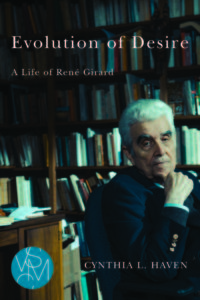
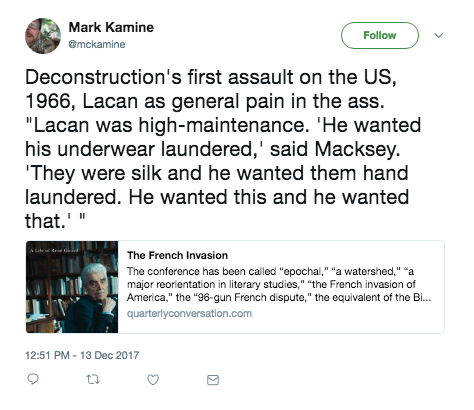
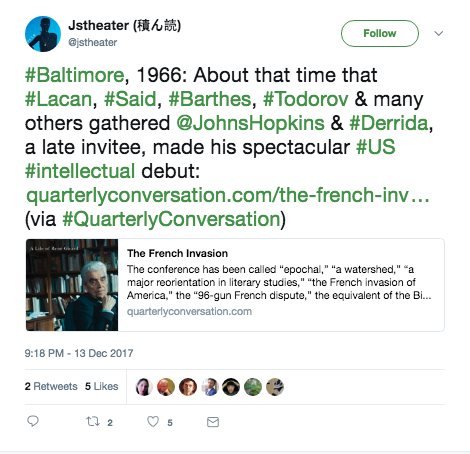
A belated postscript to last week’s Quarterly Conversation publication of a single chapter from Evolution of Desire: A Life of René Girard, which will be out in April (you can find the essay here; and our post about it here). It describes the 1966 Baltimore conference that René Girard organized, with Richard Macksey and Eugenio Donato, that brought French thought to America – and with it Jacques Lacan and Jacques Derrida.

A few days ago, a friend from Paris sent us a Tweet we might otherwise have overlooked. Pierre Assouline is one of France’s most visible critics, and he’s on the Goncourt jury, which awards France’s most prestigious literary award. Moreover, he has more than 32,000 Twitter followers, so that tweet was retweeted more in the days after this screenshot. We lost track of the other French posts after that. But our hard little heart fluttered a bit to see France taking note.

We were also pleased to hear that “The French Invasion” is one of the tony Quarterly Conversation‘s top hitters, with 10,000 readers in the first few days. Give it a click if you haven’t. As one reader said a few days ago, “Haven’t read anything on the internet in a while that’s given me so much pleasure.”

Postscript on 12/20: There’s more: The popular economist Tyler Cowen has featured Evolution of Desire as the lead news item on his website here.  Wikipedia tells me he is #72 among the “Top Global Thinkers” in 2011, by Foreign Policy Magazine.

Here’s to Hitch on “Hitchmas”: “Never be a spectator of unfairness and stupidity.”

December 16th, 2017
Share

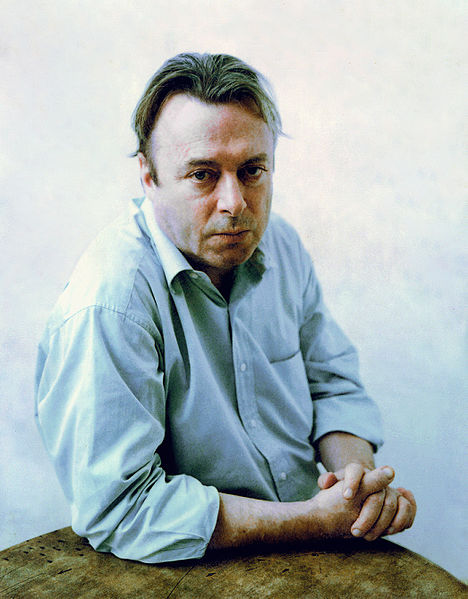
Hitchens in 2008 (Photo: Creative Commons)

An anniversary passed yesterday, the sixth year after the death of author, essayist, and journalist Christopher HitchensIt’s not an event the Book Haven normally observes, but some in our circle do – mutual friend Steve Wasserman among them, and a few others who no doubt would raise a glass if they were here. The late poet and historian Robert Conquest (we’ve written about him here and here) was a close colleague. Some of Hitchens’s aficionados, whether they knew him or not, go so far as to call December 15 “Hitchmas” – there’s even a website for the celebrations here.

The title is catchy, but surely Hitchens himself would have scoffed at the implications of any “mass” in his honor. In any case, he hated Christmas (i.e., “Christ’s mass”) which he likened to “living for four weeks in the atmosphere of a one-party state” that “imposes a deadening routine and predictability.” Ah, but variation within custom is what makes all rituals memorable and moving – whether weddings, funerals, graduations, or holidays. It’s a delicate art. (See how fellow atheist Salman Rushdie celebrates here.)

You see? We are still arguing with him, even in absentia. While Hitchens is not a demigod to us, and while we are far from embracing all his views (indeed, who could embrace them all?), we nevertheless revere his eloquence, his frankness, his pugnaciousness, the fluency of his pen, his tenacity to what he held to be truth – and so we, too, raise a glass to him. How, after all, can one argue with this: “Never be a spectator of unfairness and stupidity. Seek out argument and disputation for their own sake; the grave will supply plenty of time for silence.”

In this case, we have help in our fête. Paul Holdengräber of the New York Public Library has an undated commemorative post over at the Wild River Review, which includes a two-minute clip of his interview with the author and journalist, three days before he became gravely ill in 2010. The two discuss death, dying, and a mutual interest in obituaries. (The full hour-and-a-half interview at the NYPL is here.)

“I was particularly taken not by the politics, which everyone knew and though of interest, mattered less to me just then, than the literary side. Hitch was a great reader and more candid in print about his life, his mother and father, his origins,” Holdengräber wrote.

“When I played W. H. Auden reading, and Isaiah Berlin teaching a class on Russian Thought at Oxford, Christopher’s eyes lit up. He felt pleasure in reciting poetry, moving his lips to Auden’s reading, and hearing his old professor, Isaiah Berlin talk. A less pugilist side to Hitch.”

When he asked Hitchens why he wrote his memoir Hitch 22 at the relatively young age of 60, he answered simply: “You’ve got to do it in time.”

Great news! Rome revokes Ovid’s exile!

December 15th, 2017
Share

Come back, Ovid! All is forgiven! Whatever you did!

According to a report from ANSA,  the Rome city council yesterday revoked the Emperor Augustus‘s direct order exiling the poet from the city. It’s a little late: the poet died 2,000 years ago, in the year 17 or 18 A.D. He was between 58 and 60 years old.

The motion came from the ruling anti-establishment 5-Star Movement (M5S), which said it wanted to “repair the serious wrong suffered” by Publius Ovidius Naso, the the author of the Metamophoses and the Art of Love.

Ovid, one of the three canonical Roman poets along with Virgil and Horace, was exiled to a remote Black Sea town, Tomis, in today’s Romania, in 8 AD, in one of the mysteries of literary history. [Ettore Ferrari’s statue of Ovid in modernday Constanta at right.]

Ovid himself attributes his exile to carmen et error, “a poem and a mistake,” but his discretion in discussing the causes has resulted in much speculation among scholars.

According to a local website, the council unanimously approved the motion, which calls for “necessary measures” to be adopted to repeal the exile order, Repubblica reported. However, only the M5S took part in Thursday afternoon’s vote.

Rome’s deputy mayor and councillor for culture Luca Bergamo said the decision was “an important symbol because it’s about the fundamental right of artists to express themselves freely in a society in which the freedom of artistic expression is more and more repressed”.

Ovid has previously been acquitted by a court in Sulmona, the Abruzzo town where he was born, which passed its verdict onto Rome authorities.

Ovid wrote several poetry collections describing the pain of banishment. I wrote a little about this in my 2011 Kenyon Review piece about two other exiles, Nobel poets Joseph Brodsky and Czesław Miłosz:

According to a legend, Ovid wrote poetry in the language of the Gatae during his long exile on the Black Sea coast. “Brodsky would be an heir to that tradition, although his exile was not as dramatic as that of the Roman poet” (242), [Irena] Gross writes. She suggests Ovid may have been a literary “genotype” for Brodsky (285).

The pattern of Ovid, exiled for nobody knows what, may have absorbed Brodsky even earlier than generally supposed. I remember the poet in a melancholy mood in 1975. He asked me if I had read Ovid’s Tristia. I hadn’t, but got the book from the University of Michigan library, eager to please him. It’s still with me, with its sedate green cover and dog-eared edges, with exiled Ovid keening:

I am a Roman poet—forgive me, my Muses, forgive me—
 And I am forced to say many things in Sarmatian speech.
(Book vii, 11. 55-56)

Salman Rushdie on Dec. 25: “Children change things. They are all Christmas fundamentalists.”

December 13th, 2017
Share

Rockefeller Center Christmas tree (Creative Commons)

In this month’s issue of British Voguethe renowned author Salman Rushdie explains the complicated history of his relationship with Christmas.

While growing up in Bombay, Christmas wasn’t a thing. “Not only were we not Christians, we weren’t a religious household, so December 25 was just that: the 25th of December.” However, he went to a local “Cathedral School,” and that meant hymns year round and carols in December, and all the students had to sing along, whether Hindu, Muslim, Sikh, or Parsi. “This pretty much atheistic boy of Indian Muslim heritage sang along with everyone else, recommending the adoration of a Middle Eastern boy who had been born the king of angels,” he recalled.

“And because we were, after all, schoolboys, we learned the comic version of ‘Hark!’ also.”

“Hark! the herald angels sing
Beecham’s Pills are just the thing.
If you want to go to heaven
Take a dose of six or seven.
If you want to go to hell,
Take the whole damn box as well.”

Years later, in London, he would get together with fellow “Christmas refuseniks” and go out for an Indian meal on the holiday – often at the Gaylord restaurant on Mortimer Street. “No presents, no stuffing, lots of irreverent fun and tandoori chicken.”

“Then came marriage and children.”

Children change Christmas. My sons Zafar and Milan wanted — still want — a proper Christmas. So do my nieces, my sister Sameen’s daughters Maya and Mishka. So does my daughter-in-law, Zafar’s soprano wife Natalie. They are all Christmas fundamentalists. Sameen and I have given in to their demands, and so for many years now there have been tall trees decked with ornaments, and holly, mistletoe, turkey, stuffing, bread sauce, cranberry sauce, brandy snaps, crackers, the whole nine yards, even the brussels sprouts. There is the Queen on TV. There is an annual ocean of wrapping paper. There are stockings. There are Christmas jumpers. My sister and I look at each other from opposite ends of the groaning dining table and ask, silently, how did this happen to us? We allow ourselves only two small rebellions. One: we don’t like Christmas pudding and won’t eat the stuff. And two: I don’t give her a Christmas present and she doesn’t give me one. That is our small acknowledgement of the people we used to be.

Of course, we have a grand time.

The whole story is online here. And here is why you absolutely must click on the link: you will see a charming family photo of the author himself as a boy, reading Peter Pan do his dreamily rapt sisters. You will see a modern-day Rushdie, stuffing himself with brussels sprouts and cranberry sauce at a table decorated with candles and ivy and pine cones. He is wearing a sweater with snowflakes and reindeer on it. Doesn’t get better than that. (And no, I won’t reprint it here. The copyright cops will be down on me faster than a duck on a June bug.) As Tiny Tim would say, “God bless us, every one!'”

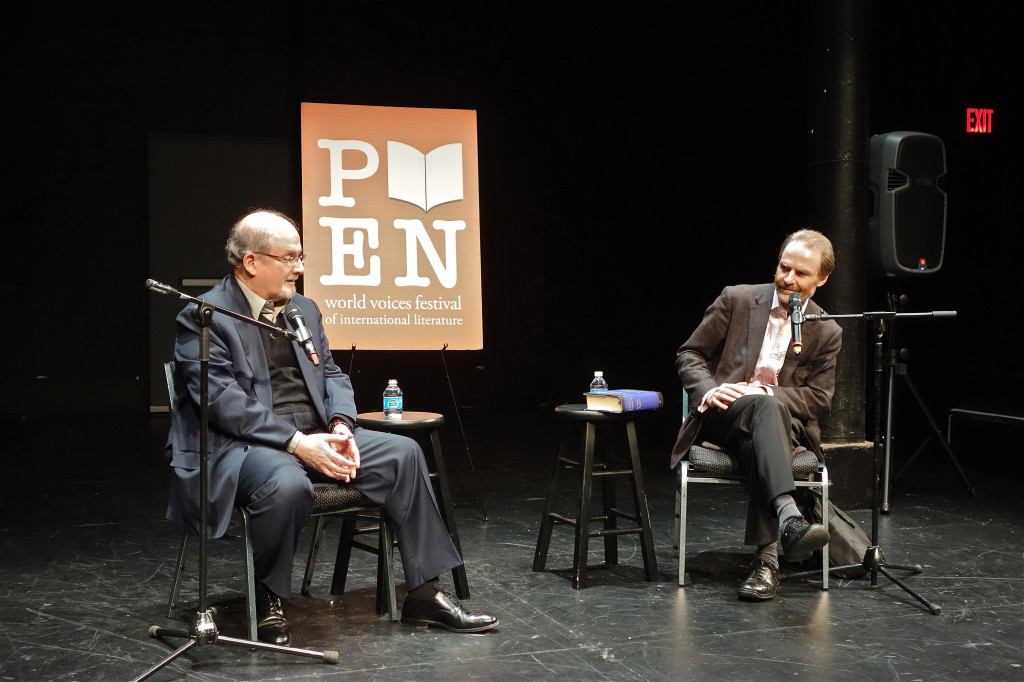
Salman Rushdie and Timothy Garton Ash in NYC, 2014. (Photo: Zygmunt Malinowski)


<<< Previous Series of PostssepNext Series of Posts >>>