Richard Rorty: “Truth is what your contemporaries let you get away with saying.”

November 15th, 2017

Share

“His most characteristic gesture was that shrug, accompanied by the hint of a shy and mysterious grin.”

The Book Haven wrote about Richard Rorty a few weeks ago, in connection with his online interview for Entitled OpinionsHe’s been called the most famous philosopher of the late twentieth century, but, as Crispin Sartwell points out, that doesn’t mean much in an era when most people couldn’t name a single contemporary philosopher (and I wouldn’t know him myself had not Czesław Miłosz mentioned him to me as a friend). Said Sartwell: “But within academia, he was as famous as anyone, which in his case involved being almost universally hated: both envied (he was the first and is still one of the few philosophers ever to get a MacArthur) and attacked relentlessly.”

Sartwell ought to know. Rorty was his dissertation advisor for more than five years in the 1980s and they developed an Oedipal relationship that he’s grateful for today. “He kicked my ass all day every day for years on end,” he writes, over at Splice Today

“I think he was wrong about everything, but at least he was wrong in an interesting and extremely bold way that was exemplary of its moment and helped create it. The academic philosophy of now, often hyper-specialized and extremely competent—isn’t usually brave enough even to be wrong.” Maybe that’s what Rorty himself meant when he said: “Truth is what your contemporaries let you get away with saying.” 

A few excerpts from Sarwell’s essay:

His shrug was famous.

In the early 1990s I saw him give a lecture to an auditorium full of eminent thinkers and grad students at the Society for the Advancement of American Philosophy. After he was done giving them his thoughts on pragmatism and truth, they fired away at him for the better part of an hour. Some asked questions. Most simply reviled him and everything he stood for, so hostile that they could barely express themselves coherently.

One person who attacked relentlessly was the quasi-celebrity philosopher Thelma Lavine, who had hosted the PBS series Socrates to Sartre. She was operating with a walker and an oxygen tank by then. I don’t remember exactly what she said but the spirit was this: “You are enemy of all that is good and true, a philosophical anti-Christ here to bring our civilization to an apocalypse”: a last-gasp defense of truth and Plato and all things decent. After that, well-known philosophers came after him one by one or in gangs. He responded in clipped one-line provocations, half Jean-Paul Sartre and half Bill Belichick.

Later at the banquet I asked him how he got through things like that. He just gave the notorious Rorty shrug. “I’ve seen it before,” he said. “They seem to enjoy it.” It didn’t seem to me like Lavine was enjoying herself, but Rorty certainly was.

***

His position was Socratic: you’d come to him with your big notions, essential ideas, revolutionary consciousness, scientific foundations and he’d use the whole toolkit from Willard Van Orman Quine to Jacques Derrida to let the air out of your tires. His most characteristic gesture was that shrug, accompanied by the hint of a shy and mysterious grin, as if underneath the pointed or even whimsical formulation there was a huge structure of ideas and arguments that he was holding back. As a matter of fact, there was.

***

“He kicked my ass all day every day for years on end.”

One thing his many detractors didn’t know was that he was always, semi-secretly, a sweet man, even to a young whippersnapper trying to refute him at every turn, and even as he became a loathed superstar with many demands on his time. As a thinker and writer, Rorty was a real swashbuckler, as bold as could readily be imagined, but one-on-one he was almost unbelievably shy. He found it terrifyingly difficult to greet people in the hall or at a reception, but opened up when happily absorbed in argument, and was completely or even maddeningly self-possessed in front of an audience. He was an extraordinarily gentle man but an extraordinarily aggressive thinker: really, quite the human conundrum.

Nevertheless, one of the most charming things about Rorty—as he showed in that auditorium—was that he delighted in attacks. He was some years past his breakthrough book Philosophy and the Mirror of Nature (1979) when I was working with him, and was drafting Contingency, Irony, and Solidarity, now widely regarded as his most characteristic work. One day in the middle of lunch in his office the phone rang and, as one did, he held up his hand and said, “Just a minute.” Then he launched into an elaborate description of CIS and a lovely assessment of how his own work was changing, how he was so far beyond Mirror of Nature, ready to kill the world. I hadn’t known before that what he was working on. It took me 15 minutes to spin out that it was Rorty’s college buddy, the equally eminent Richard Bernstein, on the other end.

Then he’s off the phone and I start arguing with him about his “literary turn” nonsense. He didn’t respond to my attacks except to give me the in-process bibliography. I read it all. (I can’t find that one. I must have chucked it when I was done.) But the most memorable thing about that phone call was that Rorty rummaged around on his desk and read aloud a couple of the most vicious criticisms of himself, as he and Bernstein cackled (cackling came through clearly on a land line).

***

With Robert Harrison for one of his last interviews.

But Lord the Rort had some critical acuity when he wasn’t just shrugging at an auditorium full of people. … In doing that, he showed me exactly what the highest level of active intellectual life really is, what you have to know to toss off apparently casual provocations and make them stick; he slowly revealed how much machinery was underneath his performance art. I’d been reading harder than anyone I knew since I started getting serious at 12, but in my 20s in the 1980s I didn’t see how knowing what he knew was even possible. He had more or less the whole history of Western philosophy and literature, with little pockets of expertise in all sorts of scholarly byways.

Read the whole thing here. Or listen to the podcast interview here. Or both.

Photographer Margo Davis and “the landscape of the face”

November 14th, 2017
Share

Photo by Margo Davis, of course.

Loyal readers of these pages know the legendary self-effacement and humility of the Book Haven. You should. We keep telling you about it. But we are shedding our accustomed modesty and shyness for a brief holiday.

Humble Moi no more! Now it’s Glamorous Moi! Elegant Moi! For we have had our photograph taken by the esteemed Margo Davis, whose artistic focus is fine arts portraiture.

The notable photographer and I met in an elevator, some years ago. We were both on our way to visit Marilyn Yalom, who was hosting the Middlebrook Salon at her lovely Russian Hill home. Margo was memorable. She was wearing a black leather jacket, with her hair characteristically short, and she spoke in a rapid-fire Connecticut accent (not New York, as my imprecise ear thought).

We’ve seen each other since – usually at Marilyn’s home. So naturally Marilyn recommended her as the perfect photographer for my once-every-seven-years photograph. Marilyn was correct, as she so often is.

Humble Moi is not the easiest client to photograph. I panic and freeze before the camera and my eyes bug out and go glassy. But Margo just kept talking, and she kept snapping, too. She talks about getting to know her photographic subjects as “a waltz between two people trying to do something in the way of a portrait.”

Margo, in color.

“You have to spend time,” she said. “This is not a journalistic activity, an in-and-out thing.” The result of her efforts above.

Margo has spoken in the past about being drawn to the “landscape of the face.” As a young photographer, she recalled: “When I was going through my proof sheets I realized I was really gravitating toward portraiture. And from that point on, I think I started moving in closer towards peoples’ faces. It was a process, it wasn’t something that happened overnight.”

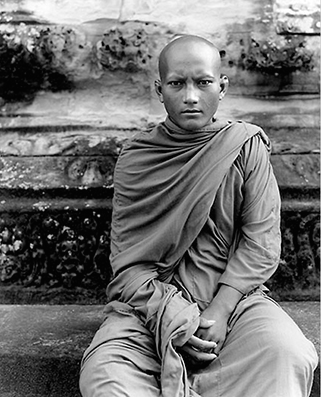
Margo always uses natural light, and is known primarily for her black-and-white portrait photography, because, she’s said, “you’re already in an abstraction process, because the real world is in color.” In black and white, she’s photograph such celebrities as Saul Bellow, Maxine Kingston and Ursula K. Le Guin as well as average people in Africa, the Caribbean, Asia and Latin America. But in my case she clearly made a colorful exception. In the quick tour she gave me of her home, I fell in love with her black-and-white portrait of an Angor Wat monk. He looks just as uncomfortable in front of the camera as I was, meditation notwithstanding.

An especial focus for her work has been Antigua in the Caribbean, as well as Africa: “I borrowed the methodology of an ethnographer: participant-observation, becoming part of the fabric of the culture,” she has said.

My favorite guy. He looks nervous, too.

“Being married to an Antiguan [her former husband Gregson Davis] and returning there often, I was able to work with this axiom in mind; the importance of getting to really know people.”

She has taught photography at Stanford University forever, as well as the University of California, Berkeley, and the University of California, Santa Cruz.

By my count, she’s up to half a dozen photography books now. Her newest book this year is Antigua 1967-1973 from Nazraeli Press. Previous books include: Antigua Pride, Edition One Press, 2013; Under One Sky, Stanford University Press, 2004; The Stanford Album: A Photographic History, 1885 – 1945 (Stanford, 1989); Antigua Black: Portrait of an Island People (1973); and Women Writers of the West Coast (1983), with text by Marilyn Yalom.

Margo’s work is in major museums, including the San Francisco Museum of Modern Art Cantor Art Center at Stanford, the Brooklyn Museum, and the Bibliothèque Nationale de France.

Writer’s block? You’re not alone. Dorothy Parker sends you a telegram…

November 11th, 2017
Share

Overwhelmed? You’re not alone. So was Dorothy Parker. The witty writer penned hundreds of poems and short stories, and was also a popular book critic for The New Yorker. She even tried her hand at screenwriting – and two of the scripts she co-wrote won Oscars. The wisecracking writer, critic, and satirist, was also one of the leading lights at the legendary Algonquin Table circle of writers, columnists, and hard-drinking journalists who gathered daily for lunch at the Algonquin Hotel in Manhattan.
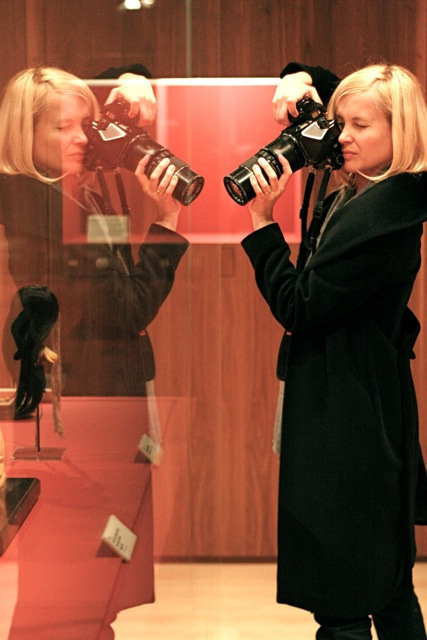
No wonder she couldn’t get everything done. Here’s a 1945 telegram she sent to her editor at Viking, Pascal Covici. And it’s for all of you readers, too, as you struggle to catch up with deadlines over the weekend.

Lena Herzog on photography: “It stuns me every time. It’s the stuff of magic.”

November 9th, 2017
Share

“When I see an image come through in my developer, it stuns me every time. It’s the stuff of magic.”

Lena at work

Lena Herzog is a visual artist and photographer who develops thoughts and ideas as well as images. In his introduction to their conversation, Entitled Opinions host Robert Harrison suggests that her camera follows Joseph Conrad’s aesthetic creed to “render the highest kind of justice to the visible world.” The interview is available on Entitled Opinions new channel over at the Los Angeles Review of Books, here.

Harrison and Herzog discuss the cultural transition to digital photography and Herzog’s penchant for a ghostly or alchemical – or even sacramental – approach to creating images. Herzog usually works with pre-digital cameras, where latent images are transformed into visible ones with emulsions in a darkroom.

The two discuss how many cultures have believed that photographs steal the soul. Have millions of digital images eroded meaning from places and people? Walter Benjamin said that photography is one of the most powerful instruments of desacralization of the world, so Harrison and Herzog discuss the over-familiarization of images of landscapes and objects, in an era when we live in oceans of images.

Herzog argues that the images capture the “inner state of being” of the photographer: “Five photographers are in a trench, they pop out, they take a picture if the same event, they pop back in. They come out with completely different images. Remember the picture of the naked girl at the napalm bombing during the Vietnam War? It’s Nick Ut’s very famous iconic image. On that bridge stood half a dozen photographers, including a photographer from the New York Times who was far more famous at the time. None of them produced images that stuck with us. They were shooting at the same time with the same group of Vietnamese running towards them. This is an extraordinary and fascinating aspect of photography.”

Listen to the whole interview here.

Potent Quotes

“About five billion people who have cellphones can produce fairly competent images. They’re okay, but okay is not enough.”

“The procedures that I work with go back to dawn of photography, but not for sentimental reasons. It’s just because they’re better. … The possibilities are enormous. When I see an image come through in my developer, it stuns me every time. It’s the stuff of magic.”

“We are three dimensional creatures. We don’t have the companionship and camaraderie with files, with zeroes and ones. Even when you see an image that is perfectly perfect, which is very high-resolution digital, there is something about it that doesn’t speak to us.”

“One of the reasons that I use all these complicated technologies and techniques and large-format cameras is because I want to take special care. It should not be offhand, it should not be careless how I photograph.”

“The mystical part of it is not only that mechanically I can reproduce the astonishing likeness of the world, but also mechanically I can reproduce how I feel, how I see the world. … It not only registers the event, but the photographer’s inner state of being.”

“When an object or a thing or a person is over-familiarized, something happens to it, something in our perception of it happens, and we lose the mystery, the expectations. For me, that’s why celebrities are absolutely uninteresting. Familiar to us, and yet they have become completely unfamiliar because there is a veil of familiarization that holds us back from true understanding. To look at it afresh, to pay attention to it carefully, is a task right now.”


“Touching the good”: on Richard Wilbur – and Charlee Wilbur gets the last word

November 7th, 2017
Share

Richard and Charlee Wilbur getting married, 1942.

Death doesn’t offer many satisfactions, but there’s a notable one in the death of the late Richard Wilbur, the most perfect poet in the English language. I was gratified by the outpouring of love for his poetry from many unexpected quarters – one can’t quite call him “neglected,” but he certainly didn’t command the notice he merited. How often was he recognized as America’s foremost living poet? Moreover, he was as great a human being as he was a poet.

But one friend needed no selling, on that point in particular. Wrote Sam Gwynn: “I knew him for almost 50 years, and he was always the same–courtly, courteous, and civilized. He showed a lot of us how to live as both a person and as a poet.”

The praise continues over at First Thingswhere a friend A.M. Juster (we’ve written about his translations of Petrarch here) has written (not entirely warmly) about  Robert Bagg and Mary Bagg‘s new biography, Let Us Watch Richard Wilbur: A Biographical Study.  From the essay, “To Imagine Excellence”:

Although friendly with most of his poetic contemporaries, Wilbur resisted the trendy temptations of his time. Unlike Adrienne Rich, Louis Simpson, Donald Hall, and many others, he did not succumb to the pressure to abandon formal verse for free verse. Like Elizabeth Bishop, he refused to put his life on display in the manner of Robert Lowell, Sylvia Plath, Anne Sexton, John Berryman, and the “confessional” poets who were his peers. His work often displays joy and optimism, qualities in short supply among contemporary poets..

Juster: a Petrarch lover, too.

These qualities caused him to be largely ignored, and occasionally criticized, by the academy and the poetry establishment. In 1964 Leslie Fiedler complained that “there is no passion and no insanity” in Wilbur’s verse. Adam Kirsch, a critic whose work I usually admire, criticized Wilbur’s Collected Poems, 1943–2004 for employing “a style so elaborately formal that the most awful subjects are sublimated into irony, or even black comedy.”

These charges of bloodlessness and clumsiness lack merit. Even in the gorgeous “Love Calls Us to the Things of this World” is the unexpected violence of the phrase “the punctual rape of every blessèd day.”

Well you can read that whole poem here. It is gorgeous.

The Baggs’ new biography won’t change the perceptions about Wilbur’s “almost suspiciously normal life,” he writes, “although it should dispel the sense that he shared none of the horrors and despair of his more self-revealing peers.” The biography documents his combat experience in World War II, when he witnessed the death of friends and nearly died himself.  “The book discloses early financial difficulties and the autism of one of his four children. It also reveals that he and his devoted wife went into rehab for overuse of sleep medications and maybe alcohol.”

He was throughout, writes Juster, “a singularly humble and self-effacing member of a generation of competitive and catty poets.” He continues: “When Wilbur won the 1957 Pulitzer Prize for Poetry, a disappointed John Berryman sent him a sarcastic telegram so subtle that he missed the barb entirely. (Berryman later both clarified and apologized.) Robert Lowell, Elizabeth Bishop, and others frequently denigrated Wilbur in order to lift themselves up in rankings of the greats.”

However, he bristles at the the Baggs’ speculation that Wilbur had an affair during the war years, “simply on the basis of one photograph of him posing with a woman that someone in France had sent to his wife.”

And here’s the money shot: Charlee Wilbur’s “feisty and forgiving 1945 letter” that she sent to her husband, after he warned her of the photo’s existence:

You’re a dolt! Did you really think you had to forewarn me about that picture of you and that sexy-looking French Frail? Even if I saw a picture of you actually in bed with such a babe, I shouldn’t think any other thought than—“god, I’d like to be in her shoes!” (Or out of them as the case might be.) You must remember that I have tremendous respect for your essential taste. And I also have great faith in and dependence upon our common love so that whatever you did couldn’t possibly touch the good that ties us irrevocably together.

Read the whole thing here.

Having a Rilke moment? The great poet on “the difficult work of love”

November 5th, 2017
Share

A portrait of Rilke by Leonid Pasternak (Boris’s dad)

A dear friend referred recently to having “a Rilke moment.” That returned me to Rainer Maria Rilke’s Letters to a Young Poet (trans. Stephen Mitchell), perhaps the most famous and most treasured letters of the last century. The ten letters were written to Franz Xaver Kappus, a 19-year-old cadet at the Theresian Military Academy. He was seeking advice from the young Rilke, who was less than a decade older, for guidance on writing his own poetry. He got advice on a lot more than that.

An excerpt from the seventh letter, written on May 14, 1904:

It is also good to love: because love is difficult. For one human being to love another human being: that is perhaps the most difficult task that has been entrusted to us, the ultimate task, the final test and proof, the work for which all other work is merely preparation. That is why young people, who are beginners in everything, are not yet capable of love: it is something they must learn. With their whole being, with all their forces, gathered around their solitary, anxious, upward-beating heart, they must learn to love. But learning-time is always a long, secluded time, and therefore loving, for a long time ahead and far on into life, is –: solitude, a heightened and deepened kind of aloneness for the person who loves. Loving does not at first mean merging, surrendering, and uniting with another person (for what would a union be of two people who are unclarified, unfinished, and still incoherent –?), it is a high inducement for the individual to ripen, to become something in himself, to become world, to become world in himself for the sake of another person; it is a great demanding claim on him, something that chooses him and calls him to vast distances. Only in this sense, as the task of working on themselves (“to hearken and to hammer day and night”), may young people use the love that is given to them. Merging and surrendering and every kind of communion is not for them (who must still, for a long, long time, save and gather themselves); it is the ultimate, is perhaps that for which human lives are as yet barely large enough. …

Whoever looks seriously will find that neither for death, which is difficult, nor for difficult love has any clarification, any solution, any hint of a path been perceived; and for both these tasks, which we carry wrapped up and hand on without opening, there is no general, agreed-upon rule that can be discovered. But in the same measure in which we begin to test life as individuals, these great things will come to meet us, the individuals, with greater intimacy. The claims that the difficult work of love makes upon our development are greater than life, and we, as beginners, are not equal to them. But if we nevertheless endure and take this love upon us as a burden and apprenticeship, instead of losing ourselves in the whole easy and frivolous game behind which people have hidden from the most solemn solemnity of their being, – then a small advance and a lightening will perhaps be perceptible to those who come long after us. That would be much.


<<< Previous Series of PostssepNext Series of Posts >>>