
Roving photographer Zygmunt Malinowski spends a day with Henrik Ibsen in Norway

November 3rd, 2017

Share

They know how to treat theater in Norway: the National Theatre of Norway in Bergen

The Book Haven’s roving photographer and reporter, New York City’s Zygmunt Malinowski, wrote to us following his recent visit to Henrik Ibsen’s Bergen – and, as always, he documents his journey with photos, which he generously shares with Book Haven readers. (Some of his previous photographic journeys are here and here and here and here, among other places.)

From Zygmunt:

The man himself.

On the way to the northernmost part of Norway a few months ago, I had a stopover in Bergen. I was looking forward to revisiting “Bryggen,” a colorful waterfront historical area.

A few short blocks from my hotel, the street opened up into a wide plaza that ended with a stately building in art nouveau style – the National Theatre of Norway. A well-manicured lawn in front with planted flowers, shrubs, and trees on both sides added to its dignity. On one side of the green square, a large modern minimalist statue:  not surprisingly, Henrik Ibsen, the Norwegian playwright considered the father of modern theater, as well as the father of realism.

Ibsen was the first director and writer-in-residence of “Det Norske Theatre,” now the new National Theatre. He wrote several plays there, which did not earn acclaim, but nevertheless gave Ibsen much-needed experience in his craft. After he left for Italy and Germany, he wrote his most important works; Brand made him famous in his native country, and world success followed with among others: Peer Gynt, Pillars of Society, Doll’s House, Master Builder. He returned to Christiana (later, Oslo) during his late years.

In 2006, the centennial of Ibsen’s death, A Doll’s House was the most performed play for that year. Ibsen is said to be the most performed playwright after William Shakespeare.

All of Ibsen in 78 minutes.

The Ibsen statue erected more recently was modern. The body was elliptical, only the head was more realistic and even here the eyes were circular, like two oval slices. The sculptor rejected the romantic ideals just as Ibsen did in his works.

On the facade of the building, two large placards announced the current offering, one was for a new Ibsen production: Henrik Ibsen’s samlede verker på 78 minutter performed in Lille Scene, one of the three theatre stages, an intimate setting situated on the east side of the building.

Combining 28 of Ibsen’s plays in 78 minutes seemed like a magic act – as suggested by the graphic depiction of actors juggling top hats in the poster for the event. According to reviews, it’s “a comic marathon by dramatist Knut Naerum that offers a chance to learn all about Ibsen in one evening.” Performances continue through December.

It was good to be back in Bergen, especially since my visit occurred during one of these pleasant sunny days that led many Norwegians to stroll the boulevards and linger outdoors. Across from the statue at the corner building, smartly dressed couples enjoyed a glass of wine with their late afternoon meal on the patio at the Theatro restaurant and bar, part of the boutique Hotel Oleana.

Photos copyright Zygmunt Malinowski.

Hotel Oleana when it’s empty.
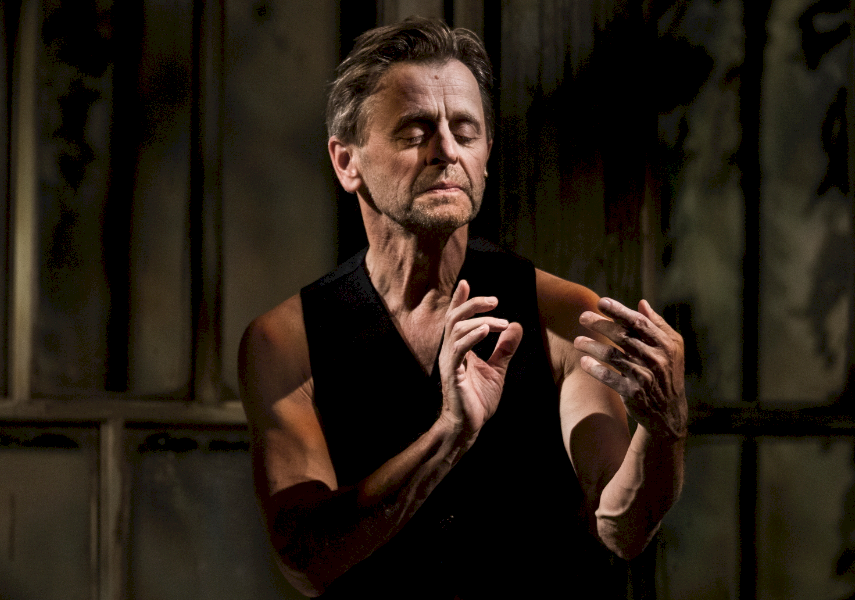
Mikhail Baryshnikov: “Water is his church, Brodsky’s church.”

November 1st, 2017
Share

“I remember his voice, I remember the way he read.” Screenshot from Brodsky/Baryshnikov

We’ve written before about Mikhail Baryshnikov’s acclaimed Brodsky/Baryshnikov show, which blends the renowned dancer’s movements with the poetry of his friend, the Nobel poet Joseph Brodsky. (I hear rumors that the show, which debuted in the dancer’s native Riga, is coming to Berkeley, but so far it’s not showing up on any websites so far.)

However, we missed Neil Munshi’s Financial Times of London’s article, “Poetry and motion: Mikhail Baryshnikov on Joseph Brodsky”, which describes the two Russians’ long camaraderie. An excerpt:

“He loved to be by the embankment, because it reminded him of Leningrad, with the water and perspective,” Baryshnikov says. “In his poetry, there are so many poems about water, from the north to Venice, to the Hudson, to the Caribbean. He really worked on a metaphysical level about the water: the proximity, and the colour, and the essence of it. Water is his church, Brodsky’s church, because he grew up [with the] Neva River.” Baryshnikov has referred to Brodsky as his “university”, the man who gave him the higher education his dancing prevented him from receiving. Brodsky introduced him to not just the work of writers but to the writers themselves.

Screenshot from Brodsky/Baryshnikov

“He said that he was surprised how much poetry I know, which was a total exaggeration. He was trying to pay me a compliment, I don’t know why. But I would rather sit and listen to his conversations with Derek Walcott, and maybe half of it, I couldn’t understand. Or with Stephen Spender, or Czeslaw Milosz. He’d just talk about politics with Susan Sontag,” he says. Baryshnikov moved on to reading “Walcott from St Lucia, and Seamus Heaney in Ireland, or Louise Glück, in the States, or Mark Strand”.

“One of the first books Joseph gave me was a book of Mark Strand,” Baryshnikov says. “He said, ‘Mouse, have this.’ And I said, ‘Joseph, I don’t speak a word of English.’ It was at the very beginning. He said, ‘You will, and very soon, and we will read this man.’ And he was absolutely right.”  And there was always Brodsky. Baryshnikov keeps a full collection of his friend’s work in all of his homes and offices. “I always travel with one or two [of Brodsky’s] books. And some of them are still too difficult for me. I’m not pretending that I know his work inside-out at all,” he says. “I remember his voice, I remember the way he read. Sometimes he asked me to read. He said, ‘I want to hear a different voice, can you read this?’ Sometimes, I was lucky to be the first person to whom he read.”

Read the whole thing here.

Early days: Joseph Brodsky in Ann Arbor in the 1970s.

Éric Chevillard: “The writer I am was put on earth to foil the plans of the novelist I had hoped to be.”

October 29th, 2017
Share

Éric Chevillard, born in the Vendée in 1964, is one of France’s most inventive writers. The new issue of Music & Literature – and if you don’t know that tony publication, you should – has a whole section on the postmodern novelist, who is published by the legendary Éditions de Minuit.

From an introduction by Oliver Bessard-Banquy and Pierre Jourde (translated by Sandra Smith): “Éric Chevillard has devoted his entire self to writing. Few writers have so entwined their lives with literature. At the age of twenty-three he published his first work, Dying Gives Me a Cold. He would never have another profession. Until recently, he refused all public appearances, and has since consented to only a select few gatherings. In a world that demands communication above all else, Chevillard seems to strive to perpetuate the image of an uncompromising writer … Nor is it a question of keeping a haughty distance: if there is a distance, it resides mainly in irony, in an all-pervading humor.”

From an interview in the same issue, “Exhausting the Form,” Jourde asks:

Would you define yourself as a novelist? Is the novel the form in which you’re most comfortable? More broadly, do questions of form matter much to you?

I’ve finally come to understand that the writer I am was put on earth to foil the plans of the novelist I had hoped to be. The writer I am wants nothing to do with the novelist. He thumbs his nose at the novelist, lampoons him, sets fire to his surroundings and pours sugar in his gas tank. He suspects the novelist of wanting to restore to fiction the particular order of reality that suffocated him and drove him to write in the first place. He has no desire to revert to what he strove so determinedly to resist, much less to revive it himself. Hence, a battle between the writer and the novelist. But the novelist is necessary for the writer, of course – as the emblem of a traitor, as the enemy to be vanquished, as the incarnation of all he detests and all he rebels against, without all of which he ultimately couldn’t exists. The novelist I pretend to be is a character invented, for the sole purpose of being obliterated, by the writer I am.

Would you say that there is always a tension in your novels between the fragments and the whole?

An inevitable tension, in that I still haven’t figured out how to fit a digression into an aphorism, these being the two apparently contradictory forms toward which my prose naturally inclines. But this opposition can, at times, be resolved: a story can come together suddenly in the phrase that concludes it, or, conversely, a wild unfurling might result from a brief, solemn utterance. Like a dissertation already contained in two lines on the topic.

Another Q&A in the same issue, “An Unquiet Place,” this time by Anne Diatkine, translated from the French by Jeffrey Zuckerman, includes this question.

Do you need a room to write?

Perhaps even a matryoshka doll of rooms, a room within a room within a room. Like Proust’s nested rooms, the one he withdraws into in order to evoke the one his childhood self-occupied, the one from which the entire book proceeds. In a sense, Prous never left his room. We’re born in a room, we make love in a room, and ideally we’ll even die in a room. A room isn’t just a place to rest or a refuge for a frightened animal. Why wouldn’t one write better in a room than anywhere else?

The Q&A with Jourde is one of the online offerings here. Other online offerings here. And read a profile of the author over at Quarterly Conversation here.

“It’s a negative freedom, something like a negative capability type of freedom.”

October 27th, 2017
Share

“I love the technical joy and pleasure,” says poet and translator Dick Davis. (Photo: L.A. Cicero)

Our friend and eminent blogger Patrick Kurp of Anecdotal Evidence has a review over at the Los Angeles Review of Books this week – “A Negative Freedom: Thirteen Poets on Formal Verse” (it’s here). The book considers Thirteen on Form: Conversations with Poets, a collection of interviews edited by William Baer. A number of other dear friends – poets, all – are mentioned. And there’s some splendid words about the often-overlooked form of “light verse.”

A moralist at heart

Said Richard Davis, the foremost translator from the Persian into English ever as well as a top-notch poet in his own right, said, “I do love those kinds of poems — light verse as it’s called. I love the technical joy and pleasure that takes place in the writing of such poems, and the hope that those reading them will sense the pleasure that the poet experienced while writing them.”

Patrick Kurp notes that R.S. Gwynn is often labeled a writer of light verse, “a classification at once limiting and dismissive.”

Top blogger Patrick Kurp

He wrote: “Like many formal poets, Gwynn is a moralist at heart, one who favors mockery over sermons. His instincts, if not his politics (which remain unstated in the interview with Baer), are conservative, and the best satires are most often produced by writers of conservative sensibility. Think of Juvenal, Pope, Swift, Johnson, and Waugh.”
According to Sam Gwynn, “[M]y lyricism works best when it’s counterpointed against something else, like irony, for example.” From Patrick’s review:

In “Approaching a Significant Birthday, He Peruses The Norton Anthology of Poetry,” Gwynn assembles a poem consisting entirely of lines from 28 certified poetic war horses. Half the fun is identifying the sources and marveling at the deathless elasticity of iambic pentameter:

All human things are subject to decay.
Beauty is momentary in the mind.
The curfew tolls the knell of parting day.
If Winter comes, can Spring be far behind?

Lucretius fan

MacArthur “genius” Fellow A. E. Stallings, who recently translated Lucretius’s The Nature of Things into rhyming fourteeners, also writes witty, graceful, and profound poems in form. Rhyme, she says, allows her to “say something shocking or something totally unexpected.” In Alicia’s own words:

It’s helpful and effective to have some limitations on one’s choices and even to “give up” some control over the poem. Which, I suppose, is a little scary for some people. To give up some control to the muse, to outer things. I feel there’s almost a sort of Ouija Board feeling about rhyme and meter, where maybe you’re in control, and maybe you’re not. […] Maybe it’s a negative freedom, something like a negative capability type of freedom.

Read the whole review here.

What literature teaches us.

October 25th, 2017
Share

The meeting of Aeneas and Dido, as portrayed by Sir Nathaniel Dance

I’m always making the case for literature, and readers of the Book Haven know my argument that a great deal of our predicament today follows from our abandonment of great literature in our schools, our public conversations, and our thinking. An excellent column from Scott Esposito makes the same argument, with a new twist, over at Lithub, “How the Oldest Stories Can Give Us the Best Perspective.”  It opens:

An oddly postmodern thing happens right near the beginning of Virgil’s ancient classic the Aeneid. Having fled Troy in defeat from the Greeks, and destined to found the great Roman civilization, a defeated, beleaguered Aeneas and his men wash up on the northern coast of Africa near Carthage. Before long Aeneas locates the bustling port city, eventually stealing into the magnificent temple of Dido the queen. As he is acquainting himself with the surroundings he discovers an elaborate depiction of the very war that he is a refugee from:

Wondering at the good fortune of the city,
And admiring all the things the makers had done,
The workmanship of what was told on the walls,
Suddenly he saw depicted there,
One after another, the scenes of the Trojan War,
Famous through all the world . . .
Aeneas stopped, and weeping at what he saw,
Said, “Is there, Achates, anywhere on earth
That does not know the story of our trouble?”

He started it.

Imagine it: the catastrophic war that has wiped your home off the face of the Earth is now the stuff of legend, famous clear across the entire known world. The beloved comrades you watched die as you struggled to defend your homeland are now wrought exquisitely into the walls of a queen’s temple. You even see your own self, fighting the war you have just fled from. It is a curiously modern moment: Aeneas sees the horrific reality he has just escaped as a story told by foreigners a thousand miles away, not so different from, say, a refugee from Venezuela, or Yemen, or Syria, or Myanmar escapes to a more stable nation, only to see the story of her nation’s escalating tragedy—and maybe even herself—broadcast on CNN.

He describes how the Homeric tale winds its way through Western literature, from Virgil to the works of Dante and beyond (though he misses Derek Walcott’s Omeros), and offers this takeaway:

This column began with a war in the Middle East that storytellers began recounting 1,000 years before the birth of Christ, and we have followed it to North Africa, Rome, Italy, Spain, and Britain—and all the way to Borges clutching his bilingual copy of the Divine Comedy in Argentina in the early 1940s. I find this one of the greatest things about the literary tradition: it works on the longest timescales of human history, and it easily perforates borders. Literature conducts ideas across continents and through time with a startling efficacy: in the case of the Trojan War, it has traveled all throughout the world and back to the dawn of recorded history. Literature is the medium that is most conversant with humanity’s master narratives, the one that has done the most to form them and make them so indispensible and famed.

Practicing what he preaches

He proposes the “Virgil test”:  “if an artisan were carving this story into a palace wall half a world away, which incidents would make the cut? Which developments in this critical American saga would make it into the grand narrative of these years that may one day be passed down through the ages? Which things would we want to see if, like Aeneas, we happened to suddenly discover this story being told far away? And which developments are just noise, things that sap our energy and attention but that ultimately are not worth so much fuss?”

Read the whole thing here.

 A triumph for Sándor Márai’s little-known classic Embers

October 23rd, 2017
Share

Another Look director Robert Harrison, with founding director Tobias Wolff

If you felt a slight tremor in the earth on Wednesday, October 18, the epicenter was at Stanford’s Encina Hall. The Another Look book club took on Sándor Márai‘s Embers – and the whole room rocked!

The event was close to a record-breaker, with about two hundred participants – not bad for an off-the-beaten track Hungarian novel (and only equaled by Zora Neale Hurston‘s Their Eyes Were Watching God).

Sándor Márai’s taut and mesmerizing novel, published in 1942, opens in a secluded Hungarian castle, where an old general awaits a reunion with a friend. It is 1940, and he has not appeared in public for decades. The long-estranged companions talk all night – or rather, the general talks, as the evasive visitor listens to the general discuss love, intimacy, honor, betrayal, and a beautiful, long-dead wife.

The novel is set against the backdrop of the disintegrated Austro-Hungarian empire, and shares the melancholy wisdom of its narrator: “We not only act, talk, think, dream, we also hold our silence about something. All our lives we are silent about who we are, which only we know, and about which we can speak to no one. Yet we know that who we are and what we cannot speak about constitutes the ‘truth.’ We are that about which we hold our silence.”

Acclaimed author Robert Pogue Harrison moderated the discussion. The Stanford professor who is Another Look’s director writes regularly for The New York Review of Books and hosts the popular talk show, Entitled Opinions. He was joined by renowned author and National Medal of Arts winner Tobias Wolff, professor emeritus of English at Stanford, and Jane Shaw, Stanford’s Dean for Religious Life at Stanford.

Toby Wolff, Another Look’s founding director, opened by praising the courage of author Márai to sit down and create a remarkable novel about an all-night conversation – two men meet, but only one of them talks, and they persevere till dawn. The end. A daunting creative challenge that Márai pulls off magificently.

We were happy to see a lively Hungarian contingent in the audience, too – including the Hungarian Consul General for the Bay Area. And boy, did the Hungarians have a different take on the book – they praised Carol Brown Janeway‘s translation, but said that the richness of their native tongue is AWOL. And while Márai is little known west of the Danube, they assured us his books are everywhere in Budapest.

The podcast is here. And all photos, as always, are by by loyal Another Look aficionado David Schwartz.


<<< Previous Series of PostssepNext Series of Posts >>>