Bourgeois liberal democracy? “It’s done more for human happiness than the Buddha ever did.”

September 27th, 2017

Share

“What revitalizes philosophy is some genius suggesting new way of thinking.”

“Bourgeois liberal democracy has always been a very fragile creation … It’s easy to imagine after a nuclear terrorist attack that we’ll lose all our civil liberties overnight.”

Harrison as radio host (Photo: L.A. Cicero)

Richard Rorty is considered one of the greatest philosophers of the 20th century – and one of his last interviews is now available on the Los Angeles Review of Books’ new Entitled Opinions channel here.

Rorty is credited with reviving the philosophical school of American pragmatism and challenging the accepted pieties of analytic philosophy. He championed “quietism,” which he says attempts “to dissolve, rather than solve” sets of problems that should now be considered obsolete. This November 23, 2005, interview with Robert Pogue Harrison is among his last; he died in 2007.

Rorty came to Stanford as a fellow at the Humanities Center in 1996 and then joined the faculty of the Comparative Literature Department in 1998. Beginning in the 1970s, he challenged the notion of philosophy as a discipline that could discern timeless truths about the world. Such attempts were motivated by western philosophy’s misguided reliance on Platonic metaphysics, the notion that there are underlying structures, realities or truths that stand firm against the vagaries of history and social mores. Rorty insisted that we have only a linguistic and causal relationship with the world, so any attempt to find some kind of transcendent, unmediated knowledge about it is futile. He famously urged that intellectuals shift their focus from “the problems of philosophy” to “the problems of men.”

Harrison and Rorty on air, 2005

His Entitled Opinions conversation with Harrison moves to the limits of philosophy in describing the nature of reality, and then whether philosophy should tackle human aspirations for greatness or stick to maximizing human happiness. In an occasionally testy exchange with Harrison, Rorty makes a controversial defense of bourgeois liberal democracy, arguing that the rest of the world should be more like America, and America should be more like Norway. The potential cost for cultural diversity? “That’s the price we pay for history,” he says. He takes a number of provocative positions in the conversation. Does he stand alone? As he notes, loneliness is the lot of mankind: “If you don’t have any sense of loneliness you probably won’t be interested in religion or philosophy; if you do, you will.”

Potent Quotes

“Quietists say there is no such thing as the nature of the world. Science doesn’t tell it to us. Nothing tells it to us. The whole question is a bad question. You can ask about a real Rolex and a fake Rolex, or real cream and a non-dairy creamer, but you can’t ask about reality in general. ‘Real’ only has a sense when it’s applied to something specific.”

“The problems of analytic philosophy keep changing with each generation. It’s given rise to a literature that goes out of date every ten or twenty years.”

“The main problem with metaphysics is that it’s a game without rules … anyone can say anything and get away with it.”

Is mankind “on the right track”?

“The development of bourgeois society in the last two hundred years has put mankind on the right track.”

“The best we can ever hope for the globalization of the society we’ve managed to create in the modern West.”

“Bourgeois liberal democracy has always been a very fragile creation … It’s easy to imagine after a nuclear terrorist attack that we’ll lose all our civil liberties overnight.”

“With all the nuclear weapons floating around, I didn’t realize how likely it was that they would be used on American cities before 9/11. Now I think it’s overwhelmingly likely.”

On bourgeois liberal democracy: “How about it’s the best thing anyone has come up with so far? It’s done more for human happiness than the Buddha ever did.”

“We secularists lead as spiritual a life as anybody has ever led, but our focus is on what might come to pass here below, in the human future.”

“What revitalizes philosophy is some genius suggesting new way of thinking.”

Check out the whole interview here.

Steve Wasserman: “The world we carry in our heads is arguably the most important space of all.”

September 25th, 2017
Share
He’s back in Berkeley

We’ve written about Steve Wasserman before – here and here and here. On Saturday, he gave the keynote address at the 17th Annual North Coast Redwoods Writers’ Conference at the College of the Redwoods, Del Norte, in Crescent City. The subject: “A Writer’s Space.” He’s given us permission to reprint his words on that occasion, and we’re delighted. Here they are:

Not long after I returned to California last year to take the helm of Heyday Books, a distinguished independent nonprofit press founded by the great Malcolm Margolin forty years ago in Berkeley, my hometown, I was asked to give the keynote speech at this annual conference. I found myself agreeing to do so almost too readily—so flattered was I to have been asked. Ken Letko told me the theme of the gathering was to be “A Writer’s Space.”

In the months that have elapsed since that kind invitation, I have brooded on this singular and curious formulation, seeking to understand what it might mean.

What do we think we mean when we say “a writer’s space”? Is such a space different than, say, any other citizen’s space? Is the space of a writer a physical place—the place where the writing is actually done, the den, the office, the hotel room, the bar or café, the bedroom, upon a desk or table or any available flat and stable surface?

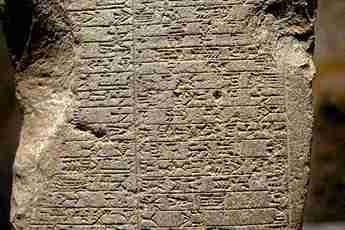
Babylonian shopping list

Or is the “writer’s space” an inner region of the mind? Or is it a psychological place deep within the recesses of the heart, a storehouse of emotions containing a jumble of neurological circuitry? Is it the place, whether physical or spiritual, where the writer tries to make sense of otherwise inchoate lives? In either case, is it a zone of safety that permits the writer to be vulnerable and daring and honest so as to find meaning and order in the service of story?

Perhaps it will be useful to begin at the very dawn of writing when prehistory became history. Let’s think, for a moment, about the clay tablets that date from around 3200 B.C. on which were etched small, repetitive impressed characters that look like wedge-shape footprints that we call cuneiform, the script language of ancient Sumer in Mesopotamia. Along with the other ancient civilizations of the Chinese and the Maya, the Babylonians put spoken language into material form and for the first time people could store information, whether of lists of goods or taxes, and transmit it across time and space.

It would take two millennia for writing to become a carrier of narrative, of story, of epic, which arrives in the Sumerian tale of Gilgamesh.

Writing was a secret code, the instrument of tax collectors and traders in the service of god-kings. Preeminently, it was the province of priests and guardians of holy texts. With the arrival of monotheism, there was a great need to record the word of God, and the many subsequent commentaries on the ethical and spiritual obligations of faithfully adhering to a set of religious precepts. This task required special places where scribes could carry out their sanctified work. Think the Caves of Qumran, some natural and some artificial, where the Dead Sea Scrolls were found, or later the medieval monasteries where illuminated manuscripts were painstakingly created.

First story

Illiteracy, it should be remembered, was commonplace. From the start, the creation of texts was bound up with a notion of the holy, of a place where experts—anointed by God—were tasked with making Scripture palpable. They were the translators and custodians of the ineffable and the unknowable, and they spent their lives making it possible for ordinary people to partake of the wisdom to be had from the all-seeing, all-powerful Deity from whom meaning, sustenance, and life itself was derived.

We needn’t rehearse the religious quarrels and sectarian strife that bloodied the struggle between the Age of Superstition and the Age of Enlightenment, except perhaps to note that the world was often divided—as, alas, it still sadly is—between those who insist all answers are to be found in a single book and those who believe in two, three, many books.

The point is that the notion of a repository where the writer (or religious shaman, adept, or priest) told or retold the parables and stories of God, was widely accepted. It meant that, from the start, a writer’s space was a space with a sacred aura. It was a place deemed to have special qualities—qualities that encouraged the communication of stories that in their detail and point conferred significance upon and gave importance to lives that otherwise might have seemed untethered and without meaning. The writer, by this measure, was a kind of oracle, with a special ability, by virtue of temperament and training, to pierce the veil of mystery and ignorance that was the usual lot of most people and to make sense of the past, parse the present, and even to predict the future.

A porous epidermis

This idea of the writer was powerful. It still is. By the time we enter the Romantic Age, the notion of a writer’s space has shed its religious origins without abandoning in the popular imagination the belief that writers have a special and enviable access to inner, truer worlds, often invisible to the rest of us. How to put it? That, by and large, artists generally, of which writers are a subset, are people whose epidermises, as it were, are more porous than most people’s. And thus they are more vulnerable, more open to the world around them, more alert, more perspicacious. Shelley put it well when he wrote that, “Poets are the unacknowledged legislators of the world.” Think Virginia Woolf.

By the end of the nineteenth century, writers in their person and in their spaces are widely celebrated and revered, imbued with talents and special powers that arouse admiration bordering on worship. It is said that when Mark Twain came to London and strode down the gangplank as he disembarked from the ship that had brought him across the Atlantic, dockworkers that had never read a single word of his imperishable stories, burst into applause when the nimbus of white hair atop the head of the man in the white suit hove into view. Similarly, when Oscar Wilde was asked at the New York customs house if he had anything to declare, when he arrived in America in 1882 to deliver his lectures on aesthetics, he is said to have replied: “Only my genius.”

Applause, applause

Many writers were quickly enrolled in the service of nationalist movements of all kinds, even as many writers saw themselves as citizens in an international republic of letters, a far-flung fraternity of speakers of many diverse languages, but united in their fealty to story. Nonetheless, the space where they composed their work–their studies and offices and homes—quickly became tourist destinations, sites of pilgrimage where devoted readers could pay homage. The objects on the desk, writing instruments and inkwells, foolscap and notebooks, the arrangement of photographs and paintings on their walls, the pattern of wallpaper, the very furniture itself, and preeminently the desk and chair, favorite divan and reading sofa, lamps and carpets, all became invested with a sacredness and veneration previously reserved only for religious figures. Balzac’s home, Tolstoy’s dacha, Hemingway’s Cuban estate, are but three of many possible examples. Writers were now our secular saints.

Somehow it was thought that by entering these spaces, the key to unlocking the secret of literary creation could be had, and that by inhaling the very atmosphere which celebrated authors once breathed, one could, by a strange alchemy or osmosis, absorb the essence that animated the writer’s imagination and made possible the realization of native talent.

Read the rest of this entry »

“Coetzee has always been an intensely metaphysical novelist.”

September 23rd, 2017
Share

“Chaste, exact, ashen prose” drawn to “passionate extremity.” (Photo: Creative Commons)

A dispiriting Saturday sifting through bins of unsorted papers from the garage, deciding whether I really need the proofs of books published long ago, wondering how long I should keep old Christmas cards from friends, trying to decipher the signatures on yellowed letters, and asking myself whatever will I ever do with all the photos of nieces and nephews at one year old, then two years old, then three…

So why was I holding on to a Christmas issue of The New Yorker from almost a full decade ago? Ah yes. “Squall Lines: J.M. Coetzee‘s ‘Diary of a Bad Year'” – a review written by a literary critic who maintains that “the novel exists to be affecting…to shake us profoundly. When we’re rigorous about feeling, we’re honoring that.” His essays make me weep with envy.

I can do no better on a slow Saturday night than to quote from James Wood‘s 2007 review on the Nobel Prizewinning South African writer Coetzee, a novelist who, also, makes me weep with envy.

Diary of a Bad Year’s protagonist is a novelist who is, in some ways, an alter ego, who laments that his art is “not great-souled,” that it lacks “generosity, fails to celebrate life, lacks love.” But what a soul he has – as Wood comments, if not great-souled, than deep-souled:

Yet this is the cold air just beyond the reach of a fire. Coetzee’s chaste, exact, ashen prose may look like the very embers of restraint, but it is drawn, again and again, to passionate extremity: an uneducated gardener forced to live like an animal off the South African earth (“Life & Times of Michael K”); a white woman dying of cancer while a black township burns, and writing, in her last days, a letter of brutal truths to her daughter (“Age of Iron”); a white woman raped on her farm by a gang of black men, and impregnated (“Disgrace”); a recent amputee, the victim of a road accident that mangled a leg, helpless in his Adelaide apartment, and awkwardly in love with his Croatian nurse (“Slow Man”). Coetzee seems compelled to test his celebrated restraint against subjects and ideas whose extremity challenges novelistic representation.

***

James Wood

Coetzee is devoted to Dostoyevsky, and “Elizabeth Costello” made clear that part of that devotion has to do with what the Russian literary theorist Mikhail Bakhtin called the “dialogic” nature of Dostoyevsky’s arguments. Bakhtin noted that it is impossible to infer from the novels what Dostoyevsky believed, because no single idea ever gains authorial dominance. Instead, ideas, like the characters themselves, are in constant circulation and mutual qualification. It is how Dostoyevsky the ardent Christian was able to argue against himself, awarding Ivan Karamazov the most devastating petition against conventional Christian belief ever mounted in a novel. Coetzee is interested in how we profess ideas, both in life and in novels. We tend to think of ourselves as intellectually stable, the oaken pile of principle driven reassuringly deep into the ground. All the Presidential-campaign cant about “values” testifies to this; to flip-flop is to flop. But what if our ideas are, rather, as Virginia Woolf imagined consciousness: a constant flicker of different and self-cancelling perceptions, entertained for a moment and then exchanged for other ones? Imagine a fervent Christian, who has always believed in the afterlife. One night, waking in terror, he realizes, for only a second, but absolutely, that there is no afterlife. The terror passes, and the next morning he reaffirms his public vows. He does not succumb to doubt. Still, the question remains: what has happened to his orthodoxy? If it has not been cancelled or refuted by the nightmarish doubt, does it now contain, like a trapped smell, the ghost of its opposite?

***

Devotion

Unlike the philosopher, the novelist may take an idea beyond its rational terminus, to the point where the tracks start breaking up. One name for this tendency is the religious, the realm where faith replaces reason. Coetzee has always been an intensely metaphysical novelist, and in recent years the religious coloration of his metaphysics has become more pronounced.

***

It is not the force of Ivan’s reasoning, he says, that carries him along but “the accents of anguish, the personal anguish of a soul unable to bear the horrors of this world.” We can hear the same note of personal anguish in Coetzee’s fiction, even as that fiction insists that it is offering not a confession but only the staging of a confession. His books makes all the right postmodern noises, but their energy lies in their besotted relationship to an older, Dostoyevskian tradition, in which we feel the desperate impress of the confessing author, however recessed and veiled.

Here’s the good news: I can throw the 2007 New Yorker away! The article is all online! Read the whole thing here.

שנה טובה ומתוקה! And finding live fish in Palo Alto.

September 21st, 2017
Share

Some time ago I posted about Stanford’s Ruth Starkman, and how a t-shirt totally changed my mind about being a public intellectual. Now she’s changing my mind about time. We’re not in 2017. As of today, we’re in 5778. Shanah tova!

She knows how to be a public intellectual, too.

Her post on Facebook: “Preparing for the New Year’s ritual of taschlich – where one throws bread to the fish, whose unblinking eyes represent the all-knowing universe, I thought of all the things for which I needed to ask forgiveness – a long list! I also looked at the 613 mitzvot to mediate on the good and sweet things I could do this coming year. I always loved the command to feed one’s animals, elders, and children before one eats. This year I’m working on finding modern ways not to muzzle an ox while it’s working. I especially like the command to praise the ox and anyone who works with you for a job well done. Working on this for 2017-8 and 5778. A good and sweet new and academic year to all שנה טובה ומתוקה.”

Many of the ancient customs for the Jewish holidays seem to be drawn from the harsher passages of Leviticus. “So I looked for things that could be humane and meaningful as Autumn quarter starts and I know that these are the ones that have to do with animals.”

Praise them. Praise them.

For example, “not to muzzle an ox while plowing.” Not an issue for most of us. However, Ruth says, “I’ve been combing through these every darn year since my bat mitzvah looking for ways to capture the spirit of the good deed.”

Well I have no problem feeding the cat I live with before I feed myself. He demands no less. And he demands very loudly. And I’m a vegetarian. Surely the first step in kindness is not eating them. But what to do about the fish?

The fish … no bread in the house except a stale piece of pita. Could I find a fish? Where would I go? Ruth offered a helpful comment on Facebook: “Gosh, I wish there were fish somewhere near Palo Alto I can only think of the Bay or the canal where we were, and someone had dumped goldfish. Nope they were not interested in our bread crumbs.” Even the fish turn up their wet little noses.

Food fussers.

I biked to Stanford, but although the fountains seemed to have chlorine, there were no fish to be found anywhere, not even fashionable oversize koi in ponds next to the expensive new buildings. The only fish I found were over ice at Whole Foods on Emerson, where I stopped to pick up a ripe avocado on the way home, as the sun was dropping towards the horizon.

Is there no hope for me? Ruth extended some hope: “Taschlich usually is this afternoon, but I’ve known many who try to get this in between Rosh Hashana and Yom Kippur – it’s a time to acknowledge your weakness and ask for forgiveness, as well as a time to throw away grudges, which mangle the soul and shrink the heart.” For example, she said, “working on not grudging nor envying other’s great work,” she said, mulling over the photo at the top of this post, “but that’s hard when you have to post someone else’s round challah of sweet and plenty – the pic above is not mine – because my own challah turned out like a Rubik’s cube!”

It’s the small things that count. And Wikipedia agrees with her about the timing:

The ritual is performed at a large, natural body of flowing water (e.g., river, lake, sea, or ocean) on the afternoon of Rosh Hashanah, the Jewish New Year, although it may be performed until Hoshana Rabbah. The penitent recites a Biblical passage and, optionally, additional prayers. Optionally, if the ritual is performed not on the Sabbath, small pieces of bread are thrown into the water.

How much time does that give me? About six or seven more days. But “large, natural body of flowing water”? With fish in it, too? Where does one find that in Palo Alto?

Brodsky Among Us: “I cannot say that I enjoyed writing this book, it was torn out of me.”

September 20th, 2017
Share

Carl Proffer snapped a photo of Joseph Brodsky with Ellendea outside Leningrad’s Transfiguration Cathedral in 1970. (Photo: Casa Dana)

The Kenyon Review wandered into the Cleveland Public Library and learned that Ellendea Proffer Teasley, will be speaking there at 6 p.m. on October 2. She is the author of Brodsky Among Usa memoir of the time she and her husband, the late Carl Proffer, spent with the great Russian poet and Nobel prizewinner, Joseph Brodsky.

Eminent translator Viktor Golyshev, Ellendea Proffer Teasley, and critic Anton Dolin at standing-room only event. (Photo: Casa Dana)

The Proffers, back in the 1971, launched Ardis, to publish the best of Russian literature when the Soviet government would not. Ardis is a legend in Russia, and Ellendea spoke at standing-room-only events throughout Russia when her book was published in Russian translation by Corpus in 2015. Now it’s in English.

So Laura Maylene Walter of The Kenyon Review decided to run a short interview with the fascinating author and publisher (we’ve written about her here and here and here, among other places). Two excerpts below:

The Russian publication of Brodsky Among Us has been described as a “sensation.” Can you describe the book’s reception in Russia and how that reception aligned with your expectations? More generally, how would you compare the Russian and American publishing experiences?

In Russia, I am a somewhat famous figure due to the books published by Ardis Publishers from 1971-2002, when the company ceased to exist. … As I was writing the Brodsky memoir, a glossy Moscow magazine sent someone to interview me in California. They asked what I was working on now, and I told them it was a memoir about Brodsky.

Signing books at the Dostoevsky Library (Photo: Casa Dana)

Immediately upon publication of that interview I got calls and emails from Russian publishers. Luckily Corpus Publishers wanted the book and offered to have a famous translator do it, Viktor Golyshev, who happened to be an old friend of Brodsky’s. They translated and published this book incredibly quickly, and it became a bestseller even before I went for a PR tour in 2015.

I expected nothing because Russian audiences are not usually interested in what an American might say about their most famous poet, but it was standing room only at the events. I had a brilliant PR team and a wonderful publisher, so all of that was a wonderful surprise. The surprise for the Russian audiences was that despite the fact that I have no Russian background, I spoke in Russian. . .

The American story was very different. Since the memoir is short, deeply personal, and not meant as a biography, this presented marketing problems. Many well-known literary people read it in manuscript and told me they stayed up all night reading it, but I did not find a publisher until 2016, and the book came out this year with Academic Studies Press. Some of the problem is that I am as not as well-known here now, and certainly Brodsky is not the incredible star here he is in Russia.

***

On Russian TV with Ksenia Sobchak (Photo: Casa Dana)

What was the most challenging part of writing Brodsky Among Us? What part of the process did you find most enjoyable or affirming?

I cannot say that I enjoyed writing this book, it was torn out of me. What I enjoyed were the Russian audiences in 2015 and in April of this year. They waited in long lines to get their books signed and thanked me for existing. This was all deeply moving, especially since the audiences tended to be young. Besides being their favorite poet, Brodsky is a model of how to withstand oppression, among many other things, I think.

You and your late husband founded Ardis Publishers in 1971 to publish Russian literature. How did that experience inform your later writing and publishing ventures?

In order to write this book I had to live a life split between Russian and America, so without Ardis many things would be unthinkable. That I became friends with Nadezhda Mandelstam, Nabokov, Aksyonov, Brodsky, and many others was the gift of this work. I am the last person alive who had dinner with Borges, Nabokov, and Brodsky. This seems amazing to me.

Read the rest here.

Remembering Sir Peter Hall and a journey to Denver for Tantalus

September 18th, 2017
Share


Sir Peter Hall, founder of the Royal Shakepeare Company, died last week, after long illness. I met the eminent theater director briefly on the South Bank’s National Theater, after a performance of … what? It must have been his three-night ten-play cycle of The Greeks in 1980. I attended so much theater during my years in London, it may have been another production, but certainly the RSC’s The Greeks is the one that left a mark on me. The Greek playwrights, and Greek theater in general, have never been the same. It also made me a huge fan of the late great Billie Whitelaw, who played Andromache, among other roles in the production (including in the chorus).

Alas, a search online suggests the much-praised production has dissolved into oblivion. I can’t even find a smidgen of a youtube video.

That must have been the occasion when I chatted with Hall in the National Theater lobby, and exchanged contact information to have a conversation that never happened and I can’t recall why. In fact, I had forgotten the exchange until yesterday. Perhaps someday I’ll find the scrap of paper, with his address and phone number (the pre-internet age before email), scribbled in his handwriting.

Cut away to a new century. By then I was on the West Coast, and struggled mightily to head out for the Denver opening-night production of Hall’s new effort, Tantalus. Hall had moved with his family to Denver to rehearse and hone the script for a sacrificial six months.

“The subsequent play – which had been written by John Barton over 17 years, is still to this day billed as the largest undertaking in the 2,500-year history of theatre,” according to the Denver Center’s website tribute. ‘Nothing has come along like it, and it probably won’t ever happen again,” [Denver Center founder] Seawell said before his death in 2015. … It brought critics from all over the world. It brought people to Colorado from 38 states and more than 40 countries.’” It also cost about $8 million of the founder’s money.

“Tantalus, directed by Peter Hall and his son, Edward, and created by an international ensemble of artists, was an epic spectacle on-stage and off. The six-month rehearsal process and subsequent British tour is a tale of artistic squabbles, clashing egos, mounting tension, hurdles of time and money – and spectacular artistic achievement culminating in a standing-room only run at London’s Barbican Theatre.

While going through some old boxes of papers this weekend, I found the “special edition” of Applause commemorating the epic event. Said Hall, “My intention is not perversely to rewrite the old masterpieces but to use the material as a metaphor for today”:

I see the whole thing as a metaphor about myth and history, but also about how a great myth helps us to understand history. The boundary lines between myth, history and truth are hazy. This blurring is something we understand well today. And if we don’t, we should.

It is important to stress that throughout the cycle the Roman words “Greece” and “Greek” are never mentioned. My image is of something both pre-Homeric and long past it. The situation is that Agamemnon leads a group of war-kings from “The West” whom he would like to unite into a nation. His army is simply called “The War Kings” or “The Men from the West.”

The title Tantalus relates us to this approach. Death is certain but doom is postponed. The fruits of the earth are ours for the taking, but most people never quite get a real taste of them. Tantalus, the friend of Zeus and the ancestor of Agamemnon and Menelaus, learned the gods’ secrets. When he betrayed them to men, he was given the eternal punishment of living forever under a great rock which was always about to fall, but never fell, close to a tree of delicious fruit which the wind swept away whenever he clutched at it. The Rock, roped up to Heaven, overhangs the whole cycle. …

I think more and more of the cycle as a metaphor for aRea single age in human history, squeezed in between Floods, Ice Ages, man’s general self-destructiveness or some other human catastrophe. Or perhaps yet another cosmic disaster of an unknown nature.

Read Michael Billington’s post about the 2000 production in the Guardian hereOr the Denver Center’s tribute here.


<<< Previous Series of PostssepNext Series of Posts >>>