Want to communicate with the dead? A dead man tells us how. (Plus some kind words for the Book Haven!)

September 16th, 2017

Share

Words of praise for the Book Haven from Rhys Tranter over at his lively and excellent website:

One of the finest literary blogs around is Cynthia Haven‘s The Book Haven, hosted by Stanford University. The site covers a rich variety of topics in a lively and accessible way, and includes reviews and interviews alongside thought-provoking essays. In addition, Haven is alert to the political and cultural turmoil that continues to shape contemporary American consciousness. In a recent post, she draws on the words of American writer James Baldwin to examine how literature can lead to greater empathy and understanding between people and communities:
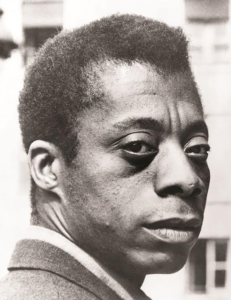
Preach it. (Photo: The Granger Collection)

There’s a direct line between our moral and social crises and the collapse of the humanities. […] Here’s one reason: literature is our chance to explore the world of  the “other,” to enter into some head other than our own. You can’t read The Brothers Karamazov without being able to understand multiple ways of living and thinking in the world, and some quite alien to one’s own p.o.v. That’s precisely what’s lacking in today’s public life, and that’s the understanding that should have been grounded in our educational system.

Then he included the words of James Baldwin I had cited: “You think your pain and your heartbreak are unprecedented in the history of the world, but then you read. It was Dostoevsky and Dickens who taught me that the things that tormented me most were the very things that connected me with all the people who were alive, or who ever had been alive. Only if we face these open wounds in ourselves can we understand them in other people.”

There’s so much to be said beyond Baldwin’s insightful words, however. We’ve said it before here and here, for example. Here’s a passage from James Marcus‘s interview with the late Susan Sontag on the subject:

“Education of the heart”

“Reading should be an education of the heart,” she says, correcting and amplifying her initial statement. “Of course a novel can still have plenty of ideas. We need to discard that romantic cliché about the head versus the heart, which is an absurdity. In real life, intellect and passion are never separated that way, so why shouldn’t you be moved by a book? Why shouldn’t you cry, and be haunted by the characters? Literature is what keeps us from shriveling into something completely superficial. And it takes us out of ourselves, too.”

“Perhaps some people don’t want to be taken out of themselves,” I suggest.

“Well, reading must seem to some people like an escape,” she allows. “But I really do think it’s necessary if you want to have a full life. It keeps you–well, I don’t want to say honest, but something that’s almost the equivalent. It reminds you of standards: standards of elegance, of feeling, of seriousness, of sarcasm, or whatever. It reminds you that there is more than you, better than you.”

“a form of moral insurance”

Joseph Brodsky went even further in his Nobel lecture (here), famously saying, “There is no doubt in my mind that, had we been choosing our leaders on the basis of their reading experience and not their political programs, there would be much less grief on earth. It seems to me that a potential master of our fates should be asked, first of all, not about how he imagines the course of his foreign policy, but about his attitude toward StendhalDickensDostoevsky. … As a form of moral insurance, at least, literature is much more dependable than a system of beliefs or a philosophical doctrine.”

It also prevents us Gary Saul Morson what I call the “Downton Abbey Syndrome”: “the more that authors and characters shared our beliefs, the more enlightened they were. This is simply a form of ahistorical flattery; it makes us the wisest people who ever lived, much more advanced than that Shakespeare guy. Of course, numerous critical schools that judge literary works are more sophisticated than that class on Huckleberry Finn, but they all still presume the correctness of their own views and then measure others against them. That stance makes it impossible to do anything but verify what one already believes. Why not instead imagine what valid criticisms these authors would advance if they could see us?”
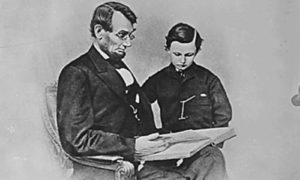
“converse with the dead, the absent, the unborn”

According to Abraham Lincoln:  “Writing – the art of communicating thoughts to the mind, through the eye – is the great invention of the world. Great in the astonishing range of analysis and combination which necessarily underlies the most crude and general conception of it – great, very great in enabling us to converse with the dead, the absent, and the unborn, at all distances of time and of space; and great, not only in its direct benefits, but greatest help, to all other inventions.”

Protection against propaganda returns us to Rhys Tranter again, in his post this week:, which has takes on the more ominous side of a society that no longer cultivates emotional standards and discrimination, this time in the words of Thomas Merton: “[In] an evolved society there are no innocent victims of propaganda. Propaganda succeeds because men want it to succeed. It works on minds because those minds want to be worked on. Its conclusions bring apparent light and satisfaction because that is the kind of satisfaction that people are longing for. It leads them to actions for which they are already half prepared: all they ask is that these actions be justified. If war propaganda succeeds it is because people want war, and only need a few good reasons to justify their own desire.”

“Nothing is as it was…To understand nothing”: Julia Hartwig, “the Grand Dame of Polish Poetry,” 1921-2017

September 13th, 2017
Share

At her house in Warsaw, 2011 (Photo: Humble Moi)

The poet Julia Hartwig was buried in Warsaw today. That was the first news I heard. Then I learned that she had died in her sleep on July 13, in the Pocono Mountains of Pennsylvania, where her daughter lives. A shock, but not a surprise.

She was the “Grand Dame of Polish poetry”  – so said the president of Poland, but it’s hardly the first time the tag was applied to her. Czesław Miłosz said it decades before. I’ve written about her here and here and here. Or you can read about her in my own 2011 article in World Literature Today. To my best knowledge, it is the only interview with the poet in an English-language publication. It was republished by the Milena Jesenská Blog here.

She was buried today next to her husband, the poet and translator Artur Międzyrzecki. She was 95.

She was my friend in Warsaw – more than that, my psychological north star in that reconstructed city. We met at the suggestion of Adam Zagajewski, and the introduction was made by Marek Zagańczyk of Zeszyty Literackie.  I would visit her on my return to Poland, either at her home in Warsaw or in Kraków, at the Czesław Miłosz centenary.

The photo at above was taken at our first meeting in 2008, after Marek guided me on foot through the backstreets of Warsaw at dusk of a hot August day. She was a gracious hostess. She always had a glass of wine and at least a light meal or snack prepared for me – and on that day, she also gave me a hardcover copy of In Praise of the Unfinished, newly published in English. Her accented English was formal but fluent,  for she and her husband had spent years in America on the academic circuit. She told me of the war years – she had been a courier for the Home Army during the German Occupation, and as a teenager, was tipped off that the Gestapo were looking for her. She had to walk out of the city with the clothes on her back. (I write about her description of that experience and others in World Literature Today article, again here.)

I wondered if that sense of a vanished life, disappearing in an instant that was fixed in fear, left a poetic mark on her – as shown in lines like this one, from “Return to My Childhood Home”:

Amid a dark silence of pines – the shouts of
young birches calling each other.
Everything is as it was. Nothing is as it was. . . .
To understand nothing. Each time in a
different way, from the first cry to the last breath.
Yet happy moments come to me from the
past, like bridesmaids carrying oil lamps.

Julia before, and still…

As Rita Signorelli-Pappas wrote while reviewing In Praise of the Unfinished in World Literature Today, “Although Julia Hartwig, like her fellow Polish poets, suffered and survived the constraints that postwar communism imposed on personal freedom, the experience has not irrevocably darkened her poems, which continue to affirm natural beauty and childlike wonder. In ‘Return to My Childhood Home,’ what is too painful to be understood is firmly held in counterpoise with remembered contentment.”

From the Signorelli-Pappas review again:

What gives Hartwig’s poems their unusual freshness is her lightness of touch—she seems able to effortlessly balance the real and the mythic. In “Philemon and Baucis,” she presents a modern epilogue to the Ovidian myth. A husband who distractedly listens to his wife’s shuffling footsteps in the middle of the night suddenly becomes disoriented and asks, “Is this shuffling real, or is it only a memory, in the past, in nonexistence?” In Ovid, the couple’s generosity to the gods was rewarded with a gift that froze them in eternal union, but Hartwig’s poem suggests an elastic, reversible sense of time in which the present looks back at the past and the past points forward to the present.

I have one quibble with my own photograph, and the images included in the Polish news coverage: why do we always honor the dead with photos of decrepitude and old age? The smaller photo above is also Julia, and equally her, and equally the way we should remember her.

I made a habit of celebrating her birthday with a phone call to Warsaw or a blogpost. Her birthday wasn’t hard to remember – it was the same birthday as my own mother, and of Miłosz’s death: August 14. Her birthday greeting this year went unanswered.

“Empire of Disorientation”: Berkeley philosopher Hans Sluga discusses Donald Trump

September 12th, 2017
Share

“The values that have guided the republic since its beginning are no longer being taken seriously. Behind them is the cynicism of power and the sale of political power for money.”


The tip of an iceberg.

Who is Donald Trump, and what does he stand for? Do we know? Does he himself know? Or is he caught in that precarious state of disorientation that characterizes our current political predicament.

The public discourse is heated, the language inflammatory. Philosopher Hans Sluga of the University of California, Berkeley, brings a cool head and rational thinking to his interview about our 45th president, Donald Trump, with Entitled Opinions host Robert Harrison. Go here for the hour-long conversation on the brand new Entitled Opinions channel on the Los Angeles Review of Books

Trump has been a real estate developer, a reality TV star, a prolific tweeter, a politician, and has changed his party affiliation seven or eight times. Is he a fascist? Sluga, author of Wittgenstein and Heidegger’s Crisis, warns against easy tags: “We’ve drained this word of much of its specific meaning.” Fascism, he says, “is a form of statism quite different from what we have in America today.”

Is he a populist? That’s not clear, either. “Plutocrat,” the term Aristotle used to describe the rule of the rich, might be a more precise characterization. Sluga says we might turn to the world of real estate to understand Trump’s worldview.

Sluga is the author of Heidegger’s Crisis. Philosophy and Politics in Nazi Germany (Harvard, 1993); Wittgenstein (Wiley-Blackwell, 2011); and Politics and the Search for the Common Good (Cambridge, 2014).

He studied at the University of Bonn and the University of Munich. He subsequently got a B. Phil. in philosophy at Oxford, where he studied under R. M. Hare, Isaiah Berlin, Gilbert Ryle and Michael Dummett. “My overall philosophical outlook is radically historicist,” he has said. “I believe that we can understand ourselves only as beings with a particular evolution and history.” He received a fellowship from the National Endowment for the Humanities in 1991-92.

Potent quotes:

“What you see is what you get. But the problem is, what do you see? You don’t understand it. You don’t know what to make of it.”

Philosopher Sluga

“The values that have guided the republic since its beginning are no longer taken seriously. Behind them is the cynicism of power and the sale of political power for money.”

“Trump seems to represent the reunification of the political and the economic. He’s a businessman, and remains a businessman while he’s president.”

“We have underestimated the political significance of real estate in our world.”

“Trump is not anti-government, he just has a different notion of what government’s role is in the alliance between economy and politics.”

“He wants regulation to assert his own will-to-power more effectively. He’s an authoritarian, certainly, we shouldn’t doubt that at all – but not necessarily someone out to destroy the state or its institutions.”

“Plutocrats have interests that any ruler has: to be legitimized, to be accepted by the population.”

“Money has begun to undermine everything in politics now.”

“He is the tip of an iceberg. What I’m really interested in is the iceberg itself.”

René Girard wrote words – his Avignon kin perform music.

September 10th, 2017
Share

A few years ago, I drove from Paris to Provence in a little silver Citroën to explore Avignon, the birthplace of a French theorist who is the subject of my forthcoming book, Evolution of Desire: A Life of René Girard (spring 2018 with Michigan State University Press). One facet of Avignon I didn’t experience, however, was the Quatuor Girard, an eminent string quartet formed by members of the Girard family, René’s great-nieces and great-nephews. My interest was not entirely research, however, but largely aesthetics. Listen to the short recording below.
That’s Hugues Girard and Agathe Girard on violins, Odon Girard on viola, and Lucie Girard on the cello performing Ludwig Van Beethoven‘s
String Quartet no. 16 in F major, opus 135 – one of the astonishing late string quartets.

Perhaps a postponed pleasure for my next visit to unforgettable Provence…


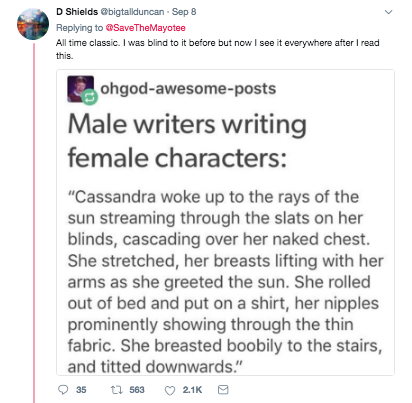
What if women wrote about men the way men write about women?

September 9th, 2017
Share

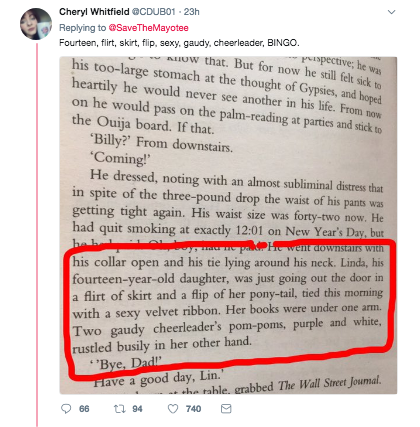
What if women wrote about men then way men write about women? Here’s the sort of thing that gives us pause:

And that’s about a man talking about his 14-year-old daughter? He’s turned on by her ribbons? As someone replied on Twitter, it makes you want to go and take a shower. Or perhaps turn the tables a bit. With luck, we might be able to jeer this whole tired genre out of existence. 

Meg Elison gives us some examples in how to flip the genders over at McSweeney’s:

There is a particular look about a teenage boy that lets you know what kind of man he’ll be. A certain fullness of lips, a frank sensuality in his gaze. We all know what the word for that is, but it’s not polite to use it until he’s proven he’s that kind of boy.

***

Hugin was chosen, among all the boys of the village, to compete in the Races. He had grown up, the child of a simple, lovely baker, and his wife, the wolf-hunter. Hugin wore his hair in simple golden waves and had the longest legs anyone had ever seen, coated in fine, silky down. When the yearly selection began, other boys watched Hugin. They knew he would be the one, and they pouted.

***

Brett pulled his tank top up over his head and stared at himself in the full-length mirror. He pushed down his jeans, then his boxers, and imagined the moment when Jennifer saw him nude for the first time. His feet were average-sized, and there was hair on his toes that he should probably take care of before tonight. He liked his legs just fine, but his thighs were wide and embarrassingly muscular. He tried standing at an angle, a twist at his waist. Some improvement. In that position, it was easier to see his ass and notice that it was not as pert as it had been at 22. He clenched both cheeks, hoping that tightened its look. He sucked in his tummy and pulled his pecs up high, trying to present them like pastries in a bakery window. Would she like him? Were the goods good enough? He pouted his lips and ran his hands over his thighs, masking their expanse. Maybe.

The subject did not idly occur to me. While rambling through my Twitter feed today…I found a tweet by  that got close to 92K retweets and 102K likes. That’s a lot of applause. The original tweet is here, but we won’t post because the Book Haven is a family blog. (We paused at the adverb “hairily”.)

We’ll just post a few of our favorites:


Sound far-fetched? Not at all. I’ve heard many passages just as absurd and arbitrary in the works of famous writers.

Many of the tweets today were too salty for the delicate ears of the Book Haven’s gentle readers – we feel like we’re pushing our luck with the last one, but the image of the coin purse made it an indispensable addition. (Note bene: That’s taut not taught, but … Twitter.) We’ll leave you with this gentler gender-switching prose, from Elison:

“But I don’t get it!” Shea was panting, trying to catch up to Michael as he fled. “The monster ate everyone else. How did you escape?”

Michael reached the boat first, flinging himself in. He waited for Shea to follow him and take the oars, guiding them smoothly away from the shore.

“It’s because I was different from the other boys,” he said, pushing his hair behind his ear and looking away.

“What do you mean, different?” Shea’s muscles rippled and flexed as she rowed them to safety, and Michael could not tear his eyes away.

“Different. Pure, the monster said. Because I’m… I’ve never…” He looked away again, and the moonlight caught on his throat, outlined his clavicle.

“You’re a virgin,” Shea said, realization dawning. “What a waste.”

Michael blushed.

“If we get out of this alive,” she said. “I’m going to fix that.”

Read more here.

Postscript on 9/10:

Zora Neale Hurston: “I haven’t the wings, and must ride the tortoise.”

September 7th, 2017
Share

.

.

“I shall try to lay my dreaming aside. Try hard, But Oh, if you knew my dreams! My vaulting ambition! How I constantly live in fancy in seven league boots, taking mighty strides against the world, but conscious all the time of being a mouse on a treadmill. Madness ensues. I am beside myself with chagrin half of the time; the way to the blue hills is not on tortoise back, it seems to me, but on wings. I haven’t the wings, and must ride the tortoise.”

Zora Neale Hurston

in a letter to playwright Annie Nathan Meyer

.


<<< Previous Series of PostssepNext Series of Posts >>>