Starving writers: you are not alone! Have you ever wondered how to plea with your editor for payment tout de suite? American poet Edna St. Vincent Millay did it the classy way. Here’s her letter for an advance from the editor of Poetry magazine, in 1918 – about the time the photo above was taken. (And if you’d like to see her rather fancy shoes, try here. and if you’d like to hear about her plummy vowels, try here.)
“’Blown canes.’ Those were his first words to mark me,” recalls the Jamaican poet Ishion Hutchinson in the current New York Times Book Review. He continues:
“Like any true discovery, they came tangled in myth. I was about 16, a sixth former at Titchfield, my high school on a peninsula in Port Antonio, a town on the northeastern coast of Jamaica. Almost daily, for my last thing after school, I went to the town’s library. Once inside, I was at sea, isolated, but not alone.”
Son of Jamaica
The myth of evening: porous light aslant a single bookshelf labeled West Indian Literature. Was it new? I had never, impossibly, seen it before. I picked up the first book at hand, the soft-covered, fading Caribbean Writers Series Heinemann of Derek Walcott’s “Selected Poetry,” edited by Wayne Brown, a Trinidadian poet and critic. I opened to the lines, “Where you are rigidly anchored, / the groundswell of blue foothills, the blown canes.” A sort of force triggered in me at “blown canes” that fogged my eyes. I stood, rigidly anchored. West Indian literature had arrived on two words.
With a backlog of work on my desk, Hutchison’s tribute for the Nobel poet of Saint Lucia, who died last March, struck a familiar chord. In moments of panic, hurry, confusion, and deadlines, I often think of the beauty of the Caribbean, and my long absence from its white sand and sapphire sea, and the dead quiet of a long empty coastline of Ocho Rios I remember.
Hutchinson eventually got to know the poet whose lines that mesmerized him as a teenager. He quotes a dozen lines from Walcott’s “The Schooner Flight,” then adds:
Son of Saint Lucia
The lines are not the most famous. Yet I hear in them the sonic, somber complement to the credo Walcott makes in his Nobel lecture: “Poetry is an island that breaks away from the main.” The vernacular of the lines shelters me into a manifold self. It is the cadence of experience that performs the gathering, a healing, to use a line from “The Bounty,” of “our blown tribes dispersing over the islands.”
Blown tribes. Schoolchildren in uniform, market people, the posh dignitaries, friends from distant countries, daughters, granddaughters, even the wandering tourists — they were all there, the disparate tribes all gathered on the day of his funeral. Where else? Everywhere else. In every nook of private homes pierced by his poetry.
Fyodor Dostoevskywanted to present a uniquely Russian brand of Christianity to the world. What better way than Elijah the Prophet, popular image in iconography and a hero of folklore?
Hence, the axe murderer Raskolnikov of Crime and Punishment confesses on Elijah’s Day, after wandering the city all night during a fierce thunderstorm – which, according to Russian folklore, is always expected on Elijah’s holiday. Elijah stands in for retribution and judgment in the folkloric cosmology – and also for the pagan thundered Perun.
Today’s his feast day. Celebrate with – what? A flaming brandy, perhaps?
The link with Dostoevsky is a fascinating one. According to a post today on SEELANGS, an Eastern European listserve:
Raskolnikov confesses to a gruff assistant police superintendent named Elijah (Il’ia) whose portrayal is replete with imagery connected with thunder, lightning and fire. There is no doubt that the spectacular storm is the proverbial Elijah’s Day thunderstorm because the story begins in the first week of July. Two weeks pass before the confession, taking us to around July 20 (August 2 on the new style calendar). The assistant superintendent’s nickname is Gunpowder, a detail that evokes the boom of thunder as well as the Petersburg Church of Elijah, which stood at the gunpowder factory. In his earlier work called “The Village of Stepanchikovo” Dostoevsky had used the Elijah’s Day storm in a similar fashion at the story’s climax. In Stepanchikovo the assembled characters cry out “Elijah the Prophet!” as thunder strikes overhead and the central hero ejects the evil backbiter Foma Fomich from his home. It is Elijah’s Day, the nameday of the hero’s son and father.
Elijah’s biggest booster
Dostoevsky’s early novella “The Landlady” is undecipherable without a knowledge of the Russian folkloric Elijah. The bileous, enigmatic old Elijah Murin is an earthly emanation of the prophet Elijah. Failing to see this, scholars have interpreted Murin as a demonic figure in the tale and have misunderstood the author’s intent. Elijah symbolism runs through around ten other works by Dostoevsky, including The Brothers Karamazov, where the Elijah theme is very prominent. In the first drafts of the novel, the family name Il’inskii (from Il’ia ‘Elijah’) is used instead of Karamazov.
The story of this imagery in Dostoevsky’s fiction is long and fascinating. Literary scholars have been blind to the Elijah allusions because most of them know little about the folklore of Elijah and they have never suspected that folk beliefs of this nature could play such a central role in Dostoevsky’s writing. The late Yurii Marmeladov is the discoverer of the Elijah theme in Dostoevsky. See his study Tainyi kod Dostoevskogo (1992) …
A trio of essays about historian and poet Robert Conquest is now online at the Hopkins Review.Humble Moi is among them. But so is Richard Davis, a British poet (now transplanted to Ohio State University), who is perhaps the best translator from the Persian ever. (We’ve written about Dick here and here). Both of us were intrigued by the link between Bob’s poetry and his historical work. As Dick points out, “a kind of bedrock common sense” runs through both. British poet John Whitworth rounds out the triad.
Let me first quote a bit from the inestimable Dick Davis’s “The Minds of Poets”:
When it comes to his career as a historian I think there is a sense in which Robert Conquest’s opinions, tastes, and predilections were also to some extent an infuriated reaction to what he saw around him in the 1950s and 1960s. Not that this was where his historical insights and clarity came from of course, but that the writing down of what he had found to be true was partly motivated by an intense desire to show the foolishness of much of the self-deceiving political cant that was current at the time. His book on Stalin’s purges, The Great Terror, was the first to set out in such horrific detail the brutal nature of Stalin’s Russia, and it was written against a great deal of bien-pensant vague pro-Soviet and less vague anti-American sentiment that was current in (especially) British intellectual life in the 1950s and ’60s, a kind of knee-jerk groupthink leftism that meant giving the Soviet Union pretty much a free pass when it came to human rights issues. When a later, revised edition of the book was to be issued, by which time Conquest’s anatomization of the disasters of Soviet rule was coming to be widely accepted as accurate, Conquest jokingly suggested to Kingsley Amis that he title the book I Told You So, You Fucking Fools. And it was true, he had told us so, when far too many of us didn’t want to believe it.
Dick Davis visiting Stanford. (Photo: L.A. Cicero)
A confidence in a kind of bedrock common sense runs through Conquest’s poetry, his writings on poetry, and his historical writings, and this confidence goes with what can seem at times a magisterial impatience with those who would obfuscate such common sense by disdainful appeals to ideology, political posturing and blather, or vatic rhetoric that covers and tries to compensate for a simple lack of artistic or political integrity. But what sounds like magisterial confidence comes from a wholly admirable humility before the nature of quotidian reality, before what is demonstrably there in the world, and a preference for recognizing this reality over the comforts of bombast and self-deception. Much of Conquest’s best-known poetry is funny, even absurdly hilarious, but when it is serious it is continuous with the voice that wrote on history and politics. It can remind us of the title of one of Isaiah Berlin’s books of essays, The Crooked Timber of Humanity, and its epigraph from Immanuel Kant, “Out of timber so crooked from that which man is made nothing entirely straight can be built.” Utopian and inevitably murderous visions that try to make something “straight” out of humanity’s crooked timber earned his contempt; what his political voice advocates in his poetry is a pragmatic humanist compromise between absolutes. The absolutes are kept in view because they are what make man’s social life possible, but they can never be realized because they contradict one another (absolute freedom is anarchy with the strong preying on the weak; absolute order is the ultimate prison with no possibility of freedom). The meditative, moving seriousness of this vision is present in the closing section of one of his last and I think most beautiful poems, “The Idea of Virginia”:
The dogwood blooms, the cardinals perch, the lean hounds hunt
Where Pocahontas danced, where John Smith scouted, where Spotswood rode,
Where Washington marched to victory, Jackson to death,
By the slow rivers, the cool woods, the mountains, the marshes.
The Idea, never fulfilled, was never abandoned;
The free order only approaches its goal.
The land lived on imperfect in city and forest,
Its Form half-remembered; as it lay in the minds of poets.
And from my own, “Poetry and Politics”:
Receiving the Medal of Freedom in 2005.
Aristotle sharply distinguished the domains of Clio and Euterpe. So did a Russian poet some centuries later. Nobel poet Joseph Brodsky once remarked that the only thing poetry and politics have in common are the letters “p” and “o.” There are powerful exceptions, however—think of Dante. Surely Brodsky’s attitude had been shaped by his refusal to define himself in terms of the Soviet system both he and Conquest deplored, the system that would eventually exile him. However, at some point, politics intersect with reality, with what happens to real people when governments and policies go wrong. And history, on the large scale of people and events, is inevitably bound up with politics. It is said that Conquest’s revelations of the millions killed in Stalin’s regime did not influence his poetry at all—except for a few poems with overt political references, such as “Get Lost, Gulag Archipelago” and “Garland for a Propagandist.” However, both his muses were intertwined and informed each other, which would quickly move him miles away from the surrealist poems of his youth in the 1930s. World events would also move him far from the fashionable Communist Party of Oxford, where he had briefly been a member before deciding that it was not a place for grown-ups. By enlisting in 1939, he implicitly rejected the party’s line that the war was a capitalist and imperialist venture. His wartime experiences would bring their own understandings and leave their own scars.
In a long poem commemorating his friend, the poet Drummond Allison, who was killed in the fighting in Italy, he tells of his shattering disillusionment about just causes, after a death, as he wrote, “which no future can ever repay.” He listed the clichés—“He died in a good cause,” “We sacrifice our best,” “He lives in our memory”—which caused him to write, “All this is not untrue / But its irrelevance shakes me like a fever . . .” He could not reconcile the public need against the private loss, “the just war and the individual’s unjust / Death. . . .”
He was not going to write the great war poem; he knew that. While describing the war in verse was possible, it was not possible for him. In “Poem in 1944,” he wrote:
. . . I must believe
That somewhere the poet is working who can handle
The flung world and his own heart. To him I say
The little I can. I offer him the debris
Of five years’ undirected storm in self and Europe,
And my love. Let him take it for what it’s worth
In this poem scarcely made and already forgotten.
He did a little bleeding himself. (Photo: Bachrach)
Harvard Prof. Stephen Greenblatt‘s grandparentsparents were Lithuanian Jews from tsarist Russia, who settled in Boston. “But the heavy Talmudic volumes left a residue, an inherited respect for textual interpretation that—reshaped into secularized form—led people like me to embrace the humanities, an arena in which the English Department held pride of place,” he writes. But sometimes what we embrace doesn’t embrace us back, and he remembers the poignant shock of discrimination at the all-male Yale College when he was a freshman:
I had a particularly intense engagement with my freshman English-literature course. Midway through the year, the professor asked me if I would be interested in being his research assistant, helping him prepare the index for a book he had just completed. Ecstatic, I immediately agreed. In those days, research assistants were required to apply for their jobs through the financial-aid office, where I dutifully made an appointment. I was in for a surprise.
“Greenblatt is a Jewish name, isn’t it?” the financial-aid officer said. I agreed that it was. “Frankly,” he went on, “we are sick and tired of the number of Jews who come into this office after they’re admitted and try to wheedle money out of Yale University.” I stammered, “How can you make such a generalization?”
“Well, Mr. Greenblatt,” he replied, “what do you think of Sicilians?” I answered that I didn’t think I knew any Sicilians. “J. Edgar Hoover,” he continued, citing the director of the F.B.I., “has statistics that prove that Sicilians have criminal tendencies.” So, too, he explained, Yale had statistics that proved that a disproportionate number of Jewish students were trying to get money from the university by becoming research assistants. Then he added, “We could people this whole school with graduates of the Bronx High School of Science, but we choose not to do so.” Pointing out lamely that I had gone to high school in Newton, Massachusetts, I slunk away without a job.
Thus begins Greenblatt’s brilliant, moving essay, “Shakespeare’s Cure for Xenophobia,” his exploration of identity, the 500th anniversary of the Venice ghetto (it was last year), and … inevitably, William Shakespeare, for Greenblatt is one of the foremost Shakespeare scholars of our era.
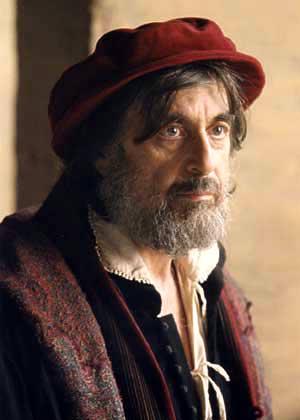
Al Pacino as Shylock in 2004 film.
From The New Yorker: “We arrive in the world only partially formed; a culture that has been in the making for hundreds of thousands of years will form the rest. And that culture will inevitably contain much that is noxious as well as beneficent. No one is exempt—not the Jew or the Muslim, of course, but also not the Cockney or the earl or the person whose ancestors came to America on the Mayflower or, for that matter, the person whose ancestors were Algonquins or Laplanders. Our species’ cultural birthright is a mixed blessing. It is what makes us fully human, but being fully human is a difficult work in progress. Though xenophobia is part of our complex inheritance—quickened, no doubt, by the same instinct that causes chimpanzees to try to destroy members of groups not their own—this inheritance is not our ineluctable fate. Even in the brief span of our recorded history, some five thousand years, we can watch societies and individuals ceaselessly playing with, reshuffling, and on occasion tossing out the cards that both nature and culture have dealt, and introducing new ones.”
That brings him to an exploration of Shakespeare’s Merchant of Venice, and the queasy, ambivalent feeling of watching it as a Jew. Surprise! Greenblatt writes: everyone feels that way. The play is designed to make you feel that way. The Bard regularly gets carried away by one or another of his characters who “steal the show,” so to speak. Think of Falstaff, Caliban, or Lady Macbeth. Who is, after all, the title character of the play? Antonio? … or Shylock?
Ideologies of various kinds contrive to limit our ability to enter into the experience of another, and there are works of art that are complicit in these ideologies. More generous works of art serve to arouse, organize, and enhance that ability. Shakespeare’s works are a living model not because they offer practical solutions to the dilemmas they so brilliantly explore but because they awaken our awareness of the human lives that are at stake.
What Shakespeare bequeathed to us offers the possibility of an escape from the mental ghettos most of us inhabit.
He never met a wall he liked.
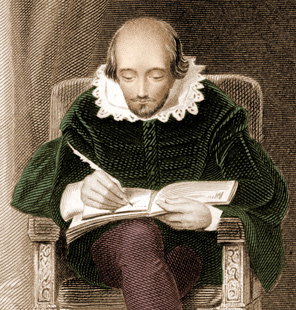
Shakespeare apparently went out of his way to learn about Jews in Venice – England had expelled its Jews in 1290 – yet he couldn’t quite grasp the notion of the ghetto, which is curiously AWOL from his play. The more multicultural, cosmopolitan atmosphere in Venice intrigued him, however. The contemporary English audiences of his plays would have been shocked not by the restrictions on the Jews in Venice, but the openness with which they participated in Venetian society.
But the same Shakespeare who did not grasp that a ghetto existed in Venice had no patience with walls, real or imaginary, and, even in a play consumed with religious and ethnic animosity, he tore them down.
He did so not by creating a lovable alien—his Jew is a villain who connives at legal murder—but by giving Shylock more theatrical vitality, quite simply more urgent, compelling life, than anyone else in his world has.
Read the whole thing here. And watch Shakespeare’s greatest statement on immigration and xenophobia below (we wrote about it here).
The première of my opuscule at University of Notre Dame. It’s the one with the bright blue cover.
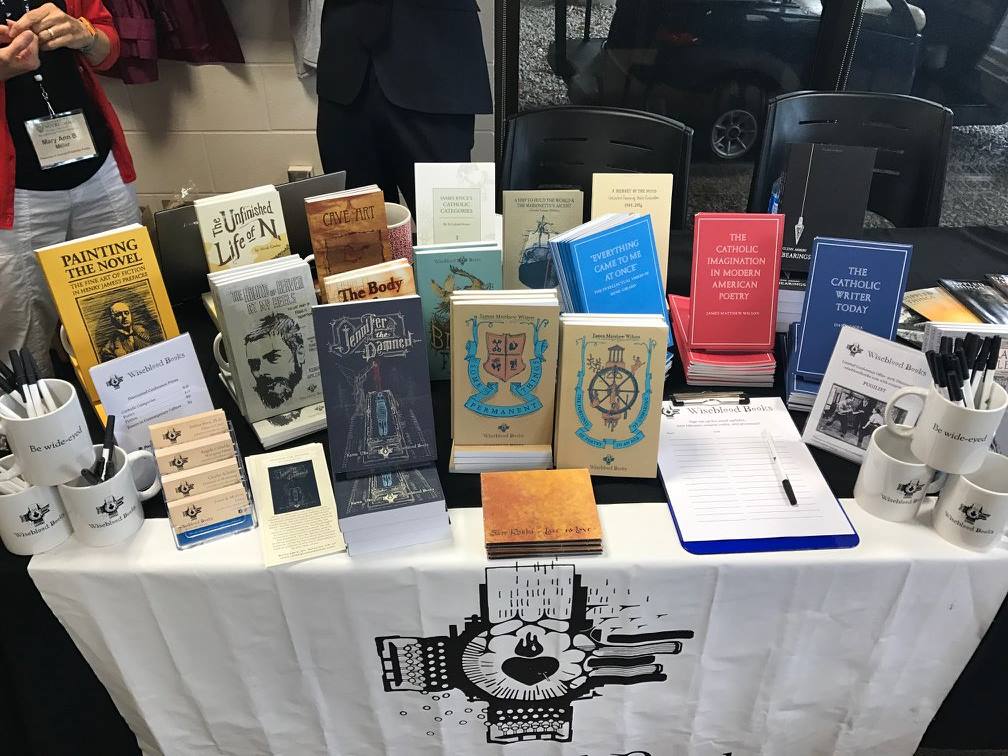
I was finishing Evolution of Desire: A Life of René Girard (out next spring with Michigan State University Press), when Joshua Hren, founder of a fine-press publishing house called Wiseblood, approached me to see if we could adapt and republish one of the chapters as a stand-alone. Dana Gioia had suggested the project to them, so … how could I say no? Voila! This week’s publication of Everything Came to Me at Once: The Intellectual Vision of René Girard.
From the jacket:
French theorist René Girard promulgates a sweeping vision of human nature, human history, and human destiny, but few understand the mysterious experience that gave birth to his theories: “Everything came to me at once in 1959. I felt that there was a sort of mass that I’ve penetrated into little by little,” he said. “Everything was there at the beginning, all together. That’s why I don’t have any doubts . . . I’m teasing out a single, extremely dense insight.”
The tough question was: what color for the cover? Blue. It had to be blue. But Dana had already made a clear and dignified blue statement with his covers. Blue was “taken.” Red was simply out of the question. Yellow, Joshua suggested. How about yellow? But René was not a yellow kind of guy. So I picked a bright sky blue. But I nervously awaited the final to see if the white letters would “pop” enough. I think they do.
Artur Rosman, literary scholar, translator, and blogger at Cosmos the in Lost, (we’ve written about him hereand here) generously served as a blurber:“René Girard devoted his career to tracking down the twists and turns of mimetic desire in literature, philosophy, and anthropology. Cynthia Haven’s primer makes an invaluable contribution to Girard studies by tracking down the places where Girard discussed how his theories emerged from a personal process of intellectual and spiritual conversion—and its public consequences. What emerges is a compelling picture of Girard as a post-secular thinker who tears down artificial boundaries, such as the ones between the religious and the secular, between the private and public. Haven invites would-be Girard readers to see themselves as participating in a common struggle rather than scapegoating each other. This is a must-read book for a time when mimetic competition, shorn of scapegoating safeguards, rends the fabric of civil society.”
Trevor Cribben Merrill congratulated me on the final essay – an “opuscule,” he called it. That was a new word for me, and I liked it. Now I use it all the time. I roll it around my tongue. I find ways of working it into the conversation. “Have you seen my little opuscule?” Well… I guess “little” is redundant.
Any, the opuscule (see? I did it again) begins this way:
“Midway in the journey of our life I found myself in a dark wood, for the straight way was lost.” – Dante Alighieri, Inferno, Canto 1, trans. Charles Singleton
René Girard had reached the traditional midway point of life—35 years old—when he had a major course correction in his journey, rather like Dante. The event occurred as the young professor was finishing Deceit, Desire, and the Novel at Johns Hopkins University, the book that would establish his reputation as an innovative literary theorist. His first book was hardly the only attempt to study the nature of desire, but Girard was the first to insist that the desires we think of as autonomous and original, or that we think arise from a need in the world around us are borrowed from others; they are, in fact, “mimetic.” Dante’s “dark wood” is a state of spiritual confusion associated with the wild, dangerous forests. Three beasts block his path; the leopard, the lion, and the wolf represent disordered passions and desires. Dante’s conversion begins when he recognizes he cannot pass the beasts unharmed. Girard experienced his “dark wood” amidst his own study of the disordered desires that populate the modern novel. His conversion began as he traveled along the clattering old railway cars of the Pennsylvania Railroad, en route from Baltimore to Bryn Mawr for the class he taught every week. …
Postscript on July 31: Kind words from Frank Wilson over at Books Inq.: “Perhaps the most interesting thing I’ve read this year is a mere 20 pages long and takes less than half an hour to read.” Read it here.




 From the jacket:
 René Girard had reached the traditional midway point of life—35 years old—when he had a major course correction in his journey, rather like Dante. The event occurred as the young professor was finishing Deceit, Desire, and the Novel at Johns Hopkins University, the book that would establish his reputation as an innovative literary theorist. His first book was hardly the only attempt to study the nature of desire, but Girard was the first to insist that the desires we think of as autonomous and original, or that we think arise from a need in the world around us are borrowed from others; they are, in fact, “mimetic.” Dante’s “dark wood” is a state of spiritual confusion associated with the wild, dangerous forests. Three beasts block his path; the leopard, the lion, and the wolf represent disordered passions and desires. Dante’s conversion begins when he recognizes he cannot pass the beasts unharmed. Girard experienced his “dark wood” amidst his own study of the disordered desires that populate the modern novel. His conversion began as he traveled along the clattering old railway cars of the Pennsylvania Railroad, en route from Baltimore to Bryn Mawr for the class he taught every week. …