
Award-winning essayist, editor Brian Doyle, 1956-2017: “Something is opening in me, some new eye.”

June 26th, 2017
Share

I heard recently of the death of writer Brian Doyle. I didn’t know him. I didn’t think I knew him. But someone later mentioned that he had been editor of the estimable Portland Magazine, and a memory came back. Someone had suggested years ago that I contact him. I think it was to propose some sort of article about Nobel poet Czesław Miłosz. Earlier this month, I retrieved the exchange of emails from my oldest email account and reread them. We corresponded in 2005, and had a phone conversation. Nothing came of it, and I can’t remember why. I wish something had. He died in May at the age of 60, from complications related to brain cancer.

Under his leadership. the magazine was consistently been ranked among the best university magazines in the country and in 2005 received Newsweek’s Sibley Award as the top university magazine in America. He was nominated for the Oregon Book Award nine times, and finally won last October for his novel, Martin Marten.

“Naked as a baby…”

He learned last November that he had a brain tumor. When people asked how they could “help,” he replied, “”Be tender to each other. Be more tender than you were yesterday.” Then he underwent surgery for what he referred to as “a big honkin’ brain tumor”.

In an email sent to faculty and staff announcing his death,  University President Mark Poorman wrote: “He was a man filled with a sense of humanity and wonder, who was interested in everyone’s story and who saw everyone’s potential. His warmth, humor, and passion of life will be deeply missed and his loss will be acutely felt here and beyond The Bluff.”

From a writer at The Beacon, this time a student, Rachel Rippetoe:

Sometimes I think we all relate to each other like characters in a TV show with no stakes, wandering around a living room set with no fear that the floor might fall through. Every once in awhile, you meet someone who shakes you by the shoulders and reminds you that we’re all standing on a precipice, bits of rock slowly eroding underneath the sneakers we bought at Macy’s for half price.

He had these eyes that curved around his cheeks, issuing an earnest and acute plea for humanity upon anyone who meets them. His voice cracked and crooned and he swayed on the balls of his feet, all the while those hands stayed in his pockets, only unleashed when his most abundant and resounding message was hurled at an audience that couldn’t have been anything but enthralled by him.

The essayist Dinty Moore posted this quote from him on Facebook: “You can brick up your heart as stout and tight and hard and cold and impregnable as you possibly can and down it comes in an instant, felled by a woman’s second glance, a child’s apple breath, the shatter of glass in the road, the words I have something to tell you, a cat with a broken spine dragging itself into the forest to die, the brush of your mother’s papery ancient hand in the thicket of your hair, the memory of your father’s voice early in the morning echoing from the kitchen where he is making pancakes for his children.”

Now here’s the thing. I was cleaning out the garage today, always a major undertaking, and throwing out boxes and boxes of papers and magazine, and then the magazine pictured at right fell out of a pile in a box that had been untouched for over a decade. Brian had sent it to me in 2005, during those discussions for an article that never happened. And inside the front cover was his short editor’s essay called “Word Less,” on silence. It concludes:

“I rise earlier and earlier in these years. I don’t know why. Age, sadness, a willingness to epiphany. Something is opening in me, some new eye. I talk less and listen more. Stories wash over me all day like tides. I walk through the bright wet streets and every moment a story comes to me, people hold them out to me like sweet children, and I hold them squirming and holy in my arms, and they enter my heart for a while, and season and salt and sweeten that old engine, and teach me humility and mercy, the only lessons that matter, the language I most wish to learn; a tongue best spoken wordlessly, with your hands clasped in prayer and your heart as naked as a baby.”

Oddly, I hadn’t read the mini-essay or the article he wrote for that particular issue. The moment of our connection passed, and I went on to other things. But I will, now.

Mikhail Bulgakov couldn’t figure out what the Soviet bigwigs wanted of him.

June 24th, 2017
Share

Our friend Boris Dralyuk of the Los Angeles Review of Books has a fascinating review of J.A.E. Curtis’s Mikhail Bulgakov over at the Times Literary Supplement, and unlike the recent article by Humble Moi, it is not behind a paywall (an excerpt of my review of Andrzej Franaszek‘s biography of Czesław Miłosz is here). We don’t get a chance to write about Mikhail Bulgakov, author of The Master and Marguerita, very often, so this is an opportunity for us:

One of the most revealing episodes in J. A. E. Curtis’s Mikhail Bulgakov, in the Reaktion Books Critical Lives series, itself concerns the writing of a “critical life”. In 1932–3, Bulgakov, a man devoted to the theatre, wrote a brief novelized biography of Molière. The book was commissioned for the hallowed Russian series Lives of Remarkable People, but like much of Bulgakov’s work from the 1920s and 30s, it would not see the light of day until decades after his death in 1940. As usual, the Soviet author had taken a thoroughly un-Soviet approach to the topic, presenting Molière as an individual genius – rather than as a product of his era and class – and fitting the facts of his life into a fictional frame. In his rejection, the series editor explained Bulgakov’s error: “You have placed between Molière and the reader some sort of imaginary storyteller. If, instead of this casual young man in an old-fashioned coat, who from time to time lights or puts out the candles, you had given us a serious Soviet historian, he would have been able to tell us many interesting things about Molière, and about his times”.

This incident captures a central tragedy of Bulgakov’s life: almost all his efforts to win official acceptance, if not approval, were stymied by his inability to produce – and at times even deduce – what was asked of him. The fate that befell the seemingly innocuous Molière biography also befell a number of his plays, including The Last Days, about Alexander Pushkin – timed to coincide with the 1937 commemoration of the centenary of the poet’s death – and Batum (1939), about Stalin’s youth. The Bulgakovs were informed that Batum “received a harshly negative review up there (in the Central Committee, probably)” for making fiction out of a romanticized Stalin; it was also seen as “representing a wish to build bridges and to improve attitudes towards [the author]”. Yelena Bulgakova “indignantly repudiated these latter suggestions”, Curtis writes, “although it is hard to believe that this was not to some extent what had motivated Bulgakov in agreeing to take on this project”. In the 1930s, any Soviet author who craved an audience needed approval “up there” – and Bulgakov certainly craved an audience.

Read the whole thing here

Stay cool, folks! Roving photographer Zygmunt Malinowski reports on a long-lost ship from the Arctic.

June 21st, 2017
Share

Zodiacs near shore of Beechey Island. Devon Island in back. (Photo: Zygmunt Malinowski)

The Book Haven’s roving reporter-photographer Zygmunt Malinowski made this trip to the Arctic last September, but we thought it was more than usually timely now given the heat wave that is currently smothering the West. Here’s his latest from our New York City colleague, who recommends Gore-Tex (and you can read about his earlier adventures here and here and here):

During a voyage through the Northwest Passage on Ocean Endeavour in late September, I heard an astonishing announcement on the speaker system: the HMS Terror had been discovered in Terror Bay, south of the Nunavut archipelago’s King William Island. It was Sir John Franklin’s ship. The polar explorer made an ill-fated expedition to find the North West passage in 1848. None of his 129 men survived. Franklin’s flagship, HMS Erebus, and the Terror were abandoned far north of the wreck site.

Through a fortunate coincidence during my voyage, Adventure Canada was nearby. The official travel partner of Explorers Club, specializing in remote Arctic trips, was going north with a Zodiac stop at Beechey Island, also in the archipelago. At 3 a.m. in bone-chilling night I and several others walked up to the upper deck so that when we crossed the intersection line at 3:15 a.m., we could acknowledge the somber discovery of the vessel whose fate had been unknown for 168 years.

An Inuit crew member of Gjoa Haven, a hamlet in Nunavut, was onboard the Arctic Research Foundation’s research vessel Brigmann, and he told them a story: Several years prior he saw part of a wooden mast sticking out of the sea ice which led to the discovery of the shipwreck. The well-preserved ship standing upright in 80-feet of water appears to have been winterized (operationally closed down) with hatches and windows closed when it was abandoned in 1848. Canadian archeologists confirmed the discovery when measurements were compared against original plans, and found the smokestack from a steam engine that was especially installed for the voyage, as well as a wheel and ship bell similar to the Erebus’ bell were identified. The other ship, HMS Erebus, was found in 2014 further south in Queen Maud Gulf.

You can read more about the discovery of the HMS Terror here.

Beechey Island. Burial site for three of Sir John Franklin’s men. (Photo: Zgymunt Malinowski)

Jacobshavn Ice Stream, Ilulissat, Greenland. (Photo: Zygmunt Malinowski)


The last surviving Nuremberg prosecutor at 97: “And you know what keeps me going? I know I’m right.”

June 18th, 2017
Share

Revisiting the Nuremberg courtroom in 2012 (Photo: Adam Jones)

We were mesmerized by a recent 60 Minutes broadcast about 97-year-old Ben Ferencz, a Hungarian immigrant (barely five feet tall), raised in New York City with Yiddish as his native tongue, who by a series of twists, turns, and coincidences worthy of any Dickens novel, became a prosecutor in the Nuremberg trial for genocide.

Twenty-two SS officers responsible for the deaths of more than one million people would never have been successfully tried for genocide were it not for his efforts as the prosecutor of the biggest murder trial ever. The officers, in  Einsatzgruppen units, were charged with following the German army as it invaded the Soviet Union in 1941 to kill Communists, Gypsies and Jews. All were found guilty, and four were hanged. Ferencz says his goal from the outset was to affirm the rule of law and deter similar crimes from ever being committed again, and that has been his life’s work since.

He is the last Nuremberg prosecutor alive today. He is the author of an autobiography, Mémoires de Ben, procureur à Nuremberg et avocat de la paix mondiale, published in Paris in 2012. He is also the recipient of the 2009 Erasmus Prize.

From his CBS interview with Lesley Stahl:

Stahl: You know, you –  have seen the ugliest side of humanity.

Ferencz: Yes.

Stahl: You’ve really seen evil. And look at you. You’re the sunniest man I’ve ever met. The most optimistic.

Ferencz: You oughta get some more friends.

He recalls that the “defendants’ face were blank, all the time. Defendants – absolutely blank. They could – like, they’re waiting for a bus.” One claimed to have killed in self-defense. The killings of helpless people? “He was not ashamed of that. He was proud of that. He was carrying out his government’s instructions.”

Stahl: Did you meet a lot of people who perpetrated war crimes who would otherwise in your opinion have been just a normal, upstanding citizen?

Ferencz: Of course, is my answer. These men would never have been murderers had it not been for the war. These were people who could quote Goethe, who loved Wagner, who were polite –

Stahl: What turns a man into a savage beast like that?

Ferencz: He’s not a savage. He’s an intelligent, patriotic human being.

Stahl: He’s a savage when he does the murder though.

Ferencz: No. He’s a patriotic human being acting in the interest of his country, in his mind.

Stahl: You don’t think they turn into savages even for the act?

Ferencz: Do you think the man who dropped the nuclear bomb on Hiroshima was a savage? Now I will tell you something very profound, which I have learned after many years. War makes murderers out of otherwise decent people. All wars, and all decent people.

He remains optimistic, despite the endless repetition of genocides since World War II.

Stahl: Now, you’ve been at this for 50 years, if not more. We’ve had genocide since then.

Ferencz: Yes.

Stahl: In Cambodia—

Ferencz: Going on right this minute, yes.

Stahl: Going on right this minute in Sudan.

Ferencz: Yes.

Stahl: We’ve had Rwanda, we’ve had Bosnia. You’re not getting very far.

Ferencz: Well, don’t say that. People get discouraged. They should remember, from me, it takes courage not to be discouraged.

And so he goes on. He’s donating his life savings to a Genocide Prevention Initiative at the Holocaust Museum. He says he’s grateful for the life in the U.S., and wants to pay it forward:

Ferencz: So the world is changing. And you shouldn’t – you know – be despairing because it’s never happened before. Nothing new ever happened before.

Stahl: Ben—

Ferencz: We’re on a roll.

Stahl: I can’t—

Ferencz: We’re marching forward.

 Stahl: Ben? I’m sitting here listening to you. And you’re very wise. And you’re full of energy and passion.  And I can’t believe you’re 97 years old.

Ferencz: Well, I’m still a young man.

Stahl: Clearly, clearly.

Ferencz: And I’m still in there fighting.  And you know what keeps me going? I know I’m right.

Read his story here.

Postscript on 6/18 from one of our favorite medievalists, Jeff Sypeck: “I haven’t had many brushes with greatness, but I did have the honor of meeting Ben Ferencz a few years ago when my best friend convinced him to come speak to the undergraduates in his international-studies class. (Apparently he rarely responds to such invites, but he was in town for a conference and my friend has superhuman powers of persuasion.) Ferencz is one hell of a raconteur: He stunned the kids into silence when he discussed the techniques he used to intimidate the Einsatzgruppen during interrogations–and how he visits their graves once in a while.
“Several students recognized that they were in the presence of living history, so Ferencz later held court on a bench on the campus green for more than an hour. He posed unsolvable moral quandaries to students; he charmed us all with his wit, which mingled old-fashioned dignity with the wryness of a bygone New York; and he beguiled and delighted my friend’s infant son, who gave him cause to crack a couple of disarming potty jokes. He was the sharpest nonagenarian I’ve ever met, and we all could have listened to him for hours. If he’s not the household name he should be, I suspect that’s because his activism, his sunny demeanor, and his trenchant sense of humor don’t add up to someone who fits into easy political categories–my favorite kind of person. Face to face, he’s as wonderfully unpredictable as he is principled; it was a privilege simply to sit there and listen.”

Maria Stepanova: “Poetry is a powerful tool of inner resistance.”

June 16th, 2017
Share

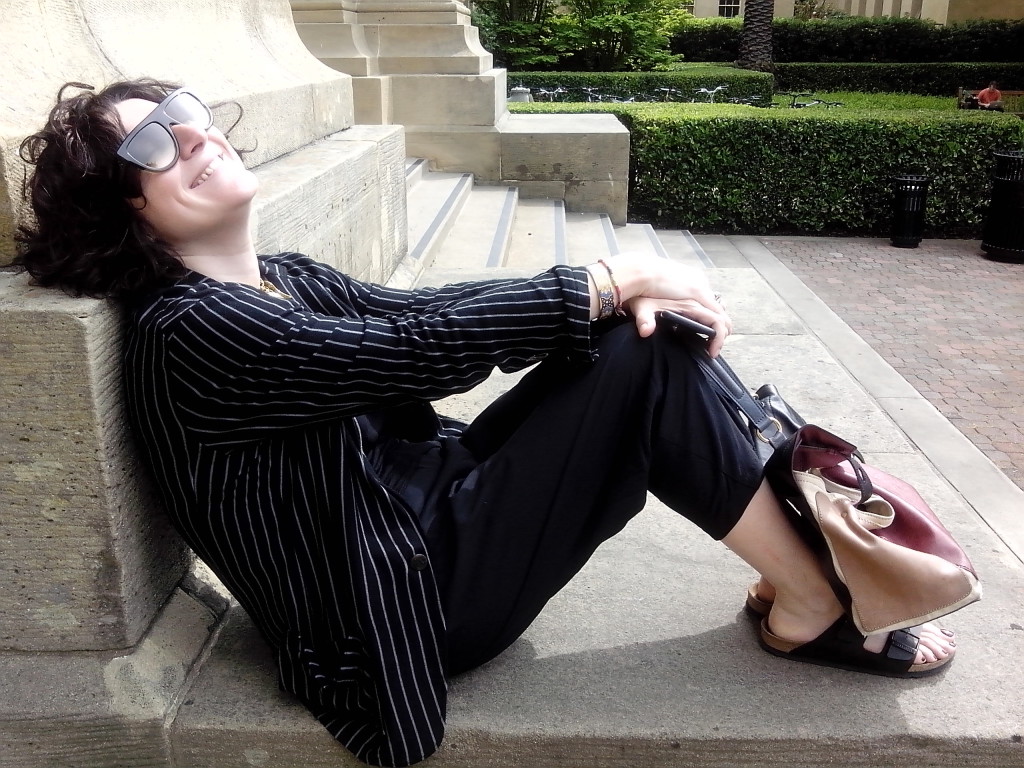
Taking in the California rays, on the steps of Stanford’s Green Library. (Photo: Cynthia Haven)

Maria Stepanova is a star at the Los Angeles Review of Books today. She’s already a supernova in her native land: the Muscovite is among the most visible figures in post-Soviet culture — not only as a major poet, but also as a journalist, a publisher, and a powerful voice for press freedom. She is the founder of Colta, the only independent crowd-funded source of information in Russia. The high-traffic online publication has been called a Russian Huffington Post in format and style, and has also been compared to The New York Review of Books for the scope and depth of its long essays. The Muscovite is the author of a dozen poetry collections and two volumes of essays, and is a recipient of several Russian and international literary awards.

My L.A.R.B. interview with her is here. A few excerpts below:

Photo: Sergey Melikhov

You know that all the cells of the human body are constantly replacing each other, and in seven years not a single cell of your old body is left. All that holds our personalities together is mere willpower — and our selves are as replaceable as brain cells. The human mind is a flowing thing, it is a process, and it happens somehow that the only solid and constant thing we can cling to is the inner zoo of the soul. I mean the persons and stories from the past that have no relationship to our own stories. Antigone or Plato or Brutus, invented or real, are actors in the theater of the mind. They do not change; they are strong enough for us to test them with our projections and interpretations. You could call the destructive element in yourself Medea or Clytemnestra — but it is you who is switching from one identity to another. In a mental theater, a single person plays all the parts.

And that’s how you see the poetic process?

I guess it is a fair description. A play is being performed, or maybe improvised, and there is an actor for every part, and a certain idiosyncratic language for each of them. But it is all centered on some very urgent question that is formulated from the outside, something you’ve been dealing with all your life: you’re born with this question and the need to answer it again and again. W. H. Auden spoke of neurosis as a life-shaping experience that is to be blessed — we’d never become what we are without it. I’m totally sure that certain patterns are shared, extrapolated to the scale of the whole society, so that everyone you know is shaped, at least partly, by the same problem. I guess this could describe what’s going on in a number of post-Soviet states; one can only wonder if a country can undergo some kind of therapy, if it can do collective work on collective trauma. Especially in times that are rather allergic to any collective project.

And this one:

Do you find that poetry, for you, is a space of freedom, even though it’s affected by your political predicament?

I feel that the poetry is a powerful tool of inner resistance, because what’s important, what really counts, is how much you let the outer forces deform you. Poetry keeps you in shape. More important than outward protests is inner freedom, the ability to stay yourself. That is usually the first thing you lose. You can imitate the motions and doings of free people but be utterly unfree inside. You become an expert in deforming your inner reality, to bring it into accord with what the state wants from you — and this could be done in a number of subtle, unnoticed ways. This kind of damage weighs on us the most.

The whole thing is worth a read here. She’s a fascinating and profound figure – and thoroughly unrepeatable, as great poets tend to be.

Congratulations to Tracy K. Smith, our newest poet laureate!

June 14th, 2017
Share

Tracy K. Smith, who in 2012 won the Pulitzer Prize for Life On Mars, will be our newest poet laureate, beginning this fall. She is a former Wallace Stegner Fellow at Stanford.

According to the press release, “Her work travels the world and takes on its voices; brings history and memory to life; calls on the power of literature as well as science, religion, and pop culture. With directness and deftness, she contends with the heavens or plumbs our inner depths—all to better understand what makes us human.”

She succeeds Juan Felipe Herrera, another poet with Stanford links, in this case, a degree in anthropology from Stanford. He has served as poet laureate since 2015.

When I interviewed Tracy after her Pulitzer, she was bubbly and courteous.  She talked about her upbringing and her father, who had been one of the engineers who worked on the Hubble Space Telescope. I have no notes that I can find (they’re somewhere, really, they’re somewhere),

Turning 40 is a landmark for many, and poet Tracy Smith was no exception. She planned to celebrate in style with champagne. But what she didn’t expect was the biggest present ever: her husband told her The New York Times website had just announced that she’d won this year’s Pulitzer Prize in poetry. …

Pulitzer prizewinner Smith, at Stanford from 1997 to 1999, said her years at Stanford “pushed me to move towards a mature sense of what I was doing. To be honest, I didn’t know how to do that.”

The program’s focus on moving from manuscript to book “frees you from the person you were as a student and into what you will be as a poet.”

Smith, now an assistant professor at Princeton, was awarded for her collection Life on Mars. The New York Times called her “a poet of extraordinary range and ambition” whose book “first sends us out into the magnificent chill of the imagination and then returns us to ourselves, both changed and consoled.”

According to the Washington Postshe was caught offguard this time, too: “I was stunned,” she said from her office at Princeton University, where she is director of creative writing. “It took me a minute to take it in and think about it, and then, of course, I was immensely honored and started thinking about all the ways I could lend my voice to the celebration of poetry on the national stage.”

She has written two other poetry collections, in addition to Life on Mars (Graywolf, 2011) and a memoir, Ordinary Light (Knopf, 2015).


<<< Previous Series of PostssepNext Series of Posts >>>
