Congratulations to Tracy K. Smith, our newest poet laureate!

June 14th, 2017
Share

Tracy K. Smith, who in 2012 won the Pulitzer Prize for Life On Mars, will be our newest poet laureate, beginning this fall. She is a former Wallace Stegner Fellow at Stanford.

According to the press release, “Her work travels the world and takes on its voices; brings history and memory to life; calls on the power of literature as well as science, religion, and pop culture. With directness and deftness, she contends with the heavens or plumbs our inner depths—all to better understand what makes us human.”

She succeeds Juan Felipe Herrera, another poet with Stanford links, in this case, a degree in anthropology from Stanford. He has served as poet laureate since 2015.

When I interviewed Tracy after her Pulitzer, she was bubbly and courteous.  She talked about her upbringing and her father, who had been one of the engineers who worked on the Hubble Space Telescope. I have no notes that I can find (they’re somewhere, really, they’re somewhere),

Turning 40 is a landmark for many, and poet Tracy Smith was no exception. She planned to celebrate in style with champagne. But what she didn’t expect was the biggest present ever: her husband told her The New York Times website had just announced that she’d won this year’s Pulitzer Prize in poetry. …

Pulitzer prizewinner Smith, at Stanford from 1997 to 1999, said her years at Stanford “pushed me to move towards a mature sense of what I was doing. To be honest, I didn’t know how to do that.”

The program’s focus on moving from manuscript to book “frees you from the person you were as a student and into what you will be as a poet.”

Smith, now an assistant professor at Princeton, was awarded for her collection Life on Mars. The New York Times called her “a poet of extraordinary range and ambition” whose book “first sends us out into the magnificent chill of the imagination and then returns us to ourselves, both changed and consoled.”

According to the Washington Postshe was caught offguard this time, too: “I was stunned,” she said from her office at Princeton University, where she is director of creative writing. “It took me a minute to take it in and think about it, and then, of course, I was immensely honored and started thinking about all the ways I could lend my voice to the celebration of poetry on the national stage.”

She has written two other poetry collections, in addition to Life on Mars (Graywolf, 2011) and a memoir, Ordinary Light (Knopf, 2015).


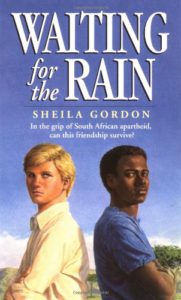
South Africa’s Sheila Gordon on apartheid, and “the pity and pain of how we deal with one another”

June 13th, 2017
Share

A few weeks ago I wrote about the writer Neil Gordon, who died last month. In the course of writing about him, I found an Atlantic interview with his mother, the novelist Sheila Gordon, who died in 2013, also in May. Like mother, like son: “I’m interested in where the personal and the political touch each other, in how prevailing society affects people’s daily lives and relationships,” she said. “While growing up in South Africa I found myself observing an officially sanctioned unjust society, and I could see how everyday lives were shaped by the politics of apartheid. I suppose one’s political and moral commitments are intrinsic to what one writes about. I don’t feel writers are obliged to be more politically committed than other citizens.”

An excerpt:

Q: Do you choose your subjects or do they choose you?

A: When I’m taken with an idea, I write. The length is dictated by the idea itself. Waiting for the Rain, for example, deals with how children regard the “Other,” or those who are different from themselves. The idea for the novel came as I watched on television a group of white soldiers riding into a township to quell an uprising of black schoolchildren. I saw how scared the white soldiers looked; the same fear was on the faces of the black children — who were the same age as the soldiers. I was moved to pity by the situation; these children were pitted against one another by the conditions adults had laid down for them. Out of this brief image the whole novel developed.

She suggested that “perhaps the place of one’s birth is stamped indelibly on one’s sensibility. Africa particularly: there’s something so vast, lonely, dramatic, and primal about that continent. One experiences it vividly and profoundly.”

She concludes, “I don’t think it’s the writer’s job to change people, although I believe that truly good fiction transforms, enriches, heightens awareness. When I write, I’m trying to tell a good story, to reflect on the pity and pain of how we deal with one another, and in a way that will engage the reader’s imagination and heart.”

Read the whole thing here.

On Susan Sontag: “she was always an angry writer”

June 10th, 2017
Share

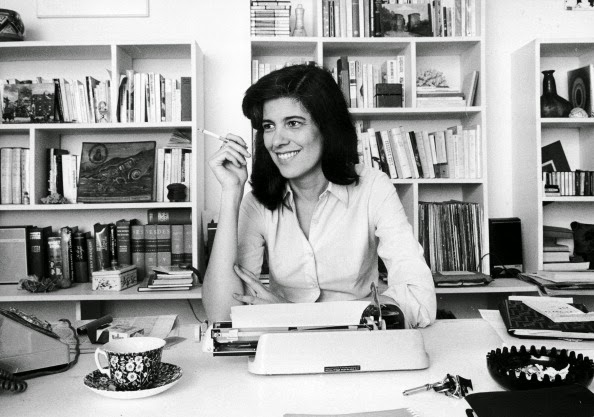
It’s been an angry year for many people the world over. And we can hear that anger as a backdrop to the conversations here, outside Philadelphia, where The Book Haven is otherwise immersed in poetry at the West Chester Poetry Conference this weekend. A few days ago we reposted some remarks by the late Susan Sontag. Here are a few observations about her from Craig Seligman, author of Sontag & Kael: Opposites Attract Me.

Sontag in 1972. The very act of writing implies the opposite of despair.

She never claimed she never erred; in fact, she took pride in correcting her errors. But she was always an angry writer, and her anger angered her readers, roiling around in the mind until – magically – it settled into thought.

She was angry at the philistinism of the consumer culture into which she had the good and bad luck to be born, and what I feel most bereft over is the loss of that anger, since more than ever it seems like the only rational response to the society we live in. One reason, I believe, she so often limited her literary essays to praise was that once she started in the other direction she couldn’t stop. She didn’t handle her anger gracefully. That was why I never thought of her as a great political writer. The greatness was in her cool, hardheaded essays on aesthetic matters; as an aesthete defending the senses against the intellect, the new against the established, silence against noise, she was magnificently coldblooded. But she was hotblooded and hotheaded when she turned to politics. I still find myself backing off nervously from her vitriolic essays and speeches on the Vietnam War, even as I endorse the politics behind them. In those writings, frantic rage (“We are choking with shame and anger”) is motivated by a frantic need: to do something – namely, to stop the war. And for all the incendiary rhetoric, the spewing fury, the bitter eagerness to bite the hand of America, the urgency of the need to halt the war implied a hope – a shred of hope. Something could be done. The war could be stopped.

The political writing of her final years is different. I’m referring to her profoundly humane and reflective 2003 essay “Regarding the Pain of Others,” whose theme was atrocity pictures, and its magisterial pendant — written when she was already sick with the cancer that would, after 30 years, finally kill her – her 2004 essay “Regarding the Torture of Others,” on the Abu Ghraib photographs. The quality of the prose in those writings has changed because the quality of the anger has changed. But given the disheartening events that elicited that shift, not even Sontag — who could talk about cultural achievement with a Nietzschean absolutism that bordered on the callous  could have taken much consolation from her triumph. By 2004, the United States was a society very different from what it had been even during the ugliest years of the Vietnam era, and the rage smoldering beneath every sentence of that great, judgmental final essay was a different order of rage: a rage without hope. Speaking out, speaking angrily no longer had a goal so simple as stopping the war, because the war was, in the phrase she hammered at with disquieting control, an “endless war.” “The torture of prisoners is not an aberration.” “The photographs are us.”

Those are despairing words, and since November that despair has become widely shared. But despair isn’t really a Sontagian emotion. It’s worth noting that her repeated “endless war” carefully avoids the easy, even useful echo of Orwell’s “permanent war”; the conditions of “1984” don’t exactly apply to the current situation. It’s worth further noting that this kind of care with words implies the opposite of despair. The very act of writing implies the opposite of despair.

Read it here, with more reminiscences than these.

“We don’t lead global lives!” Dana Gioia gives a passionate defense of the arts at inaugural Sierra poetry festival

June 6th, 2017
Share


Dana Gioia_5

California state poet laureate launches the first-ever Sierra Poetry Festival. (Photo: Radu Sava)

Dana Gioia, California’s poetry laureate, vowed to visit each of California’s 58 counties, and by gum he’s keeping his word. He’s visited Los Angeles County, 9.11 million, and Alpine County, 1,114. He also helped launch the first-ever Sierra Poetry Festival in Grass Valley in April (that means he gets to check off Nevada County on his list). While there, he gave perhaps the most passionate and eloquent defense of the arts, literature, and poetry I’ve ever heard.

Sierra Poetry_1

Poet from afar: U.K.’s Mel Pryor leads a workshop at Sierra festival. (Photo: Radu Sava)

The former chairman of the National Endowment of the Arts lauded the people gathered in the room, some of whom had come from some distance and personal sacrifice, praising them as people who have “dedicated significant part of our lives, in a broader sense, to something our society doesn’t much value. We are people at odds with the values that are trumpeted around us in the media.”

Those values, he said, could be summarized in three terms: “money, power, and other visible forms of social status.” That’s why, he said of one of his predecessors as state poet laureate, Al Young, who was in the audience “operated at a level any celebrity chef would look down upon.”

He countered society’s values with “three words our society is suspicious of, and professors of literature absolutely hate: beauty, truth, goodness. Are there three more discredited words in our society?”

Dana cited Robert Frost‘s words, that a contemplation of stillness moves you from delight to wisdom. “That is what it’s about. To make something that is beautiful. … to get something right.”
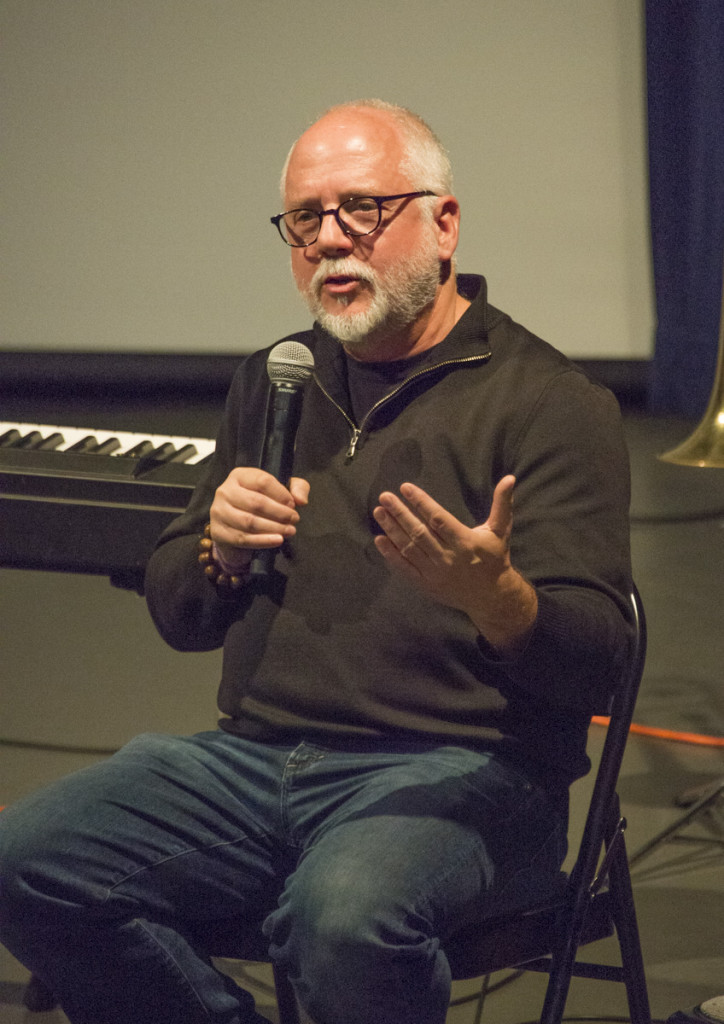
Sierra Poetry_12

Pablo Frasconi on William Everson (Photo: Radu Sava)

Intellectual rationales don’t capture the motivation that drives us. The real reasons, he said, are “experiential” – “to restore our souls, to give us a drink of what refreshes us.”

“We bear a certain kind of spiritual wisdom,” he said. “It’s something that happened to all of us. We saw and experienced, at a really very early age, the transformation that beauty affords. We encountered things that changed who we were.”

“You have this beauty, which leads to joy, which becomes wisdom, which becomes a kind of helpful humility about what you can possess, and where and what you are. That has happened to everyone in this room repeatedly. Once you experience that, you want more. You will bring yourself at great expense and great difficulty” to those places that provide such occasions, whether Yosemite, the National Gallery of Art, or a small poetry celebration in the Sierra Foothills.

“It awakens you to the full possibilities of your own humanity,” he said. “What we are sold by society are generic, prepackaged versions of what our lives should be and how we should experience them– and what it’s going to cost us to have those predictable experiences,” he said. “Apple, Amazon, Netflex: they don’t want beauty, they want to own beauty. They ‘like’ art, they want to own art – and turn it into entertainment.”

“They want to take all the unknowns and pre-package them, and sell them as a predictable product that they can own as a kind of property. We’re rather helpless and hopeless in front of this enormous global power which is trying to narrow and define our lives in ways that are not the way we want to live. It’s not the kind of mystery that has to unfold unpredictably and personally,” he said. “Joy is something I cannot own.”

“We don’t lead global lives. We don’t lead generic lives.” Speaking for myself (and the Book Haven), that’s one reason why I’m so uncomfortable about the politicization of our culture, which is another attempt to co-opt the private sphere, the personal “aha” into a collective, ready-made experience, which is necessarily narrower and more generic. This trend, of course, is accelerated by the social media, by television, and even by our academic institutions.

Dana Gioia_11

“The battles are mostly local.” (Photo: Radu Sava)

I was happy to hear, at the end of the day, Dana’s eloquent championing of the writer William Everson, in an onstage conversation with filmmaker Pablo Frasconi, who is doing a film on the too little-known poet of the San Francisco Renaissance.

During the morning address, Dana also mentioned Everson, recalling his frequent misrepresentation and neglect over the years. It returned him to his main line of thought: In his research, he recalled a Poetry Foundation article that was riddled with errors, and noted that, in 1947, Everson became “a poet of national importance.”

“What the hell does that mean?” Dana asked. “Poetry is not something that happens and is judged in New York or Paris or London. We lead our lives in a particular place, in a particular time, in a particular body.”

“We have battles to defend that. The battles are mostly local. Why is there no arts education in local schools? It’s not because anyone in Washington made that decision.” Those decisions are made at the city and county level.

Yet an education in poetry, literature, the arts, is the way we shape our students’ emotions and intuition, he continued. “To produce people who are not educated in that experiential part of their humanity,” he said, is to process students who are “not educated, not able to take their particular life into a complicated society in the complicated business of living to have a productive life.”

Dana & Cynthia

Dana poses for a photo with Humble Moi, with flowers by the matchless Eliza Tudor, who organized the event. (Photo: Mary Gioia)

“We are here because we know these things are of value,” he said to the audience. “It rests on us unfortunately to communicate those beliefs to society, be it in the U.S. senate and House of Representatives, where unfortunately I have spent a great deal of my energy and time in the last three months – not to mention the previous decade – or the local schools boards or county supervisors.”

May the Book Haven add a note to this? Too often, arts education has yielded to a wrong-headed notion of self-expression, rather than as an apprenticeship to something more enduring and more profound than the limited ego and short-lived self. For example, it is a lesson in humility to write write essays, articles, even blogposts, and then read Great Expectations on the train, or memorize Shakespeare on the elliptical, just as it must be for an artist (or anyone else really) to study Giotto before returning to the commercial art studio. It subsumes us into something greater than ourselves, and one is happy to put a nail into the most obscure cupola in the magnificent edifice of civilization. It teaches one humility, and we could all use a little o’ that.

“I love California, I want to see every corner of California. Every place matters,” said the Angelino poet as he concluded his remarks. And a few hours later he hit the road again. I got an email from him a little while later – he’d traveled over a thousand miles by car in the past ten days, not counting flights to and from Los Angeles, where he currently holds the Judge Widney Professor of Poetry and Public Culture at the University of Southern California.

Listen to his whole talk here. Kudos to Eliza TudorExecutive Director of Nevada County Arts Council, for pulling off a smashing launch of a promising annual event. And congratulations to Molly Fisk, Nevada County’s inaugural poet laureate!

 

Want to be an investment banker? Read Shakespeare.

June 1st, 2017
Share
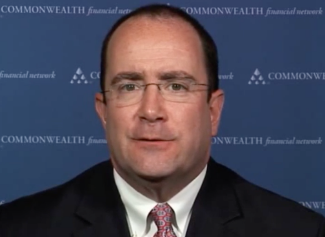
McMillan

Yeah, him.

Brad McMillan is the chief investment officer at Commonwealth Financial Network, which oversees about $114 billion – and he thinks it’s time to hit the books. In an interview in Business Insider, he said this:

“You need to read [Edward] Gibbon‘s The History of the Decline and Fall of the Roman Empire. Read Shakespeare. There’s more in Shakespeare about power, decision-making, ambition, and how people are blinded by their own needs that’s so incredibly applicable to the investment process. To see it in that context is something that makes it real. It’s not about the P/E ratio. Sure, you need to know that. But ultimately, it’s about the people that are investing.

“If you read writing done by Warren Buffett, Charlie Munger, and Howard Marks, they obviously have the technical fundamentals in place. But what they’re focused on is how to think, how to analyze a situation, and how to understand where we are in light of where we’ve been. In order to do that, you need a much broader context than the investment universe.”

Harumph.

Yeah, him too.

“While technical knowledge is essential, a broader knowledge base is what takes you to the next level. Read history, read literature, understand how people think, and how they’ve acted in the past. Markets are all about people. Technical knowledge alone is not enough.

The Book Haven could have told him that, and more. As Susan Sontag said: “Well, reading must seem to some people like an escape. But I really do think it’s necessary if you want to have a full life. It keeps you–well, I don’t want to say honest, but something that’s almost the equivalent. It reminds you of standards: standards of elegance, of feeling, of seriousness, of sarcasm, or whatever. It reminds you that there is more than you, better than you.” Read more about that here.

Lonesome George’s lesson: light verse is not always a laughing matter.

May 30th, 2017
Share
George

A lonely life on the Galapagos for George (Photo: Mike Weston)

Two friends have the spotlight today: Patrick Kurp, one of our favorite bloggers over at the incomparable Anecdotal Evidence, writes about the poet X.J. Kennedy, who turns 88 this year in the today’s Los Angeles Review of Books. The review, “‘A Sweetness in This Sense’: On X. J. Kennedy’s That Swing: Poems, 2008–2016,” spotlights the latest collection of his poems. Well, we’ve written Joe Kennedy’s thoughts about aging here, on the occasion of one of his previous birthdays. And we’ll most likely have more to say about him after the West Chester Poetry Conference next month, where he will be a guest of honor. 

Here’s what Patrick has to say about Joe, aging, and the light verse for which the poet is renowned:

thatswing“Kennedy’s standing as a poet recalls the late Thomas Berger’s as a novelist. Berger, the author of some of the funniest novels in the language, always denied being a comic writer, because, in our culture, humor is regarded as suspiciously frivolous. But consider the serious humor of Kennedy’s “Lonesome George,” devoted to a giant tortoise, the last of its species, kept in a pen at the Charles Darwin Research Station in the Galápagos Islands:

No mate for him exists.
.  Last one of his subspecies,
he solemnly persists
.  in turning into feces
eelgrass brown and dry,
.  spine-sprinkled cactus leaves.
Straining to gulp a fly,
.  dejectedly retrieves
blunt head. Dead-ending male,
.  lone emblem of despair,
he slumps on his kneecaps, his tail
.  antennaing the air.
For a long moment we bind
.  sympathetic looks,
we holdouts of our kind,
.  like rhymed lines, printed books.

XJKennedy

Da man.

“Lonesome George, like his author, persists in doing what he does best, and without self-pity. Humor has many timbres and tones, and Kennedy plays with most of them, from the scatological to rarefied wit. Has anyone before him rhymed “subspecies” and “feces”? Kennedy’s gift for concision is a marvel (the meeting of poet and tortoise could easily be a fleshed-out essay or story, and much would be lost), as is the way he bends and shapes his basic iambic trimeter line. In a note to the poem, Kennedy, who visited George in 2011, delivers the punch line: “In June 2012, a few days after this poem appeared in a magazine, George died, leaving no progeny.” Light verse isn’t always a laughing matter.”

Read the whole thing here.


<<< Previous Series of PostssepNext Series of Posts >>>