Remembering Martin Amis: “It’s the deaths of others that kill you in the end.”

May 24th, 2023


Share
Martin Amis: He didn’t smile for the camera … any camera… (Photo: Bryan Appleyard)

Never met Martin Amis in person, but I was a dozen feet away from him eleven years ago at Stanford’s Cemex auditorium – and wrote about it here. “As you get older – and this has to be faced – most writers go off,” said.  “I lay the blame at the feet of medical science.”

He cited W.B. Yeats: “Now I may wither into the truth,” he said. But although occasionally withering, he was far from withered. I wrote about him here and here and here, among other places.

In a puzzling move, he began the evening by recounting long lists of Nazi atrocities – a return to Time’s Arrow.  The subject matter is timeless, he said, and defies “that greasy little word – closure.”  (Fine.  About time someone took that cliché down.) “Rule Number One:  Nobody gets over anything.  It’s the deaths of others that kill you in the end.”

He was already thinking about death, and he died on May 19, of esophageal cancer, the same disease that claimed his friend, the author and journalist Christopher Hitchens, in 2011.

From Boyd Tonkin, writing in The Guardian, about the “writer whose acrobatic wit defied gravity and solemnity and who epitomised literary fame in an age of glitz and hype.”

“The writer Martin Amis, who has died aged 73, delighted, provoked, inspired and outraged readers of his fiction, reportage and memoirs across a literary career that set off like a rocket and went on to dazzle, streak and burn for almost 50 years. His scintillating verbal artistry, satirical audacity and sheer imaginative verve at every level from word-choice to plot-shape announced a blazing, once-in-a-generation talent.”

Read the rest here. A few words from a few who knew him. From the journalist and author Bryan Appleyard:

I saw Martin Amis in Brooklyn in 2014 and took this photo (above). I asked him to smile but he said he could not act. He had asked me to bring him a packet of rolling tobacco from London. I took him two packets. He smoked incessantly. In some interviews it looked as if his trousers were on fire. He died of esophageal cancer. He was a dazzling writer and deserves all the tributes and more. RIP

From the Hungarian poet and translator George Szirtes:

It’s oddly shocking to hear of the death of Martin Amis. A certain energy, a bullish certainty, a kind of headlong barrage of wit and Eighties street-wisdom passes with him. As a public figure he was almost more than himself. He was just a few months younger than me and he always seemed young. I met him only once when we were seated next to each other at a dinner in Manchester though I can’t remember what the occasion was. We talked a little about Thomas Hardy‘s poetry and Philip Larkin‘s too. He quoted chunks. He was friendly and mild and sad, possibly rueful. Novelists – did he say poets too? – should stop writing before they get old, he sighed. He was not joking. He had crashed out of critical adulation by then. The new wave of feminist writers had little time for him and his prestige counted against him. The £500,000 advance, the affair of the new teeth (reminds me I am back at the dentist on Monday), the book on Stalin, and the strange Booker-listing of Time’s Arrow, which – for me – was him at his brilliant but preening worst in the worst of all causes, did seem to hollow him out a little. But Money, for example, remains the work of a stunningly vivid writer. There also remains the image of the Fenton-Hitchens-Amis intellectual triumvirate with Fenton, in my view, the most princely of poets and Hitchens the most entertaining and commanding of polemicists. I imagine Clive James and John Fuller standing in the wings. And there also remains the suggestion – whose, I don’t remember – that the Eighties explosion of so-called ‘Martian’ poetry, referred to as Martianism, was so named as an anagram of Martin Amis, either that or (more likely) that it was a reference to Craig Raine‘s book of poems, A Martian Sends a Postcard Home (1979). Much remains in other words. I liked the weary, rueful man at the Manchester dinner table and I do feel a sense of shock that he is gone. A slice of historical voice is gone with him. He was not an old man but a young man grown older.

From the Polish poet, literary critic, translator, and essayist Jerzy Jarniewicz

Martin Amis, author of, among others, London Fields, The Information, and Time’s Arrow, has died; also (although he did not write poems himself) co-founder of the poetic school called the “Martian School.” There is a well-known tale about fools who wanted to see the moon, and when someone finally pointed at it, they looked at the pointing finger. I’d say that Martin Amis was looking at his finger – not because, however, like this fool, he didn’t know that it was pointing at the moon – but because he was more interested in his fingers than blue bodies suspended far away in space. Especially since the father’s generation made him look at the moon for a long time. I wrote about Amis (father and son) in the “Attendance Note,” where you can also find a conversation that we had with Peter Sommer in November 1995.

Scott Timberg and “Boom Times at the End of the World”: the future that none of us wanted

May 15th, 2023
Share
Leading chronicler and champion

“Humans doing the hard jobs on minimum wage while the robots write poetry and paint is not the future I wanted,” wrote architect, satirist, and cartoonist Karl Sharro on Twitter today. It’s not the future anyone wanted, but here we are.

Perhaps no one foresaw our civilizational predicament with such clarity and eloquence as the late award-winning music and cultural critic Scott Timberg.

I’ve written before about the Stanford-born author of Culture Crash: The Killing of the Creative Class (Yale University Press), whose 2019 suicide at the age of 50 dismayed not only his friends and family, but writers, artists, editors, and critics everywhere. (Go here and here.) Now we have a collection of his best essays as well.

“For many of us, Scott’s death revealed uncanny and disturbing connections with his professional life over the last decade, when he emerged as our leading chronicler and champion of creative professionals who had been squeezed and displaced in the ‘culture business,'” writes Ted Gioia in his eloquent introduction to Boom Times at the End of the World, just published by Heyday Books (Berkeley). If you want to read some of his music writing, go to the chapters on Glenn Gould or Gustvo Dudamel. If you want to understand his concern with the collapse of culture and media, you can read his essay, “How the Village Voice and Other Alt-Weeklies Lost Their Voice.” There’s lots to choose from.

Timberg writes:

My path into the creative class – as an observing reporter – was pretty typical. Growing up a middle-class kid, I had no illusion that I’d ever become wealthy, but I had a sense that I could get really good at something if I worked as hard as I could and surrounded myself with what someone once called – in a phrase that now sounds antique – the best that has been thought and said. Mine was a pragmatic, find-a-summer-job, get-Triple-A-and-change-your-oil-regularly kind of family. But there was also a respect for culture. Reading James Joyce‘s Dubliners showed me a new way to see: there was a world behind the world that you could discern if you squinted just right. …

But I’m telling this story not because of what happened to me, or what happened to my friends. … And while the Internet and other digital innovations had taken a huge bite out of some professions – disemboweling the music industry, for instance, though both piracy and entirely legal means – this was about more than just technology. Some of the causes were as new as file sharing; others were older than the nation. Some were cyclical, and would pass in a few years; others were structural and would get worse with time. There was a larger nexus at work – factors, in some cases unrelated ones, that had come together in the first decades of the twenty-first century to eviscerate the creative class.

As someone who has shared his struggles to make a living in the collapsing world of cultural journalism, I wanted to focus in this blogpost on his own journey in “Down We Go Together,” beginning in 2008, the year the housing bubble burst, as he was in Portland. He got the phone call so many of us dread (always assuming we have a house in the first place):

Then my cell phone rang, the face of my wife back home in Los Angeles showing up on its small screen. She didn’t waste time. “The bank,” she said, “is suing us.” She’d woken up to a courier posting a note on our front door. “I’m sorry,” was all he said before taking off. Pulling the photocopied forms off our door – in triplicate – she saw that one of the largest banks in the world had initiated legal action to take our little house from us. …

Timberg describes a world in which supporting players are being forced out of the culture industry, and hence “too much quality art becomes a tree falling in empty woods, and each artist, regardless of temperament, must become his or her own producer, promoter, and publicist.”

“These changes have undermined the way culture has been created for the past two centuries, crippling the economic prospects of not only artists but also the many people who supported and spread their work, and nothing yet has taken its place. The price we ultimately pay is in the decline of art itself, diminishing understanding of ourselves, one another, and the eternal human spirit.”

The book is on Amazon of course, here – but you can also purchase directly through Heyday here.

Simone Weil: Be careful with words. It may save lives.

May 8th, 2023
Share
Author Down Under: Chris Fleming

Simone Weil’s “Ne recommençons pas la guerre de Troie” was published in Écrits historiques et politiques (Gallimard: 1979, pp.257-8). This post was translated by Australian author and scholar Chris Fleming. He’s done guest post here and here, and we’ve written about him here. Simone Weil actually entered the public domain in 2014, which a good thing for all of us. The more we can spread her words the better. Here are a few:

The Greeks and Trojans massacred one another for ten years on account of Helen. Not one of them, except the amateur warrior Paris, cared one iota about her. All of them agreed in wishing she’d never been born. The person of Helen was so obviously out of scale with this gigantic battle that, in the eyes of all, she was no more than the symbol of what was actually at stake; but what was at stake was never defined by anyone, nor could it be, because it did not exist. Thus, it couldn’t be calculated. Its importance was simply imagined as corresponding to the deaths incurred and the massacres expected. From then on, its importance exceeded any assignable limit. Hector foresaw that his city would be destroyed, his father and brothers massacred, his wife degraded by a slavery worse than death. Achilles knew that he was condemning his father to the miseries and humiliations of a defenceless old age; the populace were aware that their homes would be destroyed by them being so long long absent; yet, none thought the cost was too great, because they were all pursuing a nothingness whose only value was in the price paid for it. When the Greeks began to think of returning to their homes it seemed to Minerva and Ulysses that reminding them of the suf­ferings of their dead comrades would be sufficient to shame them…. Nowadays the popular mind has an explanation for this sombre relentlessness in accumulating useless ruins; it imagines the supposed machinations of economic interests. But there is no need to look so far. In the time of Homer‘s Greeks there were no organized bronze merchants nor a Committee of Blacksmiths. The truth is that in the minds of Homer’s contemporaries, the role which we attribute to mysterious economic oligarchies were attributed to the gods of the Greek mythology. But there is no need of gods or conspiracies to force humans into the most absurd catastrophes. Human nature will suffice.

“We don’t need words to make us stupid.”

For the clear-sighted, there is no more distressing symptom today than the unreal character of most of the conflicts that are emerging. They have even less reality than the war between the Greeks and Trojans. At the heart of the Trojan War there was at least a woman and, what is more, a perfectly beautiful one. For our contemporaries, the role of Helen is played by words with capital letters. If we grasp one of these words, all swollen with blood and tears, and squeeze it, we’ll find that it is empty. Words that have content and meaning are not murderous. If sometimes one of them becomes mixed up with bloodshed, it is rather by accident than by inevitability, and the resulting action is generally limited and efficacious. But when we capitalise words devoid of meaning, then, on the slightest pretext, men will shed streams of blood for them, will pile up ruin upon ruin by repeating them, without effectively grasping anything to which they refer, since what they correspond to possesses no reality, since they mean nothing. In these conditions, the only definition of success is to crush a rivals who claim enemy words; for it is a characteristic of these words that they live in antagonistic pairs. Of course, that all of these words are intrinsically meaningless; some of would have meaning if we took the trouble to define them properly. But a word thus defined loses its capital letter and can no longer serve either as a flag or hold its place amidst the clanking of enemy slogans; it becomes simply a sign to help us grasp some concrete reality, a concrete objec­tive, or method of action. To clarify ideas, to discredit congenitally empty words, and to define the use of others by precise analyses – to do this, strange though it may seem, might be a way of saving human lives.”

Postscript from Chris Fleming: “What first strikes me in this essay is the clarity and moral intensity of Weil’s voice. And this is combined with a kind of analytic rigor which avoids all easy partisanship; there are no set targets in her piece, no free passes or ways in which we can say “they (over there) are the problem.” And what also strikes me, no doubt, is that what she says seems both true and shockingly contemporary: that we are prone to be shamed into conflicts over almost nothing, that we will fight not so much as the result of a just cause, but that the fighting itself will somehow justify that cause during and after the fact – that we will shed blood in defence less of ideals than words, words whose substance turns to vapour upon closer examination.”

In the original French below the fold…

Put Mikhail Iossel, a stranger, and Hannah Arendt into a shaker and what do you get? One odd conversation.

May 4th, 2023
Share
Soviet-born

Mikhail Iossel, author of Every Hunter Wants to Know: A Leningrad Life and contributor to The New Yorker, was born in the Soviet Union. Two years after his 1986 arrival the U.S., he began writing in English. Now he writes in both English and Russian … in Montreal. He’s also a former Wallace Stegner Fellow in Fiction at Stanford. All that’s bound to give him an unusual perspective, and sometimes makes for an odd conversation, too. Here’s one brief one:

Recently in a conversation at a social gathering (god knows, I love those), a young man I hadn’t met before told me he wanted to be a prominent American poet.

How prominent? I asked him.

Well, prominent prominent, you know, he replied. Prominent, you know. It’s just a word.

I merely would like to understand the gradations of prominence here, I explained. Prominent to the point of selling out Madison Square Garden with an evening of your poetry – or prominent enough to be a reasonable potential contender for a tenure-track position of an assistant professor of English at East-West Podunk Hollow State College?

The second, he said, after a thought.

Then another man, still young but older than the first, slightly unsteady on his feet and with a drink of scotch in his hand, joined us and, staring off into space meaningfully, said that he found it difficult to love the world as it is, with all the horrible and evil stuff and all the injustice taking place in it.

I don’t have a problem with her, either.

I was kinda quoting Hannah Arendt, if you’d like to know, he added in a somewhat wounded tone, fixing his diffuse gaze on me, when we said nothing in response to that statement of his. Do you have a problem with Hannah Arendt?

I don’t have a problem with Hannah Arendt. I have zero problem with Hannah Arendt. I respect Hannah Arendt.

She also said that one doesn’t always have to speak, I told him, and he immediately took it personally and was up in my face and wanted to know what I meant by that and whether maybe I would like to take it outside.

At that point, his wife, suddenly materializing by his side with an apologetic smile, took him by the elbow and led him away.

One person was there with a dachshund. A very pretty little thing, turbo-charged, toffee-colored. Extremely friendly. It later peed on the floor. I forget the name.

Are Stendhal and Shakespeare ready for the world of AI? Mike Gioia says “yes”!

May 1st, 2023
Share
Bringing Stendhal to the 21st century


Entrepreneur
Mike Gioia wants to broaden the reach of poetry through digital media. That’s why he created a poetry film studio called Blank Verse Films (you can find them on YouTube here), where he experimented with new, ambitious ways to bring poetry to audiences by adapting it into short films. He also founded a generative AI company called Pickaxe.

Name sound familiar? It should. He is the son poet Dana Gioia, former National Endowment for the Arts chair and former California poet laureate. I’ve written about him countless times on the Book Haven, for example here and here and here. Type in the search box for more.

Mike and I have something important in common: both of us share a love of literature and the humanities. Moreover, we’ve both received Emergent Ventures grants from the Mercatus Center, the creation of Tyler Cowen. Mike is one of the most recently honored by the grant program.

I’m a big advocate of video as a mass education tool and way to reach a broader audience,” he says. “I pushed my to dad to film and publish all the poetry videos on his YouTube channel.” (You can watch them here.) “I’m focused on making super powerful tools like Large Language Models accessible to ordinary people through good, simple design and practical applications.”

From Mike:

I’ll win Book Haven readers’ trust with an uncontroversial opinion: reading Shakespeare is enjoyable and worthwhile. And now I’ll lose you entirely: we should read Shakespeare with AI. 

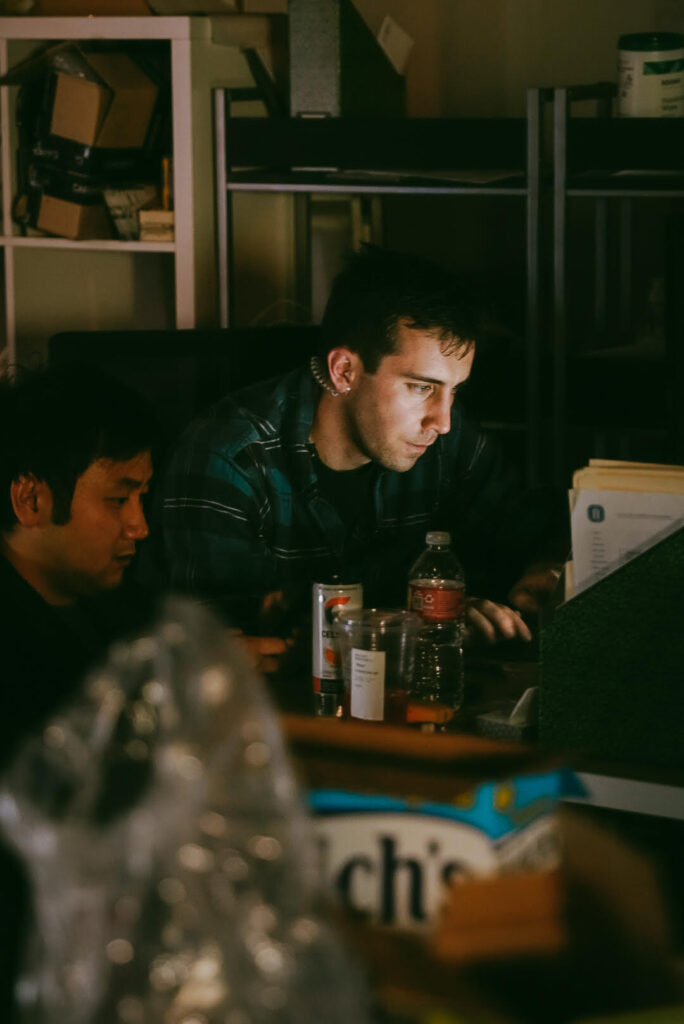
On set of a comedy pilot, watching the director’s monitor.

Recently, I’ve been reading with the assistance of Large Language Models (abbreviated to LLMs). These are AIs that can process and generate text. 

When I use LLMs to read, I’m still reading. But AI is on the sideline to contextualize anything I want, transform paragraphs into new shapes, or even offer an opinion. LLMs are models trained on the entirety of humanity’s literary output with the goal of “predicting the next token” in any sequence of text. In other words, they’re super intelligent auto-complete systems. It’s surprising how agile these models are with such a narrow mission. They can simplify complex ideas, modernize archaic expressions, and even transform subjective prose into objective statements. This versatility proves invaluable when reading texts that may be challenging due to historical or cultural contexts. 

Take the example of French realist novels. I’ve always loved The Red and the Black by Stendhal, but my less than impeccable knowledge of the Bourbon Restoration in French made me suspicious I was missing context. So I created an AI tool with the instructions: “Please explain any context necessary for a modern reader to better understand the following text from Stendhal’s The Red and the Black.” 

Here’s the opening of Stendhal’s novel: 

The little town of Verrières can pass for one of the prettiest in Franche-Comté. Its white houses with their pointed red-tiled roofs stretch along the slope of a hill, whose slightest undulations are marked by groups of vigorous chestnuts. The Doubs flows to within some hundred feet above its fortifications, which were built long ago by the Spaniards, and are now in ruins. Verrières is sheltered on the north by a high mountain which is one of the branches of the Jura. The jagged peaks of the Verra are covered with snow from the beginning of the October frosts. A torrent which rushes down from the mountains traverses Verrières before throwing itself into the Doubs, and supplies the motive power for a great number of saw mills. The industry is very simple, and secures a certain prosperity to the majority of the inhabitants who are more peasant than bourgeois. It is not, however, the wood saws which have enriched this little town. It is the manufacture of painted tiles, called Mulhouse tiles, that is responsible for that general affluence which has caused the façades of nearly all the houses in Verrières to be rebuilt since the fall of Napoleon.

And here’s the context my tool gave me: 

To better understand this passage from Stendhal’s The Red and the Black, it is important to consider both the historical context and Stendhal’s literary style.

Historical context:

Mike Gioia directing on set.

–– Franche-Comté: Franche-Comté is a historical region in eastern France, bordering Switzerland. It was an important strategic location between France and the Holy Roman Empire during the 17th and 18th centuries. The region was known for its natural beauty, which Stendhal describes vividly in this passage.

–– The fortifications built by the Spaniards: During the 16th century, Franche-Comté was controlled by Spain as part of their Habsburg territories. Spanish forces constructed numerous fortifications throughout the region, including at Verrières, as a way of establishing their dominance.

This context is several steps more specific and more useful than writing a comparable google query. I was able to get this information within seconds without much effort. 

Now, there’s an obvious objection that using AI to translate classic works degrades the action of reading. This perspective misconstrues the role of AI in reading. In most cases, AI should be seen as an augmentation for an activity rather than a replacement for it. AI reading co-pilots promise to drastically expand the readership of many older literary classics. The opportunity to grow audiences is especially exciting with Shakespeare. While Shakespeare perseveres to become a favorite of anyone who gives him a fair try, for a lot of readers the Elizabethan language is a barrier to entry. Phrased more bluntly, Shakespeare is hard to read for first time readers! When they get it, they love it. But they have to get it first.

I’ve always maintained that the message of poetry is universal. And I’ve done a lot of work to bring poetry to wider audiences. It’s with this same mission I sat down to build an AI-powered Shakespeare Translator on Pickaxe to help young readers enjoy the Bard. The tool allows readers to instantly translate any Shakespearean text into modern English. The tool is not rewriting Shakespeare. It’s offering a plain English explanation for any chunk of language that isn’t transparent to a reader. These are not attempts to supplant the original. They present a simple interpretation of the original passage that maintains the original message and themes, and allows readers to return to the original text with enhanced enjoyment. 

Mike encourages everyone and anyone to try it or use it in classrooms. You can try the Shakespeare translator tool on Pickaxe here. Let us know how it goes.

Postscript: “So how does it go?” I asked. Like greased lightening. Mike Gioia is already in The Guardian, as of a few days ago. From the article: “Those who hate AI are insecure’: inside Hollywood’s battle over artificial intelligence”:

Some recent entrants to the AI industry say that the current technology is being overhyped, and its likely impact, particularly on writers, has been exaggerated.

“When people tell me the studios are going to replace writers with AI, to me, that person has never tried to do anything really difficult with large language models,” said Mike Gioia, one of the executives of Pickaxe, a new Chat GPT-based platform for writers with a few hundred paying customers.

He called the idea that AI could produce full scripts “science fiction”.

“The worst-case scenario for writers is that the size of writers rooms is reduced,” he said. …

Writers have made AI central to their strike in part because “it’s a good story”, Gioia argued and partly because they are much less accustomed to being disrupted by technology than other industry workers.

“A lot of people in post-production have lived through multiple technological revolutions in their fields, but writers haven’t lived through a single one,” he said.

Read the whole thing in The Guardian here.

Robert Harrison to explore “critical frontiers” in Cambridge’s Clark Lectures, May 9-18

April 30th, 2023
Share
Courting adventure and possible disaster


LINKS TO THE LECTURES:
Lecture 1: The Thin Blue Line here.
Lecture 2: Mysteries of the Plainosphere here.
Lecture 3: Tellurian Symbols here.
Lecture 4: On Separation
here .

Stanford’s Robert Pogue Harrison is the Clark Lecturer at Trinity College, Cambridge, this year – an important honor. In preparation for the lectures (the theme will be “thresholds”), he had a Q&A interview that was published on the Trinity College website. Read the whole thing here; excerpt below. He says: “The more deeply you explore the western canon, the more you realize how liberating and revolutionary it really is.”

Tell us a bit more about the theme of your lectures: why ‘thresholds’?

Thresholds both separate and relate what they come between. In my Clark Lectures I will examine a variety of thresholds: between the finite and the infinite, the terrestrial and extraterrestrial, the living and the dead, the apparent and the nonapparent. In an essay called “The Psychology of Places” (1910), the British writer and outdoorsman Algernon Blackwood wrote that “the threshold is ever the critical frontier that invites adventure and therefore possible disaster. The psychical aspect of a threshold is essentially thrilling.” He advises campers never to pitch camp on the edge of anything: “put your tent in the wood or out of it but never on the borderland between the two, since that is not a place of rest but of activity.” I choose not to follow his advice in my lectures but to court adventure and possible disaster by seeking out different types of edges where things get critical as well as thrilling…

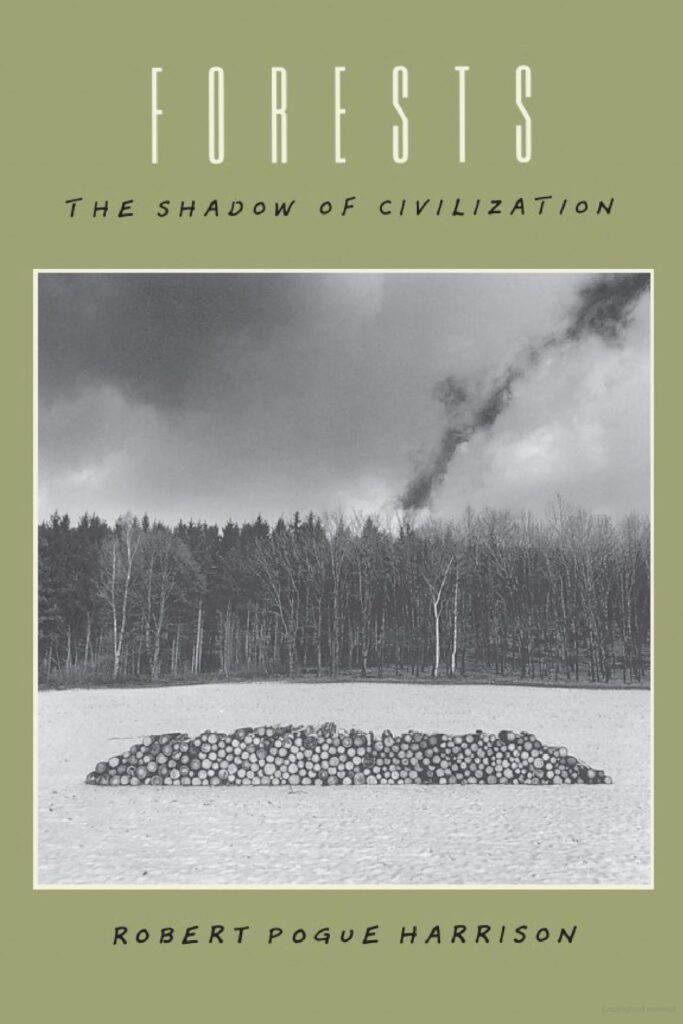
You wrote Forests: The Shadow of Civilization over 30 years ago now and it has only grown in relevance. How differently would you write it now, if at all?

It’s quite amazing for me to remember how, when I was writing Forests (University of Chicago Press, 2009), most of my friends and colleagues thought I was crazy to pursue such a project and endanger my academic career by defying academic genres and specialization. I was young enough at the time to take that risk, yet even more than that, Forests was a book that wanted to be written. Some books write themselves almost independently of their authors.  At least that is the experience I had during the years in which I labored over this selective history of forests in the western imagination.  I’m sure there are any number of ways Forests could be profitably revised, supplemented, or reconfigured, yet I would not know how to change a word of it, given that I do not really consider myself its author, if by authorship we mean ownership of a book’s contents and manner of expression.

Your work covers what was once called, without challenge or embarrassment, the whole canon of Western literature. Is the idea of such a canon still defensible?

According to the idea of translatio imperii, western civilization has been on a westward course for quite some time. I live at the western edge of the western world, in a place called California.  From this edge, it seems to me that the western canon is poised for “a new birth of freedom,” to quote Abraham Lincoln. It’s not a question of “defending” it so much as rediscovering its astonishing richness and subversive radicality. The more deeply you explore the western canon, the more you realize how liberating and revolutionary it really is.

The Clark Lectures take place in the Winstanley Lecture Theatre. No booking is required. The website here says they’ll be available online. Watch the website space.

Tuesday 9 May at 5pm: The Thin Blue Line

Thursday 11 May at 5pm: Mysteries of the Phainosphere

Tuesday 16 May at 6pm: Tellurian Symbols

Thursday 18 May at 5pm: On Separation


<<< Previous Series of PostssepNext Series of Posts >>>