
Poet Elizabeth Bishop: “the loneliest person who ever lived.”

March 12th, 2017

Share

bishop-bookIn case you missed it, The New Yorker has a long feature by Claudia Roth Pierpont, “Elizabeth Bishop’s Art of Losing.” It catalogs precisely how much Elizabeth Bishop lost over the course of a lifetime. In one passage, about her unrequited love for a Vassar classmate, Bishop mulls over that vague word in English, “friend,” that can describe Twitter followers you’ve never met or a man you’ve dropped two babies with: “Bishop confided to her notebook a few months earlier, while suffering over Margaret Miller: ‘Name it friendship if you want to—like names of cities printed on maps, the word is much too big, it spreads all over the place, and tells nothing of the actual place it means to name.'”

An excerpt from the New Yorker article, which discusses Megan Marshall’s new biography, Elizabeth Bishop: A Miracle for Breakfast (Houghton Mifflin Harcourt),

Bishop began to travel restlessly—France, Morocco, Spain—at about the time she began to publish, in the mid-thirties. She had no real home, after all. At school, she had always hated holidays, getting through in an empty dormitory or as a friend’s appendage or sometimes just staying in a cheap Boston hotel. Her father’s estate provided enough money so that she didn’t need to work, and the Vassar classmate who did respond to her feelings, Louise Crane, was seriously rich. (The Crane family made paper, including the paper used in dollar bills.) Bishop was attractive to both women and men, sometimes too much so for her own good. In 1935, she turned down a marriage proposal from a young man she had strung along (just in case?) since college. He committed suicide the following year, and a postcard he’d sent her arrived a few days later, inscribed “Elizabeth, Go to hell.”

Louise whisked her off to Florida to recover, and she soon discovered Key West. Still a sleepy backwater of an island, it became her regular haven for nearly a decade, long outlasting the relationship with Louise. Bishop was deeply drawn to islands—places where she felt isolated, solitary, safe. Although she continued to spend time in New York, she hated the city’s pressures. Even having lunch with people from Partisan Review (including [Mary] McCarthy) gave her nightmares. She wrote very slowly, often working on a poem for years, and increasing requests for publication only made her aware of how little she had done. Her finest works of the late thirties were two Kafka-like stories that seem to reflect her emotional state: “The Sea & Its Shore,” in which a man toils to keep a public beach free of ever-accumulating papers, working every night, by lantern light, and trying to make sense of the scraps he finds; and “In Prison,” a condition that the narrator anticipates with relief.

And one more excerpt, on the publication of her collection North & South and her relationship with poet/critic Randall Jarrell:

Reactions to the book itself were mixed, but the most influential voices were highly favorable. Moore, wholly ungrudging, wrote a keen appraisal in The Nation, and Randall Jarrell, the most brilliant critic of the time, set the tone for future evaluations with his praise of Bishop’s “restraint, calm, and proportion,” just as she was entering a period when she seemed to be trying to drink herself to death.

Jarrell gave Bishop another important gift when, in January, 1947, he introduced her to Robert Lowell. Tall, handsomely tousled, and six years Bishop’s junior, Lowell charmed her as no one had since she’d met Moore. Indeed, he soon replaced Moore as her most valued friend, even though his first commercial book, “Lord Weary’s Castle,” also published in 1946, beat out “North & South” for the Pulitzer Prize. Throughout their lives, his work was far more celebrated than hers. Yet any competitiveness was softened by his devotion to her writing, by his eagerness (and ability) to help her in material ways—grants, jobs, reviews—and by an aura of romance, which he perpetuated (Lowell gave pretty much everything an aura of romance) and she indulged. Two years after they met, he nearly proposed; he remembered later that she told him, “When you write my epitaph, you must say I was the loneliest person who ever lived.”

Read the whole thing here.

Pinsky’s “Favorite Poem” comes to Stanford on Thursday night! Be there!

March 8th, 2017
Share

Robert_pinskyEvery U.S. Poet Laureate seems to initiate a project that puts a personal stamp on the office. For Robert Pinsky, it was the Favorite Poem Project. (it has its own website, with videos, here.) Since he’s at Stanford this quarter as a Mohr Visiting Poet (we wrote about that here), he’s brought the latest incarnation of the moveable feast here. The reading will be held on Thursday, March 9th at 7:30 at the Black Community Services Center.
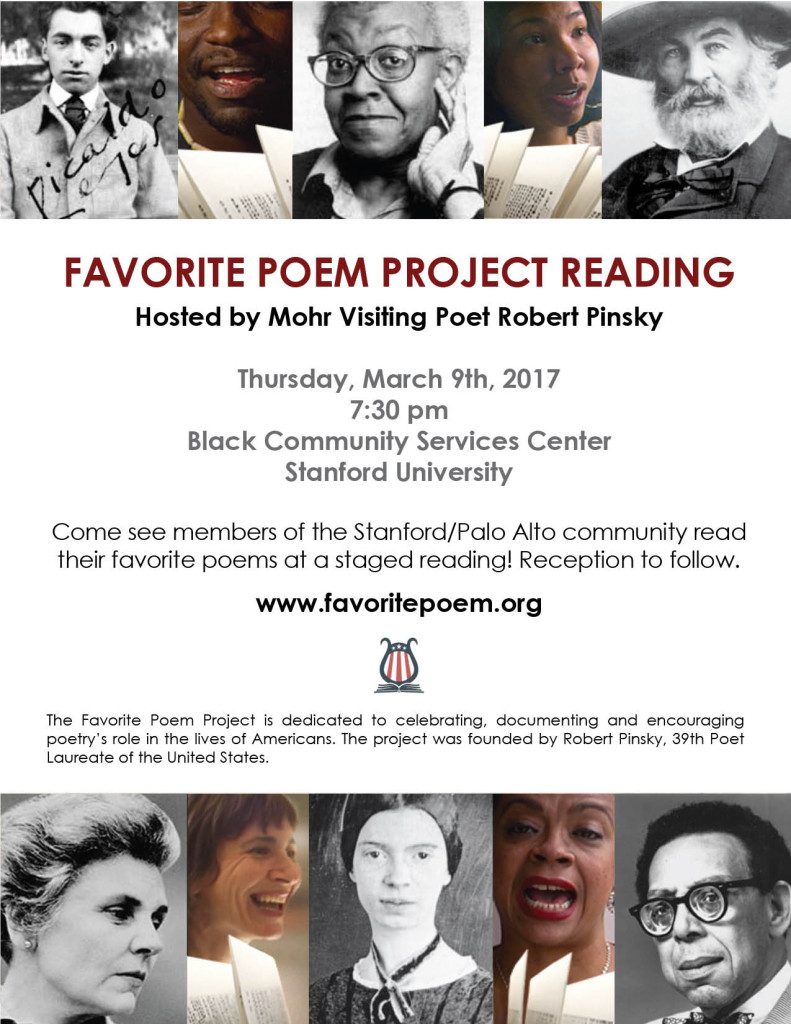
Stanford’s new President Marc Tessier-Lavigne will be reading a poem, too. Join them Thursday night. It should be fun.

The event is free and open to the public. Read more on the electronic poster below.

.

FPP Flier (Larger JPEG)
 .

Farewell to John Felstiner, critic, translator, poet: “an exemplary life in literature”

March 3rd, 2017
Share
resist_felstiners_news

Mary and John Felstiner at their campus home in 2009. (Photo: Linda Cicero)

Literary critic, translator, and poet John Felstiner died last week, on Friday, Feb. 24. He was 80, and had suffered from aphasia for six years. The Stanford professor of English is perhaps best remembered for his book Paul Célan: Poet, Survivor, Jew (Yale, 1997). His translation of Célan’s legendary poem, “Todesfuge,” is widely considered a masterpiece in itself (read more about his translation of the poem here). He is remembered by colleagues for his passion, humor, and fierce intelligence.

Don Share, poet and editor of the nation’s preeminent Poetry magazine, praised “an exemplary life in literature.”

felstiner

Exemplary. (Photo: L.A. Cicero)

“As [poet/translator] Michael Hofmann put it, his book Paul Célan: Poet, Survivor, Jew was ‘of inestimable value to anyone wanting to read Célan with understanding.’ That’s because John didn’t just translate the work, he translated the life – both difficult to narrate, but he succeeded. It should also be remembered that Felsteiner’s scholarly and literary service extended to the likes of work on Henry James, Max Beerbohm, Pablo Neruda, Franz Kafka, and editing collections of nature poems and Jewish-American literature, just to give a sampling.”

He was also known for his book Can Poetry Save the Earth? A Field Guide to Nature Poems (Yale University Press), published in time for Earth Day, April 22, 2009. An NPR interview here; I wrote about the book here. An excerpt:

I’m not a scientist or a policymaker, I’m not a nature writer,” he said, deciding that he must be an environmentalist “for fear of being irrelevant.”

“In fact, environmental urgency trumps everything else,” he said. “I say that with due respect to the horrible tragedies happening all over the world.”

He began to wonder how he could use poetry about nature to reach people, using “the pleasure of poetry to reach their consciousness, and their consciousness to reach their conscience.”

“What’s the transition from consciousness to conscience—so that you will never drop an empty beer can in a bush?” he said.

The book that emerged from his labors—including six years teaching the Introduction to the Humanities course titled Literature into Life—took nine years to write.

At that time, I had interviewed John over the phone – he was at the couples’ home in the Santa Cruz mountains. But I interviewed both Mary and John face to face when I interviewed John and his wife, Mary Felstiner, a visiting professor in history, about a course they were teaching a course on what they called “creative resistance” during the Holocaust. They had given a talk at Stanford Hillel’s Koret Pavilion on their research.

What I wrote:

“People are so focused on the tragedy of the Holocaust – or if they think of resistance, it’s of armed resistance – that it’s so easy for humanities and arts and letters to get forgotten. Yet that’s what makes us human beings,” said John Felstiner their campus home.

The team is well positioned to map out this new branch of scholarship: He is the lauded translator and biographer of poet Paul Célan (1920-70). She is the acclaimed biographer of Charlotte Salomon (1917-43) in To Paint Her Life: Charlotte Salomon in the Nazi Era.

celan-bookThe common feature of creative resistance, said Mary Felstiner, “is that pushing into the future, that sense that we need to mark this moment because there must be a future out there that will look back on us.”

The Felstiners’ investigations show that an explosion of drawings, paintings, music, writing, even graffiti was “pervasive all over Europe, all of the time, in unthinkable conditions.” …

For Stanford art and art history Associate Professor Jody Maxmin, the Felstiners’ April presentation offered “a clarity and simplicity that reminds me of what drove me to art in the first place.”

Perhaps that’s one reason why an unexpected sense of exaltation accompanied the standing-room-only event: “The last thing one wants to do is take joy in the Holocaust, but there is an elation to art,” said John.

Felstiner was born in Mount Vernon, New York, on July 5, 1936, and grew up in New York and New England. He graduated from Phillips Exeter Academy, Harvard College, A.B. (magna cum laude), 1958, and Harvard University, Ph.D., 1965.

From 1958 to 1961, he served on the U.S.S. Forrestal, in the Mediterranean. He arrived at Stanford in 1965 as a professor of English, retiring in 2009.

He was the recipient of a Guggenheim Fellowship for Humanities. Paul Célan: Poet, Survivor, Jew was nominated for a National Book Critics Circle Award for criticism. His Selected Poems and Prose of Paul Celan was published in 2001. See more of his books here.

He was three times a fellow at Stanford Humanities Center; a Fulbright professor at University of Chile (1967–68); visiting professor at Hebrew University of Jerusalem (1974–75); and visiting professor of Comparative Literature and English at Yale University (1990, 2002).

His collection of Célan’s manuscripts and letters, along with Felstiner’s own translation archive, are at the Lilly Library, Indiana University, Bloomington.

He continued to swim every day until his final weeks, despite his illness. He went on expeditions with those around him, continued to enjoy music and poetry, and looked forward to visits from his children  and grandchildren. From my own occasional meetings with him, I know losing language and cognition frustrated him enormously, and I was moved to hear that he struggled against it to the last.

He is survived by his wife Mary, his two children: Sarah and Alek, and also two grandchildren.

Happy birthday to poet Edgar Bowers! He thought “intelligence and sympathy” would save the world.

March 2nd, 2017
Share

edgar-bowers3Los Angeles poet Timothy Steele has another birthday post (see earlier ones here and here and here). This time the Stanford alum is appreciating another Stanford alum, the under-recognized Edgar Bowers:

Born in Rome, Georgia, on March 2, 1924, Edgar Bowers served in Europe in the Second World War with the Army’s Counter Intelligence Corps. After Germany surrendered to the Allies, he was posted to Hitler’s alpine retreat in Berchtesgaden, where he headed a unit of the “De-nazification” program, whose goal was to identify individuals and groups responsible for atrocities committed during the Third Reich.

In his later years, Bowers came to believe that the survival of the species depended on its intelligence and sympathy, though he recognized that human knowledge is inevitably limited and that science and peace will probably never entirely overcome the forces of ignorance and war. He published five books of poetry, including a Collected Poems in 1997.

Bowers died of non-Hodgkin’s lymphoma in San Francisco in 2000.

One of Bowers’s best-known poems is “The Astronomers of Mont Blanc,” which he reads in the video below. The poem and the recording  (taken the early 1950s, when he was a graduate student at Stanford University) are reproduced with the kind permission of The Literary State of Edgar Bowers and its Executor, Joshua S. Odell.

Happy birthday, Edgar!

The Astronomers of Mont Blanc

Who are you there that, from your icy tower,
Explore the colder distances, the far
Escape of your whole universe to night;
That watch the moon’s blue craters, shadowy crust,
And blunted mountains mildly drift and glare,
Ballooned in ghostly earnest on your sight:
Who are you, and what hope persuades your trust?

It is your hope that you will know the end
And compass of our ignorant restraint
There in lost time, where what was done is done
Forever as a havoc overhead.
Aging, you search to master in the faint
Persistent fortune which you gaze upon
The perfect order trusted to the dead.

– Edgar Bowers (1924-2000)

Happy birthday to poet Edgar Bowers! He thought “intelligence and sympathy” would save the world.

March 2nd, 2017
Share

edgar-bowers3Los Angeles poet Timothy Steele has another birthday post (see earlier ones here and here and here). This time the Stanford alum is appreciating another Stanford alum, the under-recognized Edgar Bowers:

Born in Rome, Georgia, on March 2, 1924, Edgar Bowers served in Europe in the Second World War with the Army’s Counter Intelligence Corps. After Germany surrendered to the Allies, he was posted to Hitler’s alpine retreat in Berchtesgaden, where he headed a unit of the “De-nazification” program, whose goal was to identify individuals and groups responsible for atrocities committed during the Third Reich.

In his later years, Bowers came to believe that the survival of the species depended on its intelligence and sympathy, though he recognized that human knowledge is inevitably limited and that science and peace will probably never entirely overcome the forces of ignorance and war. He published five books of poetry, including a Collected Poems in 1997.

Bowers died of non-Hodgkin’s lymphoma in San Francisco in 2000.

One of Bowers’s best-known poems is “The Astronomers of Mont Blanc,” which he reads in the video below. The poem and the recording  (taken the early 1950s, when he was a graduate student at Stanford University) are reproduced with the kind permission of The Literary State of Edgar Bowers and its Executor, Joshua S. Odell.

Happy birthday, Edgar!

The Astronomers of Mont Blanc

Who are you there that, from your icy tower,
Explore the colder distances, the far
Escape of your whole universe to night;
That watch the moon’s blue craters, shadowy crust,
And blunted mountains mildly drift and glare,
Ballooned in ghostly earnest on your sight:
Who are you, and what hope persuades your trust?

It is your hope that you will know the end
And compass of our ignorant restraint
There in lost time, where what was done is done
Forever as a havoc overhead.
Aging, you search to master in the faint
Persistent fortune which you gaze upon
The perfect order trusted to the dead.

– Edgar Bowers (1924-2000)

Long after the Cold War, have we become our opponents? Václav Havel weighs in.

February 25th, 2017
Share

I have long observed how people become the thing they hate most, so when René Girard described how locked rivals come to resemble each other more and more, it was no surprise to me. Czech writer, dissident, and president Václav Havel apparently felt much the same way. This recent New Yorker article – Pankaj Mishra’s “Václav Havel’s Lessons on How to Create a ‘Parallel Polis” – has been an open tab in my Google Chrome window for at least a week. Don’t you wait that long to read it. Despite Mishra’s Manichaean cast of mind (it’s not a case of the pure and the monstrous, we could all use a little self-examination), it is essential reading that expresses some important thoughts for this particular historical moment:

Václav_Havel

Have we become “statistical choruses of voters”?

The problems before humankind, as Havel saw it, were far deeper than the opposition between socialism and capitalism, which were both “thoroughly ideological and often semantically confused categories [that] have long since been beside the point.” The Western system, though materially more successful, also crushed the human individual, inducing feelings of powerlessness, which—as Trump’s victory has shown—can turn politically toxic. In Havel’s analysis, politics in general had become too “machine-like” and unresponsive, degrading flesh-and-blood human beings into “statistical choruses of voters.”

According to Havel, “the sole method of politics is quantifiable success,” which meant that “good and evil” were losing “all absolute meaning.” Long before the George W. Bush Administration went to war in Iraq on a false pretext, Havel identified, in the free as well as the unfree world, “a power grounded in an omnipresent ideological fiction which can rationalize anything without ever having to brush against the truth.” In his view, “ideologies, systems, apparat, bureaucracy, artificial languages and political slogans” had amassed a uniquely maligned power in the modern world, which pressed upon individuals everywhere, depriving “humans—rulers as well as the ruled—of their conscience, of their common sense and natural speech, and thereby, of their actual humanity.”

havel-michnik

With Polish dissident editor Adam Michnik

Since Western democracies as well as Communist dictatorships had suffered a devastating loss of the human scale, it mattered little that free markets were more efficient than Communist economies. For, Havel believed, “as long as our humanity remains defenseless, we will not be saved by any technical or organizational trick designed to produce better economic functioning.” Individual freedom and social cohesion were no less under threat in the depoliticized capitalist democracies of the West. “A person who has been seduced by the consumer value system,” he wrote, and who has “no sense of responsibility for anything higher than his own personal survival, is a demoralized person. The system depends on this demoralization, deepens it, is in fact a projection of it into society.”

After he became President of his country, Havel attacked, in 1997, its “post-communist morass”: an iniquitous capitalist economy that convinced many that “it pays off to lie and to steal; that many politicians and civil servants are corruptible; that political parties—though they all declare honest intentions in lofty words—are covertly manipulated by suspicious financial groupings.” But Havel had long before noticed some manifestly deep similarities between the two rival ideologies and systems of the Cold War; they had provoked him to describe the Cold Warriors who wanted to eradicate Communism as “smashing” the mirror that reminded them of their own moral ugliness. Indeed, Havel predicted in the mid-nineteen-eighties, even as Communism began to totter, that the kind of regime described in Orwell’s “1984” was certain to appear in the West. He warned “the victors” of the Cold War that they would inevitably resemble “their defeated opponents far more than anyone today is willing to admit or able to imagine.”

Read the whole thing here.


<<< Previous Series of PostssepNext Series of Posts >>>