The year is already off to a great start for Ewa Domanska

January 17th, 2017
Share

domanska

2017 got off to a great start for one of our favorite people – the Poznan-based Stanford scholar Ewa Domanska. (We’ve written about her here.) She just got a big promotion from the President of Poland – with a big celebration at the Polish equivalent of the “White House” in Warsaw. The chic scholar is now a full professor of the human sciences. She teaches most of the year at the Department of History in the Adam Mickiewicz University at Poznan. Her teaching and research interests include comparative theory of the human and social sciences, history and theory of historiography, posthumanities and ecological humanities. She’s into “posthumanism,” too.

We met over our mutual interest in a mutual friend, the late French theorist René Girard. She’s told me of his influence in Poland during the Solidarity years, when his theories about violence were daily realities for the Poles, who were reading The Scapegoat in their classrooms.

From her letter:

Ewa Domanska 2011Just before Christmas I received an official letter from the Chancellery of the President of the Republic of Poland that he granted me the title of full professor (so-called “Belweder”) of the human sciences. In Poland, the procedure is long and takes two to three years. You have five independent reviewers who evaluate your academic achievements and the book that is presented as your main “opus,” and one super-reviewer who evaluates the work of reviewers (formal procedure) and also summarizes all what was said about the achievements. Last Wednesday, there was a big celebration in Warsaw in the Presidential Palace, where I received an official document. It was a very nice event, where fifty-nine new professor got their promotion from hands of the President, Andrzej Duda. We came with families and friends.”

And one of them snapped the photo above.

Ewa teaches at Stanford every spring. It looks like we’ll celebrate with a little champagne when she comes back to California in March.

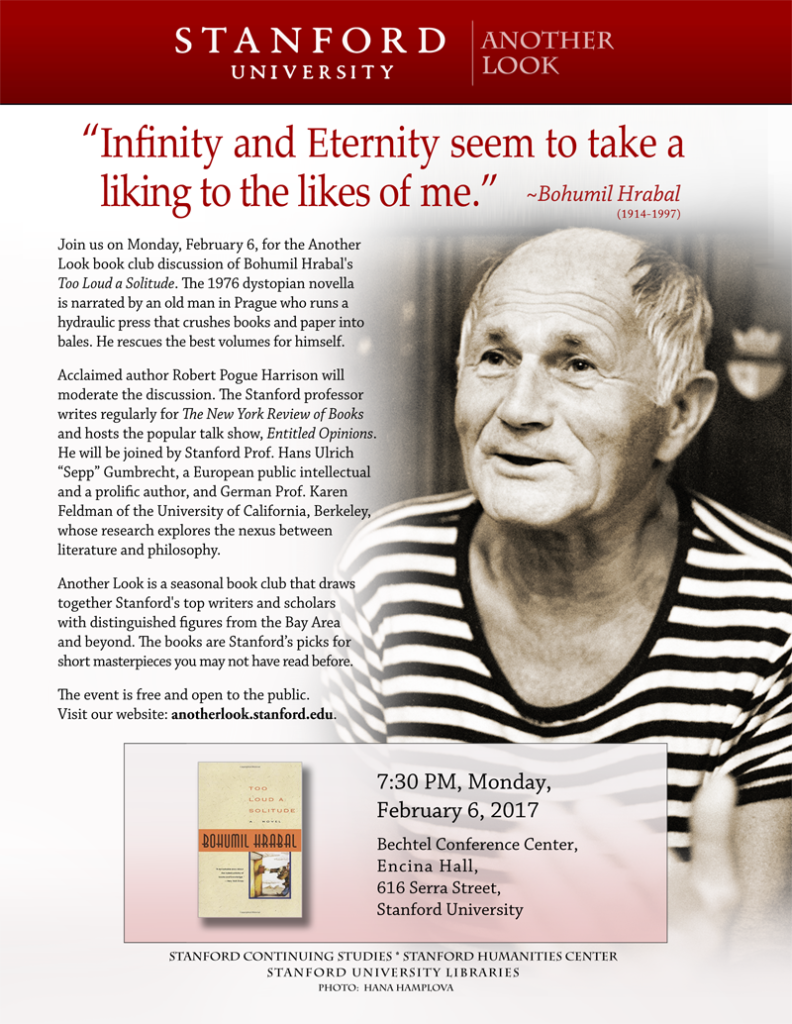
Another Look spotlights Bohumil Hrabal’s Too Loud a Solitude on Feb. 6: “a 98-page, lightning strike of a novel”

January 13th, 2017
Share
bohumil-hrabal

“If a book has anything to say, it burns with a quiet laugh, because any book worth its salt points up and out of itself.” (Photo: Hana Hamplová)

Over the years, Bohumil Hrabal‘s Too Loud a Solitude has had its fans. Peter Orner is one of them. Writing in “Night Train to Split” in Guernica (an excerpt from his new book Am I Alone Here?: Notes on Living to Read and Reading to Live (Catapult):
 .
“The first time I finished Too Loud a Solitude, I was up in Letná Park, and I remember leaping off the bench and running around in circles, holding the book above my head and shouting because I believed I’d experienced some religious illumination. A brief, ninety-eight-page, lightning strike of a novel, the book is about a man named Haňťa who has been crushing paper beneath a street in Prague for the last thirty-five years. People throw paper and books, books by the barrelful, down Haňťa’s hole in the pavement. Before he crushes them, Haňťa reads. The book of Ecclesiastes, the Talmud, Goethe, Schiller, Nietzsche, Immanuel Kant’s Theory of the Heavens. Kant, who argues that the heavens are not humane, nor is life above or below.”
.
.At 7:30 p.m. on Monday, February 6, at the Bechtel Conference Center, the Another Look book club will discuss Czech author Hrabal’s Too Loud a Solitude, a dystopian novella on the indestructibility of the written word.
Too Loud a Solitude is an elegy for literacy. It is also about how worship of unfettered technological progress invariably results in a trouncing of the human spirit. And it is about how only individual human memory has the unique power to redeem us,” Orner writes (read the whole thing here).
 .
Hrabal’s novella was published in a samizdat edition in Prague in 1976, and later published more widely after Communist rule ended in 1989. Its aging narrator runs a hydraulic press that crushes books and paper into bales. He rescues the best volumes for himself, and over time his thoughts and feelings merge with the treasures from the past – Hegel and the Talmud, Lao-Tze and Kant. According to the New York Times, “Mr. Hrabal’s is a cry of expiring humanism, and Too Loud a Solitude is a book to salvage from the deadly indifference that is more effective in killing the letter than the most sophisticated compacting machine.” You can read the New York Times review here.
Acclaimed author Robert Pogue Harrison will moderate the discussion. The Stanford professor who is Another Look’s director writes regularly for The New York Review of Books and hosts the popular talk show, Entitled Opinions. He will be joined by Stanford Prof. Hans Ulrich “Sepp” Gumbrecht, a European public intellectual and a prolific author, and German Prof. Karen Feldman of the University of California, Berkeley, whose research explores the nexus between literature and philosophy.
 .
Another Look is a seasonal book club that draws together Stanford’s top writers and scholars with distinguished figures from the Bay Area and beyond. The books are Stanford’s picks for short masterpieces you may not have read before. The events are free and open to the public.

Too Loud a Solitude is available at Stanford Bookstore, and also will stocked at Kepler’s in Menlo Park and Bell’s Books in Palo Alto.
.
hrabal-poster-EMAIL

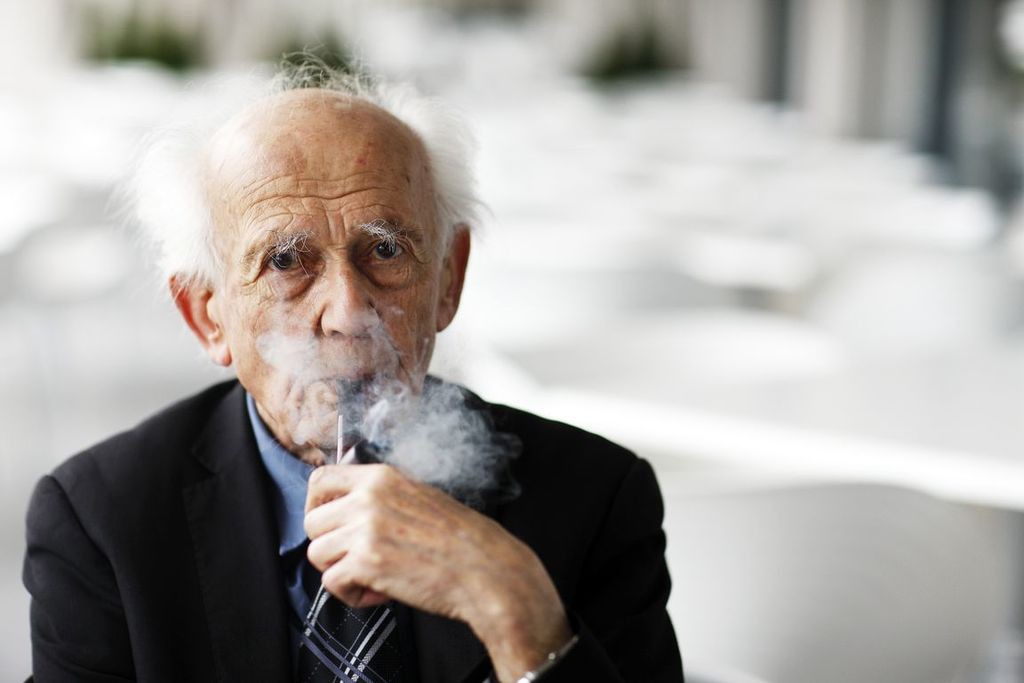
Zygmunt Bauman goes “to liquid eternity.”

January 11th, 2017
Share
Bauman

“There is beauty, and there are the humiliated.” In Wrocław, 2011 (Photo: Wikimedia Commons)

Zygmunt Bauman, the Polish sociologist and a major public intellectual, is dead at 91 – or, as his widow put it, he has changed his place of residence “to liquid eternity.”

According to The New York Times“The Polish-born left-wing thinker’s works explored the fluidity of identity in the modern world, the Holocaust, consumerism and globalization.” The article continued:

Renowned for an approach that incorporated philosophy and other disciplines, Bauman was a strong moral voice for the poor and dispossessed in a world upended by globalization. Whether he was writing about the Holocaust or globalization, his focus remained on how humans can create a dignified life through ethical decisions.

He wrote more than 50 books, notably “Modernity and the Holocaust,” a 1989 release in which he differed with many other thinkers who saw the barbarism of the Holocaust as a breakdown in modernity. Bauman viewed the mass exterminations of Jews as the very outcome of such pillars of modernity as industrialization and rationalized bureaucracy.

“It was the rational world of modern civilization that made the Holocaust thinkable,” Bauman wrote.

In the 1990s, Bauman coined the term “liquid modernity” to describe a contemporary world in such flux that individuals are left rootless and bereft of any predictable frames of reference.

In books including “Liquid Times” and “Liquid Modernity” he explored the frailty of human connection in such times and the insecurity that a constantly changing world creates.

Read the NYT obituary here. Or, from a more insightful Polish perspective, you might try this piece by Polish scholar Artur Sebastian Rosman over at his blog, Cosmos the in Lost:

His Liquid Modernity might be the single best description of the world we inhabit where all that is solid melts into thin air. The center does not hold, but Bauman is a sure guide to understanding what all that means. What Liquid Modernity describes, and it is something I’ve briefly discussed before, is not an academic exercise, but something that affects not only the present, but also the collective future. I cannot recommend this work highly enough if you feel confused about the world we inhabit and where it is heading. If you can’t relate to this feeling of vertigo then you probably have some bigger problems.

But I don’t want to dwell on psychoanalyzing you, nor on the details of liquid modernity (which you can explore here); nor on Bauman’s period of zealous Stalinism (I believe in Kołakowski’s dictum from Metaphysical Horror, “A modern philosopher who has never once suspected himself of being a charlatan must be such a shallow mind that his work is probably not worth reading.”); instead, a couple days after Bauman’s death (I’m not a fan of the euphemism “passing,” because it lacks substance), I’d like to share the following passage from Of God and Man, since it hopes for a more humane future: “You are right (and deserve credit) when observing that, one way or the other, we somehow possess this world, and, from time to time, here and there, are even able to change at least a small part of it for the better. Given that this world of ours is still in the making, the act of its creation yet incomplete, and the work of continuing the creation and its completion has (to recall our earlier conversations) fallen to us, then it is right for us – as for any responsible host – to care for its well-being and attend to its goodness and beauty. I will repeat again Camus’ credo: there is beauty, and there are the humiliated. God grant that I never be unfaithful to the one or the other.”

Read the whole thing here. Or watch the video, “No one is in control. That is the major source of contemporary fear,” below:

“A writer to watch”: Elaine Ray wins prize for her first published fiction

January 7th, 2017
Share
elaine

New prize for new voice. (Photo: Photo by Rachael Behrens)

One of the finest people at Stanford just won a substantial literary prize –the $1000 Gival Press Short Story Award. We couldn’t be more chuffed.

The Book Haven was one of the first to know about the short story and the prize. Elaine Ray sent her story “Pidgin” to us some time ago. We hesitate to read anything by friends and colleagues – hard to weigh in with a thumbs-down, and the diplomacy in such cases can take as long as the reading (or longer, depending on the ego of the writer).

Our immediate verdict: “Terrific! Go for it!”

We were surprised that the former director of the Stanford News Service, and one of the most beloved people at Stanford for her generosity and kindness, had emerged in fiction with an utterly new voice. We agree with the judge who called it “mercilessly exposed and utterly enigmatic,” throwing light on a lost world that as foreign to most of us as the Incas.

We we’ve written before about Elaine and her blog,  “My Father’s Posts,” named in honor of her father, the journalist Ebenezer Ray, who died when she was thirteen: “What I knew was that  my father had been a newspaper man. He had worked in the composing room of the Pittsburgh Courier before he was disabled  by Parkinson’s disease. I also knew that he had dabbled in photography: There was an abandoned darkroom in our basement, and there were  lots of photos around our house, including my baby picture, which earned Honorable Mention in the Carnation Healthy Baby contest in 1955. …I knew he was born in 1897, immigrated to the United States from Barbados, and had lived in New York  for many years before settling in Pittsburgh.” His story is the fictionalized backdrop of ‘Pidgin.'”

ebenezerHer reaction to the $1000 award? “Blown away and humbled. The first piece of fiction I’ve ever gotten published wins an award.” According to one of the judges, Thomas McNeely, author of Ghost Horse: “In fewer than twenty pages, Pidgin sketches a world of its narrator of color’s post-colonial migration, political activism, and imprisonment within the choices offered him by history. At the same time, it’s a narrative that seems shaped by mysteries that transcend and yet throw into sharp relief its political moment, the chief one being the brilliant voice of its narrator, who is at once mercilessly exposed and utterly enigmatic. Elaine Ray is a writer who plays by her own rules, and is a writer to watch.”

An excerpt, in the voice of her “father”:

My plan was to land a job at one of those big Negro newspapers. But first I had to put in some time with Oliver and Olivia Burns, a couple with ties to the printer I had worked for back home. Mr. and Mrs. Burns owned an establishment that printed invitations, birth announcements and funeral programs. They had clients who fell into three categories: The well-heeled customers they received in the front parlor of their shop with the curtains open— most of them were white or Negroes who could pass for white, like the Burnses themselves. In the second tier were those who were welcomed in the shop, but with the curtains drawn. They were mostly prominent, but browner-skinned Negroes. At the bottom rung of the Burnses’ pecking order were those who brought in most of the money. They tended toward the darkest hues, were working class or poor, and were not welcomed in the shop at all. Those are the ones I was hired to call on.

That’s how I met Lucille Braithwaite, an enterprising Trinidadian who had worked her way into a comfortable living in the ten or so years that she’d been in New York. By night, she toiled in a government factory in Tarrytown. By day and on weekends, she made extra money doing hair, managing a rooming house and hosting gatherings ý rent parties, recitals and receptions— in the upstairs parlor of her Harlem brownstone. She was known to pack a shotgun, lest anyone bring trouble or think about coming between her and her money. She was unmarried and had no children, but kept a parrot named Scarlet whose first language was Pidgin English.

Scarlet was a master of impersonation, picking up accents, inflections and languages with impressive precision.

“Who did you say sent, you?” Lucille asked the day I knocked on her door. At first glance it was hard to tell who was talking: the woman or the bird that stared from atop her head. Both gave me the once over.

colorful-parrot-2400px

“Mr. and Mrs. Burns. You wanted to order some leaflets?” I tipped my hat—a straw cross between a pith helmet and a fedora. The bird snatched it.

“Don’t be rude, Scarlet,” Lucille reprimanded, a touch of amusement around her eyes. She opened the door wider and handed my hat back.

Had it not been for Scarlet’s antics, Lucille, whose hair was wrapped in a brightly colored scarf, would have looked like she was wearing a piece of intricately constructed millinery festooned with bright red, blue and yellow feathers.

“Where are you from, Mr. Clark?” Lucille asked.

I did not realize how ridiculous I looked until I was reflected in Scarlet’s marble eyes— a dark, diminutive, bespectacled figure in navy shorts, a starched white shirt, navy blazer, knee socks and leather sandals.

Lucille was tall, slender, and the color of strong tea. She had a beaklike nose and full lips. When she listened, she stood with her torso thrust forward and her hands on her hips, her elbows taking on the shape of wings.

“Barbados,” I said.

“That must be how you know the Burnses,” Lucille warmed. “Come in.” She led me into a spacious sitting room with two matching upholstered chairs, also bright with color, with a coffee table in between. There was a card table with four folding chairs in one corner and a large wicker birdcage in the other. The place was neat as a pin.

 You can read the whole thing here at the Arlington Literary Journal.

What we’ll need for 2017: a little “elbow grease”

January 2nd, 2017
Share
andrew-marvell-3

He started it.

I don’t know about all of you New Year’s revelers, but I’ve been working steadily through the winter break, and feeling mightily miffed about missing so many opportunities to party. What will I need to make it through 2017? A little more elbow grease, I expect, which the U.K.’s “Phrase Finder” website (and thanks, Okla Elliot, for pointing it out to us) defines as “energetic labour.” I always assumed “elbow grease” was an American colloquialism. Not so, says Phrase Finder. In fact, it appears to have been coined by the poet Andrew Marvell (1621 – 1678). The concept is pretty universal, though. Knofedt, anyone?

From the website: 

It has long been said that the best sort of furniture polish is ‘elbow-grease’, that is, there is no substitute for hard rubbing to create a lustrous shine. The term itself is older than might be imagined and dates back to at least the 17th century when it was used in print by the English metaphysical poet Andrew Marvell in Rehearsal Transpros’d, 1672:

Two or three brawny Fellows in a Corner, with meer Ink and Elbow-grease, do more
Harm than an Hundred systematical Divines with their sweaty Preaching.

Marvell was suggesting that, although religious meetings could be disrupted or broken up by the speakers’ opponents, printed material could be circulated unhindered. Of course, Marvell was alluding to writing when he used the figurative expression ‘elbow-grease’. It was also used later in the same century, as it is used now, just to mean sweat or effort. An example of that usage is found in the 1699 New Dictionary of the Canting Crew:

Elbow-grease, a derisory Term for Sweat.

The expression’s inclusion in that dictionary, which itemises the language of the streets, suggests that it was a lower-class term.

Other countries have expression that are near-enough identical. In French we have ‘huile de bras’ or ‘l’huile de coude’, which translate as ‘elbow-grease’ and in Danish we find ‘knofedt’, which translates as ‘knuckle fat’.

Ramble through the whole website and look up your favorite hackneyed phrases here. Meanwhile, I hear a deadline whip cracking. Back to work!

A “crisis of degree”: an opportunity to binge on Shakespeare this holiday weekend – and it’s free!

December 30th, 2016
Share
WARNING: Embargoed for publication until 00:00:01 on 01/05/2016 - Programme Name: The Hollow Crown: The Wars Of The Roses - TX: n/a - Episode: The Hollow Crown: The Wars Of The Roses (No. Henry VI Part 1) - Picture Shows: *STRICTLY NOT FOR PUBLICATION UNTIL 00:01HRS, SUNDAY 1ST MAY, 2016* Gloucester (HUGH BONNEVILLE), Talbot (PHILIP GLENISTER), Plantagenet (ADRIAN DUNBAR), Warwick (STANLEY TOWNSEND) - (C) Carnival Film & Television Ltd - Photographer: Robert Viglasky

Hugh Bonneville as Gloucester, Philip Glenister as Talbot, Adrian Dunbar as Plantagenet, Stanley Townsend as Warwick. (Photo: Robert Viglasky)

The heavens themselves, the planets and this earth 
Observe degree, priority and place …
Office and custom, in all line of order …
Take but degree away, untune that string,
And, hark, what discord follows!

So begins the newest round in Hollow Crown series, encompassing William Shakespeare‘s Henry VI, Parts 1, 2, and 3, and Richard III (last season presented Richard II, Henry V, and Henry IV, Parts 1 and 2). But don’t go looking for a prologue in any of these plays that will include the words I’ve just cited. The lines are, in fact, a truncated version of Ulysses’s speech in Troilus and Cressida, Act I, Scene 3, as the Greek leaders discuss the morale of their army.

sophie

One tough cookie.

The late great French theorist René Girard cites Ulysses’s address in his Theater of Envy as “a meditation on the violent breakdown of human society in general, the undoing of the cultural order” – yet he didn’t find much to suit his purposes in the history plays. For me, however, these plays resound with his “mimetic crisis,” as kings fall and usurpers grab power, all in quest the “hollow crown” as a mimetic objet du désir – the “hollow crown” is a recurrent image in these BBC performances; at one point, it is tossed into a swamp, at other points, it’s an object of mesmerized fascination. Shakespeare was keenly aware of the “the canker vice,” “that monster envy” that causes ambition, selfishness, and conflict. The Bard’s “sacred kings,” victims readied for sacrifice, underscore the messages of Violence and the Sacred.

Yet the French theorist who was 100% non-Anglo could be forgiven for his relative (but only relative) disinterest in the “Hollow Crown” plays, which were principally designed to buttress the Tudor regime’s claims to the English throne. When the boy Earl of Richmond is briefly and reverently introduced in Henry VI, all Shakespeare’s audience knew why: he would become the grandfather-usurper of the Great Queen, Elizabeth I, and the future Henry VII needed all the prettifying he could get.

Hurry hurry and hurry and watch the new season – the link is here. The first of the plays will no longer be available after Jan. 3, and the others expire in the weeks following. It’s a great opportunity. Henry VI isn’t often performed, for good reason – it’s three parts, and doesn’t really wrap up until Richard III. Moreover, the weak and vasillating Henry VI is an unsatisfying focal point for so much dramatic emphasis. (I find the same for Richard II, who at least is given some grand and memorable speeches). The performance of Tom Sturridge doesn’t persuade me otherwise – but Sophie Okonedo‘s ambitious and vengeful Margaret of Anjou is great compensation (she was the wife in Hotel Rwanda). So are a range of other top-notch performances –Ben Miles as the wily and ambiguous Somerset (fans of The Crown will remember him as Princess Margaret‘s boyfriend, Peter Townsend), and Hugh Bonneville‘s Gloucester come to mind. (A small note: as far back as we can go in history, we seem to find haircombs. Could none of these characters, especially King Henry, have found one?)

I’ll finish with Richard III sometime this weekend. Meanwhile, here’s a video highlight (Sophie O. takes the term “bitch-slap” to a whole new level):


<<< Previous Series of PostssepNext Series of Posts >>>