Did Dante go mad in his hell?

October 15th, 2016

Share
Virgil says don't listen

Did Dante lose it altogether? Hmmmm…

The Book Haven always enjoys Robert Harrison‘s reflections on Dantehere and here and here. There’s more of them this week over at the New York Review of Books website. Some will find it a controversial p.o.v. – I’ve studied Dante with Robert, as well as John Freccero (and Jeffrey Schnapp), so it’s less unfamiliar territory for me.

Robert has a slightly Girardian take on the Inferno – that is, adopting some of the perspective of the late, great French theorist René Girard – with his emphasis on reciprocal and escalating violence. You hit me, I hit you back, only harder. It’s the ruling principle of the Inferno. 

In a nutshell: Girard argued that we copy our desires from each other, and hence we long for the same object, honor, recognition, friendships as others do. Envy is one of our most underestimated vices. This “mimetic desire” leads to rivalry and competition, and sometimes violence and war. However, Robert brings genocide into the mix, with his eloquent and passionate argument.

Here’s a provocative excerpt from Robert’s essay, “Dante: He Went Mad in His Hell”:

If revenge and reciprocal violence are the essence of God’s justice, Dante’s Inferno despairs of God. It is impossible, at least for this reviewer, to read the cantos that bring Inferno to a close and not come to the conclusion that “Dieu n’est pas là,” as a French nun said of Bosnia-Herzegovina when it tore itself apart with civil war in the 1990s. The extravagance of the punishments in lower Hell suggests that in those cantos, if not in the canticle as a whole, an infernal rather than divine justice is on display.

When violence enters its cycles of reciprocity, when it spreads like a contagion out of all proportion, it turns into a form of mimetic insanity, drawing everyone, including God, into its vortex. Because Dante scholars operate on the assumption that their author is always in full control of his poem, they tend to blind themselves to all the indications that Dante—the author as well as his character—is starting to lose his mind at the end of Inferno.

rene-girard

We miss you, René.

In Inferno 28 the mimetic contagion is such that the pilgrim abuses a sinner with the words, “And death to your clan!” In canto 33, after Ugolino recounts how he cannibalized his children in the Tower of Hunger, Dante the author succumbs to wild murderous impulses. In his animus against the city of Pisa he bids the Arno River to overflow “so that it may drown every person in you!” Later in the same canto, Dante turns his rage against the city of Genoa: “Ah, men of Genoa, foreign to every decent usage, full of every vice, why have you not been driven from the world?” This is not the character but the author speaking. It is astounding, but true, that even the most acute commentators of The Divine Comedy pass over in silence these genocidal fantasies at the end of Inferno.

Read the whole thing here.

Women of the Gulag: help finish the film. Putin won’t like it.

October 12th, 2016
Share
marianna3

Marianna Yarovskaya on location

Paul Gregory, author of Politics, Murder, and Love in Stalin’s Kremlin: The Story of Nikolai Bukharin and Anna Larina (Hoover Institution Press, 2010), is passing the hat. It’s for a good cause.

Filmmaker Marianna

He and Muscovite documentary filmmaker Marianna Yarovskaya are in the final stages of filming his 2013 book, Women of the Gulag. (Marcel Krüger has an interview with Yarovskaya here.) They’re nearly a quarter of the way to the $25,000 they need to complete final editing, sound mix, and music. Want to help? Go to Indiegogo here.

From the introduction to Women of the Gulag:

A remark often attributed to Stalin is, “A single death is a tragedy, a million deaths is a statistic.”

This is the story of five such tragedies. They are stories about women because, as in so many cases, it was the wives and daughters who survived to tell what happened.

These five women put a human face on the terror of Stalin’s purges and the Gulag in the Soviet Union of the 1930s.  They show how the impersonal orders emanating from the Kremlin office of “the Master” brought tragedy to their lives. They cover the gamut of victims. Two are wives and daughters in ordinary families unable to comprehend why such misfortune has overtaken them. A third is a young bride living in the household of a high party official. The last two are wives of the Master’s executioners. These stories are based on their memoirs—some written by themselves, others by close friends or by their children.

putin

Nyet.

“Why film a bunch of old babushkas?” Marianna is asked.  According to Washington Post‘s Pulitzer-prizewinning Anne Applebaum, who appears in the film,  “What had happened since the year 2000 is that history has been gradually re-politicized. And the Russians started treating history that way. And that means that they’ve become more sensitive again about discussing this sort of crimes of their past. For the Russians, understanding the history of the gulag is absolutely crucial.”

She tells us that Russia still lacks “that defining moment, that big monument” that will help the Russian people come to terms with their past.

“I wish to express my support for Dr. Paul Gregory’s and Marianna Yarovskaya’s documentary project, Women of the Gulag. Although there have been a number of excellent Gulag documentaries, this film is intended to tell the personal stories of just a few former prisoners in greater detail. It will also focus on the stories of women, which differed in a number of ways from that of their male counterparts. Rape, pregnancy and motherhood were a part of the Gulag experience, too.”

The film below gives a preview of their work.  I hope you find it as riveting as I do – and please do pony up whatever you can over at Indiegogo here. Putin won’t thank you. That’s one reason to do it.

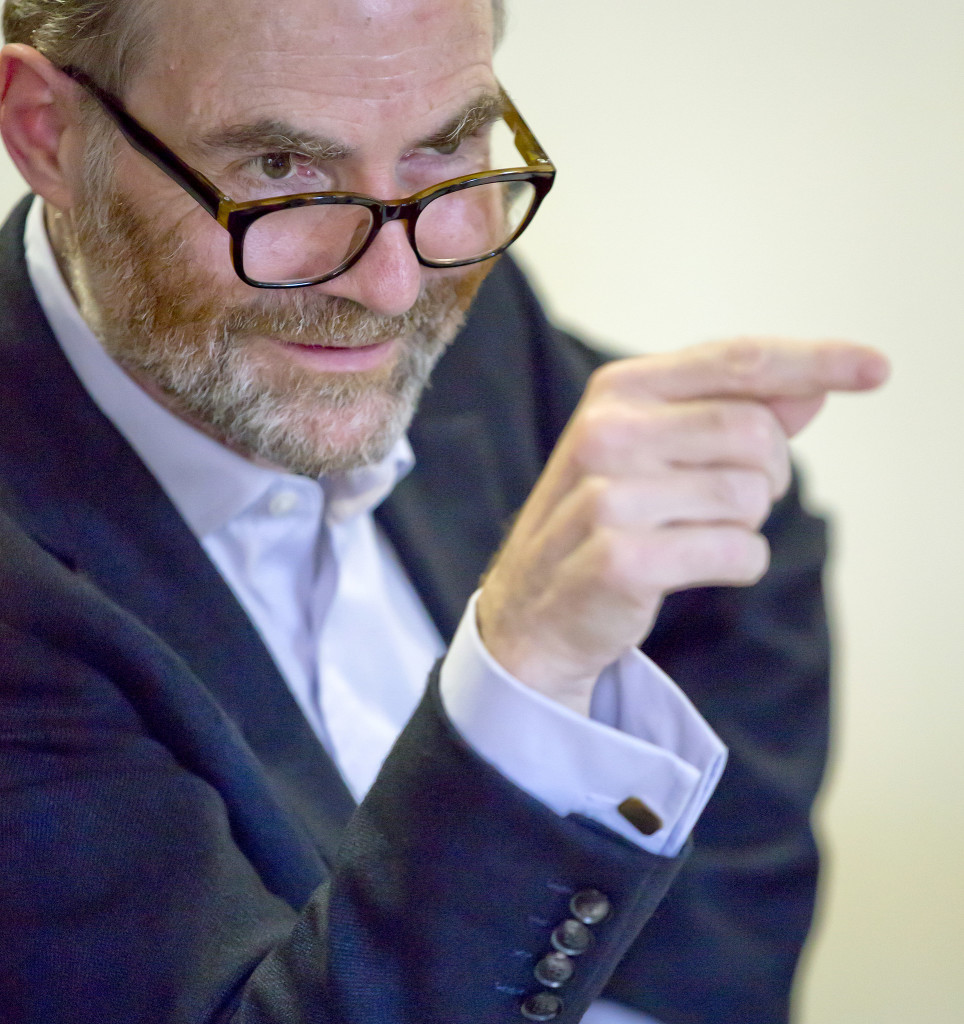
Free-speech champion Timothy Garton Ash: Are we in a “post-truth media world”?

October 8th, 2016
Share
garton1

He’s rather “robustly civil” himself. (Photo: Christine Baker-Parrish)

Last week, Timothy Garton Ash called for a “robust civility” – he added “that’s the gamble of liberal democracy.” But how does that play out in a social media avalanche of images, tweets, and hit-and-run postings?

Tim was here at Stanford in-between lectures, readings, discussions, and book-signings for his newest, Free Speech: Ten Principles for a Connected World, and that lauded 480-page volume was the subject of his talk at Cubberley Auditorium Wednesday night.

garton2

Nix the “heckler’s veto.” (Photo: Christine Baker-Parrish)

We live in an age, he noted, where 1.7 billion people are on Facebook. “Facebook is the empire on which the sun never sets,” he said. In today’s world, “one sleazy little video uploaded by a convicted fraudster in southern California” can cause dozens of deaths in demonstrations half a world away – and also result in the offer a $100,000 bounty for killing the filmmaker who exercised his freedom of expression. Such are the asymmetries of our global society, where “a Youtube video is as mighty as a fleet,” he said.

In 2000, president Bill Clinton had scoffed that China’s attempts to control internet freedom within its borders would be like trying to “nail Jell-O to a wall.” China’s reply: “Just watch us.” Today, Tim said, China runs “the largest apparatus of censorship in world history. It’s not true for the long-term, but it’s true for now.”

In the West, we’re living “a market failure in the marketplace of democracy.” Political coverage has become polarized, creating two echo chambers in the “post-truth media world.”

Online shouting earns “eyeballs, ears, clicks,” he said. “If it bleeds it leads, if it roars it scores … reality has overtaken satire …truthiness made flesh.” The sheer scale, intensity, and repetition of a 24/7 news cycle presents us with daunting challenges. He recommended George Orwell‘s essay, “Politics and the English Language” (it’s here) as a counterbalance to cant and a way “to purify the language of the tribe” (which is of course T.S. Eliot).

We’ve already written about his recent words on the cult of “safe spaces” and banning campus speakers in our previous post. (Sample quote: “It is an abuse of language to suggest that anyone can seriously be ‘unsafe’ because someone whose views they find offensive or upsetting is speaking in a room on the other side of campus.”)

This presentation was a more systematic and comprehensive presentation of his thought on the issue of free speech. He outlined ten guiding principles, also on his free speech website here (it’s been translated into thirteen languages to date).

  1. A discussion seminar featuring Timothy Garton Ash (Professor of European Studies at the University of Oxford, Isaiah Berlin Professorial Fellow at St. Antony’s College, Oxford, and a Senior Fellow at the Hoover Institution), Joshua Cohen, Faculty, Apple University, and Jennifer Granick, Director of Civil Liberties, The Center for Internet and Society at Stanford Law School on October 6 2016 at Encina Hall. The discussion revolved around Garton Ash's most recent book Free Speech: Ten Principles for a Connected World (Yale University Press, 2016). Photography by: Christine Baker-Parrish

    “Eyeballs, ears, clicks” (Photo: Christine Baker-Parrish)

    Lifeblood: We – all human beings – must be free and able to express ourselves, and to seek, receive and impart information and ideas, regardless of frontiers. He put particular emphasis on “and able” – many in the world are illiterate, or without internet access, which can be as effective as censorship.

  2. Violence: We neither make threats of violence nor accept violent intimidation. “We don’t accept the heckler’s veto,” he said, nor the “assassin’s veto.” The Charlie Hebdo massacre and the murder of Theo van Gogh have a massive chilling effect of on free speech. Anyone remember Molly Norris? Read about her here.
  3. Knowledge: We allow no taboos against and seize every chance for the spread of knowledge. This includes considerations of the currently fashionable discussions of safe spaces, microaggressions, hate speech, and so on.
  4. Journalism: We require uncensored, diverse, trustworthy media so we can make well-informed decisions and participate fully in political life.
  5. Diversity: We express ourselves openly and with robust civility about all kinds of human difference.
  6. Religion: We respect the believer but not necessarily the content of the belief.
  7. Privacy: We must be able to protect our privacy and to counter slurs on our reputations, but not prevent scrutiny that is in the public interest.
  8. Secrecy: We must be empowered to challenge all limits to freedom of information justified on such grounds as national security.
  9. Icebergs: We defend the internet and other systems of communication against illegitimate encroachments by both public and private powers.
  10. Courage: We decide for ourselves and face the consequences. He cited Pericles: “The secret of happiness is liberty, and the secret of liberty is courage.”

Watch the video below. He wants to hear from you.

The night Václav Havel created a scandal.

October 5th, 2016
Share

Václav Havelbirthday cake would have been eighty today. The playwright and philosopher who had the distinction of being the last president of Czechoslovakia and the first president of the Czech Republic was born in Prague. He died in 2011. Let us celebrate, as the New York Review of Books did, with revisiting his first 1979 piece in NYRB, called “Kicking the Door.” It’s a critique of Paragraph 202 of the Penal Code in the Soviet-dominated Czechoslovakia, which allowed arrest under the flexible charge of “creating a scandal.” The political dissident was arrested and imprisoned on precisely that charge in 1978. Here’s the story of a time that he effectively created a scandal, but managed to do so without arrest. It led to this reflection:

It was midnight one Sunday and we—two friends and I—were looking for a place where we could get a glass of wine. Surprisingly enough, we found one; not only was it open, but it would stay open for another hour. As often happens, the door was locked, so we rang the bell. Nothing. An instant later we rang again. Still nothing. After another minute we decided to knock lightly. Again nothing. Then, just as we were about to leave, the door opened—not for us, but so that the waiter could let out one of his friends. We took advantage of the opportunity to ask very politely if there wasn’t room inside for us. The waiter didn’t even bother to answer—that the place was full, that he didn’t want clients, that he was only admitting friends, or anything else. He said nothing. He made no sign, didn’t even look at us. Then he slammed the door in our faces….

Václav_Havel

Recalling the night he lost his temper…

The strange thing happened then: I became suddenly furious. If I say strange, it’s because I’m not at all an angry man. Sudden crises of rage of this sort—which distort my vision and render me capable of doing things that I never do and that aren’t characteristic of me—happen to me only very exceptionally, I would say once every seven to ten years. Typically the most important events (as, for example, when someone slanders me in public, or they confiscate my apartment, etc.) do not arouse my fury; but mere trifles do. When I was in the army, a soldier named Ulver once tried to trip me, and I turned on him to beat him up. It is in this sense that the crisis that night in front of the bar was in keeping with my personal history.

This is not to say that the trifle that makes me furious is not a kind of substitute, a compensation. Perhaps it pays, as they say, for all the larger things that don’t succeed in making me angry. Perhaps somewhere in the depths of my tranquil soul there is a secret battery that charges, little by little, until the accumulated potential reaches a certain level. Then any little provocation is enough: the cup overflows, and all is discharged in a blast for an apparently inadequate reason. Thus the innocent joker Ulver was cruelly and arbitrarily punished because I had just spent two years building a floating bridge and then been ordered to destroy it.

havel-michnik

With Poland’s Adam Michnik

So I became suddenly angry and began to kick savagely at the door of the bar. To my astonishment nothing happened; it must have been made of very thick glass. My attitude was, by all standards, absurd and indefensible. I acted like a vagabond. Some part of me knew this at the time, but it had no influence on my behavior.

It is likely that the door served as the same kind of compensation that the soldier Ulver played many years before. The door paid for all the arrogant indifference, the scorn, the humiliation, the crudity, and the disrespect that so color the life of an ordinary man today. It paid for all the waiting in public offices, all the lines in department stores, all the institutions that won’t answer my polite letters, all the policemen who don’t know how to speak to a man except as a noncommissioned officer speaks to his lackey. It paid for all the conspiracies of cops and other uniformed thugs that have made Prague nights unfit for innocent amusement. It may even have paid for the men who kicked and beat the philosopher Ladislav Hejdánek. It paid for the haughty insolence of office workers, and the terror of those who aren’t office workers, for the disdain and the fearfulness that are seeping slowly but inevitably into all corners of contemporary life, quietly dehumanizing every place and every relationship. My anger was the explosion of an impotent man piqued by a small humiliation that seemed to symbolize all the huge, complex humiliation that weighs upon his life.

What happened next? Read the whole thing here.

How Thornton Wilder’s “tough love” made a playwright of Edward Albee

October 3rd, 2016
Share
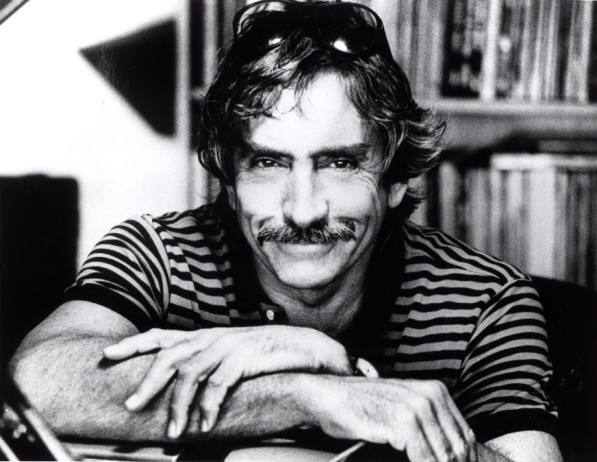
edwardalbee

Farewell to one of America’s greatest playwrights.

Playwright Edward Albee died on September 16. He was 88. I wrote nothing about it, because it’s been too long since I read Albee, the winner of three Pulitzer Prizes, or saw any of his plays performed. I could think of nothing new to bring to the subject.

Fortunately, playwright and filmmaker Ian MacAllister-McDonald could. In the most recent issue of the Los Angeles Review of Books, he describes meeting Albee on a plane from New York to Los Angeles in fall 2006 when he was 21 years old. He was new to the theater world, and stopped Albee as he walked down the aisle to stretch his legs. “We talked about Whos Afraid of Virginia Woolf? and The Zoo Story (the only two plays of his that I’d read at the time) and he stood there, patiently answering my questions,” he said.

Thornton_Wilder

Good advice.

“A few days later, we ended up getting lunch together and continued our conversation. At some point I asked him what other playwrights I should be reading, and Albee furrowed his brow and said, pragmatically, ‘Read all of Chekhov. Start there.’”

You can read the whole thing online at the LARB, but here’s my favorite bit, from a speech Albee gave five years ago at the MacDowell writer’s colony in New Hampshire:

He was funny and gracious, and told a story about meeting Thornton Wilder, when Albee was young poet, visiting a friend at the MacDowell. Albee, a fan, ran up to Wilder and shoved a bunch of poems into his hands and ran away. Later that night, Wilder found him and invited him to come sit by a pond so that they could discuss the work. The older writer took out a bottle of wine, poured them both a glass, and talked through each of the poems. And each time he finished talking about a poem, he would gently take the sheet of paper it was printed on and toss it out onto the water. When the discussion was over, the pond had all of Edward’s poems out floating on it, and Wilder turned to Edward and said, “Have you considered playwriting?”

Read “Edward Albee: Fragments” here.

Why Mayakovsky killed himself.

October 1st, 2016
Share
Vladimir_mayakovsky_and_lilya_brik

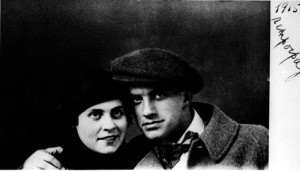
The poet with Lili Brik in 1915

Vladimir Mayakovsky was the celebrated hero poet of the Russian Revolution. His suicide in 1930, at the age of 37, rocked the Soviet world. What had happened? Had he become disillusioned with the new order he had championed? Or was it foul play? The Soviets put forth a different story – romantic disappointment. But the truth, as always, is more complicated.

Enter his biographer Bengt Jangfeldt, perhaps the foremost Mayakovsky expert in the world. I had the good fortune to visit Bengt in Stockholm this summer. He is one of the foremost authors in Sweden, and undoubtedly one of Scandinavia’s most generous spirits. He was not well that day, however, so we had to postpone a whirlwind tour of Stockholm for another visit and chat over coffee at his apartment in the old part of the city.

bengt

Biographer Bengt

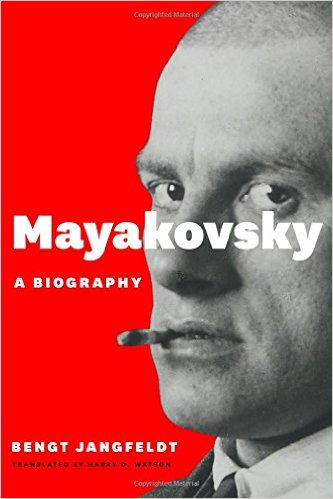
Before I left, he pressed the English translation of his Mayakovsky: A Biography (Chicago) into my hands. It hadn’t been published at the time of Bengt’s short visit to Stanford three years ago (I wrote about his lectures here and here). According to Stanford’s Marjorie Perloff“this biography is essential reading not only for students of modernist poetry but also for anyone interested in the relationship of literature to life in the former Soviet Union.”

I haven’t yet had a chance to read the 600+ page volume, but I share my guilty secret: I flipped to the end to see how Bengt would tell how the poet came to end his life with a bullet through the heart. An excerpt, which includes Bengt’s correspondence with Mayakovsky’s lover Lili Brik:

“How many times did I not hear the word ‘suicide’ from Mayakovsky,” Lili wrote. “That he would take his own life. You’re old at thirty-five! I shall live till I’m thirty, no more.” His terror of becoming old was closely connected to his fear of losing his attraction for women. “Before the age of twenty-five a man is loved by all women,” he stated shortly before his suicide to a twenty-five-year-old fellow writer. “After twenty-five he is also loved by all – except the one he is in love with.” …

mayakovsky2The urge to commit suicide is the dark sounding board in Mayakovsky’s life, and the theme of suicide the leitmotif of his writings, from the first line to the last. The tragedy Vladimir Mayakovsky, the poem “Clearance Sale” (“Years and years from now/in short, when I am no longer alive – / dead from hunger,/or a pistol shot –/professors […] will study/me/how,/when,/where I came from”). “The Backbone-Flute” (“More often I think:/it might be far better/ to punctuate my end with a bullet” [trans. George Reavey]), “Man” (“The heart longs for the bullet/ and the throat hallucinates about a razor”), the film Not Born for Money, “About This,” the film script How Are You?, the unfinished play Comedy with Suicide, The Bedbug. The list of works and quotations is almost endless.

“The idea of suicide,” Lili declared, “was a chronic disease with Mayakovsky, and like all chronic diseases it grew worse in unfavorable circumstances.” Underlying the urge to suicide was not only the fear of aging but also the feeling of not being understood, of not being needed, of loving as few are capable of loving without feeling that he was loved in return.

Mayakovsky was a maximalist: he gave all that was in his power and demanded much in return. “Countless numbers of people loved him and were fond of him,” Lili wrote, “but that was just a drop in the ocean for someone with an ‘insatiable thief’ in his soul, who wanted everyone who didn’t read him to read him, all those to come who didn’t come, and that the one he thought didnt’ love him should love him.” Love, art, revolution – to Mayakovsky, everything was a game with life as the stake. He played as befitted a compulsive gambler: intensely, without mercy. And he knew that if he lost, the result was hopelessness and despair.


<<< Previous Series of PostssepNext Series of Posts >>>