
Dana Gioia at Stanford’s Humanities House on May 5.
Dana Gioia and his 99 Poems: New and Selected (Graywolf Press) have been getting a lot of attention. California’s current poet laureate had a reading from his new collection at Stanford’s new Humanities House on May 5 (an occasion that also doubled as a family reunion afterwards), and the following week he received the Denise Levertov Award in Seattle on May 11. This week, a reading at Kepler’s in Menlo Park on the 26th.
There’s more: A.M. Juster (we’ve written about his work on Petrarch here) has an article, “The Case for Dana Gioia,” in the current Claremont Review of Books here. An excerpt on Dana’s career:
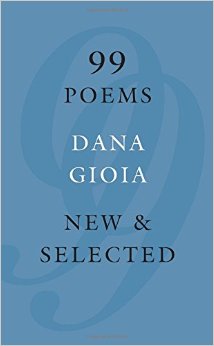 Though Gioia continued to publish poems, essays, reviews, and libretti, he came to devote more time to public service. He received broad praise, after some initial grumbling, for his tenure as Chairman of the National Endowment for the Arts from 2003 to 2009. His Poetry Out Loud program, a poetry recitation competition for high school students, has become a blowout success, particularly among recent immigrants. He also initiated programs that promoted community discussions of poetry, brought Shakespeare to mainstream audiences, and helped returning veterans relate and cope with their war experiences.
Now 65, Gioia’s new collection of brief essays, Poetry As Enchantment, is a quieter and more reflective expansion of the themes in Can Poetry Matter? He defends poetry as a spiritual need, partially resistant to the tools of New Criticism and later schools of literary theory. His populist argument is rhetorically brilliant. Gioia undercuts a likely objection by including the songlike chants of Ezra Pound’s verse as evidence for his proposition, even though Pound was instrumental in transforming modern poetry into obscurities academics pored over and everyone else ignored. Enchantment also cites the work of Rainer Maria Rilke, William Blake, and the surrealists to bolster its point.
Though Gioia’s role as a cultural warrior and arts leader would be sufficient to make him a minor figure in American literary history, his time in public service damaged his literary productivity. Thankfully, he is back on a mission with 99 Poems, a “new and selected” collection likely to be a future candidate for inclusion in the canon.
Dana is one of the few poets in the world to have an MBA – from Stanford, no less. He worked at General Foods in New York, eventually rising to vice-president. The story is retold by a former colleague, Rochelle Newman-Carrasco, in “A Poet Laureate, Jell-O, and Me” over at the Lunch Ticket:
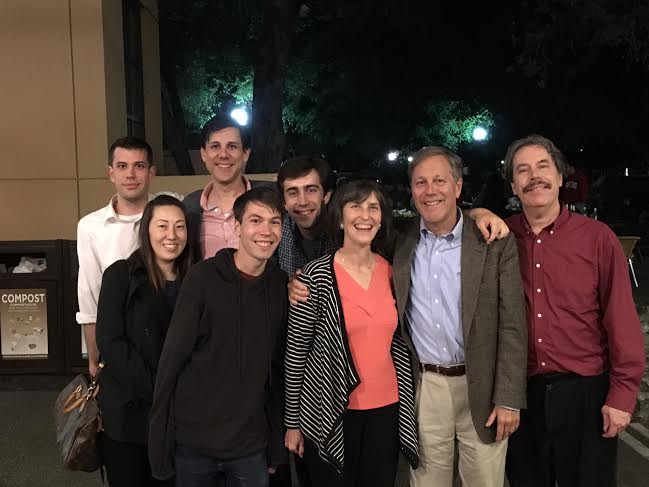
The Gioia clan at Stanford, May 5.
I attended Dana Gioia’s poetry workshop on The Poetic Line and listened to him read Gwendolyn Brooks’ poem, “We Real Cool” twice—once to accentuate the rhymes and once the way it was written. As he discussed strategies of syntax and stops, I could clearly see Gioia, the client, the man I knew more than two decades prior—the one who seemed different from other corporate executives even then.
When we had worked together, I was in my early twenties, he was in his thirties, and aside from a client crush sparked by his unchanged good looks and resonant voice, I was particularly enamored with his ability to simplify complex marketing ideas, communicating only what was essential. He was also one of the few clients who not only got the idea of culturally-specific marketing, but also seemed to embrace it. All too often, the average white male (or even female) marketing execs struggled with this new way of looking at the world. Nothing about Gioia was average. The son of a Mexican-American mother and an Italian-American father, Gioia was no stranger to cultural nuances, but there was more to his distinct style than that. He wasn’t as literal as many of his corporate MBA-trained colleagues, and he approached problem solving with an open mindedness and imagination that was more often associated with liberal arts types. At the time, I had no clue that he was a poet and neither did anyone else at General Foods or the Agency. Likewise, he didn’t know that I was an actress-writer in a costume, playing a role. There was a time when such things were better left unsaid.
…What we conceal
Is always more than what we dare confide….
From Unsaid, by Dana Gioia
 One day in 1992, I was informed that Gioia had left General Foods. The news came as a surprise to everyone. He had turned the Jell-O brand around. We had even worked on Jell-O Jigglers together, a product innovation that helped grow sales. I heard something about his leaving to become a writer, but it wasn’t anything too specific. I remember thinking, That makes sense. He was sensitive and soulful in an industry where souls were sold, not protected.
In his essay, “Being Outed,” Gioia writes about the Esquire article that stripped him of his literary anonymity. “When I entered corporate life, I resolved to keep my writing secret,” writes Gioia. “There was no advantage in being known as the company poet. For nearly a decade I succeeded in keeping my double life hidden from my co-workers.”
Oh, and listen to Garrison Keillor read Dana’s “Places to Return” last month (April 24) on the Writer’s Almanac – it’s here.



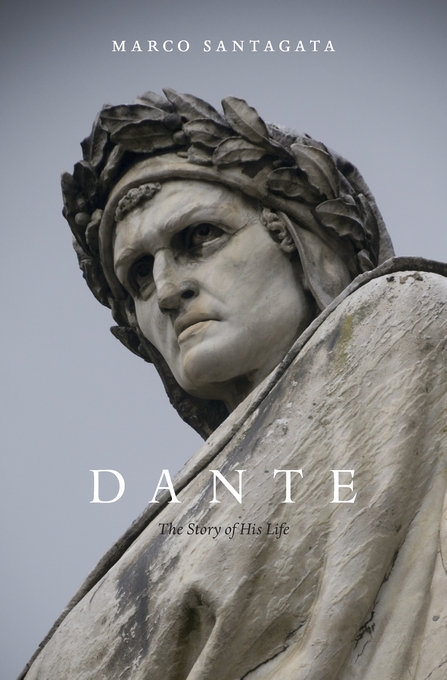 The strange mystery surrounding Dante’s marriage is also seen from a genial and old-fashioned point of view. Boccaccio made Gemma, Dante’s wife, into one of the shrews about whom he liked to tell funny stories in the Decameron. So, when Dante was exiled, Boccaccio has her remaining in Florence, with the marriage effectively at an end. Santagata shows how Dante holds back, in the Commedia, from attacking Gemma’s family, the Donati, until Corso is dead. He does not directly place Corso Donati in Hell, leaving it for his brother Forese Donati, in the Purgatorio, to describe Corso’s grisly death. In Paradise, we find Corso and Forese’s sister Piccarda, who is given one of the best lines in the entire poem. So, while the poet was ruined by his wife’s family, Santagata thinks that Dante made every effort to be pardoned by the city of Florence and to be allowed back. Gemma, Santagata speculates, might well have later joined Dante in his exile. Perhaps one of the most moving Canzone might even have been addressed to her.


 Like so many Americans, I am disheartened by the current election cycle and its dispiriting daily news. Here’s one antidote: instead of the political blogs, try reading