Another Look book club spotlights Joseph Conrad’s Shadow-Line on May 10

April 20th, 2016

Share
conrad-ship

Joseph Conrad (foreground) on board the special service ship Ready in 1916. He wrote The Shadow-Line on his return from the voyage. (Image credit: Beinecke Rare Book and Manuscript Library, Yale University)

The author Joseph Conrad insisted his work The Shadow-Line: A Confession was not a book about the supernatural. But sometimes the real can be spookier than the imagined, and what we observe outpaces our worst nightmares. So it is with Conrad’s late novella.

“The belief in a supernatural source of evil is not necessary; men alone are quite capable of every wickedness,” Conrad said a few years before World War I. Certainly the rest of the century bore out his conclusions.

The Another Look book club will discuss Conrad’s 1917 novella and the Polish author at 7:30 p.m. Tuesday, May 10, in the Bechtel Conference Room of Encina Hall. The Shadow-Line is available at Stanford Bookstore, Kepler’s in Menlo Park and Bell’s Books in Palo Alto.

The panel will be moderated by Another Look director Robert Pogue Harrison, an acclaimed author and professor of Italian literature. Harrison is a regular contributor to the New York Review of Booksand the host for the popular radio talk show Entitled Opinions. He will be joined by drama Professor Rush Rehm, artistic director of the Stanford Repertory Theater, and Monika Greenleaf, associate professor of Slavic languages and literatures and of comparative literature.

The event is free and open to the public.

“I chose this short novel because of its exquisite prose and quintessentially Conradian drama,” Harrison said. “It probes the enigma of fate by putting circumstance, landscape and depth psychology into play all at the same time.”

He added, “Conrad is a master when it comes to putting his characters through trials. The Shadow-Line is one of the most intense of Conradian trials of character. It is not one of his best known novels and is certainly deserving of another look.”

Conrad’s short masterpiece describes the “green sickness” of late youth, when a young man desires to “flee from the menace of emptiness.” The unnamed narrator’s flight ends when he is captain of a merchant ship in Southeast Asia; the terrors of sickness and the sea bring him to grief, maturity and wisdom.

In a two-page author’s note, Conrad denies the supernatural has anything to do with his story. We are meant, then, not to draw a line between the mate’s superstitious and feverish fear of his former captain, buried at sea, and the destruction of the ship to weather, wind and contagious fever. The mate says the ship will not have luck until it passes the spot where the reckless and demented captain was put overboard.

conrad2

(Courtesy Beinecke Rare Book and Manuscript Library)

The Shadow-Line can also be read as a psychological study of the disintegration of an entire ship’s crew. That would be in keeping with Conrad’s worldview; he once called life a “mysterious arrangement of merciless logic for a futile purpose. The most you can hope from it is some knowledge of yourself – that comes too late – a crop of inextinguishable regrets.”

The year The Shadow-Line was published, The Argus praised the novel: “It holds the reader under a spell so strong that the book must be finished at one sitting, and even when it is laid aside it keeps its grip on the memory, and the impression left remains with a curious persistence.”

The Sunday Times wrote, in 1917, “Mr. Conrad is an expert in the business of suggesting mystery and the action of malevolent agencies and the endurance of a man under the buffets of fate. Not even Coleridge has held passers-by more spellbound under a tale of horrors on the ocean than does Mr. Conrad in this work.”

Józef Teodor Konrad Korzeniowski – Joseph Conrad – was born in 1857 in a largely Jewish village in territory that is now Ukraine; it had been part of the Polish-Lithuanian Respublica before partition, and at the time of his birth was part of the Russian Empire. His father was a Polish patriot and man of letters, and the family had a migratory existence. Conrad began a seafaring career as a teenager, and eventually joined the British merchant marine and became an English citizen.

He was one of the very few writers to establish his literary reputation in a foreign tongue. (Vladimir Nabokov comes to mind as well, but the author of Pale Fire and Lolita was reared in an aristocratic Russian family; however, he later claimed English was the first language he learned in his trilingual household.)

World War I was much on Conrad’s mind as he wrote Shadow-Land, and the book is dedicated to his son Borys, a soldier. By the time it was published, Borys had returned from the front, shell-shocked and gassed in the new technology of warfare. The war’s end would change forever the face of the Europe Conrad remembered.

Shortly after the war, a visitor to the Conrad household observed: “Conrad spoke fluently, but his accent, his manner of expression were such as I observed among the inhabitants of the south-eastern Polish borderlands. One felt clearly that when he thought of Poland, it was of a Poland of half-a-century ago. When I listened to him, I could not evade the impression that I am being carried back in time and talk to one of the people of long ago.”

 Another Look is a seasonal book club that draws together Stanford’s top writers and scholars with distinguished figures from the Bay Area and beyond. The books selected are short masterpieces you may not have read before. This article is republished from my Stanford Report piece here.

Happy 109th birthday, Thornton Wilder! Two great quotes for his day.

April 17th, 2016
Share
Thornton_Wilder

Wilder in “Skin of Our Teeth,” 1948 (Photo: Carl Van Vechten)

I was looking for a half-remembered quote today, and found it: “There’s nothing like eavesdropping to show you that the world outside your head is different from the world inside your head.” So true.

The quote-sayer was playwright and novelist Thornton Wilder. Then I happened to remember that today is his 109th birthday.

Here’s the quote that Joseph Peschel chose for his own Facebook celebration. It’s also a good one: “I’ve never forgotten for long at a time that living is struggle. I know that every good and excellent thing in the world stands moment by moment on the razor-edge of danger and must be fought for — whether it’s a field, or a home, or a country.”

That’s from The Skin of Our Teeth. So is Carl Van Vechten‘s 1948 photo of Wilder, playing Mr. Antrobus in the production.

Happy birthday, Thornton Niven Wilder (Apr. 17, 1897 – Dec. 7, 1975)!

Donald Hall on old age: “an unknown, unanticipated galaxy”

April 16th, 2016
Share
109701765MW012_OBAMA_CONFER

Not funny. Donald Hall receiving the National Medal of Arts, 2011.

Update on June 24, 2018: Donald Hall died last night. Some memories from Don Share, editor of Poetry Magazine:

“It was only a few weeks ago that I last was in touch with Don Hall. He was so pleased with Martín Espada’s being awarded the Lilly Prize; and he always mentioned – of course! – baseball, family life, and poetry: “I wish I still wrote poems” was the last thing he wrote to me, alongside his praise of the direction POETRY, which he read faithfully, has been taking. His kindness and generosity was spontaneous, unbidden, and abiding, and these things were watered from the same deep well as his poetry. He was capacious, more so than he got credit for being. And literally to the end, he was gently courageous and somehow funny, too. He wanted to remember, perhaps, more than be remembered; but lots of us will think about him and his life in poetry all our days.”

He was one of those rare creatures, a poet who writes into advanced age and illuminates the path for the rest of us. My earlier post from 2016, on Donald Hall and old age.

The endless ageism of this election cycle has been a dispiriting spectacle for quite some time. In fact, you are welcome to join me in documenting it on my Twitter hashtag #Ageism2016. While we live in a society that is fascinated with attractiveness and youth in its leaders (cough, cough, Justin Trudeau), it stands to reason that anyone with sagacity and experience for international leadership will have cycled more than a few dozen times around the sun. But politics is not the only arena where wisdom comes with years.

Remember way back when we targeted The Washington Post‘s casual (and, I suspect, unintended) dissing of poet Donald Hall when he received the National Medal of Arts in 2011? The diss involved a caption contest for a “funny” photo of the poet. We created something of a national stir with that one, with even Sarah Palin chiming in – you can read about it here and here.

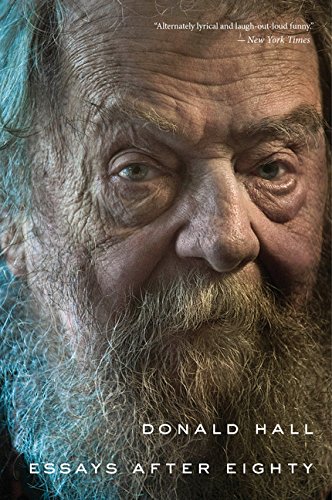
I hadn’t read the 87-year-old poet’s latest collection of essays Essays After Eighty, but Maria Popova over at Brain Pickings had, and apparently a caption contest was the least of the insults he had to work with that day in Washington, D.C. From one of Hall’s essays:

“I go to Washington to receive the National Medal of Arts and arrive two days early to look at paintings. At the National Gallery of Art, Linda [Hall’s girlfriend] pushes me in a wheelchair from painting to painting. We stop by a Henry Moore carving. A museum guard, a man in his sixties with a small pepper-and-salt mustache, approaches us and helpfully tells us the name of the sculptor. I wrote a book about Moore and knew him well. Linda and I separately think of mentioning my connection but instantly suppress the notion — egotistic, and maybe embarrassing to the guard. A couple of hours later, we emerge from the cafeteria and see the same man, who asks Linda if she enjoyed her lunch. Then he bends over to address me, wags his finger, smiles a grotesque smile, and raises his voice to ask, ‘Did we have a nice din-din?’”

His forbearance is greater than mine would have been. There’s a reason little old ladies carry handbags (hint: remember Ruth Buzzi.) But the indignities of age didn’t end with the guard or the caption contest. At the ceremony, President Obama bent to whisper a few memorable sentences in his left ear. Except that Hall is completely deaf in his left ear, and never heard them.

hall-coverRelief was near at hand:

On the day of the medal, [Linda] wheeled me from the Willard InterContinental Hotel to the White House. Waiting at the entrance to go through security, I looked up to see Philip Roth, whom I recognized from long ago. I loved his novels. He saw me in the hotel’s wheelchair — my enormous beard and erupting hair, my body wracked with antiquity — and said, “I haven’t seen you for fifty years!” How did he remember me? We had met in George Plimpton’s living room in the 1950s. I praised what he wrote about George in Exit Ghost. [I wrote about the passage in Exit Ghost here – C.H.] He seemed pleased, and glanced down at me in the chair. “How are you doing?” I told him fine, “I’m still writing.”

He said, “What else is there?”

It’s litotes to point out that none of us are getting any younger, but as I travel this dark road myself, I find the journey more interesting than anyone had ever told me it would be. Donald Hall apparently feels the same way. He holds a lamp for us as we all move forward into the night, with his wry self-awareness, stoic anguish, and endless insight:

“After a life of loving the old, by natural law I turned old myself. Decades followed each other — thirty was terrifying, forty I never noticed because I was drunk, fifty was best with a total change of life, sixty began to extend the bliss of fifty — and then came my cancers, Jane’s death [i.e, his wife, the poet Jane Kenyon], and over the years I traveled to another universe. However alert we are, however much we think we know what will happen, antiquity remains an unknown, unanticipated galaxy. It is alien, and old people are a separate form of life. They have green skin, with two heads that sprout antennae. They can be pleasant, they can be annoying — in the supermarket, these old ladies won’t get out of my way — but most important they are permanently other. When we turn eighty, we understand that we are extraterrestrial. If we forget for a moment that we are old, we are reminded when we try to stand up, or when we encounter someone young, who appears to observe green skin, extra heads, and protuberances.

People’s response to our separateness can be callous, can be goodhearted, and is always condescending… At a family dinner, my children and grandchildren pay fond attention to me; I may be peripheral, but I am not invisible. A grandchild’s college roommate, encountered for the first time, pulls a chair to sit with her back directly in front of me, cutting me off from the family circle: I don’t exist.

When kindness to the old is condescending, it is aware of itself as benignity while it asserts its power. Sometimes the reaction to antiquity becomes farce.

Adolf Hitler’s X-rays @Stanford

April 14th, 2016
Share

68007_Treasure008-2It’s April. Spring is in the air and blossoms are everywhere. What better time to think about Adolf Hitler and his skull? The exhibit is a favorite at Hoover Institution’s Library and Archives at Stanford – certainly one of the archivists’ most popular show-and-tells. Stanford students love it.

Whatever bits and pieces were missing from Hitler’s psyche and body, Stanford can definitely prove that indeed he had a skull.

These X-rays of Hitler’s skull were taken in September 1944. That was a few months after Claus Von Stauffenberg‘s attempted assassination of the Führer on July 20. Hitler had escaped with only singed trousers and a perforated eardrum, alas – but he still wasn’t feeling up to snuff a few months later. He had headaches and ringing in his ears. So the German doctors took X-rays.

The acquisition of this … treasure? … came about this way: After the war, the Allies interrogated all who had been in Führer’s circle, including his doctors. 

Enter Colonel William Russell Philp, a career military officer, serving in the first and second world wars. Philp was largely responsible for recreating the counter-intelligence corps of the West German government after World War II. And he gathered lots of records.

In the 1980s, the colonel was remarrying. His wife-to-be asked him to please clean out the cellar. Where to put all the stuff he had accumulated? He gave the Hoover Library Archives a call.

68007_Treasure010-2It was a trove indeed: included in the cellar were intelligence reports, interrogation reports, maps, and photographs relating to Adolf Hitler, the German military structure, national socialism, various aspects of German society during and immediately after World War II, various military campaigns of World War II (particularly preparation for the invasion of Normandy), denazification, and post-war reconstruction in Germany.

And yes, the X-rays of Hitler’s skull.

So what does it show? Bad sinuses and bad dental work, perhaps.

You, too, can see Hitler’s X-rays if you visit the Stanford campus – they’re kept in off-site storage, so you need to make a request in advance.

Hitler, of course, wasn’t the only one to have an odd posthumous story about his head. Consider this short blogpost a grisly postscript to our story on the curious and complicated story of  Vladimir Lenin‘s brain, here. (Hint: Joseph Stalin needed a hobby.) As I noted then: “A team of physicians insisted that his brain receive scientific study.  Not surprisingly, Russians needed scientific proof that Lenin was a genius. This was decided while the body was still warm.” That story also had a few whiffs of Hitler. And since this is a book blog, you can read all about Walt Whitman‘s brain here. It was kept in some sort of a jam jar until it broke, and a cultus formed around it.

.

(Photos from the Colonel William Russell Philp Collection, Hoover Library and Archives)

“A Company of Authors” – a pleasant afternoon of classy books this Saturday. Be there!

April 13th, 2016
Share
stansky

Our hero, Peter Stansky.

It’s that time. Peter Stansky‘s annual “A Company of Authors” is happening this Saturday, April 16, from 1 to 5 p.m. at the Stanford Humanities Center, 424 Santa Teresa Street on the Stanford campus. The annual event gathers Stanford authors from the previous year to present and discuss their books.

yalom

Encore, Marilyn!

I’m particularly looking forward to Myra Strober‘s new memoir, Sharing the Work and Albert Gelpi’s American Poetry After Modernism. I’ve heard Marilyn Yalom and Theresa Donovan Brown speak about The Social Sex: A History of Female Friendship  before, and also Edith Gelles on Abigail Adams‘s letters (we’ve written about Marilyn here and here and here, and Edie here) – I look forward to doing so again. It’s always fun.

So many people on this list I really want to see this weekend … oh, I could go on and on. What’s that you say? Why, yes, yes … Humble Moi will be speaking at 2:45 p.m. on “The Wonderful World of Books at Stanford.” I’ll be talking about the wondrous success of the “Another Look” book club which brings little-known or overlooked masterpieces to the Bay Area community – and which, I might add (and I will), has received international coverage. I’ve written about the open book club – which focuses on a series of public events –  here and here and here and here, among a zillion other places.

Anyway, great fun, and the Stanford Boostore will be selling the books in the lobby – at a 10% discount, too.

companyofauthors

She came, she saw, she conquered: Russian poet, journalist, publisher Maria Stepanova @Stanford

April 10th, 2016
Share
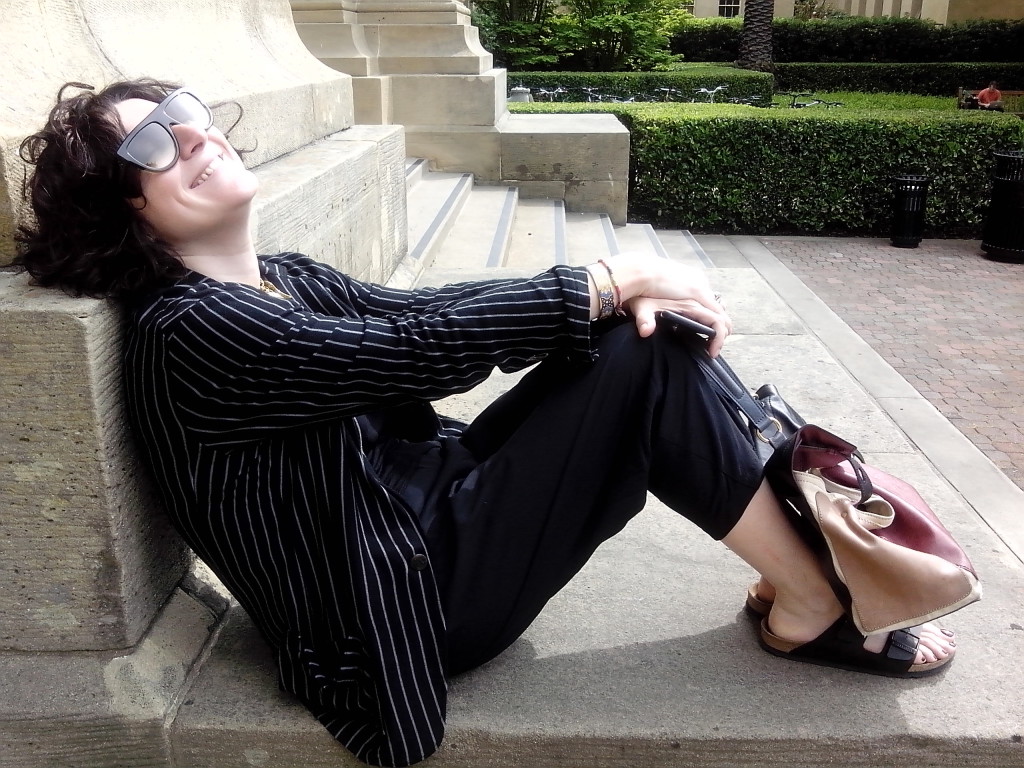
Maria Stepanova at Stanford.

La Dolce Vita at Stanford? Maria on the front steps of Stanford’s Green Library. (Photo: Cynthia Haven)

She came, she saw, she conquered. Maria Stepanova‘s visit to Stanford was short, but intense – and I took plenty of photos, so I’ll give her the star treatment. Her Stanford debut took place at the Stanford Humanities Center on Wednesday, April 6, where she spoke on “Time Backward: Putin’s Russia in Search of Identity.” Although it wasn’t exactly a full house, it came very close. The event was filmed, and I’ll post the link when it’s available. (And we’re pleased that Robert Pogue Harrison recorded an Entitled Opinions radio interview with her – we’ll post that, too.) Meanwhile, I introduced the event with these words:

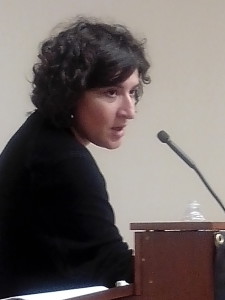
IMG_20160406_205701

Speaking on Putin’s Russia. (Photo: C. Haven)

“…I’m pleased tonight to introduce our guest from Moscow, the poet, publisher, journalist, essayist, and, I’m proud to say, my friend – Maria Stepanova.

“She was born in Moscow in 1972 and graduated from the Gorky Literary Institute in 1995. She was twice awarded the Znamya Prize, the first time in 1993, the prestigious Andrei Bely Prize and Pasternak Prize, both in 2005, and the Hubert Burda Fund Prize the following year.

“In fact, she was already an important and innovative poet by the time Vladimir Putin came to power, but the times called for her to take a tougher and more public stance. Today, she is one of the most visible figures in post-Soviet culture – not only as a poet, journalist, and publisher, but also as a powerful voice for press freedom.

“She is the founder of Colta, the only independent crowd-funded source of news that exists in Russia today, with 900,000 unique visitors per month. The online magazine has been called a Russian Huffington Post in format and style – and also compared to the New York Review of Books for the scope and depth of its essays.

“I’d like to take a minute to explain the Colta story, because it’s a good story in a country that doesn’t offer many of them at this historical moment. Colta began with the online ‘Openspace,’ which Maria founded in 2007.

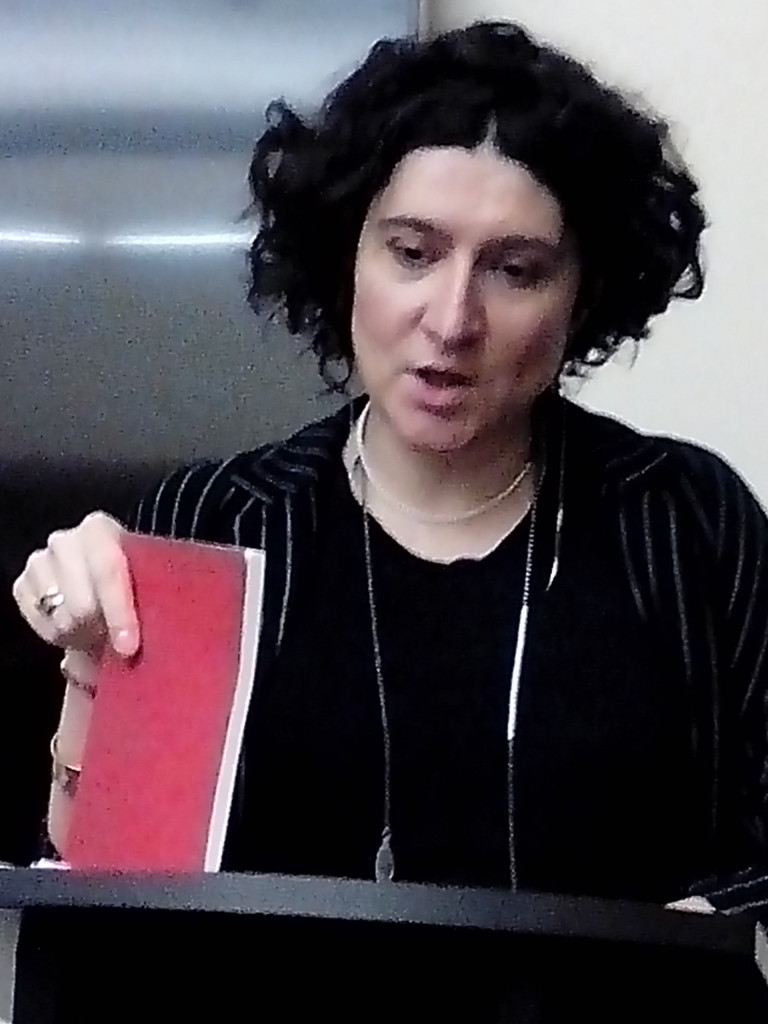
Maria Stepanova reading

At her reading. (Photo: C. Haven)

What she envisioned was a cultural daily, something that would provide Russians with up-to-date and passionate p.o.v. But she soon learned that culture couldn’t stand apart from the political and social changes that were occurring. Private funders pressured Maria to cover more entertainment, less politics. She resisted.

“The differences came to a head in 2012, when nervous funders pulled their support altogether in a political climate that was growing increasingly hostile to independent journalism. She and her colleagues received compensation when the website was terminated – and together, they used their used their severance packages to launch a new website Colta, with volunteer help.

“Colta was born only a few months after the demise of Openspace – and it was funded by ordinary Russians.”Colta had a vital role to play: as the official media, whether print or broadcast or internet, became more propagandistic and xenophobic, Colta offered an alternative. It became the place where you still could find unfiltered information what is going on in the wider world – without even a paywall to close out young, impoverished, or far-flung readers.

Maria Stepanova at SHC

At the Stanford Humanities Center (Photo: C. Haven)

“Colta has been a success for four years. But let us not forget that some consider Maria to be Russia’s greatest living poet. She is the author of ten poetry collections and a continues to get international prizes and recognition in recent years, includnig a Joseph Brodsky Fellowship, and last year a fellowship with Vienna’s distinguished Institute for Human Sciences. I encourage you to attend her reading of her poems, in Russian, tomorrow night’s reading, at 6 p.m. in the German Library, Room 252, of Piggott Hall.

“Maria’s talk tonight will consider Russia’s current obsession with a patchwork of different visions of the past, where one can take shelter from an uncertain future. Yet, as she points out, the future is inevitable, whether we welcome it or not.

“Let’s welcome Maria Stepanova.”

The questions continued well after the 9 p.m. ending time, and I finally suggested that we congregate in the lobby for informal discussion. The surprise was the euphoria afterwards, with people thanking Maria, me, and anyone else who was connected with making this event possible.

Maria was given a bottle of Chardonnay as a thank you, and I’m happy to say it was rapidly consumed that night in the  verdant gardens of Stanford Terrace Inn – by Maria, the poet Helga Olshvang, and me, as we munched the snap peas that were left over from the crudités at the Stanford Humanities Center. It was a magical evening, from the Japanese dinner that began it to the quiet conversation that ended it under the stars.

Postscript on 4/11: We got some nice pick-up from AdWeek‘s “Fishbowl” column – here.


IMG_20160407_152604

Au revoir, Maria! (Photo: C. Haven)


<<< Previous Series of PostssepNext Series of Posts >>>