Happy 2,085th birthday, Virgil! He survived some rotten reviews, too…

October 15th, 2015
Share

ingres-virgil
Who knew that Virgil and P. G. Wodehouse shared a birthday? Virgil gets first dibs, however; he preceded Wodehouse by a couple millennia. This news comes to us via our learned friend, the Los Angeles poet Timothy Steele:

tim120

Tim, not Virgil.

Virgil was born on this day in 70 BCE. The accompanying reproduction of Ingres’ painting of Virgil’s reading to Augustus, Octavia, and Livia depicts that moment when the poet has delivered his lament for Marcellus near the end of Book 6 of The Aeneid. Octavia, Marcellus’s mother and Augustus’s sister, has fainted with emotion. Livia, Augustus’s wife, was rumored to have had a hand in Marcellus’s death, and appears uneasy and annoyed rather than moved. Augustus himself looks deeply affected, either by the poetry or by the prospect of having to deal with an unconscious sister and displeased wife.

Writers everywhere may be solaced by the thought that even Virgil, whose contemporaries recognized him as the greatest poet of the age, received his share of rotten reviews. Suetonius comments on this in his Life of Virgil: “Virgil never lacked detractors, which is not strange; for neither did Homer. . . . Asconius Pedianus, in a book he wrote Against the Detractors of Virgil, sets forth a very few of the charges against him, and those for the most part dealing with history and with the accusation that he borrowed a great deal from Homer; but he says that Virgil used to meet this latter accusation with these words: ‘Why don’t my critics also attempt the same thefts? If they do, they will realize that it is easier to filch his club from Hercules than a line from Homer.’ Yet Asconius says that Virgil had intended to go into retirement, in order to prune down everything to the satisfaction of carping critics.”

bougereau-virgilTim Steele notes that Virgil has steered pretty clear of the social media … so far. Perhaps he can be coaxed out of his shell. Let’s not forget he has made at least one posthumous appearance. He was a special guest star in Dante Alighieri‘s The Divine Comedy, as the younger Italian poet’s sherpa. Here’s William-Adolphe Bouguereau‘s 1850 portrait of Dante and Virgil, and it looks like the Inferno with that U.F.O. in the background, not to mention the looks on their faces.

Tim shines in other ways on this day, Virgil’s birthday. In the “Envoi” section of David Sanders‘s current “Poetry News in Review” in Prairie Schooner (online here), he had this to say: “The only novelty sure to last in poetry is the novelty of talent. Moreover, the alert poet cannot help but be novel: his subjects are the manners and morals and aspects of his world and fellow creatures, and these are always changing. The idea that to be novel, one has to invent a ‘METHOD’ in the Poundian sense is not only wrongheaded: it is unnecessary.” That’s from his Missing Measures: Modern Poetry and the Revolt against Meter.

How Freud escaped.

October 12th, 2015
Share

escapeofsigmundfreudOctogenarian Sigmund Freud was ailing from cancer and it was long past the time to leave Vienna. Hermann Göebbels and Joseph Himmler had set out to kill psychoanalysts, especially Jewish ones. Hermann Göering had their property and assets seized, which included Freud’s publishing company. Moreover, a month after the Nazis took over Austria on March 12, 1938, every business owned by Jews had a Nazi appointed to run it. The appointed “commissar” was a 35-year-old chemist, Anton Sauerwald.

By the time he finally decided he could not live at 19 Berggasse anymore, Freud and his extended family were already living under a form of self-house arrest, his daughter Anna had been interrogated by the Gestapo, and the family’s assets were being confiscated. Freud could look out his window and watch Jewish shops being looted by ‘respectable’ Viennese; he could see Jews being beaten and shot dead by thugs.” So writes Bettina Berch for the Jewish Book Council. Why did he wait so long?

I hadn’t heard of The Escape of Sigmund Freud when it was released. I ran across it in my usual internet wanderings. The book, by David Cohen, was published by one of my favorite houses, Overlook Press. It sounds riveting.

Freud was an especial target but, as Debbie Hagan at Psych Central writes, “the Nazis couldn’t escape the fact that Freud was a well-connected, international figure, who they grudgingly had to respect. Freud did have friends throughout the world, such as William Bullitt, the American ambassador in Paris, and President Roosevelt, who telegrammed Hitler, warning him that any harm done to Freud would be considered a deplorable act. Still it didn’t stop Nazis from hanging swastikas on Freud’s stoop or the Gestapo from harassing him, claiming that he had not paid his taxes and his publishing company had outstanding debt. Thus, military police  confiscated the family’s cash and passports. These actions reached a climax when the  Gestapo arrested Freud’s daughter Anna, a noted analyst in her own right, which shook Freud into a stark reality: His life in Vienna was over.” 

In Freud’s 1927 The Future of an Illusion, he concludes that all religious beliefs are “illusions and insusceptible of proof.” He notes that “civilization has little to fear from educated people and brain-workers,” but “the great mass of the uneducated and oppressed” were of more concern. Freud concluded with the “hope that in the future science will go beyond religion, and reason will replace faith in God.” Yet he could not have conceived of the Nazis, and what the “educated people and brain-workers” might have been brought to by their own thinking. And there might be a little more to the oppressed than he had suspected. In fact, he had become one of them.  

On March 13, 1938, the Vienna Psychoanalytic Society met and Freud reached into his knowledge of Jewish history for the right story to give them hope. He told his friends: “After the destruction of the Temple in Jerusalem by Titus, Rabbi Jochanan ben Zakkai asked for permission to open a school at Jabneh for the study of the Torah. We are going to do the same. We are, after all, accustomed by our history and tradition, and some of us by our personal experience, to being persecuted.”

In the end, he was saved, not by intellectuals or grand thinking, but by bourgeois kindnesses– of friends, admirers, and a Nazi who, in the course of his relationship with Freud, developed an old-fashioned conscience and chose to look the other way as the Freuds escaped. That’s right, Anton Sauerwald himself. (Read his story here.)

“Thus, the Freud family (including his daughter, Anna, his wife, Martha, and their faithful housekeeper, Paula), fled to Britain. They toted along Freud’s famous couch, some of his books, and many objets d’artFour of Freud’s sisters stayed behind. Even though Freud made many attempts to contact them, he never succeeded. Years after his death, researchers would discover that three had died in concentration camps. The fourth most likely died of malnutrition.”

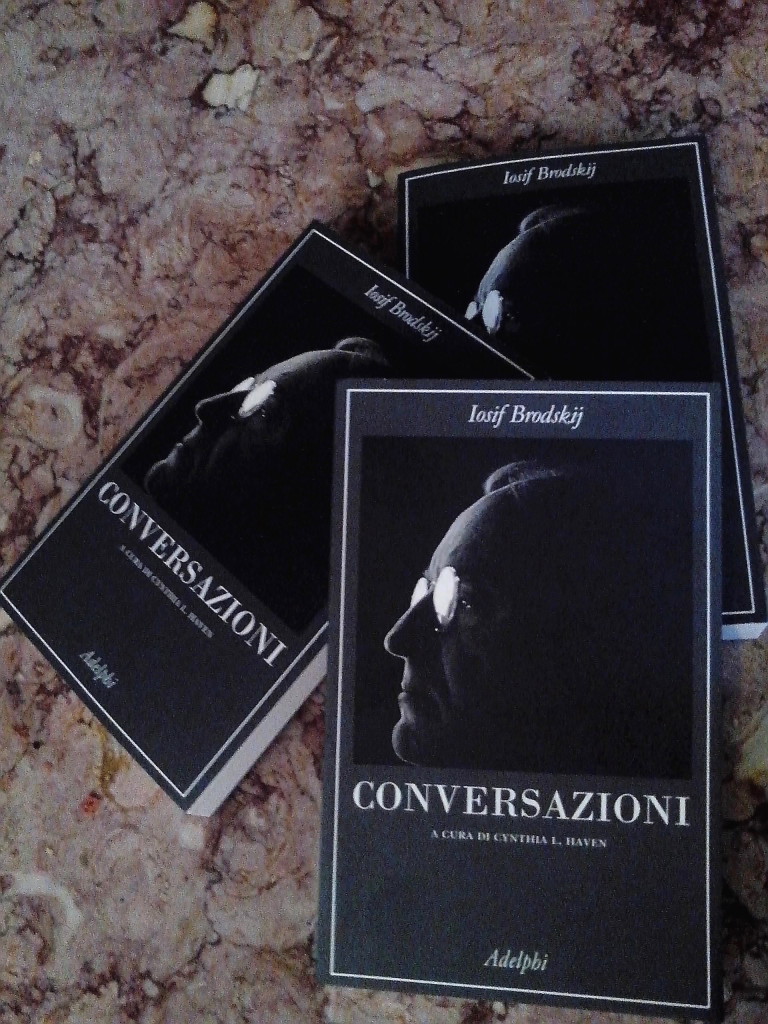
Conversations with Brodsky – in Italian from Adelphi!

October 8th, 2015
Share

adelphi2

.

Heraclitis observed that ‘the dry soul is wisest and best.’ Joseph Brodsky would have agreed, at least in principle. But no one who reads these interviews will fail to note his passionate engagement with the world – the very world from which, as a poet, he was always trying to detach himself. The development of the poetry and the development of the human animal writing the poetry are often distinct – yet in Brodsky’s case, the overlap is poignant. Certainly his psyche turned to darkness as his body betrayed him – another force driving him to seek the absolute lucidity and infallibility of a mathematical axiom in his poetry, another level of his eternal combat between grief and reason. The struggle is evident in this volume.”

brodsky2– From the introduction to Joseph Brodsky: Conversations

With great pleasure we announce that Joseph Brodsky: Conversations is now available to Italian speakers, thanks to Italy’s premier publishing house, Adelphi in Milan. (We’ve written about Adelphi’s publisher and founder Roberto Calasso, who visited Stanford last year, here and here.) It’s a great honor to be part of Adelphi’s eminent family of authors. We at the Book Haven are chuffed beyond words – even if “we” means Humble Moi sitting alone at my MacBook Pro, surrounded only by stacks of books and papers and a pile of sharpened pencils.

The book was originally published in 2002 as part of the University Press of Mississippi’s Literary Conversations series, but given the Russian poet’s famous love of Italy, it should find a natural home in lovely Milano.

Thanks to all who made this possible, especially including Maria Sozzani Brodsky. Grazie mille! We’ll be running excerpts from the reviews as they roll in.

What’s that you say? You don’t speak Italian? Try looking for the English language edition on Amazon (here), which features a stunning photo by Richard Avedon on the cover.


Getting ready for the Nobel in literature. And where better to do it than Stockholm?

October 5th, 2015
Share
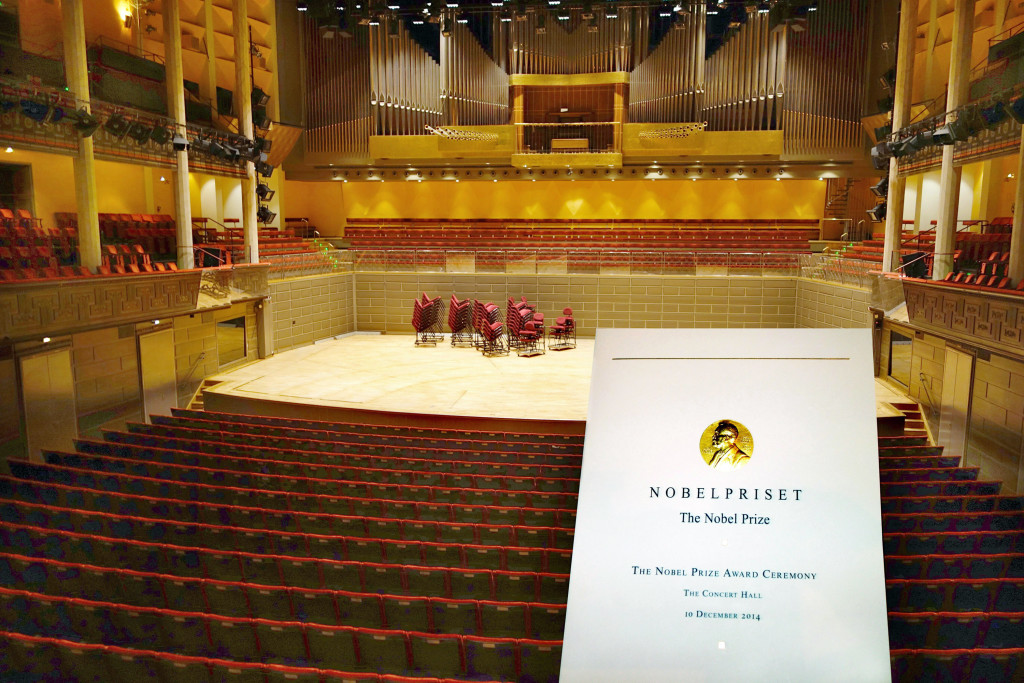
Concert Hall with nobel program. Stockholm 8/2015

Laureates are seated onstage at the Concert Hall during the ceremony. (Photo: Zygmunt Malinowski)

The Nobel Prize for Literature will be awarded this Thursday in Stockholm. While we await the announcement, our New York City-based  correspondent, roving photojournalist Zygmunt Malinowski, reports on his recent visit to the Nobel Empire in Stockholm…

During last summer’s visit to Gdańsk for the opening of European Solidarity Center (read about it here), I found a nearby harbor with ferry to Sweden. I remembered a well-known photograph of Polish poet Czesław Miłosz dressed up in a tuxedo receiving his diploma from the king of Sweden, and I wondered what traces his visit to Stockholm might have left.

8 © Zygmunt Malinowski

Stockholm City Hall for the Nobel banquet (Photo: Zygmunt Malinowski)

A journey without the usual hustle of airports and cramped airplanes makes a ship seem more natural way to travel. Even though the ferry was spartan in its accommodations, it felt spacious (except for the usual closet-sized sleeping cabin). In the evening at the large cafeteria with panoramic windows, time passes slowly. One can order a coffee or something stronger and gaze at the grayish Baltic Sea and the semi-circular, unending horizon, where the distant water edge never seems to get any closer.

After about 19 hours, we arrived at the port city of Ninanshamn. From there, it’s a short rail ride on a comfortable train to Stockholm. Stockholm consists of interconnected islands; its many bridges and water taxis efficiently transport passengers on its clean waterways and canals. The historic old town (Gamla Stan) with the narrow cobbled streets and shops, restaurants, and cafés, dates back to 13th century. The neoclassical Nobel Museum, home of the Swedish Academy that nominates the literature award, is pretty much in the center of it.

Nobel Ice Cream at Bistro Nobel, Nobel Museum. Stockholm. 8/2015

Nobel ice cream at Bistro Nobel (Photo: Zygmunt Malinowski)

I took advantage of a guided tour offered in English. As a young man, Alfred Nobel wanted to be a poet. Inspired by Percy Bysshe Shelley and Lord Byron, he wrote all his poems in English. His father dissuaded him, saying that it was not a real job, so Alfred Nobel is remembered for inventing dynamite instead.

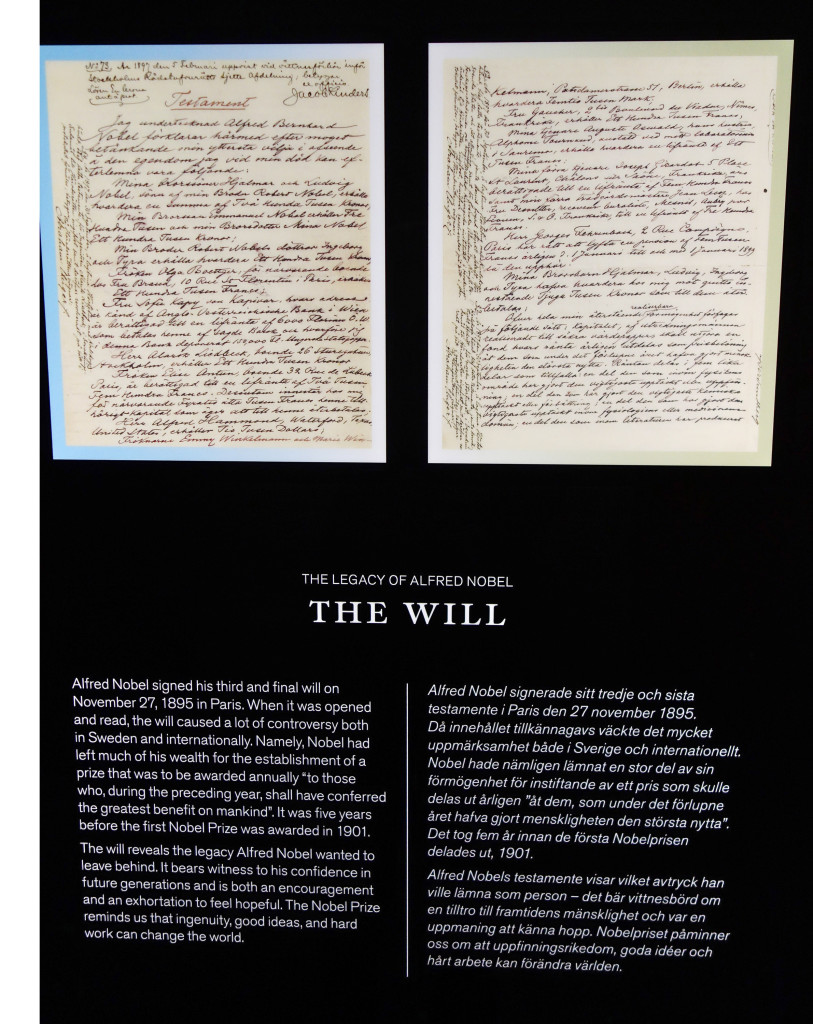
He also wrote several plays, but his family destroyed most of these papers, since they wanted him to be remembered for chemistry and inventions. He lived most of his adult life in Paris, never married, and had no children. His last will and testament gave away most of his fortune as annual prize. According to the museum, “Nobel was against inherited fortunes that he believed contributed to the laziness of humanity. The will was an ingenuous way of solving this dilemma. The inheritance, in the form of a prize, would reward those who have made themselves worthy by way of their work.”

Nobel had over 350 patents and made a fortune, but his idea of ideas was establishing the Nobel award in five categories: physics, chemistry, physiology and medicine, literature, and peace (later a prize for economy was added). The peace prize is awarded in Norway. Nobel met Victor Hugo in Paris, and throughout his life corresponded with Countess Bertha Von Sutter, founder of Austrian peace movement and author of Lay Down Your Arms. The latter influenced the formation of a peace prize, which she won in 1905.

The Nobel nominating process begins in September of the previous year, when the Swedish Academy committee responsible for the literature award sends out hundreds of letters to universities, institutions, and individuals qualified to nominate Nobel laureates. By the following April, the list that’s been gathered is whittled down to about 20 candidates. In May, the selection is narrowed to five candidates. The Academy becomes familiar with the proposed authors and their work. In September, the Academy finally makes a decision and the winner is announced in October. On December 10, laureates receive their prizes. The decision process remains a secret for fifty years – only now can we learn who nominated the winner from 1965.

6 © Zygmunt Malinowski

Would you sign my chair, please? (Photo: Zygmunt Malinowski)

The ceremony takes place in three separate locations. The laureates are invited to the Academy for lunch, on December 9, and afterwards a rehearsal. On December 10, during a ceremony at the Concert Hall they receive an elaborate calligraphy diploma and medal from the King of Sweden, in addition to a check. Attendance is by invitation only. Limos line up to take the 1,300 guests to City Hall for the banquet, first walking through the Golden Hall down marble staircase to the spacious Blue Room. In Sweden, the event is almost a holiday; it’s followed closely on TV throughout the day.

One of the highlights while visiting the museum is having lunch and Nobel ice cream with chocolate Nobel medal at the Vienna-style ‘Bistro Nobel.’ Yes, the ice cream tastes as good as it looks, and it’s actually the same dessert that was served for many years at the Nobel Banquet. Another tradition started in recent years is signing the back seat of bistro chairs. One can turn over a chair to see which laureate signed it. Signatures started after Miłosz’s visit, but I located Mario Vargas Llosa on chair #26 and Seamus Heaney, chair #23.

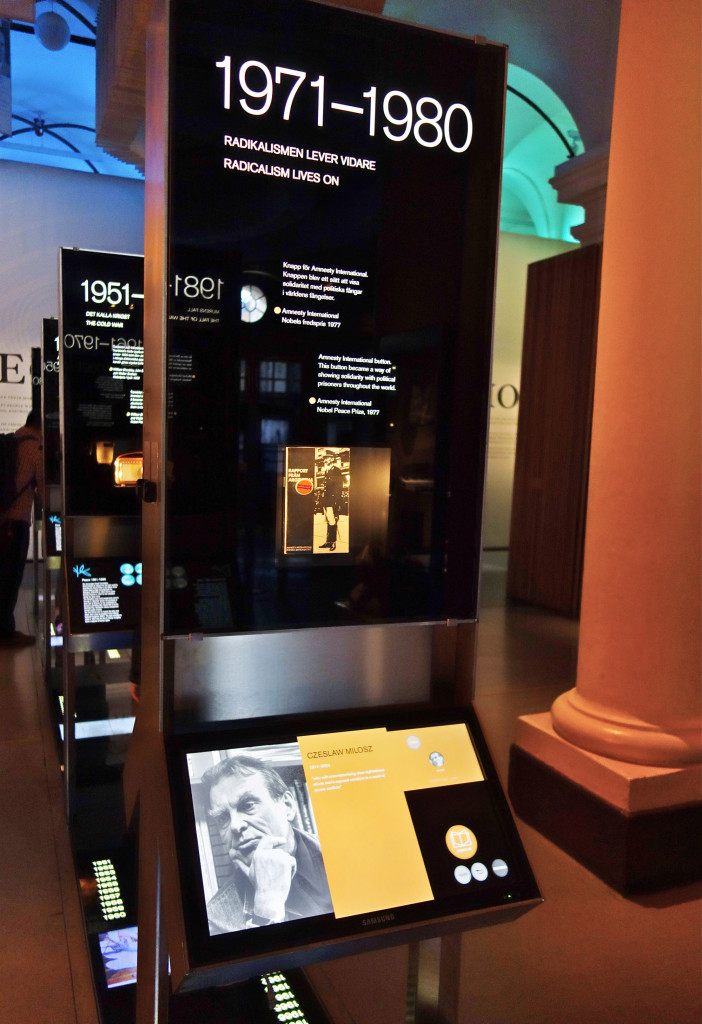
So where was Miłosz? See the photo below, from the central area of the museum. Also, all Nobel winners are featured on a ceiling display (also pictured below), but it would take hours to find a specific person since they are not in any particular order. I know, I waited as Samuel Beckett, Wisława Szymborska, and Madame Curie-Sklodowska, the first woman to receive Nobel Prize and first to receive it twice, rolled past, before heading for the ice cream.

.

2 © Zygmunt Malinowski

Miłosz at last. (Photo: Zygmunt Malinowski)

9 © Zygmunt Malinowski

After the feast, the ball – and it takes place at the gorgeous Golden Hall. (Photo: Zygmunt Malinowski)

3 © Zygmunt Malinowski

Previous winner Wisława Szymborska in a rotating ceiling display at the museum. (Photo: Zygmunt Malinowski)

1 © Zygmunt Malinowski

The august Nobel Museum and the Swedish Academy. (Photo: Zygmunt Malinowski)

4 © Zygmunt Malinowski (1)

In my end is my beginning. (Photo: Zygmunt Malinowski)

The Hopwood Awards: still giving hope (and bucks) to young writers after 84 years

October 3rd, 2015
Share
hopwood1

Presiding deity of the Hopwood Room, Andrea Beauchamp (Photo: Humble Moi)

In my day, the University of Michigan’s Avery Hopwood Award was considered a major prize for young writers. It is even more so today – what with students winning multiple awards (two awards was once uncommon), and with supplemental bonuses that resulted in one lucky student bagging $33,000 earlier this year. Those kinds of sums defray an awful lot of tuition costs. It also pays for a lot of tea and cookies, which the Hopwood Room still dispenses regularly during the fall and winter quarters on Thursdays.

Avery_Hopwood_&_Rose_Rolanda

Living it up: Hopwood with Spanish dancer Rose Rolanda, 1924.

I used to feel a little glow of pride when I entered the Hopwood Room. It was my room, after all! But would it still be in the same place decades later? I was happy that I recognized Angell Hall immediately (one of the few buildings I recognized), walked up the front stairs to the door, and up stairs inside, and instinctively turned to the right. There it was, a few steps away a on the left side of the hall. And it looked … exactly the same. “Welcome to the time warp,” announced Andrea Beauchamp, assistant director and ongoing presence of the Hopwood program.

She said the room has been deliberately kept that way. She fought off attempts to replace the worn carpet “with Oreos crushed into it” with a drab new carpet that had a “standard dentist’s office” look about it. She wanted to keep the charm, books, and dark-wood ambiance, and she succeeded. Even the big round table covered with every literary journal imaginable still dominated the room – including some journals I have contributed to over the years since I left town, the Virginia Quarterly Review, the Kenyon Review, the Georgia Review among them.

Arthur Miller and I won two Hopwoods, award-winning Anglo-American poet Anne Stevenson (I’ve written about her here and here) won an astonishing three. According to the website:

The program was endowed by Avery Hopwood, a popular American dramatist and member of the Michigan Class of 1905. Mr. Hopwood bequeathed one-fifth of his considerable estate to the University of Michigan with the stipulation that it be used to encourage creative writing among students. During the years that have passed since the first Hopwood Awards were made in 1931, we have been able to award a cumulative total of well over $3,000,000 to more than 3,200 gifted writers. Former winners include Arthur Miller, John Ciardi, Mary Gaitskill, Robert Hayden, Lawrence Kasdan, Jane Kenyon, Frank O’Hara, Marge Piercy, Edmund White, and Nancy Willard. …

For former director Nicholas Delbanco’s remarks on the history of the program and the legacy of Avery Hopwood, written for the New York Times in 1998, see this PDF.

I had stayed in touch with Andrea over the years, feeding tidbits to the Hopwood newsletter. I had kept up with her for so long that I rather expected her to be a wizened old lady of a zillion years rather than the smart and vibrant woman in the photo above. I had apparently conflated her with her predecessor, “Sister Hilda,” a nun who had a PhD in English and arrived from an obscure and dwindling order to manage the program. Had I read the Hopwood newsletter more faithfully, I would have known that the beloved sister died in 2004, at 92, and served enthusiastically and tenaciously from 1971-1981. I would also have known she did her dissertation on that much-married diehard Puritan John Milton. She must have had quite a kick to her, which I hadn’t suspected as a student.

But the Hopwood program has kept up with Stanford, too. Andrea warmly recalled recent visits from our newest National Medal of the Arts winner Tobias Wolff and Irish poet Eavan Boland. Well, you can read excerpts from Eavan’s inspiring talk at the Hopwood Awards ceremony last spring here.

hopwoodNYT

Caffeine, camaraderie, catharsis, and 125 years of editorial freedom

September 30th, 2015
Share
daily

On the threshold of the future, 1970s.

Last weekend was my first trip back to Ann Arbor since I took home a diploma several decades ago. It also marked my first trip back to the Michigan Daily offices at 420 Maynard.

Arthur Miller 1955

One of us.

The distinctive Student Publication Building has the same smell it did all those years ago, minus the rubber cement. We edited the old-fashioned way: the rip-and-glue method on pages of low-cost newsprint. The dumb waiter had vanished, too, except in the memories of those who remember the linotype days. As the 1.40 a.m. daily deadline neared, the dumb waiter saved steps as we sent copy to the typesetters on the floor below in the basement. Periodically, we would scamper downstairs to watch the progress of the night’s paper: seasoned professionals (the legendary Lucius Doyle and Merlyn Lavey foremost among them) tapped away on the big clackety linotype machines, as lead pigs were melted into pools of silver to make the slugs that were assembled on turtles, and eventually locked into place for printing. Pigs, slugs, turtles… lots of nature words for a place that was as far from the outdoor world as could be imagined – especially the underground kingdom on the floor below us. It was one of the last of the hot-type newspapers, and it was a privilege to work on it.

TomHaydenAddressesAntiWarProtestAtTheDNC20040729-01small

One of us, too. (Photo: Brian Corr)

Three Dailyites from our set went on to get Pulitzers (so far), including the Washington Post‘s Eugene Robinson. The Daily was considered “the New York Times of student newspapers” – though I was never sure of the provenance of that tag. Certainly its independence made it unique among the nation’s university newspapers. That tradition continues: It has no supervision from the faculty or the administration. It receives no funding from the university to run a full-circulation daily (five days a week now, six days a week back in my day). Decades ago, the student-run outfit even paid for its own building – the familiar 1930s-style brick landmark that offered nickel cokes in thick green glass bottles. (For old times’ sake, I bought a can of coke for fifty cents in the machine downstairs. Not the same.) Its revenues peaked at $1.4m in 2000 to about $500,000 last year. “The University of Michigan places a high value on the Michigan Daily’s editorial freedom,” one of the university’s attorneys wrote – the letter was projected on a screen at the gala dinner.

420maynard

We paid for it.

One of us, columnist Laura Berman, described the occasion this way in The Detroit News:

As newspapers shrink and, alas, sometimes die, the Michigan Daily, a 125-year-old student-run paper, is getting attention for sheer survival.

Without support or direct interference from its parent institution, the University of Michigan, the student daily has outlasted big and smaller city dailies, including the Ann Arbor News (now part of MLive.com). At a university lacking a journalism department, 20-year-old editors miraculously “train” their younger cohorts, winning national recognition year after year.

Today, the Daily opens its 83-year-old building’s doors to nearly 400 alumni from across the country, including Pulitzer Prize winning journalists, academics, doctors and lawyers. From Rebecca Blumenstein, the Wall Street Journal’s deputy editor-in-chief, to Tony Schwartz, the author and business consultant who wrote Donald Trump’s The Art of the Deal to Sports Illustrated columnist Michael Rosenberg and Detroit Free Press editorial page editor Stephen Henderson, it’s a varied group of pilgrims.

rimer

Sara Rimer of the New York Times celebrates her return.

Caffeine, ambition, camaraderie, and journalistic passion — but very little pay — have fueled the Daily for generations. …

At the gala dinner in the Michigan League, someone described the newsroom atmosphere as “stressful, exhausting, cathartic … addictive.” That about sums it up. We were a competitive and hard-working lot, and the newsroom atmosphere was intense.

After a whirlwind visit after so many years, it’s hard to describe all the emotions that were churned up in less than 72 hours. Let’s start with horror: the old-style morgue, with its scores of bound volumes, is being digitized. Thirty-nine of the 320 volumes are already electronically processed. I spent a short while in the morgue over the weekend, thumbing through the oversize volumes. Speaking for myself, you couldn’t bury some of my early stories deep enough. Time has not treated many of these pieces well, and I would not like to see them in my Collected. But the fact that I think that way at all probably owes something to the Daily.

According to the university’s LSA Today:

What do playwright Arthur Miller, two-time presidential candidate Thomas Dewey, and neurosurgeon/medical correspondent Sanjay Gupta have in common? They all wrote for the Michigan Daily, which celebrates its 125th anniversary this month. [Not to mention Tom Hayden. – ED.]

Covering campus, sports, local news, and culture, the Daily has been the object of both picketing and praise over its 125 years. And even as eminent newspapers have gone digital or crumbled, the Daily, which is financially independent of U-M, continues to thrive. In addition to its vigorous online presence, the Daily still publishes on paper. During the school year, it does so five days per week.

daily-swag

Swag bag & shirt.

“When we check Twitter or even Yik Yak, a story from the Daily is often the center of conversation,” says Jennifer Calfas, LSA senior and the Michigan Daily’s editor in chief. “Sometimes you forget how amazing it is that this work impacts so many people, but then small moments remind you.”

After all, how many university rags ever got their own segment on Jon Stewart‘s Daily Show. (Don’t believe me? Watch it here.)

My stony little heart got so sentimental I finally broke down and bought my first university t-shirt to add to the Michigan Daily mug and “M” cookie (from the fabulous local deli Zingerman’s) in my swag bag. I couldn’t bring myself to get something as naff as “Go Blue!” So I settled for “Naprzód Niebiescy,” which a Polish scholar assured me was an even stronger phrase – something along the lines of “Advance forward, blue!”

..

turque-jordan

Bill Turque of the Washington Post and Lani Jordan, formerly of UPI, thumb through old volumes in the morgue.

lipinski-tobin

Pulitzer-prizewinning Ann Marie Lipinski of the Chicago Tribune and award-winning author Jim Tobin watching the last hot-type Daily come off the presses in the late 1970s. “That college newsroom was everything,” she said. (Photo: Steve Kagan)

michdaily

Humble Moi with photojournalist Pauline Lubens of the San Jose Mercury News, poet Marnie Heyn, and David Pap.


<<< Previous Series of PostssepNext Series of Posts >>>