Adam Johnson‘s newest collection of short stories, Fortune Smiles, is reviewed by Michiko Kakutani in the New York Times.
We’ve written about Adam, the author of the Pulitzer Prize winning The Orphan Master’s Son too many times to list – here and here and here and here for starters. She wrote: “Johnson’s earlier writing — his 2002 story collection, Emporium, and his first novel, Parasites Like Us — also had a surreal, even sci-fi feel. And while many tales in his potent new collection, Fortune Smiles, have recognizable, contemporary settings, they, too, feature characters reeling from displacement, dislocation or emotional and cultural vertigo.”
She continues:
Our man picking up an award in London last year.
The volume’s two standouts — the title story and “Nirvana,” [we wrote about that story here] about a computer programmer who uses virtual reality to reanimate a dead American president — straddle the worlds of realism and fable, and attest to Mr. Johnson’s elastic and idiosyncratic voice: his ability to write with both tenderness and satiric verve, and his electro-magnetic feel for the absurdities of life and the human costs they represent. …
The two weakest links in this collection — “Dark Meadow” (about a pedophile) and “George Orwell Was a Friend of Mine” (about a former East German prison warden) — feature such reprehensible characters that Mr. Johnson has a difficult time persuasively putting across their points of view. It’s almost as though he had challenged himself to write the tales as exercises in the limits of sympathy.
These stories should have been left on the cutting room floor, but this collection is hardly alone these days in containing unnecessary padding. But never mind. The other tales in Fortune Smiles are worth everything: They reaffirm all the gifts Mr. Johnson demonstrated in “The Orphan Master’s Son,” and like “Emporium,” they attest to his athletic mastery of the short story form.
The flood of desperate refugees pouring out of Syria dominates the news this Labor Day weekend. It’s said to be the largest refugee crisis since World War II.
Shakespeare’s unfinished play Sir Thomas More was not accepted as the Bard’s until relatively recently. It’s now generally conceded to be his handiwork – in fact, it’s the only play to exist in his own hand (apparently the scholarly consensus seems to agree that it isindeed his handwriting).
Apparently, England had its own refugee crisis, with over 64,000 arriving on English shores between the 1330 and 1550, not all of them upper crust emigrés fleeing angry monarchs, and many arriving from many far-flung lands. The story is told over here, at England’s Medieval Immigrants.
Shakespeare’s play portrays the May Day riots of 1517, when Londoners protested the refugees from Lombardy who were entering the country. It is the most powerful scenes of this little-known play.
The matchless Ian McKellen had the distinction of being the first to perform the role of England’s beheaded Lord Chancellor way back in 1964, when the play was produced professionally for the first time. See film clip above. The speech begins about two minutes in, but the preamble is good, too. (He makes one curious error, however: Shakespeare never lived under a Catholic monarch; he was born in the reign of Queen Elizabeth and died under King James, both Protestants – he was never around for the brief reign of Queen Mary.)
Here’s Shakespeare’s words on the subject – but I very much recommend watching the McKellen clip above. It will make your day. Really. (And many, many thanks to “The Shakespeare Blog” herefor bringing this to our attention.)
. Grant them removed, and grant that this your noise Hath chid down all the majesty of England; Imagine that you see the wretched strangers, Their babies at their backs and their poor luggage, Plodding to the ports and coasts for transportation, And that you sit as kings in your desires, Authority quite silent by your brawl, And you in ruff of your opinions clothed; What had you got? I’ll tell you: you had taught How insolence and strong hand should prevail, How order should be quelled; and by this pattern Not one of you should live an aged man, For other ruffians, as their fancies wrought, With self same hand, self reasons, and self right, Would shark on you, and men like ravenous fishes Would feed on one another…. Say now the king Should so much come too short of your great trespass As but to banish you, whither would you go? What country, by the nature of your error, Should give you harbour? go you to France or Flanders, To any German province, to Spain or Portugal, Nay, any where that not adheres to England, Why, you must needs be strangers: would you be pleased To find a nation of such barbarous temper, That, breaking out in hideous violence, Would not afford you an abode on earth, Whet their detested knives against your throats, Spurn you like dogs, and like as if that God Owed not nor made not you, nor that the claimants Were not all appropriate to your comforts, But chartered unto them, what would you think To be thus used? this is the strangers case; And this your mountainish inhumanity.
We’ve already published Joseph Brodsky‘s reading list to have a basic conversation here, and here we published the private reading list he gave to Humble Moi here. And I’ve also published W.H. Auden‘s course syllabus from the University of Michigan here. Are you done with these yet? Good. Here’s another one.
Thanks to Open Culture, we now present you with Jorge Luis Borges‘s invented library. It came about this way: “In 1985, Argentine publisher Hyspamerica asked Borges to create A Personal Library — which involved curating 100 great works of literature and writing introductions for each volume. Though he only got through 74 books before he died of liver cancer in 1988, Borges’s selections are fascinating and deeply idiosyncratic. He listed adventure tales by Robert Louis Stevenson and H.G. Wells alongside exotic holy books, 8th century Japanese poetry and the musing of Kierkegaard.”
Call us when you’ve finished. We’ll find some more for you.
1. Stories by Julio Cortázar (not sure if this refers to Hopscotch, Blow-Up and Other Stories, or neither)
2. & 3. The Apocryphal Gospels
4. Amerika and The Complete Stories by Franz Kafka
5. The Blue Cross: A Father Brown Mystery by G.K. Chesterton
6. & 7. The Moonstone by Wilkie Collins
8. The Intelligence of Flowers by Maurice Maeterlinck
9. The Desert of the Tartars by Dino Buzzati
10. Peer Gynt and Hedda Gabler by Henrik Ibsen
11. The Mandarin: And Other Stories by Eça de Queirós
12. The Jesuit Empire by Leopoldo Lugones
13. The Counterfeiters by André Gide
14. The Time Machine and The Invisible Man by H.G. Wells
15. The Greek Myths by Robert Graves
16. & 17. Demons by Fyodor Dostoyevsky
18. Mathematics and the Imagination by Edward Kasner
19. The Great God Brown and Other Plays, Strange Interlude, and Mourning Becomes Electra by Eugene O’Neill
20. Tales of Ise by Ariwara no Narihara
21. Benito Cereno, Billy Budd, and Bartleby, the Scrivener by Herman Melville
22. The Tragic Everyday, The Blind Pilot, and Words and Blood by Giovanni Papini
23. The Three Impostors
24. Songs of Songs tr. by Fray Luis de León
25. An Explanation of the Book of Job tr. by Fray Luis de León
26. The End of the Tether and Heart of Darkness by Joseph Conrad
27. The Decline and Fall of the Roman Empire by Edward Gibbon
28. Essays & Dialogues by Oscar Wilde
29. Barbarian in Asia by Henri Michaux
30. The Glass Bead Game by Hermann Hesse
31. Buried Alive by Arnold Bennett
32. On the Nature of Animals by Claudius Elianus
33. The Theory of the Leisure Class by Thorstein Veblen
34. The Temptation of St. Antony by Gustave Flaubert
35. Travels by Marco Polo
36. Imaginary Lives by Marcel Schwob
37. Caesar and Cleopatra, Major Barbara, and Candide by George Bernard Shaw
38. Macus Brutus and The Hour of All by Francisco de Quevedo
39. The Red Redmaynes by Eden Phillpotts
40. Fear and Trembling by Søren Kierkegaard
41. The Golem by Gustav Meyrink
42. The Lesson of the Master, The Figure in the Carpet, and The Private Life by Henry James
43. & 44. The Nine Books of the History of Herodotus by Herodotus
45. Pedro Páramo by Juan Rulfo
46. Tales by Rudyard Kipling
47. Vathek by William Beckford
48. Moll Flanders by Daniel Defoe
49. The Professional Secret & Other Texts by Jean Cocteau
50. The Last Days of Emmanuel Kant and Other Stories by Thomas de Quincey
51. Prologue to the Work of Silverio Lanza by Ramon Gomez de la Serna
52. The Thousand and One Nights
53. New Arabian Nights and Markheim by Robert Louis Stevenson
54. Salvation of the Jews, The Blood of the Poor, and In the Darkness by Léon Bloy
55. The Bhagavad Gita and The Epic of Gilgamesh
56. Fantastic Stories by Juan José Arreola
57. Lady into Fox, A Man in the Zoo, and The Sailor’s Return by David Garnett
58. Gulliver’s Travels by Jonathan Swift
59. Literary Criticism by Paul Groussac
60. The Idols by Manuel Mujica Láinez
61. The Book of Good Love by Juan Ruiz
62. Complete Poetry by William Blake
63. Above the Dark Circus by Hugh Walpole
64. Poetical Works by Ezequiel Martinez Estrada
65. Tales by Edgar Allan Poe
66. The Aeneid by Virgil
67. Stories by Voltaire
68. An Experiment with Time by J.W. Dunne
69. An Essay on Orlando Furioso by Atilio Momigliano
70. & 71. The Varieties of Religious Experience and The Study of Human Nature by William James
72. Egil’s Saga by Snorri Sturluson
73. The Book of the Dead
74. & 75. The Problem of Time by J. Alexander Gunn
On an impulse, I dropped in at CineArts in Palo Alto Square to see James Ponsoldt‘s The End of the Tour, the talky film on the late great author David Foster Wallace. Silly me. I hadn’t read much about the film and thought it would be a kind of documentary, made up of recorded interviews during his life. It’s not, at least not entirely. However, much of the 90 minutes of conversations is indeed Wallace’s own, since the narrator is another writer, David Lipsky, then a reporter for Rolling Stone, who interviewed Wallace on a five-day binge in 1996. The conversations were transcribed, fourteen years later, for publication in a book called Although of Course You End Up Becoming Yourself.
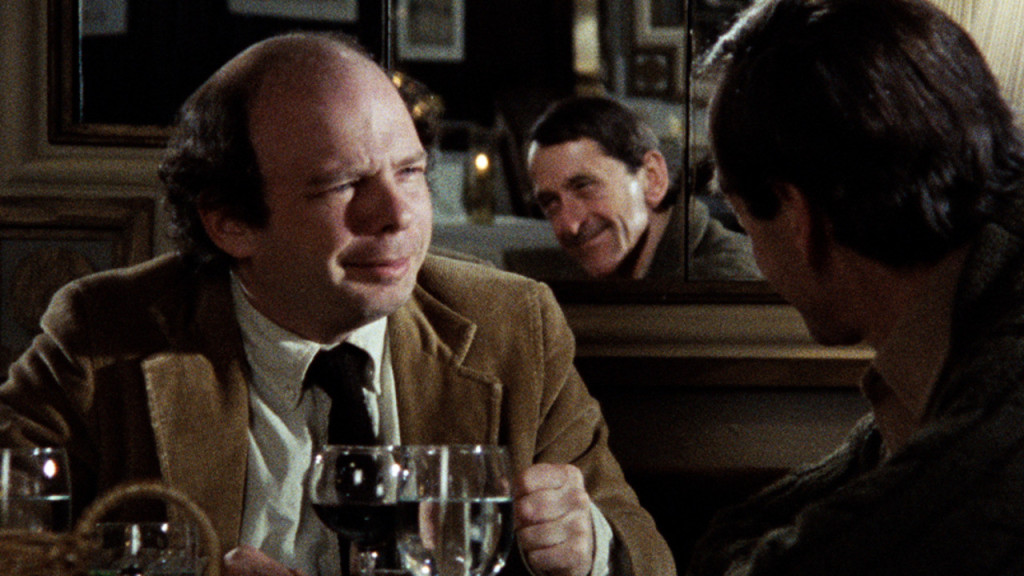
Remember 1981’s My Dinner with André? That’s another talky film recreating a long-ago conversation. How times have changed, even in three-and-a-half short decades! My Dinner with André, a restaged reunion between avant-garde director André Gregory and actor/playwright Wallace Shawn, did a deep dive into the human psyche, sure, but it was outward-facing, discussing worldwide travels and explorations and revelations. The End of the Tour is all inward and self-doubt and neuroses, shot through with insight, suffering, and light – but we never seem to leave these two men’s heads. The 1981 film never seems claustrophobic, although it is almost entirely filmed within a New York restaurant; in The End of the Tour, although it “opens out,” as they say, into Minneapolis, never seems to leave Wallace’s cluttered Illinois home in the middle of nowhere, in the overwhelming winters of the American Midwest. Well, this turn of events is what Wallace predicted would happen, isn’t it? See the film clip above.
So here I am. As one commenter put it, a writer writing about a movie about a writer writing about a writer. A few reflections:
I’m ill at ease about portrayals of “America” as a land of spiritual desert and strip malls – and I come from the same part of the world that Wallace did. If one sits in front of a TV and gets one’s food from 7/11, yes, it will be that way. But the way of the Twinkie is chosen, not inevitable. Some of us listen to Schubert and talk about Stendhal with our friends, over tapas and Cabernet. I’ve never had a poptart. Why would I?
Full disclosure: I’ve only read some of Wallace’s essays and short stories – I’ve never even tried (yet) to read Infinite Jest. So I take this warning to heart, from A.O. Scott writes in the New York Times: “Funny, intriguing and revealing as this talk may be, it does not have anything like the status of Wallace’s writing. The film not only acknowledges this distinction, but it also insists on it. In his would-be profiler’s company, occasionally glancing at the menacing red light of the predigital tape recorder, Wallace is by turns cagey and candid, witty and earnest, but he is always aware, at times painfully, that he is playing the role of a writer in someone else’s fantasy. Actually writing is something he does when no one else is around.” A minor point: Lipsky flings his tape recorder from jacket pocket to restaurant table, from his hand to Wallace’s, casually waves it around – and yet he seems to get crisp, usable recordings out of it. How does he do that? I can’t do that with today’s up-to-date recorders.
Any journalist watching this film should cringe with self-recognition. Jesse Eisenberg‘s Lipsky, a journalist who is a Wallace wannabe, conveys hunger and avidity in his every beady glance. That’s why I flinched at the tear trickling at the end – he wasn’t a tear-trickling kind of guy. This is a wolf cub. It was as phony as the magic tape recorder that never runs out of tape or drops an AA battery into his Coca Cola.
I always felt reluctant to do investigative reporting, though I know it has a vital role to play in the public square. I am always aware that I am telling the story, spinning my narrative of what I see and hear. It has to be so. Nobody wants to sit through the undigested outtakes of hours of interviewing and pages of notes. You have to assemble the mess in a way that makes sense to a broad spectrum of readers and is, above all, a compelling read – even if the reportage partakes of your own obsessions and prejudices and quirks. But what if you’re wrong – as you are wrong or unjust in a thousand relationships throughout your life? How often did you misinterpret a parent, a teacher, a lover, a child, a boss? How often did we misinterpret Wallace himself, who died by his own hand in 2008?
From the New York Times again:
In real life, David Lipsky might be a great guy, but on screen he is played by Mr. Eisenberg, which means that his genetic material is at least 25 percent weasel. Wallace at one point playfully describes himself as “pleasantly unpleasant.” Lipsky is unpleasantly pleasant, which is much worse. Twitchy and ingratiating, he wants to be a tough journalist and a pal. He desperately wants Wallace to regard him as a peer and can hardly contain his jealousy. He berates Sarah after she chats with Wallace on the phone and falls into a defensive snit after Wallace accuses him of flirting with Betsy (Mickey Sumner), a poet who had known Wallace in graduate school.
His awfulness is, to some degree, structural. A profile writer, especially in the company of another writer, is a false friend who dreams of being a secret sharer. Lipsky’s assignment is to pry, distort and betray, to use Wallace’s words and the details of his existence as material for his own dubious project. Wallace knows this and acquiesces to it — “you agreed to the interview” is Lipsky’s fallback when his subject gets prickly — and generally handles himself with grace and forbearance.
As Emily Yoshida points out in The Verge, he makes his own deal with his own devil: “in the face of Lipsky’s insatiability, the Segel can’t help but portray Wallace as constantly on the defensive, protecting nothing less than his own interiority. This, perhaps in combination with the nature of the source material, paints an even more saintly, beleaguered picture of Wallace than a conventional Oscar-bait biopic would. The film is bookended by flash forwards after Wallace’s death by suicide in 2008: we see Lipsky eulogize Wallace on NPR and at a (much better attended) reading of Although Of Course…, and these are his final acts of consumption and assumption of his subject. After his death, Lipsky becomes the foremost authority on Wallace, which is almost as good as being Wallace.”
This is said to be a life-changing role for Jason Segel, as Wallace (I wouldn’t know; I very rarely go to films). His portrayal rather overshadowed Eisenberg, but Eisenberg, too, makes a portrayal of great subtlety. We all smell Oscars in the air. But can’t two guys win?
This isn’t about the real David Foster Wallace, of course. How could it be? No wonder family and friends have resisted this film. For purposes of comparison, watch the short clip from the Charlie Rose interview below, made about the same time as the setting of The End of the Tour, and note the difference in tempo, energy, pacing. Wallace is bigger, softer, fuzzier, more self-doubting. Even the timber of the voice is radically different. Segel has created a whole new person for the cameras.
The film doesn’t end with Wallace’s death, or Lipsky’s reading of his book about Wallace. It’s much better than that. Wordless after so many words, Wallace resumes his normal life after the departure of Lipsky. As he explained to the young reporter, he is part of a dance group that relives the dances of the 1970s in the basement of a Baptist Church. And we finally leave his head: we see him in the basement, jumping and gyrating to the music with uninhibited joy. It’s a good way to leave him. The end of the tour.
Intellectual and cultural historian Marci Shore remembers Tony Judt in the current issue of the New Yorker, which quickly segues into the current plight of Ukraine:
“We are unwise to laugh too quickly at those who describe the world as a conflict between good and evil,” Tony said, in a lecture in 2003. “If you can’t use the word ‘evil,’ you have a real problem thinking about what happened in the world.” In February, 2014, the Polish philosopher Marcin Król told an interviewer that Europeans were facing a serious political crisis and a potentially fatal spiritual crisis: they had ceased asking themselves metaphysical questions, questions like “Where does evil come from?” As Król’s friend Adam Michnik, the Polish writer and dissident, once said to Václav Havel, “This is a civilization that needs metaphysics.”
Marci reminds us of Judt’s “insistence on the historian’s moral responsibility not only to understand, but also to engage.” Her own form of engagement, or one of them, took the form of skyping in for graduate seminar on Judt’s Thinking the Twentieth Century, Israel: An Alternative, and Past Imperfect. (The first is an excellent series of conversations between Judt and Timothy Snyder, who happens to be Marci’s husband.) “And so this spring, from my office at Yale, I saw Mykola [a graduate student and now soldier] in uniform on my computer screen, the unmarked walls of a Soviet-built bunker in the background. He had Skyped in as well, from the undisclosed location, and he appeared on one half of my screen; Yaroslav [Hrytsak], together with Mykolas’s classmates, appeared on the other half.”
In response to Michnik’s call, she said:
The Maidan was the return of metaphysics. It was a precarious moment of moral clarity, an impassioned protest against rule by gangsters, against what in Russian is called proizvol: arbitrariness and tyranny. It united Russian-speakers and Ukrainian-speakers, workers and intellectuals, Ukrainians and Jews, parents and children, left and right. The Ukrainian historian Yaroslav Hrytsak … described the Maidan as akin to Noah’s Ark: it took “two of every kind.” For Yaroslav, the wonder of the Maidan was the creation of a truly civic nation, the overcoming of preoccupations with identity in favor of thinking about values. People came to the Maidan to feel like human beings, Yaroslav explained. The feeling of solidarity, he said—it cannot be described.
You can read more about Marci’s unusual graduate seminar here.
By now we all know the story. Last week, Khalid al-Assad, the 83-year-old director of the antiquities at Palmyra, was brutally butchered by ISIS. He had been held for about a month before he was beheaded, but steadfastly refused to divulge the location of ancient city’s finest treasures. It was a murder “aimed at killing civilization, modernity, and all of humanity,” according to Syrian philosopher and thinker Ahmed Barqawi.
Khalil al-Hariri, a relative of Asaad’s, said that the scholar’s deep connections with “every artifact and every stone” in Palmyra meant he would not abandon his home. “Asaad refused to leave the city, although he was aware of the danger he was facing,” Hariri said. “They brought him to the square in a black van, then used loudspeakers to call for people to come and watch the execution,” Palmyra resident Abu Mohammed al-Tadmuri said after news of Asaad’s killing broke.
And naturally ISIS showed the pictures. From the same Atlantic article (here):
A graphic photo shared by ISIS accounts on social media purported to show Asaad’s bloodied and headless body hung by an orange rope on what looks like a traffic light. The elderly man’s head, its spectacles still intact, had been placed on the ground between his feet. A handwritten placard tied to the body identified the victim as “the apostate Khalid Muhammad al-Asaad” and accused him of being loyal to the “Nusayri regime,” a derogatory term for the Alawite government of Syrian President Bashar al-Assad.
He died in vain … from one angle, anyway. Palmyra was destroyed, and ISIS today released the photos of the destruction of the city, which was a caravan stop four millennia ago. It was part of the Seleucid Empire and, after the first century, part of the Roman Empire. Now it is rubble. I will not link to the photos, which are everywhere online, because the week belongs instead to Khalid al-Assad. He was Palmyra’s flowering achievement, rather than the other way around: He was a civilized man. I haven’t read much about this latest atrocity. There have been so many (and I’ve written about them here and hereand hereand here, among other places), but far and away the best thing I’ve read so far is by Henry Gould over at his blog, HG Poetics. In fact, it’s the reason for this post:
Asaad’s devoted life & iconic death reminded me of some remarks by Russian poet Osip Mandelstam, about how a person’s death somehow sums up and defines their life. This was certainly true in his own case : Mandelstam died a victim of a personal vendetta by another Osip (his evil twin), Joseph Stalin– after Mandelstam had written a brief satirical poem featuring Stalin as its target. Not a prudent thing to do in 1930’s Russia (nor in today’s Russia either, as a matter of fact). Yet Mandelstam had a commitment to something beyond his personal survival. As did Khalid al-Asaad. This is perhaps the “true” form of martyrdom, which, unlike the standard model popular today, does not require the mass murder of innocent bystanders in order to achieve its glorified apotheosis in Paradise. No, you only have to give up your own life. …
The last word.
I would rather stand with Khalid al-Asaad, devoted as he was to some local piles of classical statues & pillars & broken ancient ruins. His devotion & his death reminded me of some lines of another fanatic old codger, Ezra Pound (from Canto LXXXI) :


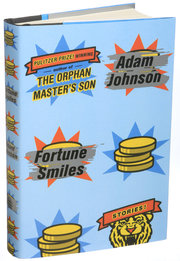 Adam Johnson‘s newest collection of short stories, Fortune Smiles, is reviewed by Michiko Kakutani in the New York Times.
 What have
  To find a nation of such barbarous temper,
 I’m ill at ease about portrayals of “America” as a land of spiritual desert and strip malls – and I come from the same part of the world that Wallace did. If one sits in front of a TV and gets one’s food from 7/11, yes, it will be that way. But the way of the Twinkie is chosen, not inevitable. Some of us listen to Schubert and talk about Stendhal with our friends, over tapas and Cabernet. I’ve never had a poptart. Why would I?
 Any journalist watching this film should cringe with self-recognition. Jesse Eisenberg‘s Lipsky, a journalist who is a Wallace wannabe, conveys hunger and avidity in his every beady glance. That’s why I flinched at the tear trickling at the end – he wasn’t a tear-trickling kind of guy. This is a wolf cub. It was as phony as the magic tape recorder that never runs out of tape or drops an AA battery into his Coca Cola.
 As
As  Intellectual and cultural historian
  The Maidan was the return of metaphysics. It was a precarious moment of moral clarity, an impassioned protest against rule by gangsters, against what in Russian is called proizvol: arbitrariness and tyranny. It united Russian-speakers and Ukrainian-speakers, workers and intellectuals, Ukrainians and Jews, parents and children, left and right. The Ukrainian historian Yaroslav Hrytsak … described the Maidan as akin to Noah’s Ark: it took “two of every kind.” For Yaroslav, the wonder of the Maidan was the creation of a truly civic nation, the overcoming of preoccupations with identity in favor of thinking about values. People came to the Maidan to feel like human beings, Yaroslav explained. The feeling of solidarity, he said—it cannot be described.

