Writer + typewriter = a classic look for the 20th century

July 26th, 2015
Share
smith-corona

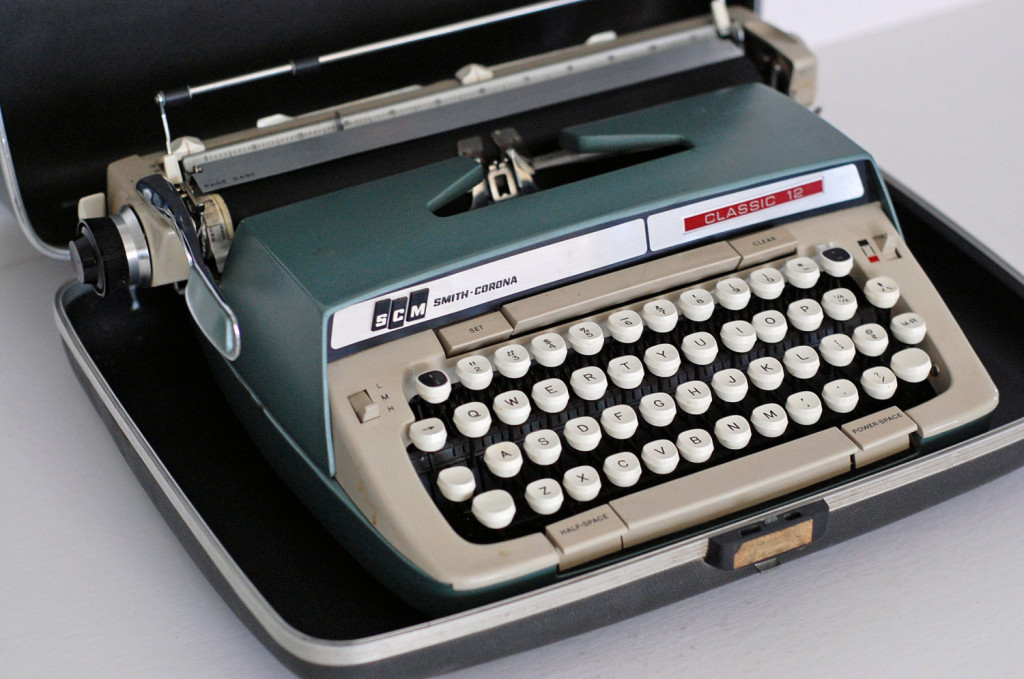
Very much like this one.

Somewhere in the back of my large garage, I have the Smith-Corona typewriter my parents gave me for Christmas in the 1970s. It was a close companion in Ann Arbor during my university years.

I have fantasies of life in a post-earthquake, post-Armageddon world without electricity or the worldwide web, where we have been reduced to gnawing on turnips pulled from the ground – but I will still be able to pump out copy on my old Smith Corona. I know, I know, every joint in the old machine has grown stiff and needs cleaning and oiling, and the typewriter ribbon has long since dried out – where would I get a new one? (You young ‘uns under forty don’t even know what I’m talking about, do you?)

48smithcorona

Dress not included.

I don’t indulge this fantasy often – as someone who would have great organizational difficulties writing without a searchable backlog of all my files at my fingertips, and since I nowadays have to write with a protective mitt on each hand, it’s hard to see how I would pound on manual typewriter without destroying both my wrists within the first few hours. It’s hard for me to get sentimental about the olden days.

However, it looks like one website I just found panders precisely to that nostalgia – Oz Typewriter here (it even won a Qwerty award – that’s a word that will mean nothing to Millennials, either). It’s home page even features a typewriter crime. On a page for writers and their typewriters, it has combox with comments like these: “Taylor Caldwell is working on a Remington – you can tell by the downturned carriage return lever. That’s a Hermes 9 that Marcuse is typing on. Amazing that Barthelme (with a wonderful ironic smile) is using such an old typewriter, with return lever on the right (LC Smith?). The margin stop on Schlesinger‘s machine looks like a Smith-Corona product to me. Huxley‘s typewriter is a Remington – you can tell from the folding tip of the return lever. My guess is a Streamliner.”

I have to say, these writers look terrific by their computers, Arthur Miller, Marguerite Duras, Salman Rushdie, and Stanford’s René Girard. We include Brendan Gill, too – the longtime New Yorker writer will be familiar to those who attended the now-defunct Stanford Publishing Course. There’s lots more on the website here – although Aldous Huxley looks a little confused and unhappy about the whole affair. Maybe his typewriter ribbon dried out.

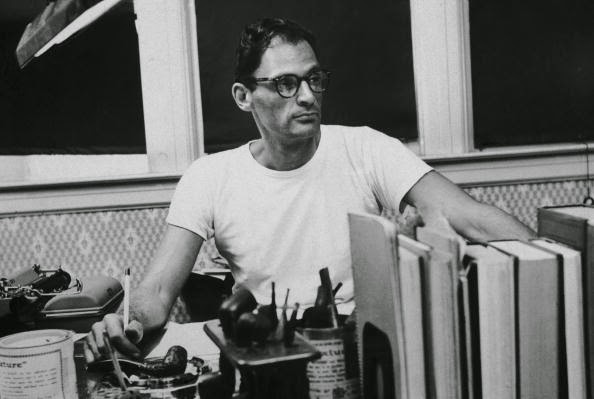
Arthur Miller 1955

That’s Arthur Miller on a Royal in 1955.

Rushdie 001

A pre-fatwa Salman Rushdie on an … electric Corona? … in 1981.

Brendan Gill 1970

The New Yorker’s Brendan Gill on an Olivetti in 1970.

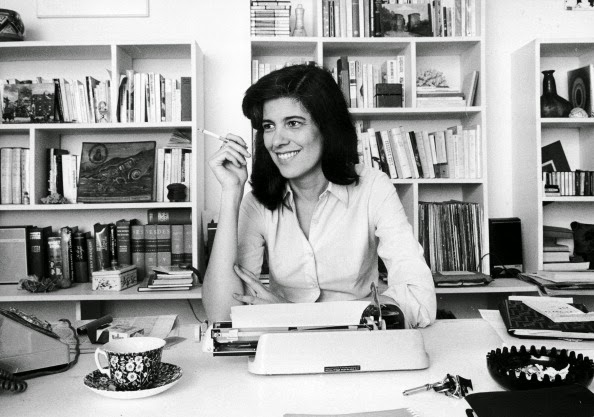
Susan Sontag 1972

Susan Sontag in 1972 – but can you identify that typewriter?

Rene Girard 1979

René Girard on an Olivetti DL, in Paris, 1979.

Alberto Moravia 1950

Alberto Moravia on a Remington, 1950.

Marguerite Duras 1955

Marguerite Duras, pounding it out on her Olivetti ICO MP1, in 1955.

Aldous Huxley 1946

Aldous Huxley hammering away on a … Royal? … in 1946.

Fiction versus philosophy: the word from John L’Heureux

July 23rd, 2015
Share

lheureuxI owe the Stanford University Libraries five books by Saturday, and naturally one of them is AWOL. The other four are stacked up neatly by the door, ready for return. Where did the fifth go? Meanwhile, in my search I stumbled across Dikran Karagueuzian‘s Conversations with John L’Heureux, and opened it at random:

Q: You’re saying you didn’t like philosophy?

JL: The way a philosopher thinks is by its nature opposed to the way a fiction writer must think. I really believe that.

Q: Explain that, will you?

JL: Philosophy moves from the particular to the abstract on its way toward universal truths, whereas fiction is concerned with the practical, the concrete. Philosophy wants to investigate eternal questions such as whether or not we can know anything for certain and, if so, how? These are fascinating questions, but they don’t make for fiction, which wants to know who this particular man is and how the thinks and acts, and why.

Q: What about philosophical novelists?

JL: The more philosophical they are, the less engaging they’re likely to be, I think. There’s Gide, Joyce, and Mann, and you certainly have to regard them as philosophical novelists, but don’t you agree that each of them is more admired for his fiction than for the philosophical questions he raises? I’ve never known anybody who reads Joyce for his philosophy. But then there’s Sartre and Camus, whom you do read for their philosophy, but they make it worth your while. Camus is a wonderful novelist. The Stranger is a fascinating book and it’s certainly the fictional embodiment of an existential issue, but in general I think it’s true that the more philosophical the work, the less impressive it is as fiction.

kolakowski

Hide and seek.

Q: Okay. You’re saying that philosophy is concerned with the pursuit of truth with a capital T whereas fiction is concerned with a particular truth of everyday experience … which may reflect something larger, but in itself it’s not concerned with abstractions.

JL: Exactly. But the real danger is the habit of mind. The The habit of speculating philosophically is opposed by its nature to the fictional process of observing the way somebody curls his lip as he puts out his cigarette, a gesture that may turn out to be trace evidence, say, of an act of violence. The fiction writer must be an observer. He has to see. “One of those on whom nothing is lost.” James.

Back to the hunt.  The missing book? Leszek KołakowskiMetaphysical Horror. Tell me if you see it. It must be here somewhere…


Stanford Repertory Theater performs Noël Coward’s Hay Fever – but who was the real Judith Bliss?

July 20th, 2015
Share
hayfever3

The Bliss Family: David (Bruce Carlton), Judith (Courtney Walsh), Sorel (Kiki Bagger) and Simon (Austin Caldwell).

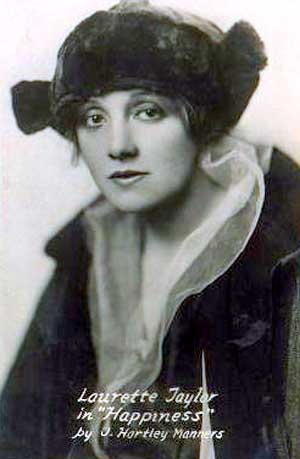
Playwright and songwriter Noël Coward spent a single weekend in the home of actress Laurette Taylor and her husband, the playwright J. Hartley Manners. The visit was such that he later, in three feverish days, wrote the play for which he is arguably best known, Hay Fever. Taylor made a big target: her larger-than-life personality was renowned, along with her theatrical moods and eccentricities. She was the sort of person who, we would say today, sucked all the oxygen out of the room. The play was a hit from the moment it opened in 1925. There were casualties, however. To put it mildly, Hay Fever strained the friendship.

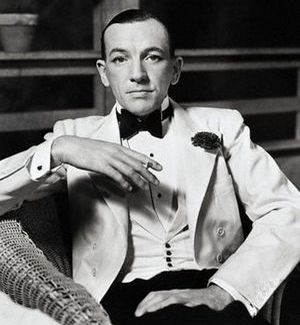
Coward

Ungrateful guest.

The Stanford Summer Repertory production, which opened last weekend, continues through August 9, with Courtney Walsh as Judith Bliss, Kiki Bagger as Sorel Bliss, Richard Carlton as David Bliss, Rush Rehm as Richard Greatham, Catherine Luedtke as Clara, Austen Caldwell as so-so novelist Simon Bliss, all under the direction of Lynne Soffer – tickets and info hereYou can’t really call a family dysfunctional when they’re so pleased with themselves, can you? The Bliss family likes itself, even if no one else does.

The play has been described as a cross between outright farce and comedy of manners. Stanford weighs in for the former, sometimes to its detriment. I could have used a slower pacing in the opening scenes, to hear the dialogue more clearly and get a feel for the characters before the comedy builds its own momentum. Sometimes the performers don’t seem to be actually listening to each other, or minding the cigarettes they light up and stub out every few minutes.

Judith Bliss is not just living in her past but the past, a different era of theater altogether. Perhaps a modern audience wouldn’t have understood the distinction, but it’s part of the fun of the play. The central character, matriarch Judith Bliss, is an actress who is past her heyday, hungering for a smashing comeback and longing for the return of melodrama with its clichéd gestures and formulaic plots. That era had given way with an excited crash to the brazen sexuality of the jazz baby. (Remember 1925 was the magic year of both Gentlemen Prefer Blondes and The Great Gatsby.)

Taylor

She really did make a comeback.

This production builds heat as it moves, trust me (and kudos to costume designer Connie Strayer). Two characters to watch in this production: Berkeley Rep veteran Deborah Fink excels as vamp flapper Myra Arundel. She’s sleek, smug, and self-contained as a cat, and doesn’t begin to unravel until the very last scenes. Another scene stealer: Kathleen Kelso as ingenue flapper Jackie Coryton. She’s making her Stanford Repertory Theater debut. The tall, willowy blonde sways uncertainly like a tall narrow tree in a high wind. The face under the cloche hat is constantly on the verge of crumpling into tears. She’s already unraveled, the moment she steps into the country house.

The original Judith Bliss, Laurette Taylor, was an actress from a previous era, more of the generation of Mary Pickford than Anita Loos or Clara Bow. Was Laurette Taylor the has-been that Noël Coward immortalized? Not quite. She finally did make her comeback in 1946, but not in the revival of a cheesy melodrama. She was the original Amanda Wingfield in an unforgettable performance of The Glass Menagerie. Tennessee Williams’s “sad, delicate drama of a struggling family in extremis was greeted with modified rapture by most of the critics as a new voice, a potential turning point for a tired commercial theatre,” according to Robert Gottlieb in The New Yorker (here):

But the true rapture was reserved for the play’s star, Laurette Taylor, reappearing after a difficult interlude of alcoholism, but still a revered name in the theatre. Her biggest success, decades earlier, had been in the comedy Peg O’ My Heart, which she performed for years both in New York and around the country, and in a movie adaptation. Now, as Amanda Wingfield, first in Chicago and then on Broadway, she emerged as an actress without peer, her performance referred to again and again as the greatest ever by an American actor. When I saw her, I knew it was the finest acting I had ever seen, and, more than sixty-five years later, I still feel that way. But why? What did she do that made her acting so unforgettable?

She simply didn’t act. Or so it appeared. She wasn’t an actress; she was a tired, silly, irritating, touching, fraught, aging woman with no self-awareness, no censor for her ceaseless flow of words, no sense of the effect she was having on her children—or the audience. It was as if you were listening in on the stream of her consciousness. Her self-pitying yet valiant voice, reflecting both the desperation of her situation and the faded remnants of her Southern-belle charm, was maddening, yet somehow endearing. You wanted to hug her, to swat her, to run from her—in other words, you reacted to her just the way her son, Tom, did.

 Actress Patricia Neal called it “the greatest performance I have ever seen in all my life.” Sometimes there really are happy endings. Even for drama queens.

hayfever

Dysfunctional family? Maybe not. Richard Carlton, Courtney Walsh, and Kiki Bagger in “Hay Fever.”

Boris Pasternak on Doctor Zhivago and “this terrible lack of time.”

July 16th, 2015
Share
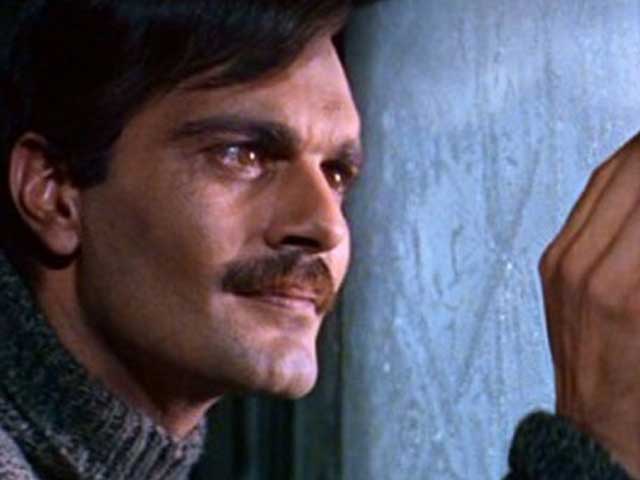
sharif

A pretty good Zhivago?

Omar Sharif, who died earlier this week, was a handsome man and an uneven actor. I was a girl when I first saw Doctor Zhivago, and it made an impression, although this is difficult to talk about in the years since because my Russian friends won’t stop laughing at me when I try. In any case, Lisa Lieberman over at 3quarksdaily put her finger on it:

“Omar Sharif plays a Russian and Doctor Zhivago was shot mostly in Spain by a British director, produced by an Italian. ‘Lara’s Theme,’ the schmaltzy leitmotif that evokes the Julie Christie character, can still be heard in elevators today. But the film has endured, in no small part due to the humanity of Omar Sharif’s performance.

“Let’s start with an early scene: it is 1912 and a group of workers are demonstrating in the streets of Moscow, led by the idealistic Pasha Antipov, a young social democrat. An equally young and idealistic Yuri Zhivago watches the scene from a balcony, and witnesses the violence as the workers are mowed down by Cossacks on horseback. Pasha is radicalized by the event and becomes a revolutionary, lashing out against the regime responsible for such brutality, but growing more ruthless as the story progresses. Yuri turns away, turns inward. Each new upheaval in Russia, each act of violence, reaffirms his determination to live, to love, and to create. Sharif registers pain in those soulful brown eyes. Unlike Pasha or the commander of the partisan unit that conscripts him later in the picture, his character never loses his humanity, never sacrifices his concern for individuals, their lives, their hopes, their needs in the name of ‘justice’ or some other abstract good.”

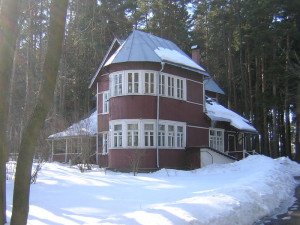
One could say the same for some of the other central characters of the Boris Pasternak‘s classic, but I wouldn’t have a chance to read the book until I went to university, and I didn’t visit Pasternak’s dacha outside Moscow in Peredelkino (the idyllic Varykino in the book is modeled on it) until many years after that. Sharif’s death did sent me back to the movie, but also back to Pasternak as well, and I was pleasantly surprised to see that, although he died in Peredelkino in 1960, the granddaughter of his friend, Olga Carlisle, managed to meet him a few months before his death, and managed to get a Paris Review piece, “The Art of Fiction No. 25” out about the experience. She describes her first visit to his home, with its “combined austerity and hospitality”:

peredelkino

The model for Varykino.

Pasternak’s house was on a gently curving country road which leads down the hill to a brook. On that sunny afternoon the hill was crowded with children on skis and sleds, bundled like teddy bears. Across the road from the house was a large fenced field—a communal field cultivated in summer; now it was a vast white expanse dominated by a little cemetery on a hill, like a bit of background out of a Chagall painting. The tombs were surrounded by wooden fences painted a bright blue, the crosses were planted at odd angles, and there were bright pink and red paper flowers half buried in the snow. It was a cheerful cemetery. [Pasternak would be buried in that cemetery within a few months. – ED.]

I paid the driver and with great trepidation pushed open the gate separating the garden from the road and walked up to the dark house. At the small veranda to one side there was a door with a withered, half-torn note in English pinned on it saying, “I am working now. I cannot receive anybody, please go away.” After a moment’s hesitation I chose to disregard it, mostly because it was so old-looking and also because of the little packages in my hands. I knocked, and almost immediately the door was opened—by Pasternak himself.

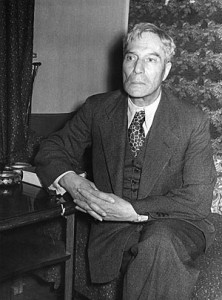
He was wearing an astrakhan hat. He was strikingly handsome; with his high cheek-bones and dark eyes and fur hat he looked like someone out of a Russian tale.

pasternak

Out of time.

The whole thing is worth a read, of course – it’s online here . The two had several Sunday afternoon meetings before she returned to Paris, and in that time he gave his opinions about a number of poets and authors, the play he was writing, poetry, music, and how old-fashioned Nietzsche seemed. And here’s what he said (well, some of it) about Doctor Zhivago: 

 “When I wrote Doctor Zhivago I had the feeling of an immense debt toward my contemporaries. It was an attempt to repay it. This feeling of debt was overpowering as I slowly progressed with the novel. After so many years of just writing lyric poetry or translating, it seemed to me that it was my duty to make a statement about our epoch—about those years, remote and yet looming so closely over us. Time was pressing. I wanted to record the past and to honor in Doctor Zhivago the beautiful and sensitive aspects of the Russia of those years. There will be no return of those days, or of those of our fathers and forefathers, but in the great blossoming of the future I foresee their values will revive. I have tried to describe them. I don’t know whether Doctor Zhivago is fully successful as a novel, but then with all its faults I feel it has more value than those early poems. It is richer, more humane than the works of my youth.”

International fame did not agree with him, at least not entirely: “… everyday life has grown very complicated for me. It must be so anywhere for a well-known writer, but I am unprepared for such a role. I don’t like a life deprived of secrecy and quiet. It seems to me that in my youth there was work, an integral part of life which illuminated everything else in it. Now it is something I have to fight for. All those demands by scholars, editors, readers cannot be ignored, but together with the translations they devour my time. . . . You must tell people abroad who are interested in me that this is my only serious problem—this terrible lack of time.”

Why no one will read your f*cking screenplay, novel, poems.

July 14th, 2015
Share
Olson2008

He won’t read your script, and he’s happy about it. (Photo: Wikipedia)

Friends occasionally ask me to read their screenplays, their poems, their unpublished novels. I fear some have the illusion that if I’m enthusiastic enough about what they’ve written, I can pick up a phone, whisper a few words to my contact at Farrar, Straus & Giroux, and bingo! Publishers Weekly here we come! Faster than you can say Michiko Kakutani.

Such is laughably far from being the case. I know what they’re thinking: it only takes an hour or two to read the screenplay, a half an hour to read a wad of poems, and the novel only a few hours longer than either. What they don’t realize is that they’re asking me to plunge into their world for that duration, and it can take a couple days, in some cases, before I recover my equilibrium enough to reenter whatever world I was writing about in my own work – the world of 20th century French thought, for example, or Cold War Russian poetry. As a writer, one hordes one’s minutes, hours, days – like fishing little bits of gold out of the dust in the foothills of the Sierra Nevada – even if most of it seems to be spent staring at a screen, or checking the various email accounts, or clicking on CNN to see if something exploded.

Josh Olson, who wrote the screenplay for The History of Violence, knows what I’m talking about. As he writes in The Village Voice:

“Now, I normally have a standard response to people who ask me to read their scripts, and it’s the simple truth: I have two piles next to my bed. One is scripts from good friends, and the other is manuscripts and books and scripts my agents have sent to me that I have to read for work. Every time I pick up a friend’s script, I feel guilty that I’m ignoring work. Every time I pick something up from the other pile, I feel guilty that I’m ignoring my friends. If I read yours before any of that, I’d be an awful person.”

And it’s true. A professional writer is for the most part a professional reader. There are tons of things I should be reading all the time, just to keep up. Not only new novels, but new poets, and essays and biographies. Not to mention the book review sections (I used to read five every week, back when there were five in the country.) And one should always, regularly, return to “The Greats” – Dostoevsky, Dante, Eliot and Auden. Reading just for the fun of it? That’s one of the guiltiest pleasures I know.

But then Olson goes off the deep end, with his repeated refrain, “No, I won’t read your fucking script!” In fact, that’s the title of the piece. Friends of friends, hangers-on, friends of friends of hangers-on, they are all asking him. I guess it’s that way in Hollywood. He finally fell prey in a weak moment to a wannabe screenwriter who was dating a friend:

“But hell, this was a two page synopsis, and there was no time to go into either song or dance, and it was just easier to take it. How long can two pages take?

Weeks, is the answer.

tom–stall

Don’t even ask. (Viggo Mortensen as Tom Stall)

And this is why I will not read your fucking script.

It rarely takes more than a page to recognize that you’re in the presence of someone who can write, but it only takes a sentence to know you’re dealing with someone who can’t.

(By the way, here’s a simple way to find out if you’re a writer. If you disagree with that statement, you’re not a writer. Because, you see, writers are also readers.)

My first draft was ridiculous. I started with specific notes, and after a while, found I’d written three pages on the first two paragraphs. That wasn’t the right approach. So I tossed it, and by the time I was done, I’d come up with something that was relatively brief, to the point, and considerate as hell. The main point I made was that he’d fallen prey to a fallacy that nails a lot of first timers. He was way more interested in telling his one story than in being a writer. It was like buying all the parts to a car and starting to build it before learning the basics of auto mechanics. You’ll learn a lot along the way, I said, but you’ll never have a car that runs.

(I should mention that while I was composing my response, he pulled the ultimate amateur move, and sent me an e-mail saying, “If you haven’t read it yet, don’t! I have a new draft. Read this!” In other words, “The draft I told you was ready for professional input, wasn’t actually.”) …

So. I read the thing. And it hurt, man. It really hurt. I was dying to find something positive to say, and there was nothing. And the truth is, saying something positive about this thing would be the nastiest, meanest and most dishonest thing I could do. Because here’s the thing: not only is it cruel to encourage the hopeless, but you cannot discourage a writer. If someone can talk you out of being a writer, you’re not a writer. If I can talk you out of being a writer, I’ve done you a favor, because now you’ll be free to pursue your real talent, whatever that may be. And, for the record, everybody has one. The lucky ones figure out what that is. The unlucky ones keep on writing shitty screenplays and asking me to read them.”

william_hurt_violence

Make that a double for Olson. (William Hurt as Richie Cusack)

And that’s certainly part of it. When you are reading something for a friend, or a friend of a friend, or someone who’s dating a friend, it’s not like pounding out a few words on a blog. You know they’re waiting for your feedback. Their protestations to the contrary, you don’t know how much criticism they can take. Mostly they really are looking for “a pat on the head,” as Olson says. You will look into the whites of their eyes, and you don’t want to cause their pain, let alone unleash their rage.

However, here’s the dirty little truth: sometimes I ask people to read my stuff, too. And Olson doesn’t quite come clean about the revised draft. We’re all revising, constantly, restlessly. We all hope the next one will be perfect. And even though we have to refuse to read a manuscript – or we won’t get our own work done – we are hoping we won’t be refused when our time comes. There are thousands and thousands of us, all across the country – up and down the professional ladder of success – waving our manuscripts, our screenplays, our sheaf of poems, bleating, “Please read mine! Please read mine!” There’s no one left to read.

But please don’t send them to Olson. He’s made it clear that he won’t read your fucking script: “If that seems unfair, I’ll make you a deal. In return for you not asking me to read your fucking script, I will not ask you to wash my fucking car, or take my fucking picture, or represent me in fucking court, or take out my fucking gall bladder, or whatever the fuck it is that you do for a living.” So there.

You can read his whole rant here. And yes, I didn’t realize when I first read it that it was published in 2009. That’s how far behind I am in my reading.


Why Gretna Green? How a tiny Scottish village became the Las Vegas of its day.

July 11th, 2015
Share
netherfield-ball-kitty-and-lydia-tippling

Slow down, sistah! Jena Malone as hot-blooded Lydia having a little too much of the punch.

“You will laugh when you know where I am gone, and I cannot help laughing myself at your surprise tomorrow morning, as soon as I am missed. I am going to Gretna Green and if you cannot guess with who, I shall think you a simpleton.” So the sex-crazed 15-year-old Lydia Bennet scribbles to her friend as she is packing her bags in Jane Austen‘s immortal Pride and Prejudice. Her more sensible sisters Lizzie and Jane panic, but why? gretnagreen1

Gretna Green was the first coach stop, crossing the border from England to Scotland, en route to Edinburgh – I knew that already. But why hop off at this remote and undistinguished village, rather than the next? I knew there was something legal about crossing to Scotland, but I didn’t know how much this particular little burg had everything that yelled “quick quick quick” and “hot love” about it. At least in the 19th century. A recent Mental Floss piece, “10 Things You May Not Know about Pride and Prejudice enlightened me.

The trouble began with the 1754 Marriage Act, which outlawed clandestine marriages in England. Lord Hardwicke championed the law, which introduced an age of consent at 21. The law also required couples to marry within a church, with all the rigmarole and prep time that required. If a parent or guardian objected, the wedding was legally nixed. As the middle classes were rising, the privileged classes were trying to keep their fortunes and their families out of the hands of upstarts, paupers, and guys on the make. The lords were quick, quick, quick to enact this law – almost as quick as Lydia on the run, with her family in hot pursuit. (The “hot pursuit” were also part of the elopement tradition, apparently.)

Scotland refused to conform this law, however, and once eager couples discovered this loophole they, in turn, were quick to take advantage and eloped to marry over the border. Gretna Green soon became a haven for fleeing couples who wanted to marry in haste before Daddy-O could track them down.

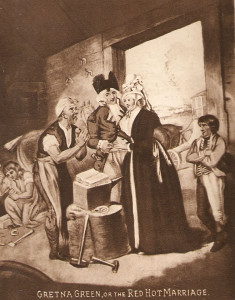
gretnagreen2That’s not all. The Scottish rite held to the ancient tradition of a “marriage by declaration” or a “handfasting” ceremony. Declare your wish to be husband and wife in front of two randomly chosen witnesses, and the deal was done. No promises to lifelong devotion or stipulations about “in sickness and in health.” None of that, thank you very much. A favorite locale to tie the very informal knot was the Old Blacksmith’s Shop and Gretna Hall Blacksmith’s Shop. According to the Gretna Greene website (yes, there is one, here), “At the Blacksmiths Shop the canny blacksmith soon downed his tools and took up the role of ‘Blacksmith Priest’… To seal the marriage he would bring down his hammer upon the anvil (the tools of his trade). The ringing sound heard throughout the village would signify that another couple had been joined in marriage.”

It’s hard to see how he could get any work done, given the number of clients in the era. Well, you can see why the Bennet family might be all of a doodah over this kind of an arrangement. As fun as it might be for a young couple, who wants to tell their kids that they were married in hot-blooded haste with a vague promise over an anvil?

Even Scotland had second thoughts. In 1856 Scottish law was changed to require 21 days’ residence for marriage, and the law was changed again in 1940. While the residential requirement was lifted in 1977, a “Gretna Green wedding” came to mean any quickie elopement destination to avoid procedures in the couple’s home district. Think Reno or Las Vegas in the twentieth century.

In short, young Lydia Bennet knew what she was about when she legged it the hell over the Scottish border. The place was notorious. Gretna Green, as well as the blacksmith’s shop, as you will see below, is still one of the world’s most popular wedding destinations. Gretna Green, and the area around it, hosts over 5,000 weddings each year and one of every six Scottish weddings. Who knew?

(P.S. Austen fans alert: Check out a pretty good Austen website, here.)

Niki Odolphie

“Make it quick!” (Photo: Niki Odolphie)


<<< Previous Series of PostssepNext Series of Posts >>>