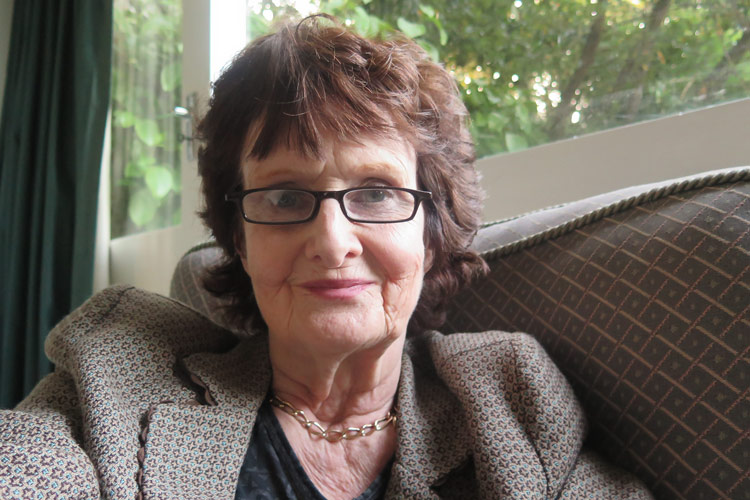
She oughta know. (Photo courtesy Eavan Boland)
I have an especial fondness for the Avery Hopwood awards at the University of Michigan. During my days as a student in Ann Arbor, I was awarded two – just like playwright Arthur Miller. That might be the only thing we have in common. But the early encouragement meant a lot.
So I was very pleased that Stanford’s Eavan Boland, one of Ireland’s leading poets, delivered this year’s address on April 22. Her subject: what advice can older writers give younger ones? She has her doubts about how far words can go, but I like Nicholas Del Banco‘s comment, which she cited: “the conflicted self is crucial.” He was commenting about novels – but I think the comment embraces all genres (so does she).
Her thoughts on the subject took her back to Dublin – “improbably a city where lightning had struck. In a figurative, artistic way that is.” She described this story between two Irish writers in a a smoking room in a Dublin café, in 1902:
The meeting took place on O’Connell Street which was then Sackville Street. It was a wide street in a garrison city which was still under British rule and would remain so for fourteen years. And all of this in a country, which was considered a backwater of Europe. Not a country that people – except for a few deep inside its secret societies – held out much hope for. The meeting was between two men, two writers, who had never met before. One was in his middle thirties and one a mere twenty years of age.
The two men were William Yeats and the very young James Joyce. And they were not equals. Yeats was already an iconic figure. He had founded the Irish theater. He had written admired poetry. Joyce had yet to write anything important. When I think of the hazards of this sort of advice I think of what happened next. Before any conversation could be started, James Joyce leaned across the table to William Yeats and said, “You are too old for me to help you.”
Then she told her own story, also in Dublin, decades later when she was a student at Trinity College, studying English literature in a place where poetry was treated as “a canonical fact.” She had no idea that Irish poetry had “been forced to shine out of a darkness with effort and pain.”
 And then at the age of 18 I picked up a book called The Hidden Ireland by a writer I had never heard of, Daniel Corkery. It had been published in 1925. The book follows the shattered narrative of the Cromwellian clearances in Ireland in the 18th century. It alights in their aftermath in a small part of Gaelic Munster, which is called Slieve Luachra, a mountainous area on the Cork Kerry border. Corkery writes about poets such as Aodhagán Ó Rathaille and Eoghan Rua Ó Súilleabháin. He records that they spoke the Irish language and wrote their poetry in it. That they were witnesses to the destruction of that language and the breaking apart of the Bardic order. “What Pindar is to Greece, what Burns is to Scotland … that and much more is Eoghan Ruadh to Ireland,” wrote Corkery.
That evening as I read on I could see what Robert Penn Warren meant when he said “the poem is not a thing we see—it is, rather, a light by which we may see.” I stopped on one page, and at one passage. Everything I was or hoped to be listened to what those words said.
Here is the passage the passage from Corkery that turned her on and, perhaps, changed her life: “Then we must also remember that these poets were simple men, living as peasants in rural surroundings; some of them, probably, never saw a city; not only this, but they were all poor men, very often sore-troubled where and how to find shelter, clothing, food, at the end of a day’s tramping. Their native culture is ancient, harking back to pre-Renaissance standards; but there is no inflow of books from outside to impregnate it with new thoughts. Their language is dying: around them is the drip, drip of callous decay: famine overtakes famine, or the people are cleared from the land to make room for bullocks. The rocks in hidden mountain clefts are the only altars left to them; and teaching is a felony.”
“Not to excuse, but to explain them, are these facts mentioned; for their poetry, though doubtless the poorest chapter in .the book of Irish literature, is in itself no poor thing that needs excuse: it is, contrariwise, a rich thing, a marvelous inheritance, bright with music, flushed with colour, deep with human feeling. To see it against the dark world that threw it up, is to be astonished, if not dazzled.”
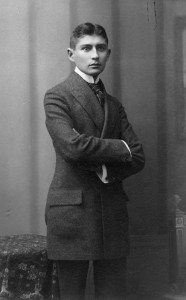
Merciless obsessions.
Eavan Boland continues: “I can remember where I was when I read this. Even now I ask myself – why was I so moved by an assertion nobody could prove; about poets from another world, most of them lost to time and history? I believe I was moved because it was the first time I had come across a bold statement about the importance of the artist ‘s life. It was the first time I had read that language and literature could testify in and through time; that such testimony could pierce the darkness of a history. It was the first time anyone had expressed the dignity of the life I hoped I would live.”
The rest led her to “a life lived in and through language, with all its challenge and reward. This won’t change and has never changed.” Let me close with some of more of the great advice from great writers she cited. This one, from the Prague-born German-language author Franz Kafka: “Don’t bend; don’t water it down; don’t try to make it logical; don’t edit your own soul according to the fashion. Rather, follow your most intense obsessions mercilessly.”

“Were you busy writing your heart out?”
And this piece closer to home, from America’s J.D. Salinger: “Do you know what you will be asked when you die? Let me tell you first what you won’t be asked. You won’t be asked if you were working on a wonderful, moving piece of writing when you died. You won’t be asked if it was long or short, sad or funny, published or unpublished. You won’t be asked if you were in good or bad form while you were working on it. You won’t even be asked if it was the one piece of writing you would have been working on if you had known your time would be up when it was finished – I think only poor Soren K. will get asked that. I’m so sure you’ll only get asked two questions. Were most of your stars out? Were you busy writing your heart out? If only you knew how easy it would be for you to say yes to both questions.”




 Somewhere in my messy house, I have a big fat edition of Ovid, but I can’t find it. But I recalled that the sad story of Alcyone inspired another Mary – Mary Zimmerman, a MacArthur “Genius” Fellow – in her remarkable play Metamorphosis. While looking for the fat Ovid, I found instead my slim paperback of the play, in which Iris calls Sleep “Mildest of all the gods, soother of souls, and healer of wearied and pain-wracked bodies and minds.” As a result, the inconsolable Alcyone gets a nighttime visit from the shrouded ghost of her husband. As he retreats to the sea, “She began to run to him; but as she ran, crying, a strange thing happened.” Then, in an Ovidian turn, the gods have mercy – she becomes a bird, and so does he:
 “When I arrived at his home in the Sierra Nevada foothills in May of 1998, Gary Snyder was covered with ants. He was on the roof of a shed, straddling solar panels and pulling out insulation that a colony of carpenter ants had claimed as its own,” recalled Eric Todd Smith. “A few minutes later, he was showing me around his tool shed and the old barn that houses his office, occasionally slapping at stray ants crawling in his hair. We talked about how to use the old crosscut saw and logging cables hanging from the walls, about local birds and trees, and eventually wound our way into poetry, Buddhist philosophy, and natural resource management. Such simultaneous immersion in concrete tasks and abstract ideas is normal for Snyder, who has lived with his family at Kitkitdizze, the house he built himself, since the early 1970s. His long poem, Mountain and Rivers Without End, testifies to his conviction that the quotidian and the cosmic are inseparable.”
 Snyder’s book-length poem was published in spring 1996. In December of that year, Snyder read from the poem at the legendary independent bookstore Kepler’s, just down the street from Stanford (we wrote about its history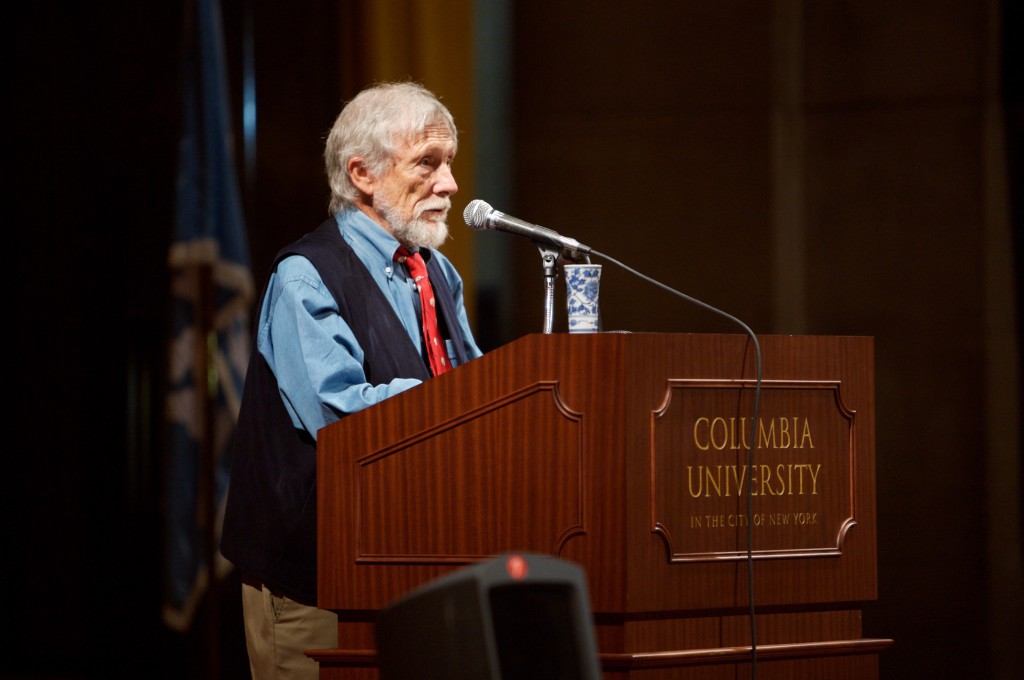
 “To believe you are magnificent. And gradually to discover that you are not magnificent. Enough labor for one human life.”


 Postscript on 6/11: Marcia DeSanctis is on the road again … but what is she reading? “When I travel, once I’ve rounded up my documents and stuffed the carry-on to bursting, the last thing I pack is a book. I slip whatever I have chosen between my change of clothes and my blanket, and close the zipper. I appreciate that e-books have, for some people, erased the need to make an absolute decision on what single piece of literature will accompany them on a journey. But on the road, I prefer a tactile, 3D, lick-my-finger-and-turn-the-page hard copy, the kind I’ve toted around for decades, stealing sentences in cafes, train stations and hotel beds all across the planet. For me, a book is a well-considered traveling companion…” Read her discussion of her travel reading in today’s Tin House. It’s