So long see you tomorrow, Toby! An evening of Camus, crowds, and many fond farewells.

June 6th, 2015
Share


camus5

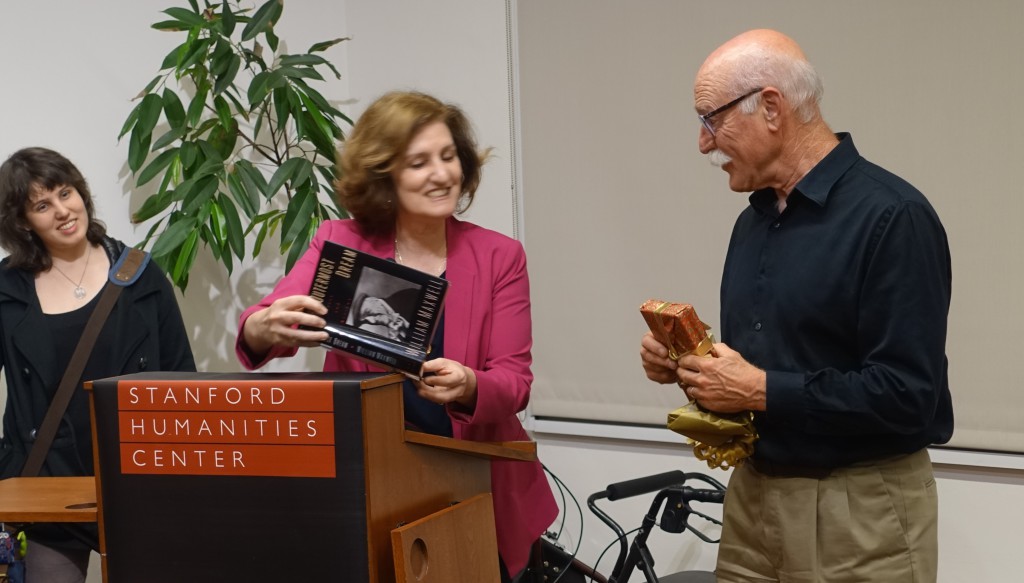
I present some surprises to Toby. Another Look’s graphic designer Zoë Patrick at left. (Photo: David Schwartz)

Stanford’s Another Look book club was born of one man’s love for a short novel – that is, acclaimed author Tobias Wolff‘s love of William Maxwells So Long See You Tomorrow, which became the first book discussed in the three-year series. He wanted to share the book not just with colleagues, but the the world. He called Another Look “a gift to the community.” (We’ve written about it here and here and here and a zillion other places). So it was fitting that we concluded the era Toby’s directorship with a Maxwell tribute. Why “see you tomorrow”? Because he’s not going far. He’s simply beginning his well-earned retirement. He’ll be around. Meanwhile, the future of the highly successful program he founded is uncertain. We’ll see what happens. Cross your fingers. Burn incense. Whatever works.

camus-10

Toby begins – a little amazed at the turn-out. (Photo: D. Schwartz)

The Monday discussion of Albert CamusThe Stranger was a knockout event – the turn-out beyond anything we had anticipated. It was way beyond standing room only. The room was impassable, with a mob in the doorway, and another outside the sliding doors to the patio, opened so a smaller crowd could listen in. People sat on the floor in the aisles. There was no place in the room that didn’t have people in it. (I squatted behind the podium and couldn’t see anyone on the panel – you could say I had audio, but not visual, reception.) It was, in short, a love-bomb.

The photos above and below don’t quite capture the size of the crowd – photographer David Schwartz, who happened to be in the audience, didn’t have much choice about what he could capture at all. The fans who were lucky enough to have seats were so jam-packed that he couldn’t move.

David couldn’t photograph all three panelists together – so we augment his photos with one of Marie-Pierre Ulloaa scholar of French intellectual life in 20th-century Algeria, taken by Remmelt Pit.

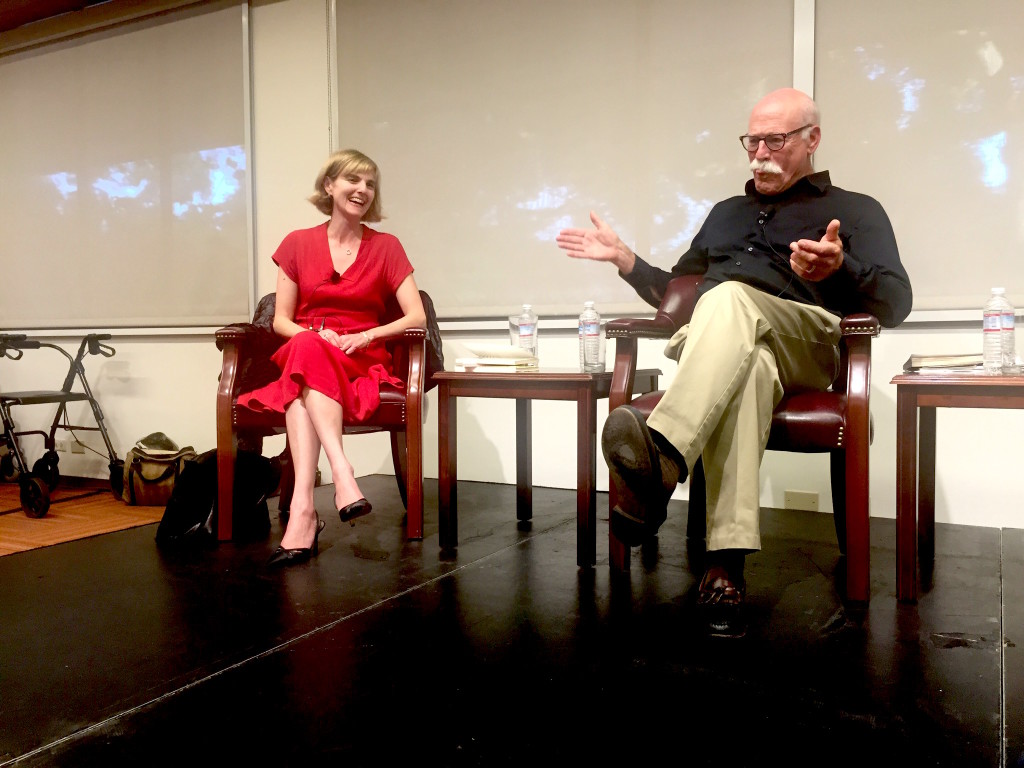
No surprise that the discussion was lively and wide-ranging. Intellectual and cultural historian Caroline Winterer, director of the Stanford Humanities Center, and Toby are old friends, as their spirited exchanges show in the photos. The audience was bubbling with questions – more than the panelists could possibly answer. Many of them focused on the four extra shots fired by Meursault into the Arab – in Matthew Ward‘s esteemed “American” translation (read about him here) is rendered “And it was like knocking four quick times on the door of unhappiness.”

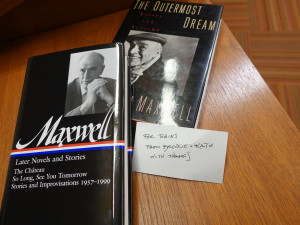
camus-9All in all, it was a wonderful send-off for Toby’s retirement – we presented him with a signed first edition of the late William Maxwell’s The Outermost Dream, a collection of his essays from The New Yorker – fitting, because Toby himself is a regular contributor to the magazine.

But the biggest surprise of the evening was the edition of Maxwell’s later novels from Brookie and Kate Maxwell, the author’s daughters, who have appreciated Toby’s attention to their father’s legacy, and his efforts for Another Look more generally. Brookie, also a photographer, included a photograph of her father that she had taken – the photograph with the kitten; you can see it here.

camus-11

Teamwork: Toby and Caroline. (Photo: David Schwartz)

camus-12

A spirited exchange between Toby and Caroline (Photo: David Schwartz)

camus7

Toby makes a face; Marie-Pierre giggles. (Photo: Remmelt Pit)

Oxford Professor of Poetry: a great honor or “sherry-drill for important people”?

June 3rd, 2015
Share
Oxford 022

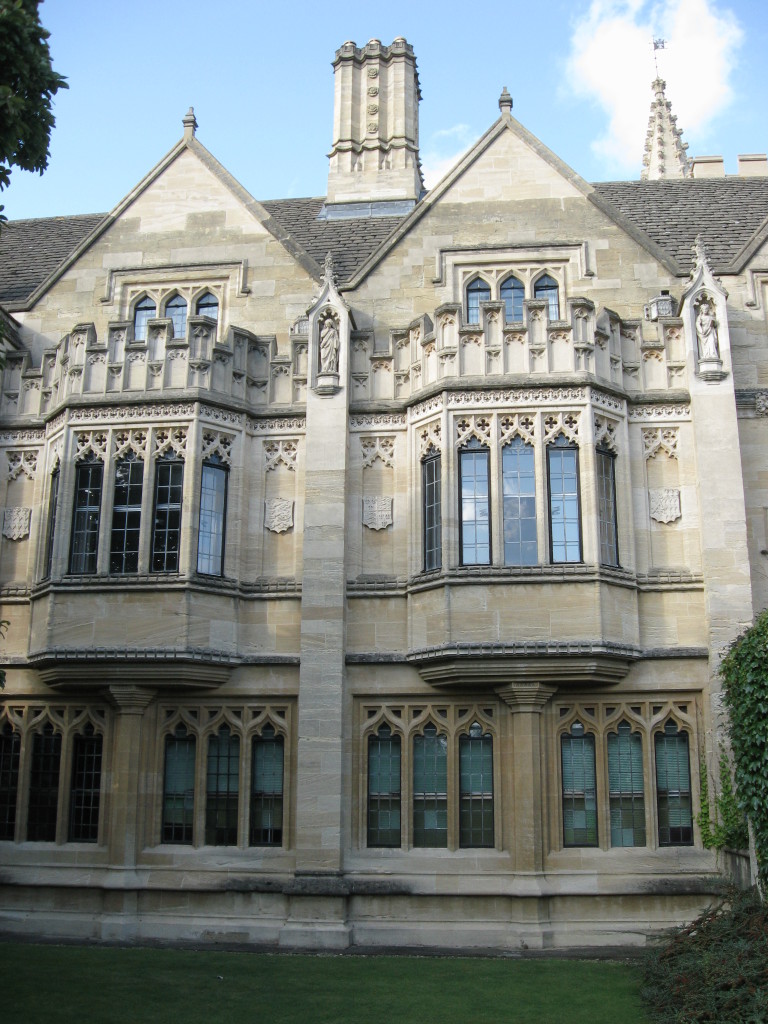
Missing Oxford every minute. From my stay in 2009.

After my recent post on Geoffrey Hill, I have been following the selection of his successor to the post of Oxford Professor of Poetry, a highly prestigious position previously held by Seamus Heaney and W.H. Auden, among others. Alas, not being a graduate of one of my favorite institutions, I am not eligible to cast a ballot. Oxford grads must register to vote by June 8. It’s too bad. I’m more excited about this than the U.S. elections. It’s way better than football. Results will be announced June 19.

The going money (presumably Ladbrokes is taking bets) is on Nobel winner Wole Soyinka, poet, playwright, novelist, and political activist. The Nigerian writer is also over 80 – disqualifying? Not so fast. So is Geoffrey Hill. According to The Guardian:

Ken Macdonald QC, the warden of Wadham College and one of Soyinka’s key backers, said: “Wole Soyinka is a poet and activist of world standing who has faced persecution and suffering with surpassing dignity. He is that rare thing: a great writer whose life and eloquence have come together in a valiant struggle for rights and freedom. His election would grace the University of Oxford.”

Soyinka’s candidacy has been endorsed by a number of high-profile graduates, including the director of Liberty, Shami Chakrabarti. “Pursued and repeatedly imprisoned by dictators who feared him, his shining language of resistance has never dimmed and his sense of justice never faltered,” Chakrabarti said. “His appointment would bring honour to the University of Oxford.”

The former archbishop of Canterbury Rowan Williams has also endorsed Soyinka, calling him “a massive cultural presence”.

A rival is emerging in poet Simon Armitage, with prominent broadcaster Melvyn Bragg recently switching his support to Armitage.

Among my own friends, there is a determined campaign for dark horse A.E. Stallings (full disclosure: a Facebook friend). There’s even a Facebook page (here) and a Twitter campaign for her candidacy. From The Guardian again:

Alicia Elsbeth

Dark horse.

Alicia Stallings, an American poet who studied classics at Oxford and the University of Georgia, and who has published three collections of poetry, is the only female nominee. The role was briefly held by Ruth Padel in 2009, but after it emerged that she had informed journalists about past allegations of sexual harassment made against her rival Derek Walcott, she resigned after less than two weeks.

Stallings, who lives in Athens, said in her statement that it is “not only the making of poems that interests me, but memorising and speaking them”, and that if elected, she would speak on topics including “the problems and possibilities of translation, poets in other languages (such as modern Greek), the classical tradition, the gears and springs of technique, the resonance between poems, and on new poets and poets fallen out of fashion”.

Ian Gregson and Seán Haldane are also contenders.

However, losers have this consolation: Philip Larkin scoffed at the honor. In a recently unearthed artifact:

The letter, typed on Larkin’s letterhead at the University of Hull’s Brynmor Jones library, replies to a suggestion from the college’s then-principal, Rachel Trickett, that he should stand for the prestigious role. Larkin receives Trickett’s letter on 8 October 1968, and after “the luxury of a few minutes day-dreaming on the subject”, writes to dissuade her from putting his name forward.

Frontrunner (Photo: Chidi Anthony Opara)

Frontrunner (Photo: Chidi Anthony Opara)

The poet tells Trickett he is entirely “unfitted” for the role. “I have never considered literature in the abstract since that blessed day in 1943 when I laid down my pen in the Sheldonian Theatre and sauntered out into the sunshine, a free man; anything I have written since then has either been hack journalism or cries wrung from me by what I believe Gide calls the frightful contact with hideous reality,” writes one of the 20th century’s most beloved poets.

He adds that he has so far given just one lecture in his life – “I hated it, and a number of people walked out in the first few minutes” – before explaining that the increasing publicity which comes with the position makes him “quite unsuited” to the position.

“My idea of hell on earth (physical pain excepted, and I am not sure that it is excepted even in this case) is a literary party, and I have an uneasy feeling that the post carries with it a lot of sherry-drill with important people,” he writes, describing himself nonetheless as “deeply honoured” to be approached.

Don’t know about you, but I could definitely use a little sherry-swilling myself. Not to mention the £12,000 annual stipend that comes with the five-year position.

Neustadt finalist Dubravka Ugrešić: “Risk is a moral category.”

May 31st, 2015
Share
(Photo: Zeljko Koprolcec/Wikimedia Commons)

Not risk-aversive. (Photo: Z. Koprolcec/Wikimedia Commons)

A few days ago I wrote that my friend Daniel Medin of the American University of Paris said he was “over the moon.”

That was true, but for more reasons than we had time to say. He wrote me in the wee hours (Paris time) to say, “So much good news, I don’t even mind being up this early.” The main reason was that one of the authors in the university’s Center for Writers and Translators – László Krasznahorkai – had just won the Man Booker Prize. Here’s another: two of the writers he works at have been named as finalists for the Neustadt; one is Can Xue (M&L5), too, on the heels of taking the just-announced Best Translated Book Award for The Last Lover. She was recently featured in Music and Literature, here.

The second, Dubravka Ugrešić, is the author of several works of fiction and essay collections. She went into exile from Croatia after being labeled a “witch” for her anti-nationalistic stance during the Yugoslav war. She now resides in the Netherlands.  Other contenders include Caryl Churchill (England), Carolyn Forché (United States), Aminatta Forna (Scotland/Sierra Leone), Ann-Marie MacDonald (Canada), Guadalupe Nettel (Mexico), Don Paterson (Scotland), Ghassan Zaqtan (Palestine).

The Neustadt Award, a prize offered by the University of Oklahoma’s World Literature Today, is considered the “American Nobel,” and is often a harbinger of the Swedish award. The winner will be chosen in October. Read more about it here.

Daniel is understandably chuffed. “Happiest for the recognition these authors are getting for their (brilliant, uncompromising) work,” he wrote. Daniel, who is co-editor of Music and Literature, recently interviewed the Croatian author. It’s very, very good  – and it’s online here.

A few excerpts from the interview:

DM: In your essay on Susan Sontag, you introduce the importance of “literary apprenticeship.” Could you discuss this notion at greater length?

DU: One has to earn the right to write, the right to “a voice.” I propagated an old-fashioned apprenticeship. I was a passionate reader from an early age. I studied comparative literature. I wrote about other writers. I translated them, too, from Russian to Croatian. I assembled anthologies. I edited, selected, and collected works of classical writers (Chekhov and Gogol, for example). I edited scholarly editions. I did a bit of literary history, criticism, and theory. I rediscovered some forgotten Russian writers (such as Leonid Dobychin and Konstantin Vaginov) and wrote about them. I think that the notion of a literary work ethic is extremely important, especially today when practically anybody can write, produce, and distribute his or her own work. This work ethic presupposes knowledge and a deep respect toward—and compassion for—your ancestors and contemporaries, toward your trade. It also assumes a deep awareness of what one is doing, why one is doing what one is doing, what the sense of the work is, what it brings to the cultural context, what it brings to the reader, and so on and so forth.

***

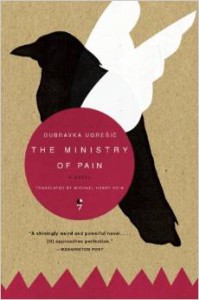
ministryDM: Could you please elaborate [on “literature as seduction”]?

DU: Yes, literature as mental, aesthetic, linguistic, emotional, intellectual, and sensual seduction. In that sense, Scheherazade is an ideal author, not solely because of her skill as a storyteller (although that too!), but for the risk that hovers above this activity. There are so many writers in this world who never ever question their trade. Fewer are prepared to confront all the dangers—and all the consequences—of their work. I experienced writing as a dangerous or double-edged activity. I was awarded the biggest prizes for literature in the former Yugoslavia (the NIN prize for fiction, for example), but only a few years later—at a time of nationalism and war—I was expelled from my cultural community and ostracized because of my writing. Instead of conforming to a changed situation, which is what the majority of people did, I took a risk. Then bore the consequences. I left my country.

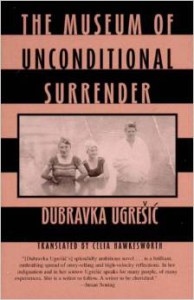
museumDM: It sounds like you’re proud of that.

DU: No; I am sad because of it. I learned a lesson I would have rather avoided, namely that the majority of writers, intellectuals, artists, and thinkers will conform to any situation—whether it is war, dictatorship, communism, fascism, extermination of the “Other,” et cetera. However, going against the mainstream is not an aesthetic category. Risk is a moral category, which shapes our attitude toward our vocation as well as our ideological, political, aesthetical, and ethical choices.

***

DM: You’ve already explained why you channeled these new experiences into fiction, instead of memoir or autobiography. Yet at least half the books you’ve published in English are collections of essays, and even the novels themselves borrow often from essayistic strategies and tone. What attracts you to this particular form of writing? Were you steeped in a particular culture of essay writing, for example a Central European one?

DU: The choice of an essay came naturally to me at one point in my life. I stepped into it like into an old comfortable shoe. In that respect, the strategy of “fictionalizing” an essay and of “essayizing” fiction also came naturally. That impulse was there from the very beginning, I would say. Besides, stepping outside his “domain” is an act of artistic freedom: that’s why some excellent writers (first recognized as fiction writers and poets) also became first-rate essayists. Joseph Brodsky, Danilo Kiš, and Milan Kundera come to mind.

The choice to write essays came with a radical change of my life: the outburst of nationalism (i.e. fascism, at this particular time and place) in former Yugoslavia, with the fall of the SFRY, the war, and subsequent exile. The essay was, at least for me, the most appropriate form to protest against human conformism, lies, killings, national and ethnic homogenization of the society (e.g. fascization of society), against trivialization and standardization of culture, and so on and so forth. I turned to the essay at a crucial moment, when things desperately (at least from my point of view!) needed to be explained, when I lost my familiar addressee and my familiar cultural environment.

***

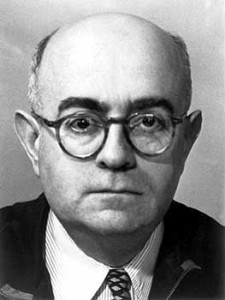
Theodor W. Adorno

Heretical essays

DU: The best definition of the essay came from Theodor Adorno, who said that heresy is at its essence and core. However, we have to be careful with all these notions today: the notion of heresy included. In our contemporary society—which is highly homogenized by the global marketplace—intellectual and artistic heresy is like oxygen. Globalized culture sucks that oxygen from our mental landscape. The global marketplace pretends that it offers us a diversity of products but in fact sells us the powerful substitute of the holy ONE. Today, we get one “subversive” philosopher, one “subversive” artist, and one subversive “writer”: the global market can’t bear more than one! In other words, we get one Coca-Cola, but we believe that by consuming it we consume the whole world. Celebs are our modern prophets, whether they sell the photos of their impressive posteriors, like Kim Kardashian, or their seductive theories, like Slavoj Žižek, or millions of their books, like Haruki Murakami. I don’t have anything against Kim Kardashian or, God forbid, against the great Slavoj Žižek, or my fellow writer Haruki Murakami, but the holy ONE policy (created, ultimately, by consumers themselves) is a quite obvious sign of a society homogenizing its tastes and needs. That’s why many cultural “species” (forms, patterns, genres, practices, ideas, and cultural spaces) are disappearing. The global market standardizes our tastes, our intellectual and cultural needs. In the result, we all read one book, one Bible, one Koran, we all follow one “prophet”; we all wait in long lines to buy a new book by one writer, or in line to see the exhibition of one artist. There is a market pressure to love Him, to buy Him, and as we live in a religious world, we like to establish our modern “prophets” (in visual art, the entertainment industry, literature, film, etc.). And then we like them and respect them because everybody else likes and respects them…


Do yourself a favor. Read the rest here.


“The courage of the poet”: Regina Derieva’s poems celebrated – quietly, in Saint Petersburg

May 29th, 2015
Share
kushner

Kushner admired “the courage of the poet.” 

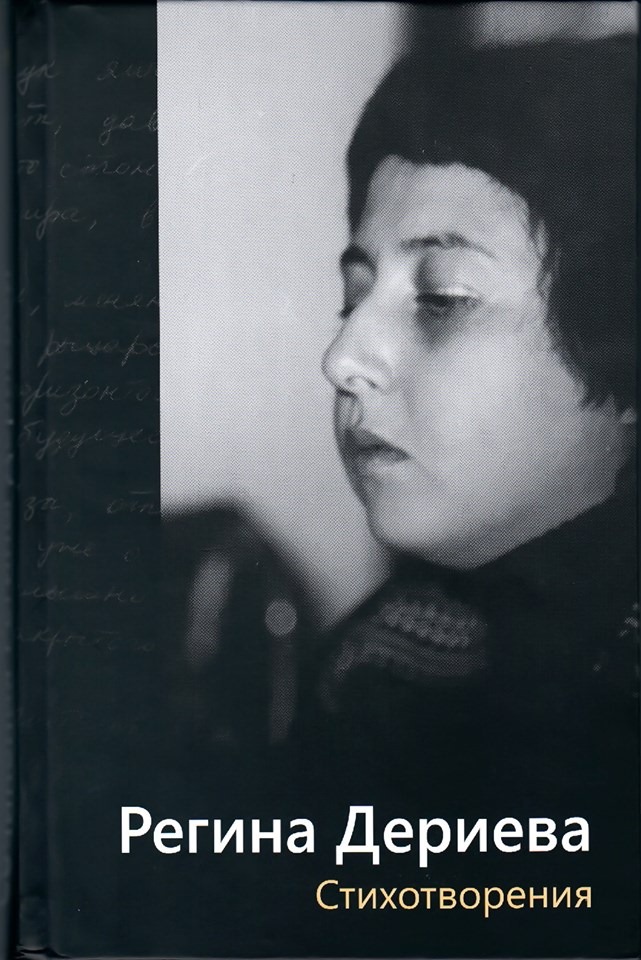
May 24 was the celebration of the late Joseph Brodsky‘s 75th birthday in Saint Petersburg, with a week of readings, lectures, and exhibitions throughout the city. The celebrations rather overshadowed a quieter fête elsewhere in town, for one of the Nobel poet’s epistolary friends, the poet Regina Derieva (we’ve written about her here and here and here).  Russia’s leading literary journal Zvezda hosted an event that launch two volumes (Volume 1: The Poems. 1975 – 2013; Volume 2: Prose. 1987 – 2013), the first edition of the poet’s work since her death in December 2013.

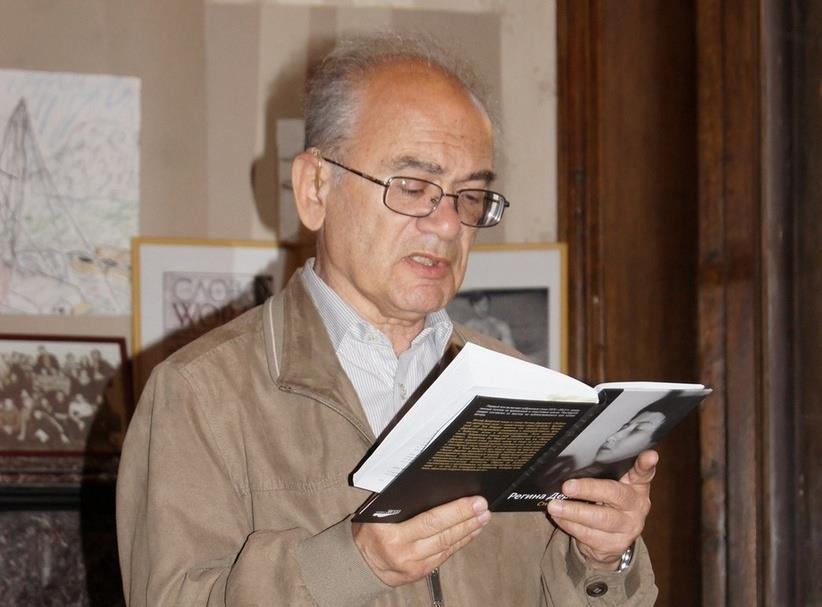
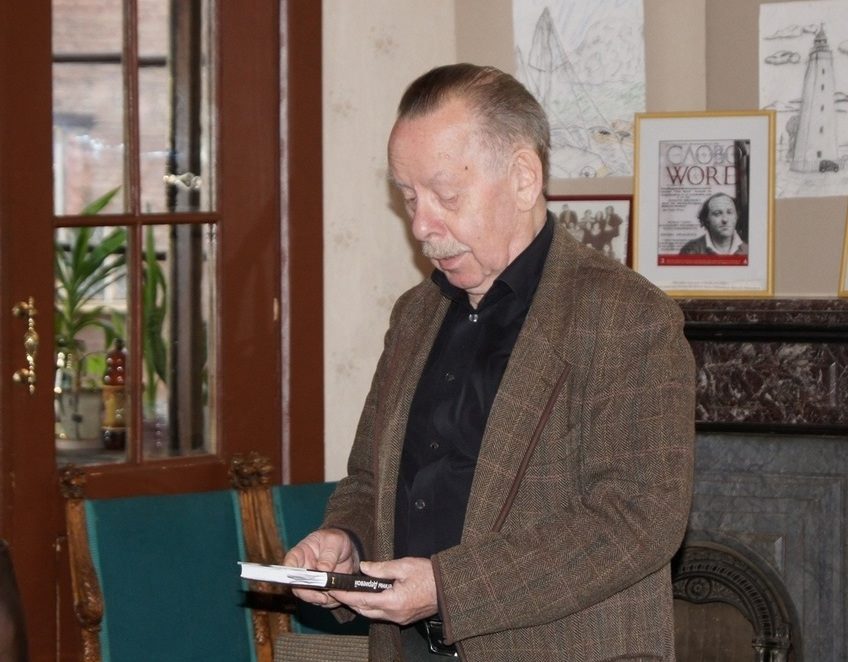
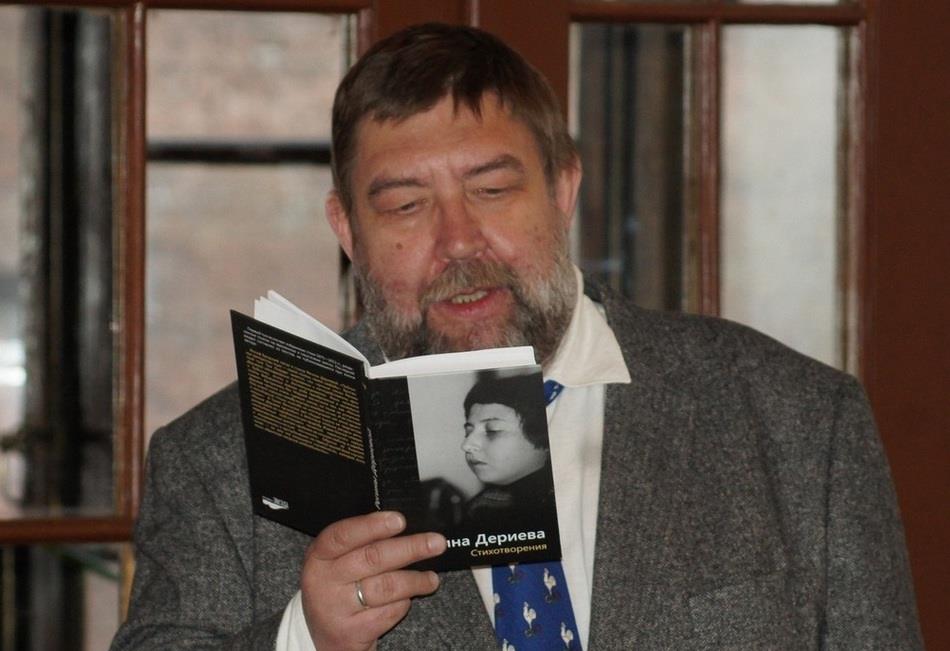
derieva-book1Because of the competing hullabaloo, the attendance on the Zvezda premises was small, but select, including the poet Alexander KushnerZvezda publisher Yakov Gordin, scholar and author Valentina Polukhina, and the poet Alexei Purin, among others.

I wrote about her for the Times Literary Supplement here. The wandering poet was born in Odessa in 1949, came of age in Karaganda in Kazakhstan, and then emigrated first to Israel, where she and her husband were mainstays of the Russian community in Jerusalem, and finally settled in Sweden, where she is buried. Throughout all her peregrinations, she remained a quintessentially Russian poet.

At the gathering, T.V. and radio journalist Mikhail Fateev discussed the religious aspect of Regina’s writings and shared a story about how he distributed Regina’s first book, which had been released in Israel by the Franciscans, to church communities throughout Saint Petersburg.

While reading Regina’s poems Yakov Gordin observed that ‘one of the main impulses running through all her poems of whatever periods is an inexhaustible anxiety.'”

Kushner discussed the dense, hermetical associations of her poems, and admired “the courage of the poet, who continued to compose poems in a language not used in the country where they were written.” He corresponded with Derieva in the 1970s, and even then appreciated her early poems.

derieva4

Derieva

Incidentally, Pushkin prizewinner Kushner is one of the most admired poets in modern Russia. He was a friend of Joseph Brodsky’s from Petersburg days, and the Nobel winner recommended (successfully) that Farrar, Straus, & Giroux publish a translation of his poems, the first of two Kushner books published by one of America’s premier publishing houses. Kushner was also a friend of the Derievs, and they had a final meeting in Stockholm in 2006.

Valentina Polukhina spoke about the poetics and stylistic features of Regina’s work and its extraordinary aphoristic quality. A few other poets read poems by Regina, as well as ones dedicated to her.

According to Fateev, “those who participated clearly appreciated this occasion for remembering Regina and reciting her poems.” The photos from the event were taken by him.

Gordin

Gordin observed her “inexhaustible anxiety.”

polukhina

Polukhina discussed Derieva’s poetics.

fateev

He distributed her books in Petersburg, fresh from Israel.

The Booker Prize: Big night for Krasznahorkai, and his editors and translators, too.

May 27th, 2015
Share
medin-krasnahorkai

Krasznahorkai’s German publisher, Hans Balmes, took a photo of Daniel Medin with the man of the hour.

There is much to celebrate in László Krasznahorkai‘s winning the Man Booker International Prize – I say that as someone of Hungarian descent, and heir to that impossible language. Certainly one reason to pop a few corks is the Hungarian novelist’s frank and humble appreciation for some of the people who made it happen. His remarks were welcome for another reason: one of the recipients of his comments happens to be among our friends, poet and translator George Szirtes. (We’ve written about him here and here – and about the London onstage conversation between the author and Colm Tóibín here, and we’ve written about the Krasznahorkai here and here, too).

szirtes

Poet and translator George

In “My Hero: George Szirtes and My Other Translators” in The Guardian, Krasnahorkai writes: “I have had six translators into English but the first was George Szirtes, who was born Hungarian but moved to England as a child and relearned the language as an adult. I knew his poetry and felt I understood his sensibility. When my publisher asked who would be a good translator, I suggested him. George said: ‘OK, but I’m not a translator, I’m a poet.’ My publisher replied: ‘Krasznahorkai wants you, so we’re prepared to be patient.’ He began with my second novel The Melancholy of Resistance and it took years.”

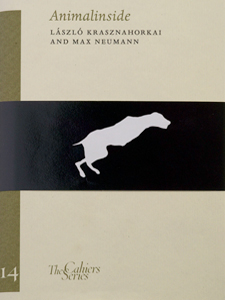
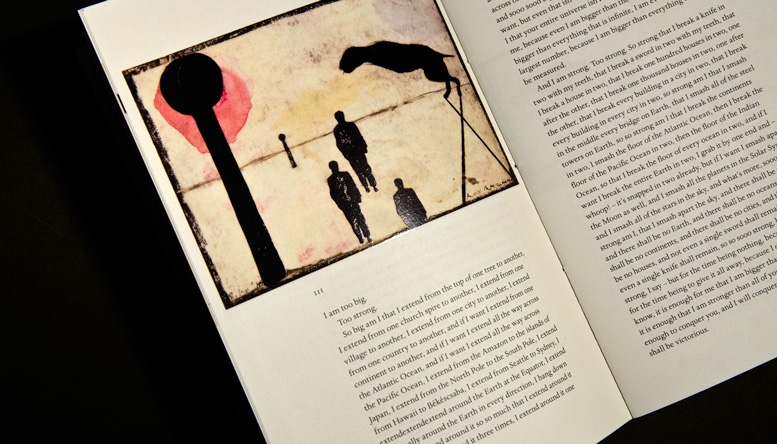
The £60,000 award has made other friends happy, too: “I’m over the moon about the prize,” wrote Daniel Medin of the Cahiers Series and the American University of Paris. The Cahiers Series (we’ve written about it here and here) published Krasznahorkai’s Animalinside, hence the jubilation. “I was excited even before they announced the winner – such a terrific, diverse group of finalists. Dozens of translations will appear as a result of this, and scores of new readers will now find their way to his books,” Daniel told me.

“All I would add is that the two publications I’ve been involved with: Issue 2 of Music &Literature, which provides a thorough overview of his entire career, and Animalinside are both, by design and by circumstance, optimal points of entry to his work.” We pass that info on.

Daniel Medin is also a contributing editor to The White Review in London, which featured a Q&A between author and translator in 2013:

G.S.: Why do you think  Sátántangó has been so successful right now? Has something happened in the world, or in literature, that has opened doors for it?

Animalinside2L.K.: I think readers who already knew Sátántangó, the film by Béla Tarr and myself, and had read The Melancholy of Resistance, War and War and Animalinside were waiting to read this too. And it seems that at the time of publication, Sátántangó was the kind of book many people actually wanted. People who wanted to escape the middle ground of high-formal pyrotechnics and the exhaustingly new; those who were waiting for a book that says something about the world; those who want something other than entertainment, who don’t want to escape from life but to live it over again, to know that they have a life, that they have a part in it, and have a preference for the painfully beautiful. My explanation is that we have no great literature. But readers need it, not as medicine, not as delusion, but because they need someone to tell them there is no medicine.

G.S.: Why is it so important for you to map things so clearly? Why is it so important to specify precise location?

L.K.:  Because it’s always important to know where things are. And a thing can only precisely be where it is.

G.S.: What do you read apart from the classics such as Kafka?

L.K.: When I am not reading Kafka I am thinking about Kafka. When I am not thinking about Kafka I miss thinking about him. Having missed thinking about him for a while, I take him out and read him again. That’s how it works. It’s precisely the same with Homer, Dante, Dostoevski, Proust, Ezra Pound, Beckett, Thomas Bernhard, Attila József, Sándor Weöres and Pilinszky

Read the whole thing here.


animalinside


“No place in the world for me”: Brodsky’s birthday fêted with an unpublished interview and more

May 24th, 2015
Share
Josef_Brodsky

The poet in Ann Arbor, a year after emigration.

Today would have been Nobel poet Joseph Brodsky‘s 75th birthday. This weekend, there’s a celebratory conference in Saint Petersburg. Some of the presents arrived early – for example, Elisabeth Markstein‘s interview with the poet in The BafflerMarkstein died in 2013, and although the interview was published in Russian in Colta shortly  afterwards, this is its first appearance in English.

In her book, Moscow Is Much More Beautiful than Paris: Life Between Two Worlds (and thanks to Kurt Leutgeb for bringing the book to my attention), the award-winning translator and author describes how news of the emigration began with a phone call while she was getting her hair done: “I sat, my head with curlers sticking out all over, under the dryer hood with dear Mrs. Luise. ‘Telephone for you!’ I crept out from under the hood. ‘Hi, Markstein?’ The voice spoke Russian. ‘It’s Joseph Brodsky here.’ He has had to emigrate, he says. Could we pick him up from the airport today right away? It was the 4th of June, 1972. ‘Of course. We will be there.’” Markstein recalls their first meeting at the home of scholar Efim Etkind:

marksteinI had met Joseph Brodsky a few years before at the Etkinds’ place in Leningrad. I was there with our daughter Mirli; she must have been three years old. I had put her to sleep on a couch in the living room. (No one would expect that a Soviet university professor had a guest room!) So: Brodsky came in, beaming with happiness because on this day his son was born. We all congratulated him. Mirli could not think of sleep after this and flirted with Joseph. He, in a good-natured way, flirted back.

The trip to the airport was unnecessary. Brodsky’s publisher [Carl Proffer] came from the States to meet him. We didn’t connect with Joseph until that evening. He was confused, despairing, full of longing for his homeland. He had left his country, because even after his trial and the resulting banishment, the KGB was after him tirelessly. While still in Leningrad, before the flight, he had written a letter to Brezhnev, then the Soviet arbiter over the fate of men. Many people criticized Brodsky for this, accusing him of being craven and servile. But me, I was so moved by the letter, which had been published in a newspaper—a proud and at the same time helpless pleading. A significant poet begged for mercy from an completely senile Kremlin lord. For that reason, I’d like to quote a few sentences from it: “It is bitter for me, to leave Russia. I was born and grew up here, I lived here and am indebted to this country for everything that is in my heart. All the bad things that have happened to me, my country generously compensated me with good things, and I never felt myself to be disadvantaged. Not even now. I ask you to give me the chance to continue my existence on the Russian soil and in Russian literature.” To be published in Russia—Brodsky’s only wish. A pure fantasy. The few things of his that had appeared in print would be removed from the Soviet libraries, like the books and translations of all other involuntary emigrants.

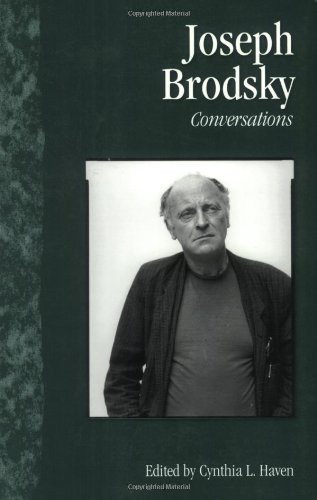
The late Carl Proffer, who founded the Russian publishing house Ardis with his wife Ellendea Proffer, shared his own memories in her indispensable Brodsky Among Usrecently published in Russia, where it skyrocketed to #2 on the bestseller list (we wrote about its debut here): “It was Sunday, June 4, and the flight arrived more or less on time at 5:35. As the bus approached from the plane I saw Joseph in the window, and he saw me. He gave a V-for-victory finger flash. Downstairs at the window there was a ten-minute delay when one of his two bags was lost, the first of a series of mechanical details that would slow everything down for days. As Joseph emerged and we embraced, I discovered that a Viennese with strong ties to Russia, Elisabeth Markstein, and her husband were also there to meet him. He and I took a cab together; his repeated reactions were one of nervousness, saying, ‘strange, no feelings, nothing,’ a bit like Gogol‘s madman. The number of signs made his head spin, he said; he was puzzled by the vast variety of cars of different makes. He said there was so much to see that he couldn’t see (he repeated this for several days).” brodskyamongusBrodsky and Proffer had dinner with Heinz and Elisabeth Markstein that evening, and they discussed the Brezhnev letter. Carl Proffer’s memories: “Markstein said he should publish the letter, but Joseph said ‘No, it was a matter between Brezhnev and me.’ Markstein asked, ‘And if you publish it, then it’s not to Brezhnev?’ And Joseph said, yes, precisely. The Marksteins were very kind, and they offered the services of their young daughters to show us both around Vienna. But for the most part we were on our own, and since for the first time we were spending a great deal of time together alone, we talked a lot, especially at night.” (The Brezhnev letter, or one version of it, is included in the new Stanford collection – I wrote about that here.) Ellendea continues the story: “The shock of arrival converted to anger in Joseph: as the two men walked around Vienna, Joseph began spontaneously condemning entire groups of writers (especially Evtushenko and Voznesensky) and dissidents in general. These were things he had said before, but now it was with a kind of hysterical intensity and much more profanity.” In the Baffler interview, he attacks some of his closest friends and colleagues left behind in Petersburg. This then, was the context for his remarks. Several readers have commented on his surprising hostility – it may be one reason why the interview remained unpublished. But this interview is fascinating for many other reasons – really, almost all the Russian poets interviews are worth reading and rereading (that’s why I recommend my Joseph Brodsky: Conversations – it’s terrific, and not because of me). From the Markstein interview:

EM: Do you consider yourself a Soviet poet?

JB: I object rather strongly to all definitions except Russian, because I write in Russian. Still, Soviet would be correct. Whatever its accomplishments and crimes, it exists, and in it I existed for thirty-two years. And it did not destroy me.

EM: I’m glad you brought this up. There are émigrés, and Soviet citizens too, who try to deny its existence, pretend it’s not there. But how can you? The Soviet Union is a historical and cultural fact.

JB: A cultural fact. Exactly. So many Soviet artists drew their inspiration not from divine intervention but from the idea of resistance. That is something to consider, with gratitude even. True, I unexpectedly found myself in the position where one can feel grateful. While you actually live there . . . I’m not sure what it is, what is wrong with my nervous constitution, but when I lived there, I couldn’t quite raise myself to anger or to hatred. Anger, yes, but never hatred. I always remembered, you see, that the regime and its manifestations were individual, ordinary people. I couldn’t give it a single face. For a resistance fighter, for a questing dissident, such emotion is death. Therefore, I’m not a fighter. An observer, perhaps.
brodsky7The Viennese Markstein spent her childhood in Switzerland, Moscow, and Prague. She was expelled from the Communist Party and barred from the Soviet Union in 1968 (according to German Wikipedia) when she was discovered smuggling letters of Alexander Solzhenitsyn out of Russia. She was appalled by the Soviet invasion and apparently said so. She continued that line of thought with the poet:

EM: In Czechoslovakia in 1968, in some cities during the first seven days of Soviet occupation, or maybe it was just one city, there was a slogan, “Remember that you are people of culture.”

JB: This is precisely what ruined their cause.

EM: How so? I believe they had won more ground than was expected.

JB: I really don’t think so. They behaved like schoolchildren. They decided that the principles they were defending, that somehow they had discovered a new way of defending those principles. But in fact, if you really want to enforce them, if you don’t want them to remain just empty words, bubbles in the air, then the only way to do it is by shedding blood. Otherwise, all you will get is a better or worse form of slavery. Once you start talking freedom, how you deserve it, how you want it, how it’s been denied you, how you refuse to remain a slave, you’ve got to take up arms. There is no other way to fight a slave-master. True, they did disgrace the Soviet Union, but pragmatically speaking . . .

EM: I used to think that death is preferable to life on one’s knees. But now I’m not so sure. I’m beginning to think that any life is better than death.

JB: True. But still, the question is, what should we remain alive for? Man is not a rock, he can’t exist just for his own sake. There’s always the “what for.” I understand that here, in the West, I won’t find the answer. Because when I look around, I don’t understand what people live for. My impression is that they live for the sake of shopping. That human life exists for the sake of shopping. The only solution is to stay on the margins, to not get too involved—in shopping, I mean. If I had grown up here, I don’t know what I would have become. This is a very disorienting feeling. I just don’t understand what it’s all for. It must be a very Russian, very totalitarian idea that something so good must come only as a reward, not as a given.

Read the rest here. In her memoir, Markstein notes: “Brodsky continued his flight to London. I never expected letters from him. At the end of 1972, we received a postcard from Venice with greetings for us and the girls for Christmas and the New Year. ‘Imagine: All washed up on these shores. Because there is no place in the world for me.’ I translate intentionally literally, because only then is the pain audible. Still, Venice soon became Brodsky’s favorite city – and where he, it so happened, wanted to be buried, on the Island San Michele. Years later Brodsky was again in Vienna, but didn’t call on us. What does that mean? It confirms for me once more that poets definitely must be egocentric.”

Brodsky&ProffersSan Francisco_1972 copy

The Proffers with Brodsky in San Francisco, 1972 (Photo courtesy Casa Dana)


<<< Previous Series of PostssepNext Series of Posts >>>