Philip Fried and the mendacity of words

May 4th, 2015
Share

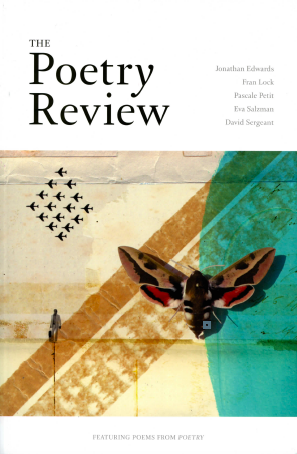
poetryreview2Over the weekend, my occasional correspondent Philip Fried, editor of the Manhattan Review (we’ve written about him here and here and here), dropped me a note. He’s rightly chuffed with the new review that’s just come out for his Interrogating Water (Salmon, 2014), which just appeared in The Poetry Review, journal of the British Poetry Society. In her review, poet Carol Rumens considered Phil’s book alongside Martha Kapos‘s The Likeness (Enitharmon).

I liked the final paragraph the best:

Fried’s poems demonstrate that whatever is made of language is open to contamination, morality included. As the soldiers in ‘Moral Helmets’ are advised, “coming soon is a Moral Positioning System/(MPS) to align your firefight decisions/With four or five of the major world religions”. But, through their heightened awareness of the mendacity of words, the poems find authenticity, and document a vision of morality almost as a superior form of politics. The nuances of Wilfred Owen‘s ‘Draft Preface’ comes to mind. “Yet these elegies are to this generation in no sense consolatory. They may be to the next. All a poet can do today is warn. That is why the true Poets must be truthful.”

Hannah Arendt: thinking vs. evil

May 1st, 2015
Share

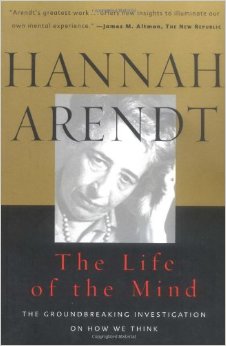
arendt3In her last, unfinished book, The Life of the Mind, Hannah Arendt returned to the subject of her earlier Eichmann in Jerusalem: The Banality of Evil. She concluded that the besetting sin of Eichmann “was something entirely negative: it was not stupidity but thoughtlessness.”

In the Time Higher Education Supplement, Jon Nixon discusses Arendt, the role of universities, “worldly thinking,” and amor mundi:

The Eichmann case raised a crucial question for Arendt: “Could the activity of thinking as such, the habit of examining whatever happens to come to pass or to attract attention, regardless of results and specific content, could this activity be among the conditions that make men abstain from evil-doing or even actually ‘condition’ them against it?” Arendt’s question arose in large part from her experience of totalitarianism, but also from her experience of political oppression under 1950s McCarthyism in the US and more generally from the ideological battle lines that defined the Cold War. She also viewed with increasing concern the unthinking consumerism and the assumption of ever increasing affluence that fuelled the American Dream prior to the stock market crash of 1973 and the oil crisis that followed later that year. Neither Hitler’s Nazism nor Stalin’s communism had, it would seem, exhausted the full potential of totalitarianism. So, the question remained urgent and pressing even within the heartlands of the democratic superpower of which she was now a citizen.

The Life of the Mind provides a tentatively affirmative response to that question: in so far as the activity of thinking requires us “to stop and think”, it may condition us against evil-doing. But this last work also raises – by implication at least – a more difficult question: could the activity of thinking not only condition us against evil-doing but predispose us towards right action? Here Arendt’s response is less clear, partly because it hinges on her suspicion of “pure thought” and partly because the final and crucial section of The Life of the Mind remained unwritten. What is clear is her insistence that without thinking that reaches out in dialogue to others there can be no informed judgement, no moral agency and no possibility of collective action – no “care for the world”.

Education was, for Arendt, an expression of that care – “the point at which”, as she wrote in her 1954 essay on “The Crisis in Education”, “we decide whether we love the world enough to assume responsibility for it”. Education provides us with a protected space within which to think against the grain of received opinion: a space to question and challenge, to imagine the world from different standpoints and perspectives, to reflect upon ourselves in relation to others and, in so doing, to understand what it means to “assume responsibility”. She had observed at first hand how such opinion can solidify into ideology. For her, thinking was diametrically opposed to ideology: ideology demands assent, is founded on certainty, and determines our behaviours within fixed horizons of expectation; thinking, on the other hand, requires dissent, dwells in uncertainty and expands our horizons by acknowledging our agency. It is the task of education – and therefore of the university – to ensure that a space for such thinking remains open and accessible.

Read the whole thing here. It’s worth thinking about as we redefine education and the humanities in collective and consumeristic ways. It’s also worth pondering as we head inexorably into an election season already riddled with clichés, banality, repetition, and derivative thinking.

His English: Ann Kjellberg on Brodsky’s self-translations

April 29th, 2015
Share
kjellberg

She ought to know.

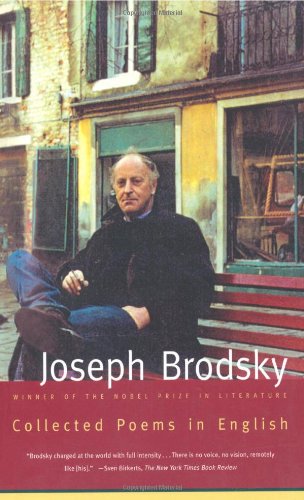
A week or so ago, we posted on Ellendea Proffer Teasley‘s terrific new memoir Brodsky Among Us (it’s here) which is a bestseller in Russia. One person, however, took exception to our criticism of Nobel poet Joseph Brodsky‘s translation of his own works from Russian into English. Her opinion is worth a read. Ann Kjellberg is the late poet’s literary executor and the editor of Brodsky’s Collected Poems in English. She is also the editor of the magazine Little Star. Here is what she had to say:

Poetry, having so little purchase in our reading life, deserves not to be approached on the defensive, but a few recent books that consider the work of Joseph Brodsky from a world perspective have once again raised the question of how effectively he has rendered himself for us in English, and it seemed like a good moment to look a little more deeply into the matter. Brodsky was born in 1940, in Leningrad, and came to the United States as an involuntary exile from the Soviet Union in 1972. By his death in 1996 he had translated many of his own poems into English, a language in which he had by then taught and written for nearly half his life. Coming from the hand of their author, these works fall somewhere between wholly subsidiary translation and original creation. Whether their language is poetically autonomous or too distortingly shaped by its Russian consanguinities has been debated since Brodsky first spoke up in the literary culture of his adoptive land.

To understand the terrain, a few words about Russian prosody are in order. The Russian language allows up to three unstressed syllables in a single word, in contrast to English, which normally follows an unstressed syllable with a stress. This fact allows Russian tremendous metrical versatility. Whereas English poetry is overwhelmingly iambic, Russian poetry spreads equally among many metrical forms, using many other combinations of stressed and unstressed syllables besides the iamb. Furthermore, as Russian is a highly inflected language, word order is permeable, and rhymes are very plentiful, allowing for a proliferation of complex musical schemes in its very young poetic tradition. Formal expression is very, very rich in Russian poetry and an integral part of the poetic experience. This flexibility has also allowed for a very full tradition of formal translation from other languages. Part of the reason Boris Pasternak’s translations of Shakespeare were said to rival the original is that Pasternak had such a plenitude of means at his disposal. The fact that many great literary practitioners (including Brodsky) were driven into translation as a safe literary occupation during Soviet times further enriched the translated canon in Russian, influencing Brodsky’s own perception of the possibilities of formal literary translation.

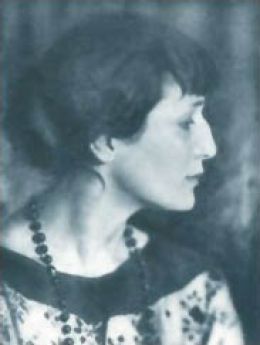
brodsky-collectedBrodsky, who received very little institutionalized education and came of age entirely outside the Soviet poetic establishment, was recognized early by his peers as a prodigy of poetic forms. It was his ear that singled him out among the swarm of young aspirants that formed around his mentor Anna Akhmatova, not his wit or his philosophical acumen. Many now regard him as the greatest innovator of Russian prosody since its forms were stabilized in the nineteenth century. He is particularly known for his expansion of the dol’nik, a looser form that cross-breeds accentual-syllabic verse with its wilder accentual cousin. For Brodsky, the musical dimension of a poem was inextricably wound into its semantic heart: the forms had coloration and value, as keys do for composers and tints for painters. He often spoke of the greyness or monotony of certain feet (the amphibrach, for instance) as an antidote to poetic grandstanding: such plays of self-effacement against assertion are very important in his work. Rhyming and metrical problem-solving are also essential to the wit of his poems, which again inflects poetic authority with impishness and deeply colors the poems’ tone. He used the pacing of poetic forms contrapuntally against the plotting and logic of his poems. The forms themselves—their shading, their pathos, their modulation of energy, their inherent proportionality—were absolutely inseparable for him from the poems and from his practice as a poet.

Furthermore, as he wrote powerfully in an essays on the translation of Osip Mandelstam (“Child of Civilization,” Less Than One), for a poet of Brodsky’s generation formal values carried a larger than musical meaning: they were a living link to the values of civilization for which poets toiled secretly in hidden rooms and basements, a whispered voice echoing from the past, an embedded conversation with their peers in books and abroad whose commitment to purely aesthetic values were ridiculed by the reigning Soviet orthodoxy. To perfect the musicality of one’s verse was to scorn the Soviet command that art hew to utilitarian ends; if a poem could be said to have a literal, exportable “meaning,” then that was precisely its least valued dimension.

Such was the import that the poetic forms carried for Brodsky and his fellow émigrés, like stowaways in their literary luggage.

By contrast, when Brodsky arrived in America in 1972, formal poetry was at a low ebb. Traditional forms were equated with loathed authority generally, the influence of the beats was pervasive and converging with continentally inflected, surrealist tendencies that would feed into the work of John Ashbery and the language poets, and the powerful generation that included Robert Lowell and Sylvia Plath was moving toward a more personal, idiosyncratic line. Brodsky quickly took up the cause of form in poetry, both championing the practitioners he most admired and struggling, in his own verse, to render what he had already learned of its possibilities. Richard Wilbur wrote the new arrival a plaintive letter thanking him for his defense of Wilbur’s work and alluding to how demoralizing it was to write formal verse in such times. Brodsky’s heraldic defense of formal verse was at the time conflated with his predictably anti-Communist political views and seen as representing a general, disreputable conservatism.

This trend has reversed somewhat, or at least fragmented. We now have a more eclectic musical environment for poetry, for reasons perhaps similar to those reviving figurative painting and tonal musical composition and realist fiction. Yet Brodsky’s own influence is surely visible here. Brodsky, like W.H. Auden, harkened back to Thomas Hardy as a formative presence, and most contemporary poets would recognize a broad stream in our poetry extending from Hardy and Auden through Philip Larkin, Seamus Heaney, Derek Walcott, Brodsky, and Les Murray, to Paul Muldoon and Glyn Maxwell and Gjertrud Schnackenberg, for example. Many poets who do not write squarely in the formal tradition are more likely to visit it than they were in 1972.

akhmatova

His mentor.

Yet the legacy of that period of formal quiescence remains very much with us. Few American readers can read verse musically with any sophistication. The notion is still widespread that there is a binary division between “formal” and “free” verse—whereas much of the best of what is read as free verse is in fact deeply colored by forms (often shadows of iambic pentameter or echoes of the syllabic lines of Moore and Bishop), and there is a big difference, for example, between verse that follows a colloquial or spoken line and verse that treats language as a found object. Similarly, “formal” poetry is not just conservative poetry that adheres to old structures, but is an evolving medium that grows and develops and constantly makes new means available to the artist. The rhymes and meters of Muldoon alone should be sufficient to make the case that form can be modern.

Brodsky’s effort to enliven and expand the formal repertoire in English, which met with considerable resistance at the time, can surely now be judged a success. Yet critics continue to argue that the specific musicality of Brodsky’s English verse is too infected by “foreignness.” I think this suggestion deserves more scrutiny.

The English language is perhaps the most permeable on earth, and has been subject to external influences almost since its origins. Our own sacrosanct forms are borrowed from the French and Italian. Many of our greatest poets have struggled to infuse English poetry with the music of classical antiquity, for example. There is no reason why this process should stop now, or why our poetry might not continue to be renewed and refreshed through foreign engagements. The notion that to accuse a poet’s intonations of foreignness is sufficient to dismiss them seems unfounded, and unnecessarily to limit the potential resources available for the growth of our verse.

Let us return to the example of Brodsky. A master of an artistic medium comes to us from another language. He embraces our culture and our verse. He dedicates much of his short life to struggling mightily to rewrite his own work so that it can be read and understood by his compatriots. (This in contrast with Nabokov, an oft-mentioned comparison. Nabokov not only grew up speaking English in his aristocratic Saint Petersburg household; he abandoned composition in Russian to become an English-language writer. Brodsky remained primarily a Russian poet, crossing over into English and crossing back and embracing a bilingual literary career.) Should we reject this effort on the grounds of unfamiliarity alone? Or should we perhaps consider that Brodsky brings us important news that might enrich our tradition, which is currently suffering from an undeniable diminution of means? Should we consider whether the challenges that Brodsky’s English verse offer us may themselves be an indication of how our language and our receptivity have contracted? Might it be worth searching for the inner cadences and harmonies in what at first seems startling to us? Or asking ourselves how an apparent violation of convention might create a more muscular or versatile poetic medium?

Brodsky1988

A firm position on verse. (Photo: By Anefo / Croes, R.C.)

Here I speak mostly of Brodsky’s formal invention, because the case against his English verse is often tied to the case against formal translation generally. But readers should remember that Brodsky is a difficult poet in any language. Working with him on translations I frequently had occasion to see how he transformed a line that had been proffered by a translator not only with deeper music but deeper thinking—for him the two were intimately entailed. In a recent review in Tablet, Adam Kirsch remarks that some “unpoetic” literal translations of some of Brodsky’s work that appear as examples in a recent book sound “poetic” to him. But we cannot think that the “poetic” is a single category, a switch that can be turned on or off. There is a danger that we will accept translations that appeal to our notion of the “poetic,” or that satisfy our expectations of poetry, without questioning whether they even approach the author’s intellectual grist. Thus, like Alice, we go down a narrower and narrower literary hall.

In this vein, it’s worth considering the frequent case against Brodsky that his English is “unidiomatic.” We should reflect on the prejudices embedded in this judgment. When did being “idiomatic” become a decisive attribute for poetry? Our own language has a particular history of returning to its colloquial roots. From Chaucer, to Shakespeare, to Wordsworth, to Auden, our great poets have recalled us to the spoken line. But other traditions have developed differently. Many poetries have a high or courtly style and a colloquial style that poets draw into strategic conflict. Brodsky himself was often accused by Soviet critics of mixing high and low. Other poets have innovated by disrupting or vexing expectation, creating a new or idiosyncratic rhetoric. By keeping the spoken and the colloquial so central to our tradition, we may have deafened ourselves to the beauty and value of innovations like these.

Indeed, Brodsky used to complain that the criticisms leveled against him for his work in English were precisely the same as those leveled against him by his Russian detractors. One difference may be that challenging orthodoxies goes down more easily in literary circles when the orthodoxies are Soviet.

Ease of digestion is at a premium in our speed-reading culture. We seem more often than not to look for reasons not to address ourselves to challenging work. However, given that contemporary Americans are raised with so little education of the poetic ear, and that the number of students of Russian (and other languages) diminishes by the hour, we might hesitate before calling for the reprocessing of work by an acknowledged genius to suit our local tastes. Brodsky’s poems in English come to us double-refracted, as it were, through his own aesthetic character. They are spun once, in the original, and then spun again, just for us. We get his difficult message double-distilled. We inhabit his precise self-placement in one civilization, lifted up and dropped into a completely different one. It is a tall order. We can find reasons to avoid it. The routines of translation give us a chance to recast the problem into a Brodsky who goes down more easily. But that may not be the Brodsky we need.

(For a comprehensive study of Brodsky’s English and Russian prosody see Zakhar Ishov, Post-Horse of Civilisation [2008].)


Postscript on 5/15: Farrar, Straus & Giroux’s Work in Progress blog republished this post. Read it (again) here!

“And the winner is …”: a few thoughts on this year’s “A Company of Authors”

April 26th, 2015
Share

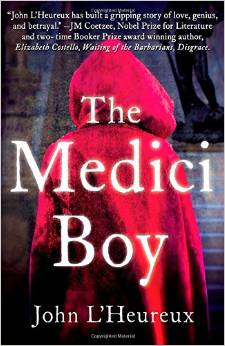
mediciThere really wasn’t a winner … or rather, there were only winners. The annual “A Company of Authors,” which we previewed here, is like the Dodo’s Caucus Race: “Everybody has won, and all must have prizes.” Alright, alright … there are no prizes, either, but everybody really does win.

That said, John L’Heureux‘s presentation of his latest, The Medici Boy, was clearly one of the highpoints of an afternoon that was full of them (some said it was the best “Company of Authors” year evah). So much so that I began taking notes against my better instincts – my home is cluttered with wads of papers filled with unused notes, whatever will I do with them? L’Heureux said that we know little about the origins of Donatello‘s bronze David, unlike most of his works that we can pin to an approximate date and a commission. Not so with this mysterious work, which L’Heureux called “a revelation.”

I was the last moderator on the final panel of the long afternoon. Hence, by the time I staggered out into the Stanford Humanities Center lobby where the Stanford Bookstore was selling copies of the featured books, much buying and selling had already taken place. However, one book had vanished entirely. You guessed it. L’Heureux’s The Medici Boy was suddenly a Stanford best-seller. No surprise, perhaps. The Washington Post said of the book and its author: “His luminous prose, swift narrative, love of art history and cool eye for human weakness make this one a pleasure to read.”

Although I had arrived too late to purchase a copy, there had been a small bonus book added to each purchase, and one or two left over. So in the spirit of the Caucus Race (“all shall have prizes”), I got a free copy of Dikran Karaguezian‘s Conversations with John L’Heureux, published by Stanford’s CSLI Publications in 2010 – and with an excellent introduction by Tobias Wolff, too. Here’s what L’Heureux said about The Medici Boy five years ago:

lheureux“Way back in 1999 on my first trip to Florence I had the good fortune to visit the Accademia and the Bargello on the same day, which meant I got to see Michelangelo‘s David in the morning and Donatello’s David in the afternoon. They provided me with a good close-up contrast. I was astonished at the Michelangelo – it’s vast and overwhelming – and I was embarrassed by the Donatello. I didn’t know where to look. The statue is so unashamedly naked. And erotic, with an eroticism that is quite calculated, I think. It asks to be looked at. It asks to be touched. I knew absolutely nothing about Donatello at that time, but one look at the David convinced me that Donatello knew exactly what he was doing and went ahead and did it anyway. …

“I concluded first that there’s a story here. That whoever modeled for this David meant more to Donatello personally than the models for Saint George or Saint Louis. Donatello gives the statue an audacity, a sexual defiance, that I’m sure he captured from the model. It’s not superimposed. It’s there in the boy posing for him. And their relationship, I concluded, was by its nature designed to break his heart. …

Q: It sounds as if you must have done a lot of research for this book.

“Actually research for this thing is an endless process. I never really intended to write the book even though I began keeping notes for it as early as 1999. I thought of it as a project for my old age, something I could keep noodling away at right up to the moment of my death … or my being sent doddering and drooling to Casa Sayanara … and when people would ask, ‘Are you working on a new book?’ I would reply, ‘Oh yes, a long term project on Donatello.’ And then I’d leave a pile of notes and nothing more at my death, but I’d have been able to kid myself that I was still at work.

miloszTruth be told, I have the same misgivings, that at my death my survivors will find only piles and piles of confused and disorganized papers and notes. So I was relieved that the bookstore also carried a few books by some of the panel moderators at “A Company of Authors” – and Humble Moi was among them. So at least one series of efforts will not be entirely lost to time. The featured book was one of my earlier efforts, Czeslaw Milosz: Conversations. While I can’t say that the small stack of my book flew off the shelves, the pile was slightly shorter when I left, which was gratifying.

One of my favorite quotes from the book: “I feel that the greatest asset that my part of Europe received in the history of the twentieth century, the privilege of our being the avant-garde of inhumanity, is that the question of true and false, good and evil, became operative again. Namely, good and evil, true and false have not been discovered through philosophical discourse, but empirically, like the taste of bread.”


“A Company of Authors”: meet the writers this Saturday at Stanford’s cozy literary fête!

April 23rd, 2015
Share
bookfest_profs

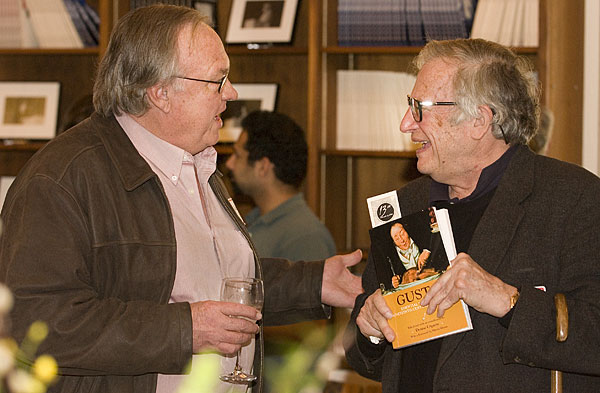
Stanford poet Ken Fields (left) chats with Peter Stansky. (Photo: L.A. Cicero)

Every year it happens – and every year we announce it. Peter Stansky, the benevolent and erudite spirit who presides over “A Company of Authors” at Stanford (the emeritus history prof is also author of The Unknown Orwell, The First Day of the Blitz, and Julian Bell: From Bloomsbury to the Spanish Civil War) has once again organized the cozy literary fête, now in its twelfth year. The event will happen this Saturday, April 25, from 1 to 5 p.m. Once again, an amazing group of Stanford writers will be discussing their recently published books. Each author will make a brief presentation, answer audience questions, and be available for conversation and book signing.

The authors who are scheduled to be speak include Richard Cottle (Stanford Street Names), Allyson Hobbs (A Chosen Exile), Maria Hummel (Motherland), John L’Heureux (The Medici Boy), Doug McAdam (Deeply Divided), Peter N. Carroll (From Guernica to Human Rights: Essays on the Spanish Civil War and Fracking Dakota: Poems for a Wounded Land), Michele Dauber (The Sympathetic State), Adrian Daub (Four-Handed Monsters), Jewelle Gibbs (Destiny’s Child), Janice Ross (Dangerous Dances), Kathryn Gin Lum (Damned Nation: Hell in America), Irvin Yalom (Creatures of the Day), Deborah Rhode (What Women Want), Marianne Constable (Our Word is Our Bond), Ann Packer (The Children’s Crusade), Alexander Nemerov (Silent Dialogues: Diane Arbus & Howard Nemerov), Benjamin Stone and John Mustain (The Tanenbaum Collection), and Tom Kealey (Thieves I’ve Known). Many have appeared on the Book Haven before.

Not least of this year’s attractions: you will have a chance to meet Humble Moi, who is willing to sign your programs and flyers. If you consult the program below, you will see that I will be chairing the very last of the panels, “Truth Through Fiction and Memoir.”

Did I mention that the event is great fun? Drop in, or indulge yourself by spending the entire afternoon in the company of these bright, entertaining, and stimulating writers. Stanford Bookstore, one of the event’s annual co-sponsors, will sell books at a 10 percent discount, and authors will sign copies. Light refreshments will be served. And it’s all free!

CompanyAuthorsSpring13_LetterSize

The book that’s rocking Russia: Ellendea Proffer’s Brodsky Among Us is a bestseller

April 20th, 2015
Share
brodsky,-Ellendea,-Sergeev-Leningrad-1970-zoecrop

Carl Proffer snapped a photo of Joseph Brodsky with Ellendea outside Leningrad’s Transfiguration Cathedral in 1970. (Photo copyright: Casa Dana)

Nobel poet Joseph Brodsky, exiled from the Soviet Union in 1972, has inspired a number of memoirs since his death. One big one was missing, until a few weeks ago.

Ellendea Proffer Teasley‘s Brodsky Among Us is now in its third printing, although it was released only last month in Russia by Corpus, one of the largest publishers in Russia. Reviews have been laudatory – and the book quickly shot to the top ten at the main Moscow bookstore, Moskva. The author is now on her triumphant tour of Russia, giving talks, media interviews, book signings, press lunches, and photo ops. With her late husband, Carl Proffer, she co-founded the avant-garde, U.S.-based Russian publishing house Ardis during the Cold War. Together, they brought Brodsky to America.

brodskyamongusThe literary acclaim has caught Ellendea off-guard. Russians generally like their poets stainless, and her memoir is as candid as it is affectionate. Her Brodsky is brilliant, reckless, and deeply human. “I did not expect the response I’m getting,” she wrote to me. “It is so moving to me. They understood exactly what I was doing, and they are grateful that it’s not more myth-making.”

While I have been encouraging her to write a memoir for years, I had not seen enough of her writing to anticipate what such a work would look like. Frankly, I did not expect anything of this caliber – an engaging, compulsively readable text that is bodacious, graceful, seamless. Perhaps I should not have been surprised: five years after Carl’s untimely death in 1984, she received a MacArthur “Genius” Fellowship in her own right. Since the dissolution of the Soviet Union, she has kept a low profile; this book marks her powerful comeback as a major figure in Russian literature.

The Proffers befriended Brodsky (1940-1996) in Leningrad. When the U.S.S.R. gave him the heave-ho, the couple miraculously secured an appointment for the unknown foreigner as poet-in-residence at the University of Michigan, which launched his career in the West. In Brodsky Among Us, she writes of the first encounter in the present tense, as if it were still replaying in her head, over and over:

“The most remarkable thing about Joseph Brodsky is his determination to live as if he were free in the eleven time zone prison that is the Soviet Union. In revolt against the culture of ‘we,’ he will be nothing if not an individual. His code of behavior is based on his experience under totalitarian rule: a man who does not think for himself, a man who goes along with the group, is part of the evil structure itself.

Joseph is voluble and vulnerable. He brings up his Jewish accent almost immediately; when he was a child his mother took him to speech therapy to get rid of it, he says, but he refused to go back after one lesson. He is constantly qualifying whatever he has just said, scanning your reactions, seeking areas of agreement. He talks about John Donne and Baratynsky (both poets of thought) then says da​? to see if you agree. (Later he would use Yah? this way in English.) This is part of his social courtship pattern. Of course there is another Joseph, the one who doesn’t like you, and that Joseph – whom we rarely see, but are often told about – is insolent, arrogant and boorish. I am reminded of what Mayakovsky‘s friends said about him – that he had no skin.”

She explains the combativeness later, “He needed his enemies; resisting them – and the state – had formed his identity.” Hence also his careerism, his relentless (and astonishingly successful) social climbing among the New York City literati: “If you had fame, you had the power to affect a culture; if you had fame you were showing the Soviets what they had lost,” she wrote.

Much of the current Russian attention is not just on Brodsky, but on the Cold War legacy of Ardis itself, given that censorship levels in Russia are returning the nation to the 1970s. Journalist Nikolai Uskov, who has visited the Ardis archives at the University of Michigan, is working on a big book about the courageous publishing house that operated out of an Ann Arbor basement.

casadana4

On Russian TV with Ksenia Sobchak (Photo: Casa Dana)

I met Ellendea back at the University of Michigan in the 1970s and visited her and Carl at the former country club that had become the Proffer family home and base of operations. Together, the Proffers published the best Russian literature at a time when the U.S.S.R. wasn’t. As I wrote a dozen years ago:

The competition was admittedly limited: Soviet publishers were hamstrung in what they could print; they weren’t publishing much that was new, let alone groundbreaking. The emigre YMCA press in Paris (which published Solzhenitsyn, among others) and Possev in Germany had a religious or political bent, a bias that often alienated younger writers. Samizdat was one alternative: haphazard, handwritten or mimeographed, and highly perishable.

Then there was Ardis. With its related venture, the innovative Russian Literature Triquarterly, Ardis brought Western readers to Russian writers. Marina Tsvetaeva, Osip Mandelstam, Velimir Khlebnikov, Mikhail Bulgakov, even Anna Akhmatova were relatively little known in the era before Ardis set up shop; their works were suppressed, their names and reputations were inevitably jumbled with a plethora of lesser, officially approved writers.

Her memoir is likely to cement the Ardis legacy in the best possible way. Brodsky Among Us is compelling, polished, pitch-perfect. She captures his restless self-reinvention, the bluster, the belligerence, the boorishness – while never losing sight of his tenderness and generosity, the reason so many, including Susan Sontag as well as the author, forgave him everything. This is, above all, a loving memoir.
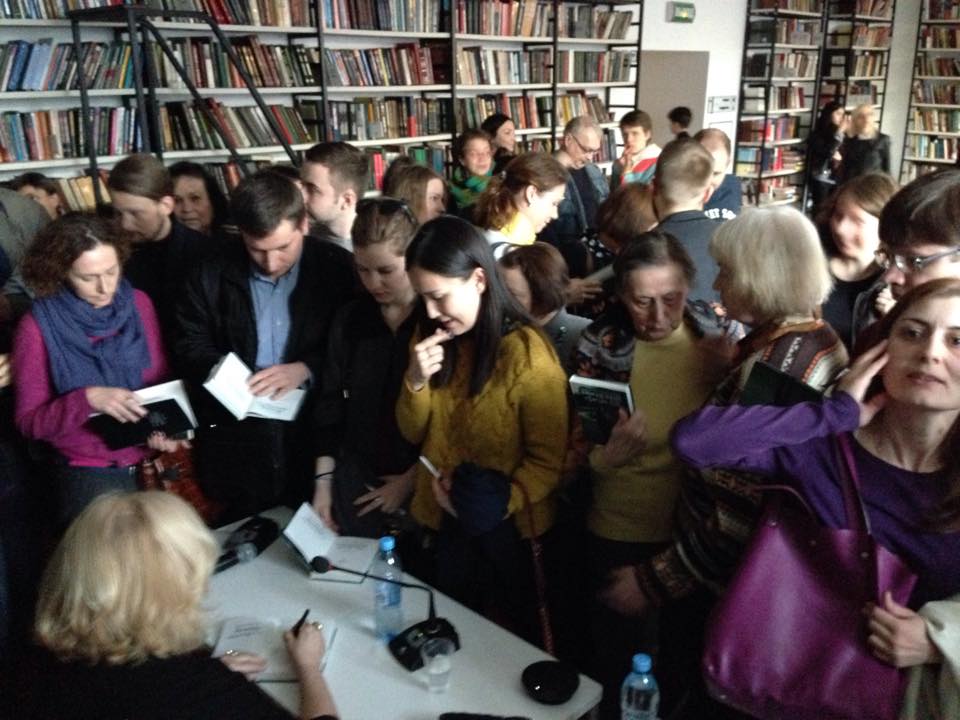
casadana1

Signing books at the Dostoevsky Library (Photo: Casa Dana)

Brodsky Among Us is about as flawless a book as one could expect. I wished it wouldn’t end. I found myself marking passages I wanted to return to, sentences I wanted to remember. It’s short, but it’s not a bad idea to leave the reader wanting more. I suspect she leaves out all the right things. While some Russian readers have noted the book’s understatements and omissions, I know that she was anxious, first and foremost, that the poet’s oeuvre not be overshadowed by the anecdotes.

Recently, Russian government has attempted to appropriate its rejected poet. Brodsky’s words were featured in the closing ceremonies of the 2014 Sochi Olympics, a startling move to reclaim the writer who would not have survived had he stayed, and may not have thrived under today’s Russian regime, either. Brodsky never returned to his beloved Petersburg. Why? In part, Proffer writes, because he didn’t believe anything had really changed. She writes: “Joseph had many stated reasons for not going back. He said different things, depending on his time and mood, so all one can really trust are his actions. He did not return to his native country when he could have. I know a few of his reasons: one was the iron conviction that return would be a form of forgiveness … Exile was so difficult that it was hard to believe one could just go back as if it had not cost you anything. As Americans descended from immigrants, we are familiar with this phenomenon: sometimes you love your country but it doesn’t love you back. This loss becomes a part of your new identity.”

casadana3

Ellendea on air at Radio Echo Moscow (Photo: Casa Dana)

The back cover of Brodsky Among Us has an attention-grabbing quote, but out of context one that sounds misleadingly harsh. Here are the paragraphs that goes around that quotation, which addresses the poet’s posthumous revision:

“There is a Brodsky stamp in America, and there is an Aeroflot plane named after him. I don’t want there to be a museum for Joseph, I don’t want to see him on a stamp, or his name on the side of a plane – these things mean that he is dead dead dead dead and no one was ever more alive.

I protest: a magnetic and difficult man of flesh is in the process of being devoured by a monument, a monstrous development considering just how human Joseph was.

Joseph Brodsky was the best of men and the worst of men. He was no monument to justice or tolerance. He could be so lovable that you would miss him after a day; he could be so arrogant and offensive that you would wish the sewers would open up under his feet and suck him down. He was a personality.

The poet’s destiny was to rise, like his autumn hawk, into that upper atmosphere even if it was going to cost him everything.”

casadana2

Eminent translator Viktor Golyshev, Ellendea Proffer Teasley, and critic Anton Dolin at standing-room only event. (Photo: Casa Dana)

When Proffer, who had relocated to southern California, sold Ardis to Overlook Press in 2002, I wrote about the transition in the TLS, and the Los Angeles Times Book Review was so eager to republish the piece they tracked me down to a secluded beach in Ocho Rios to get my permission to reprint tout de suite. Those were the days when newspapers still had cutting-edge book review sections willing to take a risk, the LATBR foremost among them. In 2015, publishers are looking at markets, not enduring legacies, and book editors don’t take too much interest in what happens beyond their shores. C’est dommage.

Here’s why this story is important here, now: most of his poetic career was in the U.S., not Russia. Previously published memoirs by Lev Loseff (I wrote about it for Quarterly Conversation here) and Ludmila Shtern (I wrote about it in the Kenyon Review here) are greatly illuminating, but shortchange his American life. The American story is one the Russians didn’t know, and the one that we haven’t told, spotlighting the auto-didact’s wondrous, rough-and-tumble self-reinvention, admittedly marred by the ambitious, ill-advised self-translations that would have torpedoed a lesser genius. He became the first foreign-born U.S. Poet Laureate. He taught generations of American students – including this one. Those of us who knew him will never forget him – those who didn’t, especially, need this book. Although the champagne corks are popping in Russia, most of Brodsky Among Us takes place on this side of the world – it’s an American story, about an American career. He is one of us.

Brodsky&ProffersSan Francisco_1972 copy

Brodsky Among Them: The Proffers & the poet at Mark Hopkins Hotel, San Francisco, 1972. (Photo copyright: Casa Dana)




<<< Previous Series of PostssepNext Series of Posts >>>