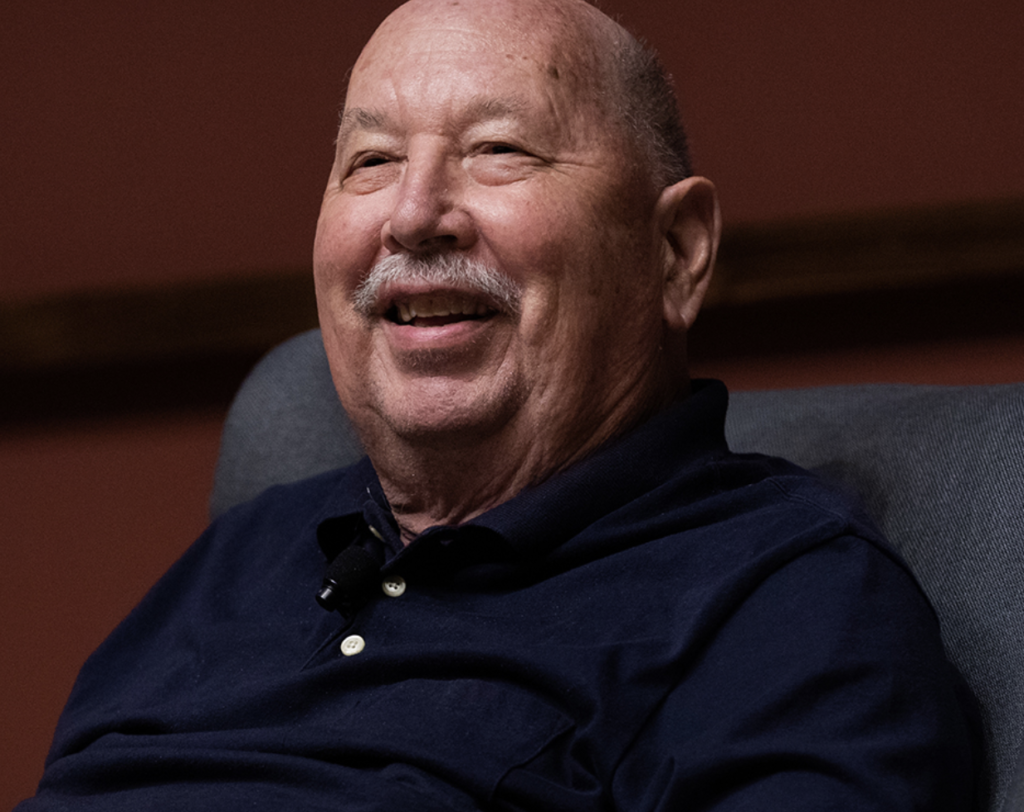
Євген Мінко, рецензючи книжку Синтії Гейвен «Еволюція бажання: життя Рене Жирара», зазначає, що для Жирара наука була полем передчуттів і осяянь, інструментом вивчення ефемерних, але фундаментальних елементів людського буття: бажання, відчуття сакрального, непереборного потягу до насильства.
In other words, (which is to say, English ones):Evgeny Minko, reviewing Cynthia Haven‘s book The Evolution of Desire: The Life of René Girard, notes that for Girard, science was a field of premonitions and insights, a tool for studying ephemeral but fundamental elements of human existence: desire, the feeling of a sacred, irresistible urge to violence.
Evgeny Minko is a writer, journalist, and psychoanalyst. The title of his article is “У полі передчуттів і осяянь,” in English, “In the Land of Premonition and Visions.” It begins, in translation:
One of the most enigmatic philosophers of the 20th century, René Girard, died in the fall of 2015, and three years later his first biography was published. Literary critic Cynthia Haven was friends with Girard during the last years of his life and de facto started work on the book with his participation: in Evolution of Desire conversations between the author and the hero are quoted abundantly. The result is a kind of hybrid of biography and memoir, and the requirements of distancing the researcher from the object of research for the sake of objectivity aren’t met. However, this fits perfectly into the coordinate system of thought created by Girard. Science — history, literary studies, anthropology — was for him a field of premonitions and revelations. A tool of careful (as if by the hands of an entomologist) study of ephemeral but fundamental elements of human existence: desire, feeling of sacred, irresistible urge to violence.
The “desire” in the title of the book for the reader, who is not familiar with Girard’s work, will primarily be a desire to understand who, in fact, we are talking about. After all, in the imaginary philosophical canon of modern times, Girard’s place is quite marginal, as it often happens (should happen!) with truly interesting and original phenomena.
René Girard was born in France in 1923, received a history education, and in 1947 emigrated to the United States, where he spent the rest of his life teaching literature at leading universities. A successful career path of a scientist, without upheavals and disasters.
However, a formal career does not convey the ambition of Girard’s entire life: to create a comprehensive system for explaining human behavior. Like the one created by Freud. And this system became his mimetic theory.
Read the whole thing here in Ukrainian. Otherwise, it’s off to Google Translate for you.
Book Haven readers will remember his earlier account of the events of 1963 in The New York Times Sunday Magazine here. We’ve also written about his account of Lenin’s brain here. And his account of Women of the Gulag here and here. And Politics, Murder, and Love in Stalin’s Kremlin here.
He recalls, “remarkably, Lee’s actions on November 22, 1963, did not surprise me. Rather, it was as if the pieces of a puzzle were falling in place as I saw him brought handcuffed and bruised into the Dallas police station.”
This is his first book-length discussion of his relationship with Lee Harvey Oswald and his Russian wife Marina. He has offered the Book Haven an introduction to the book and some short excerpts:
As a 21-year-old college student, I returned to my hometown of Ft. Worth for the summer of 1962. At the same time, an ex-marine defector to the USSR returned the Ft. Worth with his wife and infant daughter. I was thus thrown into the life and troubled marriage of Lee and Marina Oswald, as Lee struggled to fulfill his dreams of fame and Marina was introduced to a new life in the United States. Through the pretext of Russian language practice, I became a frequent visitor as they settled into their run-down Mercedes Street duplex. As their only visitor besides Lee’s brother, I got hints of Lee’s visions of grandeur, abuse of Marina, and her scornful dismissal of her “loser” husband. It was through my initiative that we introduced the couple to the “Dallas Russians,’ who took an immediate dislike to Lee, as they became determined to free Marina from her unfortunate husband.
I returned to college, and the Oswalds moved to Dallas. Other than reports from Dallas of Lee’s outrageous behavior, I did not hear or see them until shortly before Thanksgiving, as Lee used me as a pawn to get Marina to move back in with him. My last image of Lee and Marina was them running to the Dallas bus at the Ft. Worth bus station on Thanksgiving Day 1962. My next image was November 22, 1963, as a bruised Lee was dragged into Dallas police headquarters to my shock and horror. Sitting in front of a TV screen at Norman, Oklahoma, I immediately understood that Lee had done it, and why, and that he had done it alone. I had ample opportunity to express my reasons before the US Secret Service and the Warren Commission. I was picked up early morning the day after the assassination as a ”known associate” of one Lee Harvey Oswald.
Economist, Slavic scholar Paul Gregory today
This book combines my experiences with Lee and Marina with the testimonies found in the tens of thousands of pages of the Warren Commission report, a reading to Lee’s largely unknown writing on socialism and communism, and Oswald’s KGB file. Some of the most important insights come from my father’s account of translating for Marina at a hideout arranged by the Secret Service in the week following the assassination as the FBI and Secret Service clashed and Lee’s mother went off the rails.
I largely refrained from writing on my experiences with the Oswalds because my parents both considered our association with a Marine deserter and communist to be shameful and best not talked about. Virtually everyone I write about is now gone; so it is time to tell the story.
***
That the Warren Commission’s lone assassin—Lee Harvey Oswald—was an unaccomplished, poorly educated misfit continues to feed the public’s skepticism. Nonentities do not change history. By this line of reasoning, we should be leery of the lone gunman conclusion unless we can explain with firsthand detail and confidence how Oswald could gun down the world’s most heavily guarded figure using only his own meager devices. And that’s what this book is about. It asks whether our “intimate” portrait of Oswald conveys in him the motive, resources, cunning, and killer instinct to have indeed changed our history as he fired on the president’s motorcade passing below him.
I would not be writing this book had I not known Lee Harvey Oswald personally. From June through mid-September of 1962, I was the sole companion of Lee Harvey and Marina Oswald outside of Lee’s immediate family. I visited this young married couple often in the duplex where they settled after Lee’s return from his defection to the USSR.
***
On their wedding day. (National Archives)
At 2:01 p.m., an excited reporter, located at Dallas police headquarters, shouted out on camera: “They are bringing in a suspect!” The TV showed a short man, disheveled in a white, V-neck tee shirt and dark trousers. He was surrounded by police officers. His face was bruised, and one eye was black. I stared in utter and stunned disbelief. It was clearly Lee Harvey Oswald! I muttered mainly to myself in shock: “I know that man.”
***
MR. JENNER (Warren Commission Deputy Counsel): Now, you were seeking to report to us the friends and acquaintances of your brother and your sister-in-law subsequent to their return to the United States in June of 1962. Now, who next in addition to Paul and [his father] Peter Gregory?
MR. OSWALD: None, sir.
MR. JENNER: None?
MR. OSWALD: None.
*** The army of assassination buffs are wasting their time on missing bullets, Oswald doppelgangers, and Soviet, Cuban, or Mafia assassinations. We need to look no further than Oswald himself. We must ask how this “little man” with megalomaniacal ambitions mustered the wherewithal to kill the ideal target for someone who wanted to go down in history books.
***
As someone who has worked professionally with Soviet state and party documents for over a decade, the Yeltsin documents appear authentic to me. We learn that Oswald’s case was dealt with at the highest levels of the Politburo and KGB—not by the local passport office as I had previously thought. The original USSR counterattack eventually implicated the Gregorys in a “White Russian Conspiracy.”
This Soviet version remains an active thread in the JFK conspiracy portfolio. I guess Pete and Paul Gregory are still under suspicion of some kind in some quarters.
Agent Nielson bored in on whether Lee could have been part of an organized conspiracy. I answered that I had no evidence pro or con, but I volunteered that if I were to organize such a heinous crime, the last person on earth I would include in the conspiracy would be Lee Harvey Oswald. I stated that Oswald marched to his own drummer. He could not be relied upon, and he would not take kindly to orders from others. This personal opinion somehow did not make it into the official transcript of my remarks, but I am sure I said it.
“… In Girard’s view, everything we desire, everything we think is cool, is learned through copying someone else. As Cynthia Haven, writes: “We live derivative lives. We envy and imitate others obsessively, unendingly, often ridiculously. ‘All desire is a desire for being,’ [Girard] said, and the being we long for becomes wrapped up in a person. That person, whether we like it or not, is our avatar of cool.”
Read the rest here. Want to know more about him, so you can be cool, too? Try Jerry Bowdler’s excellent 2015 article in Forbes, “René Girard: The ‘Einstein of the Human Sciences.'” (Note: the late Michel Serres tagged René Girard as “the Darwin of the Human Sciences,” but Einstein isn’t bad, either.) A longish excerpt, reprinted with his permission:
Girard saw it first in literary studies. While engaging in a close examination of several great novelists, (Proust, Dostoevsky, Flaubert, even Cervantes) Girard noticed that despite the consensus that the great novelists were ‘singular’, i.e. one of a kind, they actually had several powerfully unifying themes. Those themes were that human desire does not generally emerge from within us, but rather comes from some ‘other’. We naively imagine that we simply are who we are, and that we want what we want because we are who we are. However, the great novelists present us with an inconvenient truth – that we import our most powerful desires from imitating other people.
“How did mankind survive this long? This is where Girard gets really interesting.”
Girard gives the example of a young man who admires the world’s greatest pianist. He is drawn to the pianist, and therefore he is drawn to what the pianist is drawn to – great achievement in piano performance. The great man wanted to be the best piano player in the world, and he got what he wanted. The younger man wants to be like his hero. But at precisely that point, when the younger man most idolizes his hero, they also become rivals. To truly imitate the master, the student must become the greatest piano player in the world. The two want the same thing, a thing which there cannot be two of – the title “greatest.”
The first stage Girard calls ‘mimesis’ – imitation. Young man wants to be like great man. The second stage is ‘mimetic desire’ – young man wants what his master wants (to be the greatest). The third stage is called ‘mimetic rivalry’ – young man and master want the same unique object of desire, so they become enemies.
Once you become aware of this process, you see it everywhere: celebrity feuds, geopolitical rivalries, financial asset valuation bubbles, everywhere that people interact. It’s even there among the animals, especially in the form of sexual rivalry, or rivalry over food. The Bowyer dogs desire a chew toy more when it is desired by another dog.
The idea is revolutionary because it overturns what Girard calls ‘the romantic illusion’, the illusion which goes back at least as far as Rousseau, that humans can be authentic. The romantic illusion proclaims that we can throw aside cultural and societal norms to follow our inner desires, that we can and must (as a thousand schlocky movie characters tell us to do) follow our hearts. Girard says we can’t follow our hearts instead of the group, because without the imitated other we don’t have desires in our hearts. Certainly we have instinctual urges, but not the higher purposes which we describe as desires. We get those from others.
But there is a problem larger than the disappointment in realizing that the romantic illusion is false and that genuine ‘authentic’ autonomous desire is an illusion. The larger problem is that the rivalries of mimetic desire tend to spin out of control. Switching to another of Girard’s metaphors: if I love a woman and you admire me and I praise that woman to you, you will tend to be drawn to her as well. Shakespeare does this a lot – it is the basis of the Rape of Lucretia and of Midsummer Night’s Dream, for instance. So I love her and you imitate me and come to love her too. But the fact that you desire her makes me even more confident in my initial desire for her. I am confirmed. I was right to desire her: the proof is the desire which you have for her. This can stay contained in a little love triangle or it can expand into a square, or even a pentagon… which reminds me that all of this can take on a military significance: the object of desire can become a casus belli. As Peter Robinson said in Girard’s last public interview, “There is only one Helen of Troy.” Not that the object of desire in war is typically sexual, but there is not just only one Helen — there is also only one Hellespont, and as Russia and Turkey are all too aware, only one Black Sea.
This is a self-reinforcing mechanism. Mimetic desire increases the intensity of desire, and the intensity is also then imitated, and the imitation then sets off another round of desire. This often leads to physical clashes. Girard calls this stage ‘mimetic violence’.
Economist and Girard aficionado – Jerry Bowyer
When the process enters the violent phase, there is a subtle shift in the system. The original object of desire is no longer the point. No one cares that much about Helen anymore. Now it’s about fallen comrades: Hector must be avenged. Achilles’ cousin cannot be allowed to have died in vain. Agamemnon cannot go home empty-handed after so much shedding of Greek blood. The conflict itself takes on a life of its own. Menelaus cannot just go home and wed the second most beautiful girl in Greece after all those years of fighting. Ever have an argument with someone which quickly becomes an argument over the argument itself? Someone can appear from another room and settle the original point of dispute with a, “Hey guys, I googled it, and it turns out that what really happened was X,” but the argument keeps on going, the conflict generates new injuries, new injustices, new grudges. This can become a war of all against all, described in thousands of papers by anthropologists documenting thousands of ‘primal chaos’ rituals. The rituals re-enact the primal violence which preceded the establishment of our clan, village, city, empire – out of which order came. The rituals remind us how bad things can get.
So then why aren’t societies in a perpetual state of war? How did order come? How did mankind survive this long? This is where Girard gets really interesting. Order comes from a scapegoat, someone on whom the hatred and guilt of the community can be affixed, someone who can then be sacrificed to purge the hatreds of the community. The scapegoat is not truly guilty. He couldn’t possibly be. He probably wasn’t even there when the mimesis started, scapegoats are frequently foreign visitors. He doesn’t have the power to send a whole community into chaos. This blind man who wandered into the village couldn’t have stolen all those sacred artifacts. That strange babbling woman couldn’t have ruined the crop. Those Jews and/or Gypsies would have absolutely no reason to poison the village well. But the community needs them to be guilty, so it often invents supernatural powers (witchcraft) or supernaturally wicked motivations (devil worship), and the community has now found its point of unity – the strangers must be killed. Oedipus must have been a moral monster, a mother-raper and a patricide. He has brought the wrath of the gods down upon us and he must die, at his own hand or ours. Usually it’s the latter the hands of others, lots of hands, either casting stones or casting ballots.
The victim dies, and by dying, reunites the community. Now that they have died and are no longer a threat and have performed the sacred function of re-founding the city, they are to be honored. When a champion dies in the Hunger Games, the majestic music plays — they are now ‘the fallen’. They are heroes – the social order depends on them. They have restored order by their death. They save many lives by dying. Girard suggests that the rehabilitation of the victim is perhaps an unconscious admission that the victim was, in fact, innocent. The innocence of the victim is a useful lie which cannot be acknowledged; otherwise, it is no longer useful and the violence must begin again. Girard calls this final phase ‘the scapegoat mechanism’.
The discovery of this pattern is what Girard called his ‘first conversion’. This is the conversion away from the romantic illusion that autonomous authentic man was an achievable idea, from the modern idea that religion was optional for mankind and that violence was an interruption of, and imposition upon, the default equilibrium of peace. For Girard, violence is the origin of archaic religion and archaic religion is the foundation of human culture itself. These are the ‘things hidden from the foundation of the world’, mankind’s need to reenact the cycle of violence no matter what his intentions or aims. Modern man pretends that we’re past all that, but that is another useful life – another romantic illusion.
Read the whole thing here – there’s more, really, lots more – here.
Living a nightmare: Ukrainian soldiers assigned to third battalion (NARA/DVIDS).
We’ve written about historian Timothy Snyder ever since his book Bloodlands,here and here and here. He’s a compelling and insightful thinker, and always worth a look, but particularly about Ukraine. In a vital column from his Substack, he argues: “To be sure, there is a certain temptation to concede mentally to nuclear blackmail. Once the subject of nuclear war is raised, it seems overwhelmingly important, and we become depressed and obsessed. That is just where Putin is trying to lead us with his vague allusions to nuclear weapons. Once we take his cue, we imagine threats that Russia is not actually making. We start talking about a Ukrainian surrender, just to relieve the psychological pressure we feel.
“This, though, is doing Putin’s work for him, bailing him out of a disaster of his own creation. He is losing the conventional war that he started.“
More:
War is ultimately about politics. That Ukraine is winning on the battlefield matters because Ukraine is exerting pressure on Russian politics. Tyrants such as Putin exert a certain fascination, because they give the impression that they can do what they like. This is not true, of course; and their regimes are deceptively brittle. The war ends when Ukrainian military victories alter Russian political realities, a process which I believe has begun.
The Ukrainians, let’s face it, have turned out to be stunningly good warriors. They have carried out a series of defensive and now offensive operations that one would like to call “textbook,” but the truth is that those textbooks have not yet been written; and when they are written, the Ukrainian campaign will provide the examples. The have done so with admirable calm and sangfroid, even as their enemy perpetrates horrible crimes and openly campaigns for their destruction as a nation.
Compelling and insightful thinker.
Right now, though, we have a certain difficulty seeing how Ukraine gets to victory, even as the Ukrainians advance. This is because many of our imaginations are trapped by a single and rather unlikely variant of how the war ends: with a nuclear detonation. I think we are drawn to this scenario, in part, because we seem to lack other variants, and it feels like an ending.
Using the mushroom cloud for narrative closure, though, generates anxiety and hinders clear thinking. Focusing on that scenario rather than on the more probable ones prevents us from seeing what is actually happening, and from preparing for the more likely possible futures. Indeed, we should never lose sight of how much a Ukrainian victory will improve the world we live in.
I have been a busy girl. One of the misfortunes of my workload this last year or two is that I haven’t been keeping up Patrick Kurp‘s remarkable blog, “Anecdotal Evidence.” These are daily mini-essays, erudite, witty, and – how does he do it? – he’s apparently inexhaustible. In the 16 years he’s been running the blog, he’s only missed one day, to my knowledge. And it took a Texas flood to give him a coffee break.
While yours truly has just missed two weeks of posts, he has been indefatigably pumping it out.For example, taken almost at random, a few days ago he was discussing Uncollected Poems and Prose of Edwin ArlingtonRobinson (Colby College Press, 1975), which he called “an unruly grab bag of remnants.” Robinson’s “witty, aphoristic, sometimes acerbic conversational manner” is in full play during a 1916 interview:
“Within his limits, I believe A.E. Housman is the most authentic poet now writing in England. But, of course, his limits are very sharply drawn. I don’t think that any one who knows anything about poetry will ever think of questioning the inspiration of A Shropshire Lad [1896].”
He goes on to praise the work of Kipling and John Masefield, and adds, “But I do not think that either of these poets gives the impression of finality that A.E. Housman gives.” By “finality” I think Robinson means inevitability, the sense that Housman’s lines, his rhythms and word choices, could not have been otherwise crafted. We read them and can’t imagine them otherwise.
I’ve always admired Robinson’s Yankee common sense, hard-headedness and lack of ostentation – in life and in verse. My judgment of Housman is similar – another no-nonsense fellow. According to one scholar, Housman was familiar with Robinson’s but not impressed: He told a correspondent he “got more enjoyment from Edna St. Vincent Millay than from either Robinson or Frost.” De gustibus . . .
De gustibus non est disputandumindeed. I’m rather fond of Millay myself. Check out his blog here. You won’t regret it.
Edwin Frank: “A book of concrete observations and endless reflections and lapidary sentences.”
Stanford’s Another Look book club has often showcased New York Review Books’ excellent offerings, so as we celebrate the tenth anniversary of the Stanford book event series, we’re pleased that our fall event on October 5 will feature Glenway Wescott‘s too-little-known 1940 novella, The Pilgrim Hawk: A Love Story. New York Review Books founder Edwin Frank (and, incidentally, he’s also a former Stanford Stegner Fellow), agreed to answer a few questions about the book, one of he first NYRB Classics published in 2001. (The Book Haven also ran an interview, “Great literature is literature that remains news,” between Edwin Frank and another Stanford alum, Daniel Medin, at Shakespeare & Company in Paris, 2016, here.) Another Look was launched in November 2012, with William Maxwell’s So Long See You Tomorrow. Tobias Wolff, founding director of Another Look, talked about his choice in a short video here. Our tenth anniversary event for Wescott’s novel will take place at 7 p.m. on Wednesday, October 5, at Levinthal Hall in the Stanford Humanities Center, 424 Santa Teresa Street, on the Stanford campus. The event will also be livestreamed. Come celebrate our tenth with us! It’s not to late to register here, for the virtual and live event. Walk-ins are always welcome, too. The panelists will include a special guest, Steve Wasserman, former book editor at the Los Angeles Times Book Review and editor at large for the Yale University Press, and now publisher of Heyday Books in Berkeley. Other panelists will include: Stanford Prof. Robert Pogue Harrison, author, director of Another Look, host of the radio talk show and podcast series Entitled Opinions, and a regular contributor to the New York Review of Books; Stanford Prof. Tobias Wolff, one of America’s leading writers, founding director of Another Look, and a recipient of the National Medal of Arts. Author Cynthia L. Haven, a National Endowment for the Humanities public scholar, will round out the panel.
The interview with Edwin Frank …
CYNTHIA HAVEN:Wescott’s prose is meticulous, keenly observed, epigrammatic, profound – and often very funny. Do we have any idea how he wrote? How he crafted this perfect novel? His papers and manuscripts are at Yale, do they give us any idea?
EDWIN FRANK: I don’t know how Wescott worked and haven’t seen the papers. Nor am I conversant with the details of his life, except in the vaguest way, and I hadn’t even realized that Yvor Winters was his mentor. Interesting! As to his neglect as a writer, in America, or perhaps anywhere, not writing a lot, and essentially giving up writing novels, as Wescott did, is not a great recipe for a career as a writer. Why he wrote so little is another question—I don’t know the answer—though both Pilgrim Hawk (with its ambisexual Alex) and Apartment in Athens can be read as tales of the closet, suggesting that Wescott found himself more and more caught out by not being able to write frankly as a gay man.
HAVEN:Pilgrim Hawk features a lot of complicated relationships: painful love, unhappy love, unrequited love, non-existent love—often suggested in glances, or a quip, or in silence. How much do you think this evasiveness reflects Wescott’s own ambiguities, as a gay man at a time when it was far less acceptable than it is today?
FRANK: The Pilgrim Hawk is clearly enough about frustration, in love and as a writer. Counting the triangles it traces is an interesting exercise: there’s Madeleine, Larry, and Lucy; Jean, Eva, and Rickert; Tower, Alex, and Tower’s brother (and one might treat these three triangles as constituting a higher order triangle in their own right of different—or are they all alike at some level?—kinds of marriage); and perhaps most importantly, Tower, Alex (and all the rest of them for that matter), and The Pilgrim Hawk, the story of a day (and his life) that Tower finally can be deemed to have put down (though the narrator of a book is never quite its writer, close as they may be), fulfilling himself as observer, even as central to his observation is his own inability to love. The narrator is left as one of “The lovers [who are] to be pitied…are those who have no one to hate, whose rough shooting can take place only in the imagination, and never ends” (page 34).
“More and more caught out by not being able to write frankly as a gay man.”
The rough shooting was about to hit a different order of magnitude in 1940…
FRANK:“Rough shooting” reminds me that the book also has World War II in the background, and here another triangle can be discerned, between the late 20s, when the action takes place—the past—1940, the date of narration and of publication, when the war had begun but the U.S. had yet to enter it—the present—and the future, undetermined apart from the war going on (perhaps parallel to the narrator’s loveless future). In that light the book can be read as a very subtle allegory of the feckless fashionable interwar years that the Cullens, and Alex’s showy but “not splendid” house with its big glass modern windows, epitomizes, as the senile French politician in the chateau next door does the corruption of the Belle Epoque. Implicit is the question of what future is there for the world at war (so ostentatiously charted in the first paragraph) and what kind of world was it that led to that war. (You could read the book alongside Civilization and Its Discontents.) But this question is very much implicit, and maybe I am making too much of it, though the central presence of the hawk inevitably puts questions of entrapment and predation in the air (or on a bloodstained gloved hand). The narrator’s predatory gaze is also emphasized increasingly throughout.
But as Michael Cunningham nicely says in the introduction the poor hawk is doomed from the get-go to be a symbol and yet triumphs for all that, becoming, in the telling, wonderfully, electrically, real and distinct. Those burning claws! And there is a lot of edgy, self-aware humor, too: “Still, I felt rather as if I had a great thought of death concentrated and embodied and perched on me” (page 47). Rather!
A book of concrete observations and endless reflections and lapidary sentences: “She said this in a great sad false way” (page 88); “airy murderess like an angel; young predatory sanguinary deluxe hen” (page 94).
HAVEN :The falcon’s name Lucy is usually linked with Walter Scott’s novel, The Bride of Lammermoor. But it also has associations with Donizetti’s opera Lucia di Lammermoor. Its final act is one of the most frenzied in all opera. Certainly Westcott’s fierce and ominous Lucia has a good deal of madness about her. Can you channel Westcott for a moment and connect the Lucys—Wescott’s Lucy with Scott’s and Donizetti’s?
FRANK: There is nothing subtle about Donizetti’s Lucia, but there is nothing but subtlety in Wescott’s book, subtlety and ferocity, despair, and some genuine camp. That mix, so unusual, may explain why its audience has always been a little select.