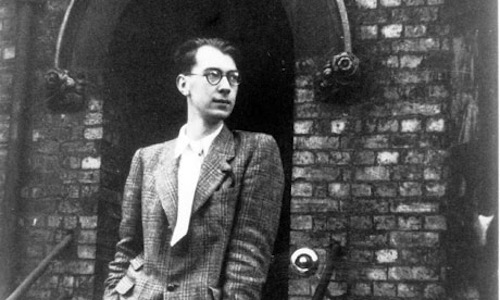
Tobias Wolff on race: “None of us would admit to a prejudice—why should we? we didn’t have any.”

August 17th, 2014

Share
Wolff

Toby explores race and illusion. (Photo: Sonia Lee)

With chaos and curfew in Ferguson, Missouri, race has been everywhere in the news this weekend. A few wise words are welcome, so please don’t miss award-winning author Tobias Wolffs “Heart of Whiteness,” his powerful piece on race in this week’s New Yorker. It opens with Toby going through stacks and stacks of old correspondence, including letters from writer Raymond Carver – “the tone so immediately and unmistakably his that I felt almost as if he were reading them to me.” Funny, that’s exactly what I felt about reading Toby’s own words. We work together on Stanford’s “Another Look” book club  (I’ve written about it tons – try here and here and here and here and here), and I could hear his voice behind every phrase.

He continues: “Then I put the file aside and began glancing through some of my own. And I was disheartened by what I found there. Clumsy, effortful wit. Vulgarity. A racist joke. Sitting there alone, reading my own words, I felt humiliatingly exposed, if only to myself; naked and ashamed.” He recalls his early gifts as a clown and satirist, with “plenty of company in this line of banter.”

None of us would admit to a prejudice—why should we? we didn’t have any—and the atmosphere of right-mindedness could become so absolute, so cloying, that one was sometimes compelled to say the unsayable just to break the spell, make some different music. But this was always done with a dusting of irony. After a black family bought a house on Ray’s block, an unredeemed neighbor complained to him that “a certain element” was taking over, and the word “element” immediately entered our lexicon as an irresistibly sublime piece of swamp-think. So, too, the word “Negro,” as if delivered by an out-of-touch white alderman seeking votes from that highly esteemed, if underserved, corner of his ward.

Could I have played with these words if I had been a racist? No—I couldn’t be a racist. Even as a boy I had been shocked by what happened in Little Rock, the spectacle of pompadoured thugs and women in curlers yelling insults and curses at black kids trying to get to school. With my brother, I joined the March on Washington. We were there.

When I joined the Army, at eighteen, I was trained by black drill instructors, marched and pulled K.P. and showered and bunked and jumped out of airplanes with black troops. If it hadn’t been for a black sergeant I served with in Vietnam, I doubt that my sorry ass would’ve gotten shipped home in one piece.

Baldwin

James Baldwin with Charlton Heston and Marlon Brando at the 1963 Civil Rights March on Washington, D.C. Sidney Poitier and Harry Belafonte are also in the crowd.

I read Ralph Ellison and Langston Hughes and, especially, James Baldwin—“Jimmy” to my brother, Geoffrey, who was his friend when they both lived in Istanbul. I even almost met Baldwin! He was supposed to drop by the apartment in New York where Geoffrey and I were staying, Christmas of 1963. We waited all night, drinking, talking nervously, but he never showed up; one of the great disappointments of my life. It turned out that he’d been stopped by the white doorman.

Yet there was that joke. And a couple of other cracks.

I didn’t like meeting the self I had been when writing these letters—still playing the rake, tiresomely refusing to toe the line and speak the approved words in the approved way. Mostly I didn’t like the sense of exertion I found here, the puppyish falling over myself to amuse and impress another man. The result was coarse and embarrassing. I wanted to think that this wasn’t really me, just some dumb, bumptious persona I’d adopted, which, to some extent, it was.

But I had, after all, chosen this persona rather than another. And I had to wonder why. When we speak with a satiric voice, in mimicry of the unredeemed neighbor, aren’t we having it both ways? Allowing ourselves to express ugly, disreputable feelings and thoughts, under cover of mocking them? I didn’t want to believe that there was anything of me, the real me, in this voice, but, given the facts of my past, looming in piles around me, how could there not be?

It’s a beautifully written piece. Please do read the whole thing here.
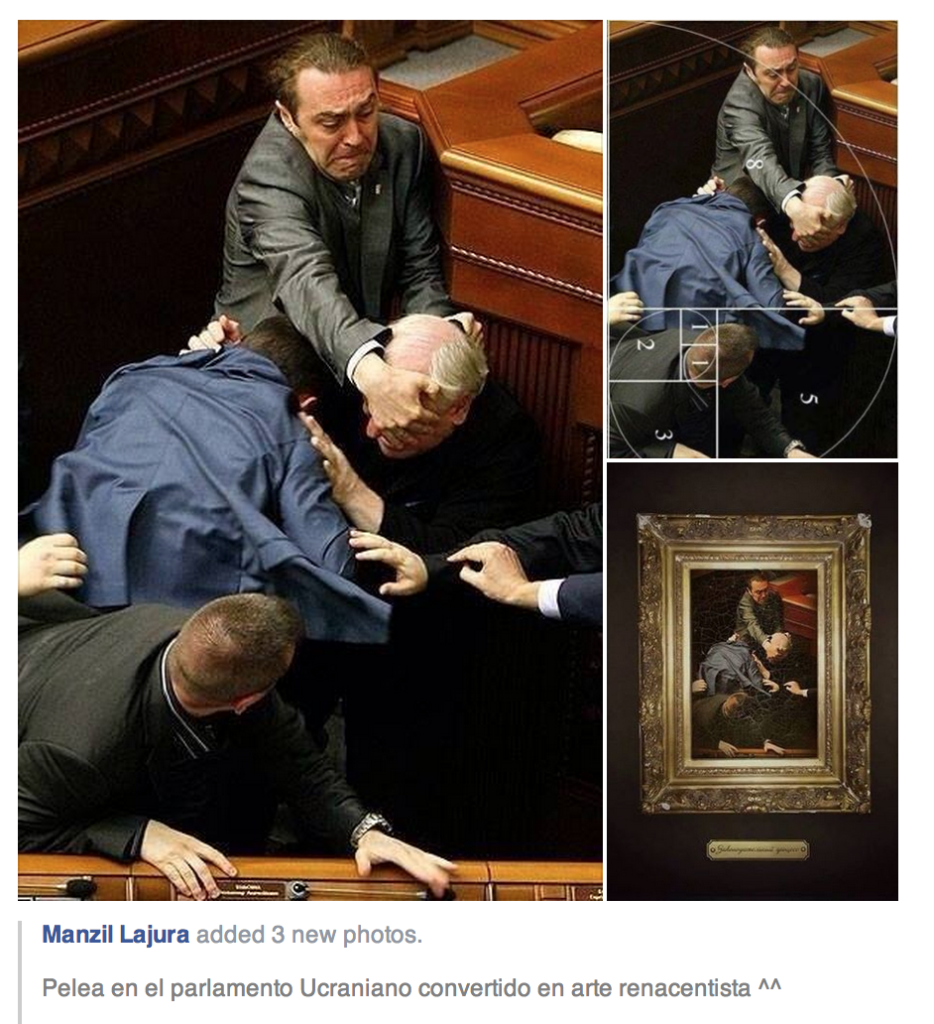


When life resembles art…

August 15th, 2014
Share

A candid photo of a fight in Ukranian Parliament is as well-composed as the finest Renaissance art …  (Via Twitter)

ukraine

Philip Larkin on WWI: “Never such innocence again.”

August 12th, 2014
Share
philip-larkin-1943-006

Larkin at Oxford in 1943, before “the failures and remorse of age.”

W.H. Auden‘s “September 1, 1939” was a World War II poem, without a single gun in it, and then had a powerful revival on 9/11. The New York Times recounted its newfound fame:

”Auden’s words are everywhere,” wrote the author of a ”Letter From New York” in The Times Literary Supplement of London. At least a half-dozen major newspapers reprinted ”September 1, 1939” in its entirety. It was read on National Public Radio. It was introduced into hundreds of chat rooms on the Internet. In the Chicago area, the Great Books Foundation and The Chicago Tribune sponsored discussions of it. Students at Stuyvesant High School, four blocks from ground zero in Manhattan, produced a special issue of their school newspaper (which The New York Times distributed to its readers in the metropolitan area) prominently featuring one of the poem’s most familiar lines, ”We must love one another or die.”

Surely, however, it shared the somber honors with Adam Zagajewski’s “Try to Praise the Mutilated World,” which appeared on the back cover of the New Yorker after 9/11.

zagajewski

Praising the mutilated world…

Could the poem for World War I be Philip Larkin‘s MCMXIV? It’s getting a lot of play this month, during the centenary of the beginning of the Great War.  The poem was first published in 1964, fifty years after the events it describes, in the collection Whitsun Weddings. 

A few words from critics about Larkin that I found along the way: Andrew Sullivan feels that Larkin “has spoken to the English in a language they can readily understand of the profound self-doubt that this century has given them.” X.J. Kennedy wrote that Larkin’s oeuvre is  “a poetry from which even people who distrust poetry, most people, can take comfort and delight.” J. D. McClatchy said that Larkin wrote “in clipped, lucid stanzas, about the failures and remorse of age, about stunted lives and spoiled desires.”

XCMXIV is only one remarkable sentence long  (mind the punctuation), and describes the enlistment of naïve young men at the war’s outset. Read it, and hear it, in the video below.


Genocide: “That kind of shakes you up, gets your attention.”

August 10th, 2014
Share
Jonah

13th century Tomb of Jonah. It’s history now.

On Friday, we said the “g” word has a lot of gravitas. An unnamed government official agreed in the most literal way: “That word has a lot of weight.” But this weekend post from Politico has left me more confused than ever:

But Thursday morning, the urgency to act in Iraq became clear: Obama’s advisers warned that there would likely be a genocide.

“I had not heard the word ‘genocide’ used in the Situation Room before,” the official said. “That word has a lot of weight.”

The reports from the intelligence community and the State Department were vivid and compelling, the official said: People were dying of hunger and thirst, women risked being enslaved and the existence of a religious minority looked imperiled. It more than met the legal definition of genocide, aides told Obama.

“While we have faced many difficult humanitarian challenges, this was in a different category,” the official said. “This was qualitatively different from even the awful things we have confronted in different parts of the region because of the targeted nature, the scale of it, the fact this is a whole people. That kind of shakes you up, gets your attention.”

I’m somewhat flabbergasted by this report. Tens of thousands of Yazidis had been cornered on a mountain, and were already burying scores of children, the ill, and the elderly in shallow graves after they had died of hunger or thirst. Clearly the ISIS intent was to kill without mercy adherents of the fascinating “devil-worshipping” religion – and those plans were not a possible genocide, but one that was well underway. As we wrote on Friday, Norm Naimark defined genocide as “the purposeful elimination of all or part of a social group, a political group.” So how many have to be “eliminated” before it is considered genocide? How many murdered to determine intent (even when the intent has been openly stated already)?

obama3I’m glad the horrific situation with the little-known Yezidis finally inspired some action, but I have been tracking the genocidal intent toward Iraqi Christians for months and waving my arms and jumping up and down about it (read the links on the Wikipedia entry here for some of the history). It’s too bad the ancient Chaldean, Melkite, Syriac Armenian, and Assyrian churches in Iraq, who numbered 1.5 million adherents a decade ago, failed to capture the public attention in quite the same way. About 200,000 are now fleeing their homes, given the choice of leaving fast with nothing but the clothes on their backs or being slaughtered. This may be about the total of all the Iraqi Christians left, and Mosul for the first time in 2,000 years has been emptied of them.
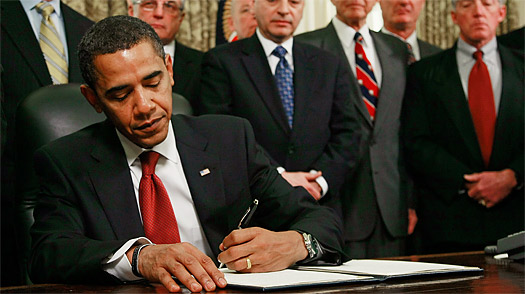
Clearly, words matter. This raises another question about genocide: is it only the most camera-ready situations that get labeled genocide? Only those people who manage to capture the public fancy?

If it hadn’t been for the Yezidis and the Kurds, would we be allowing the remainder of these Christians, and other minorities, to be robbed, beaten, raped, mutilated, beheaded, crucified, and otherwise killed or put to flight? What about the horrific massacres of Shia minorities (read about it here)? If no one calls it genocide, did it not happen? If a tree falls in the forest…

When is murder genocide? Obama drops the “g” word.

August 8th, 2014
Share
obama3

The word that gives gravitas.

It was, perhaps, his most statesmanlike moment: a president brought to the decision he didn’t want to make, to defend a far-off nation he’d hoped was part of our nation’s past. “Earlier this week, one Iraqi cried that there is no one coming to help,” President Obama said in a somber statement delivered from the State Dining Room. “Well, today America is coming to help.”  The New York Times described the situation with a certain amount of prissiness:

Speaking at the White House on Thursday night, Mr. Obama also said that American military aircraft had dropped food and water to tens of thousands of Iraqis trapped on a barren mountain range in northwestern Iraq, having fled the militants, from the Islamic State of Iraq and Syria, who threaten them with what Mr. Obama called “genocide.”

Dropping the “g” word gives gravitas to any presidential statement. What Mr. Obama “called” genocide presumably included not only the attempt to wipe the small tribe of Yezidis off the face of the earth by allowing them to die of thirst and hunger on a mountain, but also the attempt to erase 2,000 years of Christian history in Iraq, along with its Chaldean, Assyrian, and other adherents (some of whom are the last speakers of Aramaic anywhere – we wrote about that here), along with the massacre of hundreds of young Shia men at Takrit, with more, much more, to come.

If that’s not genocide, what is? What does it take to get the scare quotes off? It’s a more complicated question than might first appear. The current definition includes the planned elimination of national, ethnic, racial, and religious groups. In that case, the definition definitely embraces what is happening in Iraq today, even if carried out by a non-governmental actor.

naimark3

Genocide as “the purposeful elimination of all or part of a social group, a political group.” (Photo: John LeSchofs)

However, Norman Naimark, author of  Stalin’s Genocides, argues that we need a much broader definition of genocide, one that includes nations killing social classes and political groups. His case in point: Joseph Stalin. I wrote about this a couple years ago, here – it turns out that the Soviet genocidaire had a hand in deciding how we define the word genocide.  The Soviet delegation to the 1948 United Nations Convention on the Prevention and Punishment of the Crime of Genocide vetoed any definition that might indict its own leader, who killed 15-20 million of his own people.

Accounts “gloss over the genocidal character of the Soviet regime in the 1930s, which killed systematically rather than episodically,” said Naimark. In the process of collectivization, for example, 30,000 kulaks were killed directly, mostly shot on the spot. About 2 million were forcibly deported to the Far North and Siberia.

He argues that the Soviet elimination of a social class, the kulaks (who were higher-income farmers), and the subsequent killer famine among all Ukrainian peasants – as well as the notorious 1937 order No. 00447 that called for the mass execution and exile of “socially harmful elements” as “enemies of the people” – were, in fact, genocide.

“I make the argument that these matters shouldn’t be seen as discrete episodes, but seen together,” said Naimark, who argues that social classes and political groups should be considered in the definition of the “g” word. “It’s a horrific case of genocide – the purposeful elimination of all or part of a social group, a political group.”

Read “Stalin killed millions. A Stanford historian answers the question, was it genocide?” here.  (We’ve written about Norm elsewhere, here and here and here and here.) Also, Timothy Snyder, Anne Applebaum, and Norm on genocide here.

Postscript: Here’s more: “Isis persecution of Iraqi Christians has become genocide, says [sic] religious leaders” in The Guardian. You mean marking homes with a “nun” sign; torturing, mutilating, raping Iraqi Christians; the destruction of 1,800-year-old churches and shrines; beheading children and crucifying adult adherents; burning homes and driving thousands of people from their homes with a warning to convert or be put to the sword – that didn’t count already? Is it  only the success of the mission what determines the label “genocide,” rather than the intent? In that case, the Holocaust was not genocide because it failed to kill every Jew.

What he said.

August 7th, 2014
Share

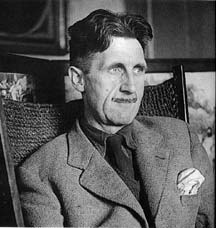
orwell.

“…atrocities are believed in or disbelieved in solely on grounds of political predilection. Everyone believes in the atrocities of the enemy and disbelieves in those of his own side, without ever bothering to examine the evidence.”

George Orwell 1942


(Thanks, Dan Rifenburgh)


<<< Previous Series of PostssepNext Series of Posts >>>