
The “Great War” centenary: Henry James saw it all
August 5th, 2014
 Via the Michigan Daily grapevine, I heard that Jon Stewart would be larnin’ the current crop of journalists at 420 Maynard, with help from Neetzan Zimmerman, former editor of Gawker. The old building where I spent most of my time as a University of Michigan undergraduate looks far more spacious, far less cramped, than it appeared in real life decades ago – that’s the camera work, I suspect. However, this may be the real innovation: it looks much cleaner than I remember it, as if someone shrank the whole building and dunked it repeatedly in a bucket of soap and bleach. What accounts for the change? No more printer’s ink and typewriter ribbons make for less smeared surfaces, most probably – we were one of the last holdouts for hot-type presses, locking up the paper the old-fashioned way at 1:40 a.m., six nights a week. And of course nobody smokes cigarettes anymore. In the background of the clip, I see the refrigerator in place of the funky old machine where we used to get small, 5-cent Coca Colas in thick green bottles. We lived on those, and took pride that we were considered the New York Times of university newspapers.
What does all this have to do with now, now, now, and finding click-bait? Let the experts tell you how in this short clip.
Meanwhile, you can also see the historic Michigan Daily building for yourself. And maybe you’ll pick up some tips from Jon or Neetzan. I picked up one of his tips in this headline. But I skipped the advice about the side-boobs. (But what the hell, I didn’t spend 15 minutes on the headline, anyway.)
Go here.

What he looked like.
Herman Melville wrote to his friend Nathaniel Hawthorne in November 1851: “I have written a wicked book, and feel spotless as the lamb.” The book, of course, was Moby Dick. Funny, he doesn’t look like a lamb. See right. He’s kind of a hunk, in a 19th-century sort of way.
Sheila O’Malley of Sheila Variations writes of the two authors: “They were dear friends and there were many dark years in Melville’s life, when his work was either not being published or being published and ignored when Hawthorne was one of Melville’s only champions. Melville opened his heart to Hawthorne, in letters – about what he was going through, what he was working on with Moby Dick – and, like a great artistic friend and mentor should, Hawthorne never said, ‘Don’t you think you need to scale it down a bit?’ or ‘Who will want to read 20 consecutive chapters about the etymology of blubber?’ No. Hawthorne basically just kept saying to his friend, ‘Keep going. It’s brilliant. Keep going.'” He did! So happy 195th birthday, Herman! From all of us!
She continues:
I read Moby Dick in high school and despised it. I thought it was one of the most boring pointless things I had ever read. It was on our summer reading list, and I clearly remember forcing myself to read the damn thing, during the dog days of August … nearly crying from the psychological boredom. Whatever, man … Moby Dick, Captain Ahab, endless discourses on blubber … I was 16. I DIDN’T GET IT.
Cut to many many years later. 2001, to be exact. I read it in the spring of 2001. Around that time I decided to systematically go back and re-read all of the books I had been forced to read in high school (which, obviously, made me despise them at the time). I read The Scarlet Letter (excerpt here) and Tess of the D’Urbervilles (excerpt here) and many others. Moby Dick is such a massive book, and I had hated it so much when I first read it that I hesitated to put myself through it again.
And honestly – it blew the top of my head off. Every page. Every page.
I have rarely had such an exciting reading experience as that one. I didn’t want it to end. I underlined passages feverishly. I put exclamations points in the margins next to particularly amazing sentences. Honestly. It blew me away.
Here’s a couple notable quotes from Melville himself. The first was unburied by colleague Hilton Obenzinger for Facebook celebrations today:.
“There are certain queer times and occasions in this strange mixed affair we call life when a man takes this whole universe for a vast practical joke, though the wit thereof he but dimly discerns, and more than suspects that the joke is at nobody’s expense but his own.”

What he thought he looked like.
This one is from friend Frank Wilson over at Books Inq.:
“To know how to grow old is the master work of wisdom, and one of the most difficult chapters in the great art of living.”
A few lingering thoughts on yesterday’s post about the current production of Orson Welles‘s Moby Dick – Rehearsed at Stanford. I said Ahab’s face (portrayed by the face of Bay Area actor Rod Gnapp), was a “rictus of resentment,” or words to that effect. It got me to thinking … isn’t that always what revenge is about? To say someone is “obsessed with revenge” makes them sound big and grand and epic and Old Testament-y. Resentment makes us sound so … so little, so peevish, so trivial. But isn’t resentment, really, what Ahab is about? He goes about jabbing creatures that never harmed him any with sharp spears and then takes it amiss that one of them strikes back. He has an inflated sense of himself and his importance (“I’d strike the sun if it struck me!”) and takes Moby Dick’s behavior personally. Clearly, I’ve been reading too much René Girard lately; he’s always one to puncture big, grand, romantic emotions that turn out to be rather little, commonplace, self-centered delusions. Looks like I prefer lambs, after all. And not for eating.
 “Parmacetty” is used several times in the Orson Welles script – “the monstrousest parmacetty that ever chipped a boat!” It sounded familiar. Where does the word come from? Where had I heard it before? I went to my OED. I squinted and squinted, since I’ve lost my lorgnette, and finally resorted to the internet OED, which calls the word “obscure,” a variant of spermaceti, “with simplification of the initial consonant cluster.” Here we go! First usage was 1545, but third is in William Shakespeare, Henry IV, Pt. 1, when Hotspur jeers at a perfumed soldier wannabe who was telling him that “the soveraignest thing on earth Was Parmacitie, for an inward bruise.” I knew I’d heard it recently! Read about our Twelfth Night with Henry IV here. But Shakespeare’s parmacetty is another word for the herb “Shepherd’s Purse.”

The madness of Ahab. (Photo: Frank Chen)
.
The protagonist, of course, is the sea – murderous, obsessive, monotonous, devourer of lives, sanity, and time, time, time. The sea is the pervasive, melancholy backdrop for the Stanford Repertory Theater‘s compelling production of Orson Welles‘ Moby Dick – Rehearsed, mercifully without intermission, which would only have diluted the oceanic severity of Welles’s wonder of a script. The “watery part of the world” is countebalanced by a quieter antagonist, the human soul itself, that “fifth wheel to a wagon,” as the mad prophetic sailor Elijah says early in the play. Welles whittled Herman Melville‘s 700-page metaphysical novel into a relentless and lyrical 90-minute show – it’s a daring choice for the artistic director Rush Rehm, and a rare opportunity. (The production continues through August 10 – tickets here.)
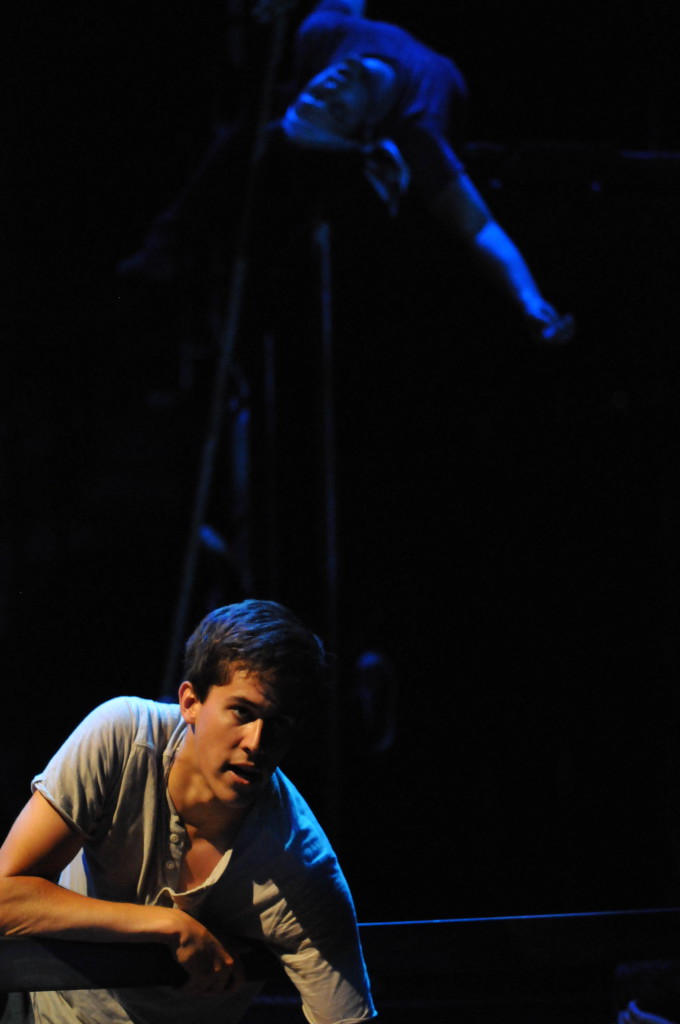
Call him Ishmael. (Photo: Stefanie Okuda)
The hard heart of the inventive production is Rod Gnapp, a Bay Area veteran of ACT, Berkeley Rep, the Brooklyn Academy of Music and others, who turns in a stellar performance as one-legged Captain Ahab. The captain is misguidedly bent on killing the whale who maimed him, his twisted face locked in a grim and grizzled rictus of resentment. His short exchanges with the upright Quaker first mate Starbuck (played by Peter Ruocco), who finally cries, “I disobey my God, obeying him!” are among the highpoints in a drama that has many of them. Here’s another: thanks to composer/sound designer Michael Keck and music director Weston Gaylord, the haunting, a cappella hymns and sailors’ songs are a delicious descant to the drama – in the end, a haunting lament for those who have given their lives for the sea.
The script itself has an interesting history. The original production took place at the the Duke of York’s Theatre in London, with a cast that included Director Welles, Gordon Jackson, Patrick McGoohan, and Joan Plowright. Welles eventually filmed about 75 minutes with the original cast, then abandoned the venture when he was disappointed with the results. Others, including McGoohan, thought the short film was impressive. We’ll never know. The film was lost when a drunken Robert Shaw was smoking in bed at Welles’s Madrid home. The house burned down, along with the only copy of the film. The Munich Film Museum owns a shorter film of excerpts from the play, filmed by Welles in 1971.
Moby Dick – Rehearsed is commonly said to be blank verse, which obviously isn’t true. At best, it’s broken iambics and prose – it falls off the metrical horse too often to be anything more. Just fine for theater, since the ear isn’t counting off metrical feet, and the irregular rhythms throw the emphasis on a hypnotic tale about a monstrous obsession. It’s a lyrical, meditative script, with lines like this one from the narrator, from the young, inexperienced sailor Ishmael (played by Louis McWilliams):
“Our souls were so possessed that Ahab’s hate
was almost ours, and the white whale
our foe as much as his…”
Or from the spiritual insightful Starbuck:
“a vulture feeds upon his heart forever: –
that vulture the very creature he creates.”
Or from hell-bent Ahab:
“…How d’ye know that some
entire, living, thinking thing
may not invisibly be standing
there, where you are standing?
In your most solitary hours, then
don’t you ever fear the feel of eavesdroppers?”
I have some quibbles. Welles’ show-within-a-show convention was already shopworn when Welles’s wrote it, and adding a few lines about deconstruction and cellphones (already a bit stale themselves), add little comedy or humor. I’d rather cut to the chase. Also, the mad characters should dial it back a bit: they’re often loud and hard to follow, which is too bad, because the delivery muffs some of the most moving and poetic lines in the play. Besides, I’ve seen insane, and that’s not all of it. Insanity is scariest when it whispers, calm and confident as a megalomaniac in a boardroom. “I’d strike the sun if it insulted me,” announces the captain. Ahab is insane.
Interesting production video below. It doesn’t quite capture the power and desolation of this drama – how could it, really? See the real thing for yourself.
We celebrate and sing ourselves! The precise anniversary was earlier this year, but we’ve just gotten round to thinking about it – so it’s a little more than five years actually. And it took us weeks and weeks to bake this cake. (Or maybe we should have baked one of Emily Dickinson‘s cakes – we wrote about that here.) Since the last weekend also coincided with the less public birthday of Humble Moi, we thought we would combine the occasions and make a sort of splash of it.
So let us take a moment to thank our readers, and do a bit of a victory lap for a few of our more successful posts over the years.
Most recently, our interview with Philip Roth here was widely picked up, leading to an article about Roth, the Book Haven, and Humble Moi in the pages of The Guardian here and in the Los Angeles Times here. French speakers might want to read Le Monde‘s republication here, Italian speakers in La Repubblica here, and an excerpted version of the interview also appeared in Germany’s Die Welt here.
It wasn’t our first time in Le Monde. When we wrote about Anaïs Saint-Jude‘s research on the communications revolution in the 17th century – which bore more than a passing resemblance to our own times – Le Monde spotlighted the piece, and we wrote about it here. It even got a mention in the New Yorker here.
Andrew Sullivan has been a Book Haven friend, mentioning us here and here and here. And we made several appearances in The Atlantic Wire here (on the troubling case of Cat Stevens) and here. We even made the top ten in Publisher’s Weekly here.

Krasznahorkai made a splash here – and we covered it.
When we heard that a new edition of Mark Twain’s Huckleberry Finn was being published without the “n” word – we were quick on the story here. It went around the world, getting a big spread in the New York Times, and just about every other American paper before the story went international. We wrote about it here and here and here and here and here and here and here. The Chronicle of Higher Education credited the Book Haven with starting the conflagration here.
When the Washington Post invited readers to make funny comments about poet Donald Hall, receiving a National Medal of Arts from President Obama, we were quick to respond here. Others joined us – including Sarah Palin in a tweet (we’ve always suspected she has a staff to do this, but still, it was under her name). Eventually WaPo responded – we discuss the brouhaha here.

You were in Vilnius with us!
College Education Online named us as a top lit blog. We sponsored a Cahiers Series giveaway with the American University in Paris here. We posted the first-ever English language video interview with Michel Serres here. My minute on Moscow television – the video is here – when, through our Lithuanian connections, a splendid Joseph Brodsky archive came to Stanford Libraries – we wrote about it here and here, and also mentioned it again when we wrote about it for Russia’s Zvezda and Poland’s Zeszytie Literackie – here and here. We brought the Book Haven with us on trips to Poland, Lithuania, England, and France (ohhhh… here, here, here, here, and here, among other places). Our photo of the Kultura office in Maisons-Laffitte made it all the way to Italy in a permanent exhibition – read about it here. We became something of a Victor Hugo expert with our post “Enjoy Les Misérables. But get the history straight” (here). The post got nearly a hundred comments – a record – and led us into being a guest speaker and informal consultant when Les Miz came to Stanford (here).
There’s more, lots more, including our Orwell Watch series of injuries to the English language (you’ll have to search, I’m afraid, too many to list), our series of interviews with PBS filmmaker Mary Skinner about Holocaust heroine Irena Sendler (here and here and here and here), and sad farewells for wonderful friends who have died, such as Dostoevsky maestro Joseph Frank, poet and translator Daniel Weissbort, Polish scholar and author Krzysztof Michalski, Polish journalist Marek Skwarnicki, poets Regina Derieva and Natalya Gorbanevskaya, and, alas, more. We covered Jean-Pierre Dupuy‘s recent panel on nuclear deterrence here, the talk by Estonian President Tomas Hendrik Illves, László Krasznahorkai and Colm Tóibín speaking in London, and so many others. Tired yet? We are. We’re winding up.

A recent hit in the Book Haven.
According to the bit.ly links, our top-hitting posts were: “Philip Roth: ‘The novelist’s obsession is with language,’” “Joseph Brodsky’s reading list ‘to have a basic conversation’ – plus the shorter one he gave to me,” “Baltic masterpiece in English at last, in a PEN-awarded translation,” “John Hennessy likes big, fat books,” and “Terry Castle: “Austen’s characters know nothing of date rape, unwanted pregnancies, hip-hop bitches.” Runners-up included “Enjoy Les Misérables. But get the history straight”, “Martin Amis: “It’s the deaths of others that kill you in the end,” “Talented artist goes into hiding: Molly Norris & “Everybody Draw Mohammed Day,” “László Krasznahorkai to Colm Tóibín: “I was absolutely not a normal child.” “Naimark on the Ukraine crisis: ‘It’s scary. Things could get a lot worse.’ The surprise was that our discussion of Paweł Pawlikowski’s Ida few weeks ago was among the runners-up. Who knew?
There! That wasn’t so hard, was it? Why did it take us so long? Oh yes … the cake … let me go turn off the oven.

It’s been a busy weekend, too soon over and too little accomplished, but I did get an opportunity to see Orson Welles‘s Moby Dick – Rehearsed, Stanford Repertory Theater‘s current production, which opened this weekend. I’ll have more to say in the coming days about Welles’s little-known and little-performed masterpiece – meanwhile, I highly recommend that you get tickets while you can here. It’s a magnificent and moving show, under the direction of Rush Rehm, and I very much doubt you’ll find much else to top it in the Bay Area this summer. With Herman Melville and Orson Welles as your starter kit – how could you possibly go wrong? The play runs July 17 to August 10, Thursdays to Saturdays at 8 pm, Sunday matinees at 2 p.m. at Pigott Theater, Memorial Auditorium, on the Stanford campus. Stay tuned in the coming days for more …
The Book Haven is proudly powered by
WordPress
Entries (RSS)
and Comments (RSS).
© Stanford University. 450 Serra Mall, Stanford, California 94305. (650) 723-2300. Terms of Use | Copyright Complaints
