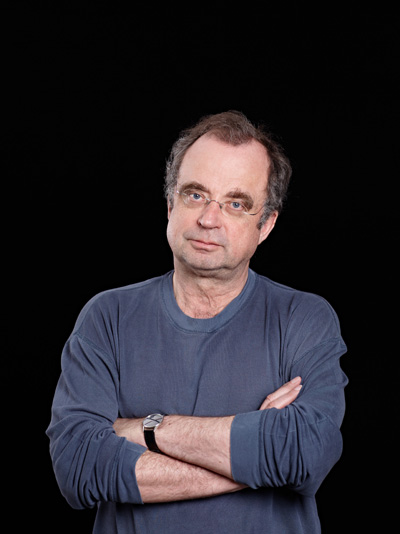
Happy birthday, Tobias Wolff! A few of his words on writing…

June 19th, 2014
Share
toby

Birthday boy.

birthday cakeHappy birthday to one of our favorite people, the award-winning novelist and short story writer Tobias Wolff:

“Writers are superstitious. I don’t mean knock on wood, throw salt over the shoulder—let me try to explain. I began this whole writing enterprise with the idea that you go to work in the morning like a banker, then the work gets done. John Cheever used to tell how when he was a young man, living in New York with his wife, Mary, he’d put on his suit and hat every morning and get in the elevator with the other married men in his apartment building. These guys would all get out in the lobby but Cheever’d keep going down into the basement, where the super had let him set up a card table. It was so hot down there he had to strip to his underwear. So he’d sit in his boxers and write all morning, and at lunchtime he’d put his suit back on and take the elevator up with the other husbands—men used to come home for lunch in those days—and then he’d go back to the basement in his suit and strip down for the afternoon’s work. This was an important idea for me—that an artist was someone who worked, not some special being exempt from the claims of ordinary life. But I have also learned that you can be patient and diligent and sometimes it just doesn’t strike sparks. After a while you begin to understand that writing well is not a promised reward for being virtuous. No, every time you do it you’re stepping off into darkness and hoping for some light. You can be faithful, work hard, not waste your talents in drink, and still not have it happen. That’s what makes writers nervous—the sense of the thing being given, day by day. You might have been writing good stories for years, then for some reason the stories aren’t so good. Anything that seems able to jinx you, to invite trouble, writers avoid. And one of the things that writers very quickly learn to avoid is talking their work away. Talking about your work hardens it prematurely, and weakens the charge. You need to keep a fluid sense of the work in hand—it has to be able to change almost without your being aware that it’s changing.”

From “Tobias Wolff: The Art of Fiction,” Paris Review, no. 183. (See him on the Colbert Report here.)

Is it possible to collapse from too much love?

June 18th, 2014
Share
Pont_de_l'Archevêché

At the Pont de l”Archevêché, “a forest of glittering objects…” (Photo: Francis Hannaway)

Some months ago we posted this, from Marilyn Yalom‘s How the French Invented Love:

During the summer of the [Dominique] Strauss-Kahn affair, I found myself walking behind the Cathedral of Notre Dame and wondering how I could finish this book. Had love in France become little more than a myth?  Were the French abandoning the ideal of “the great love” in favor of serial affairs?  Had seduction won out over sentiment? And then my eye was drawn to a strange sight. I saw, attached to the grille on the Pont de l”Archevêché crossing the Seine, a forest of glittering objects, small padlocks with initials or names on them, sometimes with dates or hearts: C and K, Agnes & René, Barbara & Christian, Luni & Leo, Paul & Laura, 16–6–10. There must be at least two or three thousand. And already, on the other side of the bridge, a few similar locks were clinging to the grille.  How long before that side would also be completely covered?

I hung around, enchanted by the spectacle, and was rewarded by the sight of two youthful lovers, who came across the bridge arm in arm, affixed a lock to the grille, drank from each other’s lips, and threw the key into the Seine.

how-the-french-invented-loveWe wondered at the time … can love sometimes be too much? Could the burden of love be lighter?  Is it possible to collapse from too much love? Yes! And that’s exactly what happened:

… the celebrated bridge had to be evacuated at the weekend after part of the railing collapsed under the weight of love locks attached to it.

Police ordered visitors to leave and closed the footbridge after a 2.4-metre section of railing broke loose.

Since the phenomenon began in 2008 it has become a headache for city officials. Not only is the full 150-metre Pont des Arts covered in locks, but visiting lovebirds have targeted other bridges in the French capital. Forty locks are reported to have been removed from the Eiffel tower. …

Protesters who say the thousands of locks are an eyesore and vandalism have long warned they are also a risk to the iron bridge, which is a listed monument, and launched a petition to have them removed. There are also campaigns on FacebookTwitter and Instagram.

The protesters wrote an open letter to the Paris mayor, Anne Hidalgo, saying the locks were “like a plague on our city’s historic bridges and sites.” They complained: “This is most apparent on the Pont des Arts, which has been terribly degraded, both visually and structurally In a few short years, the heart of Paris has been made ugly, robbing Parisians of quality of life and the ability to safely enjoy their own public spaces along the Seine, which has itself been polluted by thousands of discarded keys. The time has come to enact a ban on ‘love locks’ in order to return our bridges to their original beauty and purpose.”

The Guardian article is here. Or the BBC article here. One reader worried: “Does this mean that thousands of innocent tourists have now fallen out of love? Their dreams consigned to the watery depths of the Seine?” Another sniped: “Nothing says I love you like putting a padlock on a bridge in Paris.” I’d settle for a trip to Paris and a 7th floor walk-up on the Rue des Petits Champs.

Plain on the outside, music on the inside. What’s not to like?

June 17th, 2014
Share

mockingbird

.

“Mockingbirds don’t do one thing except make music for us to enjoy. They don’t eat up people’s gardens, don’t nest in corn cribs, they don’t do one thing but sing their hearts out for us. That’s why it’s a sin to kill a mockingbird.”

Harper Lee, To Kill a Mockingbird

..

A few days ago we mentioned To Kill a Mockingbird as excellent summer reading for book-loving cats. As I write, I’m also enjoying the mockingbirds, going crazy with song as the world teeters towards the solstice. Plain on the outside, music on the inside. What’s not to like? Hope you’re enjoying the long summer days, too. (Hat tip to Elizabeth Amrien for the quote.)

Prospero’s island: not monarchy, but despotism

June 16th, 2014
Share

piotrbookPhilosopher Piotr Nowak was already installed at Vienna’s Institut für die Wissenschaften vom Menschen by the time I arrived for my stay as a fellow in 2008 – alas, an all-too-brief a sojourn! I had just returned from six weeks of research in Poland, and he was the only Polish fellow at IWM below the rank of rector.  He was hunkered on the floor below mine in the lavish white suites that we called offices, overlooking the canal. So Piotr and I visited and chatted between floors, or at the communal lunches provided for the fellows.

At the time, he was working on something about Hannah Arendt‘s notion of radical evil, and recommended some reading on that subject. He also introduced me to the works of Leszek Kołakowski.  The sociologist Zygmunt Bauman wrote of Piotr: “His writings usually contain a challenge: so many mysterious voids of ignorance still lurk in the familiar sphere of our acquired knowledge; and also extend an invitation: so many virgin lands, omitted on our overcrowded map of knowledge, are still waiting to be explored …”

So naturally, I was interested to read that he had just written a book in English on an unexpected subject, The Ancients and Shakespeare on Time, published by the intriguing Value Inquiry Book Series. He ponders a range of questions. What kind of place is Prospero’s island? I remember one Stanford professor – was it David Riggs? – who suggested Shakespeare’s inspiration was another verdant island – Ireland, with its strong tradition of household bards and music. Or perhaps the New World, a place that had a near-mythical status in Jacobean England.

Piotr’s Central European perspective is evident in the darker version of the island he offers on Prospero’s domain (he translated from the Polish himself):

It’s climate is warm and humid, which favours decay and decomposition. However, this is not of primary importance. The first thing that comes to mind in this respect is that it is a place where anything can be done to a fellow human being, including killing, inducing insanity, sentencing to forced labour, as well as arranging relationships and dissolving them. This can hardly be called monarchy – it is rather a sphere of arbitrary absolutism.

nowak

He, too, contains islands.

On Prospero’s island, even the laws of physics work back to front. A supposed God, Prospero plays with nature – he creates and destroys as he pleases, as well as strikes with lightning and uproots pines or cedar trees. He affects other people’s perception of the reality which he himself shapes according to his will. “Poor souls, they perished,” Miranda worries, bewailing the shipwrecked. “Not a hair perished,” we soon learn from Ariel. It is only Prospero who knows the truth. What is more important and terrifying, however, is that the magician wields power over the dead, whom he can resurrect at will, though we never learn what he does with them later on – perhaps he even kills them again. Finally, he gathers both his old and new adversaries. If Prospero encourages revolt among the latter, it is only for one purpose: so that they could witness in the nearest future the consequences of political freedom that was granted to the working classes. Two drunkards and one monster, liberated from all authority, fall victim to their own unbridled passions and bad habits. … However, he does not kill them, bcause he has already grasped that all power and knowledge, if it wants to be what it is, must have its limits. This is the moment we learn about the remarkable wisdom of Prospero. …

At the same time, he becomes aware that his wisdom cannot be inherited. … The young do not wish to remember other people’s stories, because they want to create their own – there is nothing strange or surprising about it. Meanwhile, old age – which mercilessly threatens everyone, accompanied by an invariable softening in the head – takes Prospero’s imperiousness by storm. He gradually moves into the shadow and is inclined to write down the story of his youth. Thus, he prepares a book-long interview, asking for applause, which he finally receives. But then he freezes into a monument. For some time, the young light candles for him and bring him flowers. Later, however, they simply forget.

In his memory…

Sounds like he is remembering a particular production of The Tempest – I don’t remember anything like the final scene he describes in any production I have seen. I also didn’t remember this lovely excerpt he includes from W.H. Auden‘s “The Sea and the Mirror”:

If age, which is certainly
Just as wicked as youth, look any wiser,
It is only that youth is still able to believe
It will get away with anything, while age
Knows only too well that it has got away with nothing.

The book is dedicated to the memory of the man he encouraged me to meet at IWM, one reason among several to be grateful to Piotr: the institute’s rector and one of Poland’s leading scholars,  Krzysztof Michalski.

Humble Moi in Russia’s Zvezda!

June 13th, 2014
Share

zvezda2

I made my TV debut in Russia here; I made my print debut in Russia here; now, finally, my first article and in Russia’s leading literary journal Zvezda.  See the page above? That’s me, on the lefthand side. Синтия Хэвен. My article on how my friendship with Lithuanian physicist Ramūnas  Katilias in Vilnius led to the Stanford Libraries’ acquisition of an important cache of Joseph Brodsky‘s manuscripts, sketches, letters, postcards, and more. The piece is a shortened version of my earlier article, and appeared in Zvezda‘s “Letters” column.

brodsky2I had the privilege of visiting the Zvezda offices in St. Petersburg in the winter of 1998-99. It was always my fate to head into Russia in the wintertime; I even visited Siberia in February – another story for another time. The offices were literally around the corner from the Nobel poet’s former home on Liteiny Prospect. I described them at the time as “several rooms on the third floor of a dilapidated St. Petersburg mansion with a large defunct fireplace of burgundy marble, carved wooden doors, and ornate moulding on the ceiling.” Perhaps what was left of a grand apartment in an earlier era. In these rooms, I chatted with the Russian poet’s good friend, and Zvezda editor, Yakov Gordin, along with a few of the others on the editorial staff.

The article I wrote eventually wound up in the Michigan Alumnus. Here’s the only quote from the good editor: “Russian poetry has its own specialty line of existentialism. It is difficult to find even one Russian poet who departs from this kind of poetry. The difference is only in style. The specialty of this poetry is the question of life and death.” Well, if you want to, you can read the whole 1999 article here.

We’re grateful that Yakov Gordin is still at his desk, fifteen years later – and hope it won’t be our final appearance in his pages.

Introducing final book cat from Cambridge – Melisande!

June 12th, 2014
Share
lowther

Wants more books … and more lovin’

Deborah Lowther, bursar of Girton College at the University of Cambridge, offered this intimate bedtime photo to show her cat’s fondness for books and her husband, Cambridge’s retired corporate attorney, John Short.

The book at hand: Alain de Botton‘s More About Sex. “We believe in giving our cats a good grounding in the facts of life,” said Deborah firmly.

Deborah only learned the title of the book when she had enlarged the photo. “I don’t know whether he found what he was looking for,” she said wistfully. But we suspect we know what Melisande was looking for – a threesome. With cats seek out humans, it’s always the more the merrier. Deborah might also try titles that are likely to keep a cat’s attention – To Kill a Mockingbird, for example, is a perennial favorite, although many felines are disappointed there aren’t more instructions. And more illustrations.

The affinity of cats for Girton life is no surprise. We wrote about Girton feline Buster during our visit several years ago here.

And how is Buster doing nowadays? According to Deborah, “Still running the College!” It’s in good hands, then…or rather, paws.

buster

Buster still rules. Now and forever.


<<< Previous Series of PostssepNext Series of Posts >>>