More book-loving felines, and the delicate matter of the naming of cats…

June 10th, 2014
Share

bookcat

No sooner did we welcome more photos of book cats over on the Book Haven’s Facebook page (and please join us on Facebook here), than a Vermont lawyer (and friend) Max Taylor submitted his own cat, one of two Siamese siblings, for consideration among our gallery of book-loving cats. This kitty seems intrigued by J.H. van den Berg‘s Divided Existence and Complex Society (you can read Max’s review of it on Amazon here).

The teal-eyed feline’s name?  “Usually Rosie. Sometimes Rosy,” he wrote. “We adopted a hands-off approach. Each child got to name one.” This, of course, raised the delicate subject of the naming of cats, and who to address that matter than T.S. Eliot in Old Possum’s Book of Practical Cats? (You can hear the poet recite it himself in the video below.)


“The Naming Of Cats”

.

The Naming of Cats is a difficult matter,
It isn’t just one of your holiday games;
You may think at first I’m as mad as a hatter
When I tell you, a cat must have THREE DIFFERENT NAMES.
First of all, there’s the name that the family use daily,
Such as Peter, Augustus, Alonzo or James,
Such as Victor or Jonathan, George or Bill Bailey–
All of them sensible everyday names.
There are fancier names if you think they sound sweeter,
Some for the gentlemen, some for the dames:
Such as Plato, Admetus, Electra, Demeter–
But all of them sensible everyday names.
But I tell you, a cat needs a name that’s particular,
A name that’s peculiar, and more dignified,
Else how can he keep up his tail perpendicular,
Or spread out his whiskers, or cherish his pride?
Of names of this kind, I can give you a quorum,
Such as Munkustrap, Quaxo, or Coricopat,
Such as Bombalurina, or else Jellylorum-
Names that never belong to more than one cat.
But above and beyond there’s still one name left over,
And that is the name that you never will guess;
The name that no human research can discover–
But THE CAT HIMSELF KNOWS, and will never confess.
When you notice a cat in profound meditation,
The reason, I tell you, is always the same:
His mind is engaged in a rapt contemplation
Of the thought, of the thought, of the thought of his name:
His ineffable effable
Effanineffable
Deep and inscrutable singular Name.

Meanwhile, may I recommend to Book Haven cat-lovers my own thrice-named 20-lb. black cat, Rotundus, also known as Ro-diddy (because my then-12-year-old daughter assured me he’s a rapper) – and sometimes simply Da Ro-Ro. Whatever. Clearly, he’s a J.M. Coetzee fan.  (See what you started yesterday, Patrick Kurp?)

ro-diddy


Hurricane comes to the Book Haven

June 9th, 2014
Share

It’s been awhile since we heard from our friend Patrick Kurp, who runs the excellent blog, Anecdotal Evidence. It’s been awhile since we’ve heard from pretty much from anyone, hunkered down over a book manuscript as we are. However, he sent me this recent photo to add to our gallery of best book cats. This one is his own feline, Hurricane, who is keeping on top of Polish literature, as you can see below. I recognize two of my own books on the shelf: An Invisible Rope: Portraits of Czesław Miłosz and Czesław Miłosz: Conversations. It’s nice to be nestled in-between two beloved poets: the Polish Nobel laureate himself, and Adam Zagajewski, via his prose,  In Defense of Ardor: Essays and his memoir, Another Beauty. Why such an ominous name for this handsome tabby?  Patrick explains that his son Michael, then about four, named him in December 2005, when the furball showed up at the door just a few months after Katrina and Rita. Welcome to our pages, Hurricane! (Photo: Sylvia Wood)

WP_000724

Postscript: Patrick posted about his “Pole Cat” today here. He pointed out that Zbigniew Herbert (who shares the bookshelf) would have approved. Don’t we know it. We visited the poet’s cat a few years back in Warsaw. That’s Herbert’s big cat Szu-szu at right, and Mouszka at left, a later addition to the family by Madame Herbert. Stroking Herbert’s cat made a wonderful frisson of connection with the poet through time.

szu-szu

In the shadow of D-Day anniversary, a quieter memorial for fallen soldiers in Italy…

June 8th, 2014
Share
tusk

Prime Minister Donald Tusk is second from right.

This weekend, the world has been awash with memorials for the anniversary of the June 6, 1944, Normandy Invasion. Meanwhile, a quieter event took place a couple weeks ago in Monte Cassino, Italy, inaugurating a new museum for the fallen Polish soldiers in that terrible battle – we wrote about it a little here.

Since then, Piotr Markowicz wrote to give us details about the May 17 ceremony for the 2nd Corps Memorial, which included the Poland’s prime minister, Donald Tusk. Also attending the inauguration, which took place on the eve of the major celebrations of the 70th anniversary of Monte Cassino: General Władysław Anders‘s daughter, Anna Maria Anders; Karolina Kaczorowska, the widow of the last president of Poland in exile, Ryszard Kaczorowski; as well as veterans of battle in Monte Cassino and other visitors.  Poles have also created a website for Polish soldiers in other Italian battles at Bologne, Loreto, and Casamassima  here.

The exhibition panel, part of the permanent display, is in English, Italian, and Polish below – I know, I know. The image is tiny, tiny – but if you click the image and squint a bit, you should be able to read it. The only spot of color on the panel was provided by Humble Moi. It portrays the Kultura offices in Maisons-Laffitte – I wrote about that visit here..

cassino

Brenda Hillman, Anne Carson win Griffin Awards in Toronto!

June 5th, 2014
Share
carson

Two-time winner.

The Griffin Awards were announced in Toronto a few hours ago, and we’re happy to see familiar names on the lists.  Canadian poet Anne Carson, recently a Stanford guest (we wrote about her here and here)  became the first two-time winner of the $65,000 award, one of the most lucrative poetry prizes in the world, for her latest collection Red Doc.  The Berkeley’s Brenda Hillman was awarded the international prize, also worth $65,000, for her ninth collection, Seasonal Works With Letters on Fire. The jury had praised the collection as “a unique work. Its letters are on fire.”

In her acceptance speech, Brenda said that the world requires “more poetry and fewer weapons.” She had the guts to show it during the recent Occupy protests, when she and her Pulitzer prizewinning husband Robert Hass were roughed up by the police (I wrote about it here). The shortlisted poets gave a reading last night  at Koerner Hall in Toronto – a video of the readings from the shortlisted poets below. Brenda is about 36 minutes into the video, Ann Carson is at about 1.51.

hillman

Brenda goes international.

Here’s part of the reason for excitement for me: the Griffin Poetry Trust considers poetry in translation in its awards as well. It was a pleasure to hear Polish poetry again, recited by one of Poland’s best new poets, Tomasz Różycki – I was pleased to have a chance to meet him in New York three years ago. Stanford Stegner fellow Mira Rosenthal is the translator for his collection Colonies (Zephyr Press). You can see both at about 1.03 on the video below. See if you love the sound of Polish as much as I do. The book has already received a “notable translations of 2013” recognition from World Literature Today.

Other finalists for the Canadian prize were Sue Goyette for her fourth collection, Ocean, and poet and novelist Anne Michaels for Correspondences, a collaboration with the artist Bernice Eisenstein.

colonies-cover-imageThe other finalists for the International prize were Carl Phillips for Silverchest and Rachael Boast for Pilgrim’s Flower. All the finalists, including both winners, received $10,000 for taking part in the shortlist readings.

Adélia Prado was this year’s recipient of the Griffin Trust for Excellence in Poetry’s Lifetime Recognition Award – Bob Hass read a few of the Brazilian poet’s poems at about 1.40 on the video. (I’ve written about Bob here and here and here.)

Colonies is also on the short-list for the Oxford-Weidenfeld Award, which will be announced next week, June 13-14 in Oxford, UK. The book is also on the long-list for the PEN Poetry in Translation award.  The short-list for the PEN will be announced on June 17 in New York City. We’ll let you know how it goes.

.
.

griffinpoetryprize on livestream.com. Broadcast Live Free

“Oy!” said Dante…and no parking on the sidewalks.

June 4th, 2014
Share
Dante_Giotto

“Ahi…”

We visited Robert Pogue Harrison today, and that short tête-à-tête reminded us of the excellent piece he wrote a few months ago, “Dante: The Most Vivid Version” in the New York Review of Books. It was a fascinating essay (read it here), but he had reservations about the Clive James version of the first canto of The Divine Comedy, and compared it unfavorably to Mary Jo Bang‘s translation:

Clive James gives us a much less dramatic version:

At the mid-point of the path through life, I found
Myself lost in a wood so dark, the way
Ahead was blotted out….

James omits the all-important pronoun “our,” and his smooth cadence does not suit the emotion of panic nearly as well as Bang’s staccato version. The only reason James tacks on “I found” to the first line, and then tacks on “the way” to the second, is for the sake of a rhyme (James decided to cast his translation in quatrains, and to rhyme them abab). James’s version continues:

 The keening sound
I still make shows how hard it is to say
How harsh and bitter that place felt to me—

To interpolate a “keening sound” here is ludicrous, for at the start of the poem Dante has just returned from the luminous realm of Christian beatitude, so he would not “still” be wailing or shrieking with grief. The distortion seems a high price to pay for the sake of a rhyme.

Antony Shugaar of Charlottesville, Virginia disagreed. His letter was published some time ago, but we just found it today, here, and share it with you today:

Careful.

Careful.

I’m a professional translator from the Italian, and a longtime aficionado of Dante. I therefore read Robert Pogue Harrison’s piece with great interest. I feel that Professor Harrison may have slighted Clive James’s version on one point. “To interpolate a ‘keening sound’ here is ludicrous,” he writes. And yet, there is a keening sound present in Dante’s Italian, unless my eyes deceive me.

The fourth line of The Divine Comedy begins with the word “Ahi,” which represents a sound and a thought that we have in English only at a barely articulated level. It sounds like “eye,” but with a twist: “iyiyi” is one way I’ve seen it written in English. It is a slightly modified version of the sound an Italian might make after hitting himself on the thumb with a hammer. It is, in short, a keening sound. And as you can see, rendering it in English is no simple matter. Thus, James editorialized.

Longfellow rendered it as: “Ah, me.” Not a keening sound, perhaps, but neither is it the sound you’d expect from someone just back from the “luminous realm of Christian beatitude.” Longfellow’s version sounds like a maiden aunt. Dante’s did not, and in fairness to James, he rendered it, clearly and accurately, by editorializing.

It all goes to show the meaning that you can wring out of a careful reading of Dante.

We googled a bit, and found Shugaar on a number of websites. On this one, he explains his philosophy on translating from the Italian. Here’s an excerpt from Publishing World:

Of course, I understand the idea of preserving certain aspects for philological reasons. There is a translation of Machiavelli’s Discourses that intentionally reads as if it were written by a Martian, because it closely follows the sixteenth-century original, to give a perfect mirroring of certain terms. But it’s a pity, because Machiavelli was also a stylist.

But I believe that a translator should have freedom. Obviously, with freedom comes responsibilities. The responsibility to be absolutely faithful to the author’s intent (and that intent can only be found in the words of the original, so those words must be read closely). If you think the author’s intent was to write something weird, awkward, and foreign-sounding, embrace that. But on the whole, I think that if it sounded idiomatic in the original, you’re failing the author if you produce anything less than that in English.

shugaar

Translator Shugaar

I’m happy to produce a fully annotated version of anything I translate, showing where every element came from. Occasionally I’ll invent a joke or a pun to account for one that couldn’t come across. But that adheres to the law of the conservation of meaning: meaning can neither be lost nor destroyed in a closed translational system.

William Weaver once said that the hardest word in Italian to translate is “Buongiorno.” First of all, we think of it as two words. Second of all, it doesn’t mean “Good day,” except perhaps to an Australian. I often leave words like that in Italian. Unless, of course, the Italian novel is set in New York with American characters. For instance. Or Paris. Or Tokyo.

In Italian settings, you can have odd issues of style, protocol, and engineering. For instance, I remember a short story by Valeria Parrella that talking about someone moving from the road to the sidewalk. But in many places in Italy, the road is made of slabs of stone, and the sidewalk is paved with asphalt. Sort of the reverse of Brooklyn. So you might want to give the reader a tip as to which surface is asphalt, which stone. Or the fact that a sidewalk is where you park your car, now that we’re on the topic (that was a narrative point in a book by Fabio Bartolomei). The best illustration of that point I can think of was a street-cleaning/no-parking sign I saw in Milan many years ago. “Street cleaning next Wednesday, 9 a.m. – 3 p.m. Absolutely NO parking, NOT EVEN ON THE SIDEWALKS.” There you have it.


Geoffrey Hill on “the poem as selfie”

June 2nd, 2014
Share
Asked if he liked a particularly severe photograph of himself, he replied: "It terrifies me."

Asked if he liked a particularly severe photograph of himself, he replied: “It terrifies me.”

.

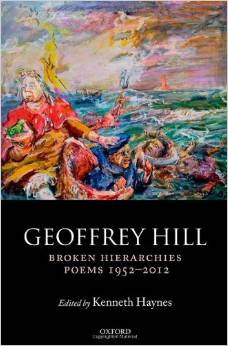
Geoffrey Hill, who turns 82 this month, is on a roll. His first Collected Poems of 1985 was less than a fifth of the length of Broken Hierarchies: Poems 1952-2012 – that’s an unusual degree of late-life productivity. “It is a bumper harvest later and richer than anybody dared hope for,” writes Daniel Johnson over at Standpoint. Hill is now the Oxford Professor of Poetry; his lectures are available as podcasts. Johnson is the founding editor of Standpoint and former literary editor at The Times.His excellent article, “Geoffrey Hill and the Poetry of Ideas,” is a must-read for any user of the English language … or any language.

A few excerpts:

Martin_Luther_King,_Jr._National_Memorial_Stone_of_Hope_at_Dusk

“Monumentality and bidding.” He passed the test.

As I entered, the Professor of Poetry was reciting: not verses, but extracts from Lincoln‘s Gettysburg Address and Martin Luther King‘s “I have a dream” speech. He went on to explain that his theme was “Monumentality and Bidding” — terms of art taken from one of his heroes of prosody, Gerard Manley Hopkins — and that his argument was that enduring, not to say great, poetry and prose must combine these two qualities. Monumentality speaks for itself, but by “bidding” Hopkins meant speaking directly to the reader and keeping his attention, “making it everywhere an act of intercourse” — “social intercourse”, Hill interjected with a wry smile. … The great speeches of Lincoln and King, a sonnet by Hopkins, the music of Purcell: each was analysed minutely, with frequent reference to the Oxford English Dictionary. It was all of a piece and, in its endearingly idiosyncratic way, “Hillian”.

***

hopkins

Not a “selfie” kind of guy.

In his March Oxford lecture, he scandalises the audience by questioning the most revered of the war poets: “To say that [Wilfred] Owen wrote two of the great poems of the 20th century, in ‘Sensibility’ and ‘Spring Offensive’, but that some of his poetry, even some of the most loved, is a bit sloppy . . . well, if one had a career to lose it would lose one one’s career, I suppose.” If language is, as he believes, the last repository of meaning, “it is essential to apply the most rigorous technical demands to these sanctified objects of public worship.”

This leads Hill to the gravamen of his charge against much of the poetry of today: “It is public knowledge that the newest generation of poets is encouraged to think of poems as Facebook or Twitter texts — or now, I suppose, much more recently, as selfies.” The mention of such an improbable neologism from such a source elicited an embarrassed titter from the audience, as if Hill had caught his academic peers indulging a secret vice. “The poem as selfie is the aesthetic criterion of contemporary verse,” he continued. “And, as you know, in my malign way I want to put myself in opposition to this view. That is to say, the poem should not be a spasmodic issue from the adolescent or even the octogenarian psyche, requiring no further form or validation.” Hill came back to the theme in his vindication of Hopkins, whose sonnets did not, he expostulated, deserve the condescension of posterity: “I do not think that they are Hopkins’s selfies.”

The underlying reason for Hill’s rejection of poetry as pure self-expression is that he sees such narcissism as beneath the dignity of his calling. He preaches, rather, what he has practised ever since his youth: a poetry of ideas. It is this determination to place ideas at the heart of his work that sets him apart from even his most celebrated contemporaries. Disputing Auden‘s claim that “art is a product of history, not a cause”, he argues that the true poem is “alienated from its existence as historical event”. To capture the realm in which it exists over and above history, he proposes the notion of “alienated majesty”, the invisible repository of ideas, values and faith. “Alienated majesty signifies a reality, however, even if not an actuality.”

***

brokenFor Hill, we who are privileged to dwell in the land of Shakespeare and Milton are in danger of squandering our most precious inheritance: our literature, and especially our poetry, which is the enduring source of our national identity. “The writing and criticism in depth of poetry is an essential, even a vital practice,” he told the Oxford audience. “We are in our public life desperately in need of the energy of intelligence created by these pursuits.” Only poetry and its rigorous criticism can discern “how the uncommon work moves within the common dimension of language”. Politics is no less dependent on language than poetry, but it is a great deal less attuned to the uncommon work. Poets, if they could only raise their sights from their navel-gazing, could and should be the unacknowledged legislators of our hearts.

***

For Hill, a poem must be “at once spontaneous and exacting” and “simultaneously wild and strict.” He said, “This is a quality which somehow must be brought back into English poetry this century, or English poetry will die.”


Read the whole thing here. It’s worth it.


<<< Previous Series of PostssepNext Series of Posts >>>