Saint Augustine, pears, and “mimetic cascades”

November 8th, 2025

Share

What did a fourth/fifth century saint from north Africa have to teach us about René Girard‘s mimetic theory? Philosophy professor Alexander Douglas of the University of St. Andrews has kindly allowed us to publish an excellent excerpt from his new and acclaimed book, Against Identity: The Wisdom of Escaping the Self, Penguin). Here it is:

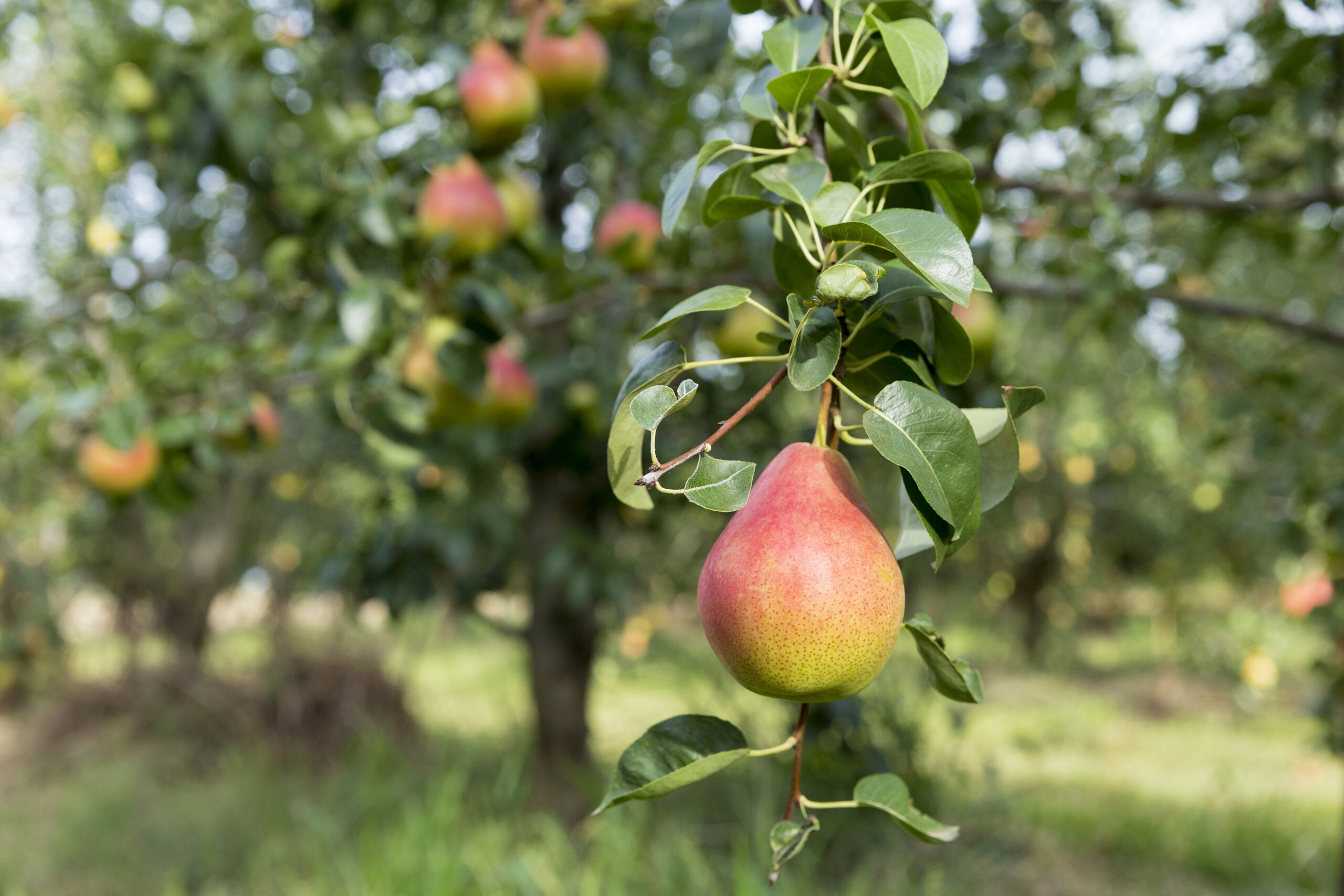
“Three quarters of what I say is in Saint Augustine,” René Girard said in an interview some years ago.1 To understand Girard’s view of the human predicament, we can look at the Confessions of this early saint. One story that Augustine tells of his youth, with much contrition, is about how he and his friends stole some pears:

“Close to our vineyard there was a pear tree laden with fruit. This fruit was not enticing, either in appearance or in flavour. We nasty lads went there to shake down the fruit and carry it off at dead of night, after prolonging our games out of doors until that late hour according to our abominable custom. We took enormous quantities, not to feast on ourselves but perhaps to throw to the pigs; we did eat a few, but that was not our motive: we derived pleasure from the deed simply because it was forbidden.”2

At first it seems odd for Augustine to make so much of what seems like a minor teenage prank. But the imagery – the fruit that is enticing because it is forbidden – makes it clear that Augustine is using this episode as an allegory for the Fall of humanity.3
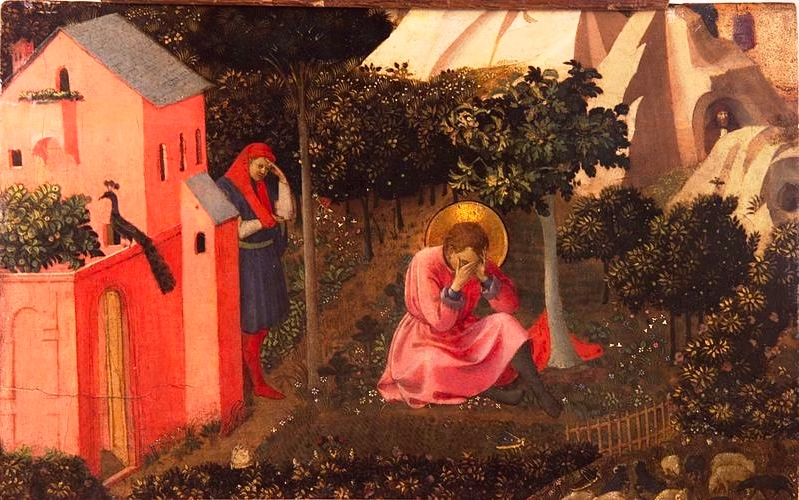
What Augustine wants to do with this story is probe into the mystery of our fallen condition. He is troubled by the fact that “there was no motive for my malice except malice”; his petty crime “lacked even the sham, shadowy beauty with which even vice allures us.”4 The object was not to eat the pears, nor to upset the owner of the vineyard, nor even entertainment – the theft was not challenging enough to constitute an exciting heist. It was simply to demonstrate his ability to act however he willed. Responding to no reasons, done to no conceivable purpose, this wanton act was meant to express his radical freedom. To conjure an action out of nothing, for no reason at all – what could be more radically free?

However, as Augustine looks back on the act, he realizes that it was not as original as he thought. In two ways, it was imitative, not original. First, his urge to express his own radical freedom was less a self-expression than an imitation of God’s omnipotence: a crippled sort of freedom, attempting a shady parody of omnipotence by getting away with something forbidden.”5 Secondly, he engaged in the act only because his friends did it too: “as I recall my state of mind at the time, I would not have done it alone; I most certainly would not have done it alone.”6 Augustine struggles to work out the reason for this. It is not simply that he did it for the sake of camaraderie. Nor was it only to share a joke. It was simply that “to do it alone would have aroused no desire whatever in me, nor would I have done it.”7
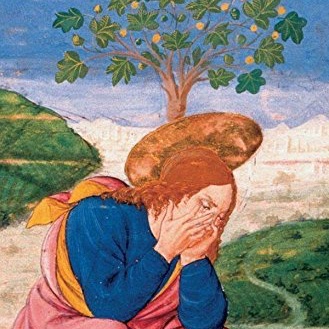
The theory of mimetic desire is very close to the surface of what Augustine writes here. His desire to act was prompted, or at least enhanced, by the apparent desire of his friends. Yet they were in the same position – only wanting to do it because the others did. This might look like a circular explanation, but in fact it shows how desire can emerge from nearly nothing, creating the illusion of the spontaneous will. We are prone to desire what others around us appear to desire, and this appearance can be a matter of a misread signal, a rumor, an accident mistaken for a ploy.8 Once an imitator has taken on a desire from the apparent desire of a model, however, she immediately becomes a model to others, and the mimetic cycle begins. Desire really does emerge where there was none before. It is never conceived by a radically free subject from nothing. Instead, it can emerge from a mimetic cascade, seeded by misperception.

Augustine’s story brings out two crucial aspects of Girard’s theory of identity. The first is that we readily believe ourselves to be little centres of omnipotence: freely deciding what to do, breaking rules, overcoming constraints and resisting impulses. The second is that the more we entertain this myth, the more profoundly we are in fact influenced by the examples of others. The radical egoist is an avid imitator in denial. This combination of prideful egoism and unconscious mimesis is the formula for the fallen condition in Augustine, and in Girard.

1 René Girard, When These Things Begin: Conversations with Michel Treguer, 133.

2 Augustine, Confessions, 1997, 2.9, 67-68.

3 Ibid., 68n32.

4 Ibid., 2.12, 70.

5 Ibid., 2.14, 71.

6 Ibid., 2.16, 72.

7 Ibid., 2.17, 73.

8 Jean-Pierre Dupuy, Le Sacrifice et l’envie – le libéralisme aux prises avec la justice sociale, 268.

Niall Ferguson on history: “I don’t think that people read enough. I don’t think they read nearly enough…”

October 11th, 2025
Share

An excerpt from a Free Press conversation between historian Niall Ferguson and Bari Weiss, newly named editor-in-chief at CBS News. Listen to the whole thing here . Meanwhile, an excerpt below:

It’s been two years since the October 7 massacre. Over at The Free Press, the event was remembered with with an hour-long conversation about anti-semitism, terrorism, between A different kind of loss. You can listen to the full podcast here. Niall Ferguson on October 7 and Our Changed World

Historian Niall Ferguson in conversation with Bari Weiss of at The Free Press. Towards the end, the conversation turned to a topic dear to my heart: the importance of reading.

I’ve written about that a lot on Werner Herzog: “Our civilization is suffering profound wounds because of the wholesale abandonment of reading.”

An excerpt from the conversation:

Ferguson: Conspiracy theories have been in the ascendant for some time. I think that they’ve benefited from the internet, but what makes you susceptible to a conspiracy theory is that you are actually post-literate or pre-literate. You haven’t really read the books that would make you skeptical about the Protocols of the Elders of Zion or skeptical about some of the claims that are now being made by [Tucker] Carson and other people on what Jim Lindsey calls the “woke right”… The problem is that people are highly susceptible to old conspiracy theories, and of course conspiracy theories have for centuries made Jews the villains if they have not read any real history. And I think that is part of what concerns me about the way history is taught in our schools, in our universities.

It is no longer being taught in the way that might make people able to defend their minds against this kind of poison.

You asked, ‘What can we do?’ Well, it sounds banal, but I think reading books is not a bad start. After all, what made me able to recognize the intentions of the perpetrators on October 7, 2023, was that I’ve read a lot of accounts of the violence against Jews that occurred in the early stages of the Holocaust, before the Holocaust was industrialized in Auschwitz, when the Holocaust was a series of wild pogroms directed against the Jews of Eastern Europe.

You know, if you’ve read accounts of those hideous events, then you know what a pogrom is like. You don’t need to have experienced one. You’ve read about it. I think reading firsthand accounts of historical events is still the most powerful way to prepare yourself for what the present and future may throw at you.

And I don’t think that people read enough. I don’t think they read nearly enough of the kind of books I read when I was researching “War of the World,” the kind of books I assigned when I was teaching the Third Reich special subject at Oxford.

I’ll just give you one example, the one thing that I would urge people to read. The Diaries of Victor Klemperer, who was Jewish, although converted to Christianity, but defined as a Jewish professor in Dresden in the 1930s and 1940s, are a wonderful account of what it is to be a Jew in a society where your rights are whittled away. You start thinking you’re a German with full civil rights. The diaries begin pre-Hitler. And then with every passing week after 1933, your rights are whittled away until you have none at all and are made to wear a yellow star and are waiting for deportation to the death camps.

I think those are some of the most important books that have ever been published about the experience of life in a totalitarian regime. People who get confused, who think somehow we’re on a path to totalitarianism, should read those volumes. It’s a good reality check. And we should read those volumes wherever we live and ask ourselves the question: “Is some similar process at work? Is that the feeling that Jews in Britain have started to feel?” I begin to think that it is, even if the source of the threat is a very different one from National Socialism. If the source of the thread is Islamism and its useful idiots on the left, that’s a very different source.

But what if the end result is the same? If you haven’t read any history, if you haven’t read Klemperer, you don’t really know what to look for. So that’s my banal advice. I guess the historian has nothing left in the end to offer but books.

Bari Weiss: You have so many to read of yours that if people have not read, for example, The Tower and the Square, and so many others of your incredible works, I recommend that they go and do that immediately.

Go here to listen to the podcast.

Come on, Stanley Kubrick. Tell us what you really think.

September 17th, 2025
Share

This peppery 1970 letter from director Stanley Kubrick to James T. Aubrey, then president of the MGM , comes to us courtesy Clarence Major.

P.S. Whoops! Snopes has the scoop on this one: “The facsimile was traced back to its source, a satire website called Gloss News. It appeared in an article published on 31 May 2014 and titled “Corman Creates Catastrophe, Kubrick Cringes.” The premise of the article was that MGM was so determined to make a sequel to 2001 over Stanley Kubrick’s objections that studio executives went to extraordinary lengths to make it happen. … ‘Are we alone in wishing this film had actually been made?‘”

Join us on TUESDAY, SEPTEMBER 16, when Another Look presents Yoko Ogawa’s “The Housekeeper and the Professor”!

September 14th, 2025
Share


Join us at 7 p.m. (PST) on TUESDAY, SEPTEMBER 16, when Another Look presents Yoko Ogawa’s 2003 The Housekeeper and the Professor, a surprising story about what it means to live in the present, and about the curious equations that can create a family. The hybrid event will take place in Stanford’s Levinthal Hall, at the Stanford Humanities Center at 424 Santa Teresa Street on the Stanford campus.

Haven’t heard of her? You should. She won the American Book Award and every Japanese literary honor.

According to Nobel prizewinner Kenzaburō Ōe, “Yōko Ogawa is able to give expression to the most subtle workings of human psychology in prose that is gentle yet penetrating.”

The story: a brilliant math professor has a peculiar problem: ever since a traumatic head injury in a car accident in 1975, he has lived with only eighty minutes of short-term memory. His brain is like a tape that begins to erase itself every eighty minutes. An astute young housekeeper is hired to care for him. Her 10-year-old son becomes intrigued by the mysteries of math and befriends him. And every morning, as the Professor and the Housekeeper are introduced to each other anew, a strange and beautiful relationship blossoms between them. the Professor’s mind is still alive with elegant equations from the past. And the numbers, in all of their articulate order, reveal a sheltering and poetic world to both the Housekeeper and her young son.

According to Pulitzer-winning author Junot Diaz, “It’s a story about love, which is quite different from a love story. It’s one of the most beautiful novels.”

Our panelists for the event:

1) ‎ Robert Pogue Harrison, director of Another Look and host for the popular radio show Entitled Opinions; he is Stanford’s Rosina Pierotti Professor of Italian Literature, Emeritus.

2) Indra Levy, associate professor in East Asian Languages and Cultures, is a senior fellow at the Freeman Spogli Institute for International Studies as well as an associate professor in Comparative Literature. She is the inaugural recipient of the Irene Hirano Inouye Memorial Award, Terasaki Center for Japanese Studies, at UCLA.

3) The third panelist is Rosaley Gai, the daughter of Chinese immigrants. She was swept up in the world of Japanese-language media, anime, and video games, which eventually led to her  interest in J-pop and Japanese dramas. At Stanford she is working for a doctorate in Japanese literature and media.

4) And we are adding a surprise fourth for this occasion: Lernik Asserian is the Director of Stanford Undergraduate Research Institute in Mathematics (SURIM) and a Stanford Summer Bridge Program instructor. She has a PhD in Applied Mathematics at University of Southern California (USC), and is the recipient of a number of awards at Stanford and USC.  She spent two-and-a-half  years as a student researcher at NASA’s Jet Propulsion Laboratory (JPL) SIRI Internship Program, California Institute of Technology (Caltech) MURF Internship Program, and JPL Year-Round Internship Program, working on various projects in Earth Sciences.

This event is sponsored by Stanford Continuing Studies and the Division of Literatures, Cultures, and Languages. It is free and open to the public. Registration is encouraged, but walk-ins are welcome.

Register for the hybrid event on the link below:

https://stanford.zoom.us/webinar/register/WN_OyCu1aR0RfKCvumamq-v3g

“Expressing the silent nature of numbers through language”: A Q&A with Yōko Agawa and Stephen Snyder

August 19th, 2025
Share

Another Look interviews Yōko Ogawa and translator Stephen Snyder, author of The Housekeeper and the Professor


On Tuesday, September 16, Another Look will spotlight
Yōko Ogawa’s The Housekeeper and the Professor, a surprising story about what it means to live in the present and about the curious equations that can create a family. 

Don’t forget to register for the September 16 event, in zoom or in person, here:

Ogawa’s book is translated by Stephen Snyder, professor of Japanese Studies at Middlebury College in Vermont and a leading translator of Japanese literature. Both agreed to talk to Another Look for the upcoming event.

In addition to his work with Yōko Ogawa, Snyder has translated Kenzaburō Ōe, Ryu Murakami, and Miri Yu, among others. His translation of Natsuo Kirino’s Out was a finalist for the Edgar Award for best mystery novel in 2004. His translation of Yōko Ogawa’s Hotel Iris was short-listed for the Man Asian Literary Prize in 2011.

Both author and translator offered to answer a few questions about this surprising book, as well as the complex dynamic between translator and author, as we prepare for our Stanford celebration of Ogawa’s book. Cynthia Haven was able to ask both translator and author a few questions.

Questions for author Yōko Ogawa:

Yōko Ogawa generously offered to answer a couple questions for Another as well. She is busy with the serialization of her next novel, so her comments are necessarily brief:

Question #1 for Yoko Ogawa: I’ve read of your interest in The Diary of Anne Frank and its influence on your work. Can you elaborate a little?

One of the major reasons I was drawn to The Diary of a Young Girl is that, within the confinement and restrictions of being locked away, there existed the infinite freedom of writing a diary. The ability to make such seemingly contradictory states coexist gives people vitality. I believe I have continued to pursue this in my fiction.

The Professor can only retain memories for 80 minutes. But by letting his mind play within the infinity of numbers, he enriches his life. Here too, we find the coexistence of the finite and the infinite—of contradiction.

Question #2 for Yoko Ogawa: Can you tell us a little about the author’s interest in mathematics?

The farther something is from language, the more I want to write about it in fiction.

Chess, birdsong, mementos, numbers… All are things that require no words. To express the silent nature of numbers through language—this too contains the allure of contradiction.

Questions for translator Steven Snyder:  

Your collaboration with Yōko Ogawa has been a fruitful one. How did your work together begin?

I am extremely fortunate to have been asked to translate so many of Yōko Ogawa’s works. More than twenty years ago, I was asked to translate “A Cafeteria in the Evening and a Pool in the Rain” for a literary journal that ceased publication shortly after I had finished the translation. Yōko’s agent suggested that we send the story to The New Yorker, and after it was published there, Picador agreed to publish the first book-length works.

You’ve translated the dystopian The Memory Police, The Diving Pool, Hotel Iris,and of course our fall feature for Stanford’s Another Look book club, The Housekeeper and the Professor. How was the work different on each? How did your understanding of Ogawa’s work change with each translation?

I translated The Diving Pool first, followed by The Housekeeper and the Professor, Hotel Iris, Revenge, then The Memory Police and, most recently, Mina’s Matchbox. The works are quite different—novels, novellas, and linked short stories—and the tone varies considerably from lighter works, such as The Housekeeper and the Professor and Mina’s Matchbox, to much darker ones, such as The Memory Police and Hotel Iris, but Ogawa’s style is consistent. Her prose is always lucid and stately, her imagery always original and striking. As I’ve translated these works – and read many others that have not been translated into English – I feel I’ve come to understand the common themes and the larger authorial vision that unites her work. A reader could explore this by making a careful comparison, for example, between The Housekeeper and the Professor and Hotel Iris. While one work is charming and uplifting and the other extremely dark, they share a common structure and any number of motifs, though employed to very different ends. As I’ve translated successive works, I have also come to feel that I am better able to grasp the essence of Ogawa’s style in Japanese and create an idiom for it in English that evolves from work to work but is also informed by the general consistency of her practice.

What are the challenges of translating Ogawa’s work? What inevitably gets lost in translation?

A great deal is inevitably lost in any translation, especially one between languages as different as Japanese and English. The genius of Japanese linguistic economy – elided pronouns, formulaic nominal patterns repeated verbatim, etc. – is impossible to reproduce in English without making the prose seem nonsensical. English can seem wordier, more explicit, less suggestive, but a consistent translation strategy, especially with the luxury of being able to develop it over several works, can help mitigate the loss. There are also challenges specific to certain works and scenes.

In The Housekeeper and the Professor, perhaps the most difficult scene was the one where the professor helps Root with his homework assignment on palindromes. Palindromes are, by definition, untranslatable. With the help of the editor, I had to find English language palindromes to substitute for the Japanese ones Root and the professor quote or invent. In a moment of translation serendipity, when the professor proposes the final palindrome, in Japanese he says “Reito toire,” a nonsense phrase that translates as “frozen toilet,” but searching through English palindromes, we discovered “I prefer pi”—a choice that could not have been better suited to the theme of the novel.

We’re not the first to showcase The Housekeeper and the Professor. You note it has been a featured book in colleges and cities around the world – why do you think that is so? What reaction have you heard from readers around the world? Any stories about its reception?

I suspect it was adopted as common reading by libraries and colleges because it combines a moving human story with a clever and stimulating introduction to some basic math concepts. I think some of us who have little skill in mathematics are attracted to the gentle, manageable explanations. One town that selected the book for its library reading program invited a guest who had a disability that resembled the professor’s and asked him to discuss the experience of memory loss. Sitting next to him at dinner added a new understanding to my own reading of the novel.

In a New York Times interview in 2019, you said, “Her narrative seems to be flowing from a source that’s hard to identify.” Has it been any easier to identify in the years since? Can you share what you have learned?

Did I say that? I suppose I was referring to the extraordinary range of Yōko’s work and her amazing productivity, but also to the mysterious way she structures a narrative for extraordinary effect. The linkages between the eleven stories in Revenge, for example, are as clever and complex as they are illuminating and central to the power of the work, but it’s difficult to say where that particular narrative impulse originates—even when reading as closely as a translator must.

What’s next for you two? Is there another book in the works?

Yes, I am currently translating Chinmoku hakubutsukan under the working title “The Museum of Silence.”

Prof. Robert Pogue Harrison had a question that is on all our minds: Does Ogawa have a passion for mathematics? How did the idea for this book come to her?

I noticed that in 2006, she worked alongside the mathematician Masahiko Fujiwara to co-write “An Introduction to the World’s Most Elegant Mathematics,” a dialogue on the extraordinary beauty of numbers. Surely that was an influence – The Housekeeper and the Professor was published two years later. What has she said about it?

Professor Harrison is correct, Yōko does indeed have a passion for mathematics, though the influence runs the other way. She published The Housekeeper and the Professor (originally Hakase no aishita suushiki) in 2003 as a result of her longstanding interest in mathematics and, on the basis of its great success in Japan, began the discussion with Professor Fujiwara that resulted in the book mentioned. Like many writers, Japanese or otherwise, she tends to develop great passions for a variety of subjects, many of which result in a novel. Her interest in chess became the wonderful “Holding a Cat, Swimming with an Elephant,” which has not yet been translated into English but has been translated into French by Martin Vergne.

Rilke’s last days: “…that someone, somewhere, in France or England, knows me, is translating me, mentions me…”

August 14th, 2025
Share

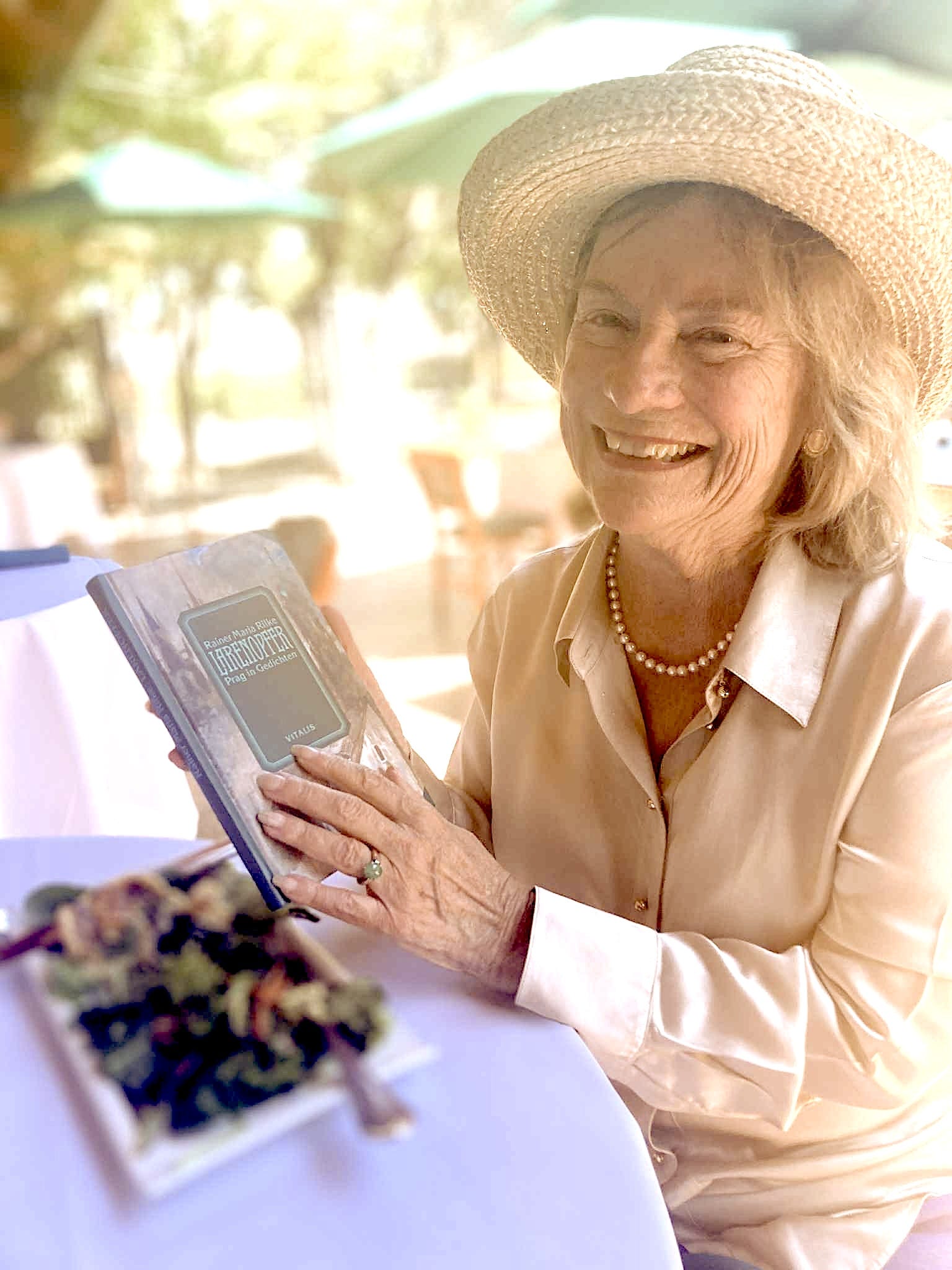
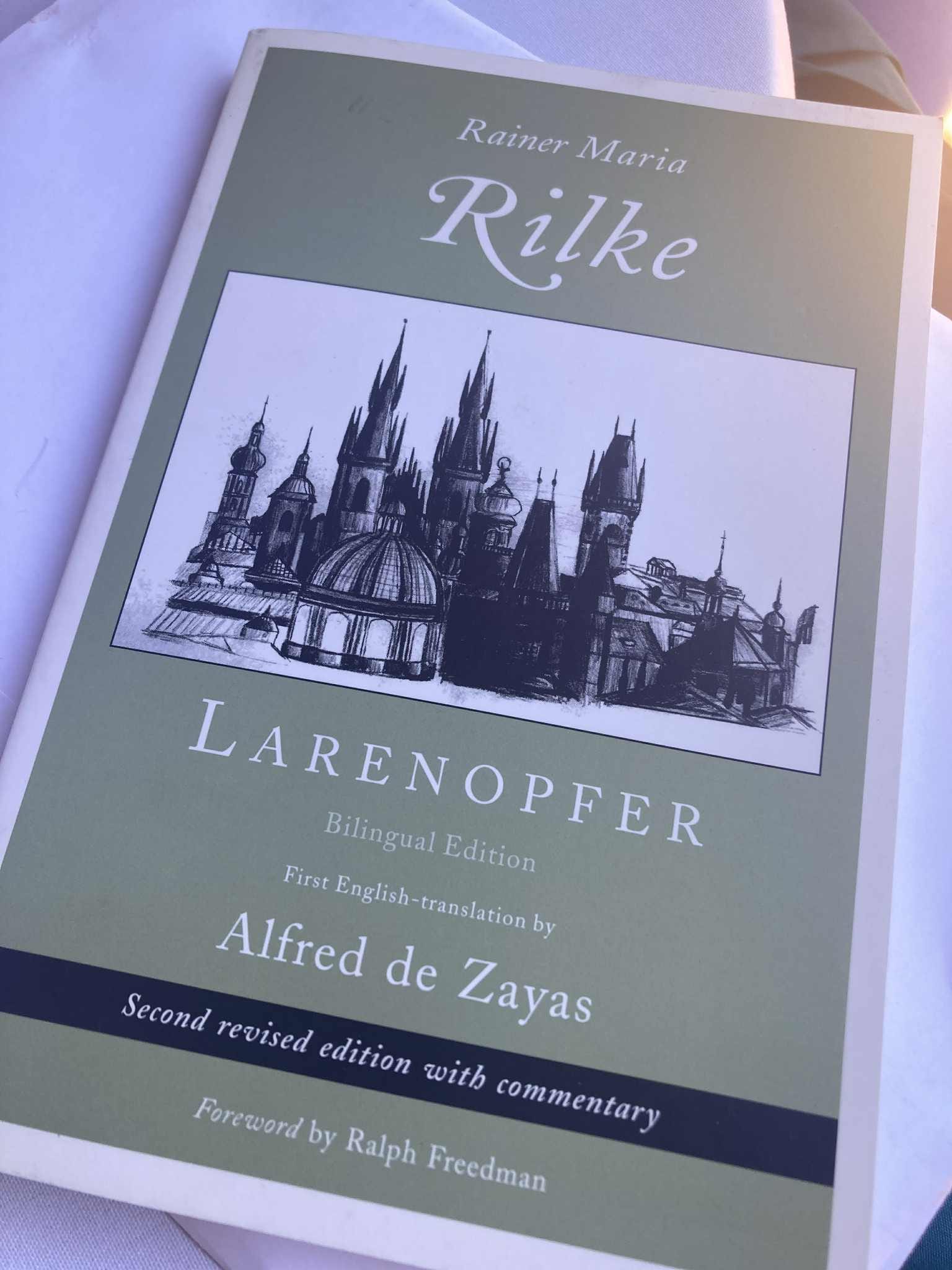
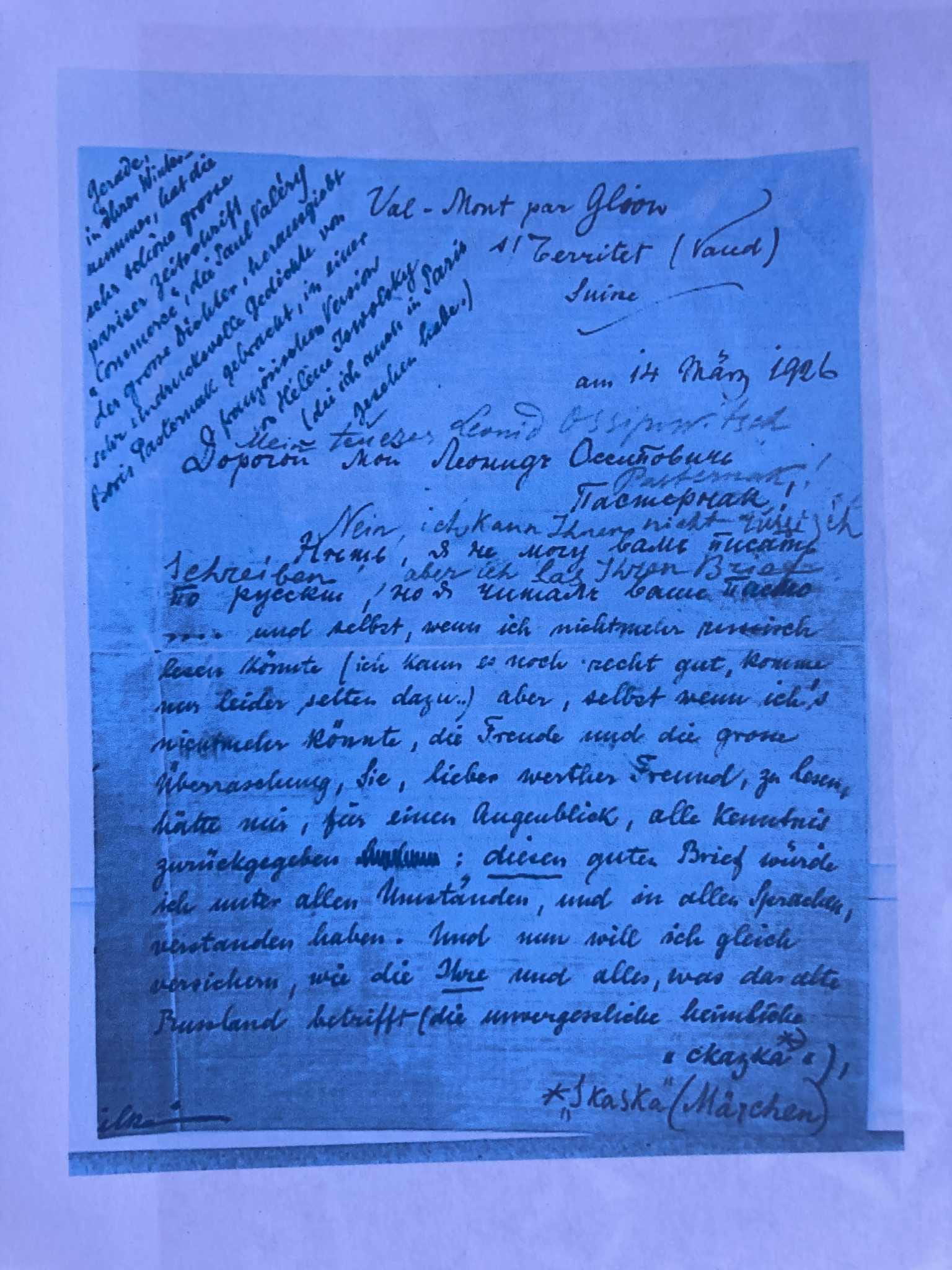
Archivist extraordinaire Elena S. Danielson (at right) kindly took me out to the Stanford Faculty Club for lunch last week. The kindness didn’t stop with the tiramisu. The former director of the Hoover Library & Archives also gave me a new edition of Rainer Maria Rilke‘s “Larenopfer” – to celebrate the 150th anniversary of the poet’s birth. The volume includes ninety of Rilke’s early poems from turn-of-the-century Prague, in German and English. Another treat, a copy of a 1926 letter from Rilke to Leonid Pasternak, the Russian poet’s father, an eminent painter.

In the letter dated March 14, 1926, the celebrated poet, already seriously suffering from the fatal illness that would end his life nine months later, wrote a lengthy, detailed, and graciously cordial letter to a Russian artist living in Berlin, Leonid Pasternak (1862-1945), the father of poet and novelist Boris Pasternak, who remained at that time in Moscow. Despite premature rumors of Rilke’s death, news reached Leonid that he was still alive, though ill, and celebrating his 50th birthday. Elated by the good news, the artist sent the great writer a birthday greeting by way of his publisher, since he didn’t have Rilke’s mailing address.

Rilke responded as soon as the letter finally reached him at the isolated medieval stone tower where he was writing his final masterpieces in an obscure corner of Switzerland. He starts out in Russian, which they had once used for their correspondence, but he switches quickly to German as his Russian skills had faded; he knew Pasternak, originally from multicultural Odessa, was fluent in German. (On the original paper, someone, possibly a family member, lightly penciled in a translation of the brief Russian phrases into German.) Rilke goes on to emphasize his continuing love of Russian culture and his faith that it will be restored, despite the chaos cause by war and revolution. And he renews their ties of friendship.

Before the Great War, Leonid had met the then unknown poet, just in his mid-twenties in Moscow in 1899, and once again by chance at a train station with the artist’s 10-year-old son Boris in 1900. A couple more brief encounters in Italy in 1904 and a few letters. That is all.

And yet they both remembered each other with great fondness. Both had a talent for lasting intellectual friendships. In his memoirs Leonid writes of the 1899 meeting: “Before me in my studio stood a young, very young, delicate, blond foreigner in a Loden coat … And already after the first short conversation we were like good old friends (which we later became).” (Die Familie Pasternak: Erinnerungen, Bericht, Geneva: Éditions Poésie Vivante, 1975, p. 62) The cordial feelings lasted even though they had no contact during the turbulent war years.

The 1926 letter in question – the first page shown here – had been published in German, but the original artifact with its still elegant handwriting, despite serious illness, conveys far more meaning than the copy in cold print. The Pasternak family carefully preserved this artifact for many years through the trauma of war, relocation, and exile. It was treated as something of a holy relic for the family. Starting in 1996, the Pasternak family began donating family papers to the Hoover Institution Archives at Stanford University for safekeeping. Among the many treasures in the collection is this original letter. In the published version, there is a brief postscript printed at the end. The original document shows this added afterthought displayed prominently in the upper left-hand corner of the first page. This brief note, crammed at the top, was even more important than either the writer Rilke or the recipient Leonid Pasternak realized at the time:

Gerade in ihrer Winter-nummer, hat die sehr schöne grosse pariser Zeitschrift “Commerce”, die Paul Valéry der grosse Dichter herausgibt sehr eindrucksvolle Gedichte von Boris Pasternak gebracht, in einer französischen Version von Hélène Iswolsky (die ich auch in Paris gesehen habe.)

Here is a translation of the note: “Just now, in its winter issue, the very beautiful, big Paris journal, Commerce, that Paul Valéry, the great poet publishes, are very impressive poems from Boris Pasternak, in a French translation by Hélène Iswolsky (whom I also saw in Paris).”

The full significance of the letter, especially the note in the corner, was not well understood in the English-speaking world until Nicolas Pasternak Slater translated and published the family correspondence in 2010. (Boris Pasternak: Family Correspondence 1921-1960, translated by Nicolas Pasternak Slater, Stanford: Hoover Institution Press, 2010. Reviewed in The Book Haven in 2011 here.) Leonid did not forward the original letter from Berlin to Boris in Moscow – he feared it might be lost – so he gave it to his daughter Josephine, who was also in Germany. Boris had previously written in August 1925 that he was devastated when he heard (erroneously as it turns out), that Rilke had already died.

When Boris learned about the letter from Rilke to his father, and got the news that Rilke was not only still alive and but had actually mentioned his poetry in the March 14, 1926 letter, Boris wrote to his sister from Moscow: “Our parents told me about Rilke’s letter, which has so thrown me that I haven’t been able to work today. What excited me wasn’t what probably pleased Papa and Mama, since after all I only got to hear of it by ricochet—that someone, somewhere, in France or England, knows me, is translating me, mentions me—but naturally I haven’t seen any of this with my own eyes…you need to know what Rilke was for me, and when this all started. This news was a short-circuit between widely separated extremes of my life. The incongruity of it shattered and devastated me, and now I don’t know what to do with myself.

Boris had told his sister that he had been dreaming, in fact quite unrealistically, of visiting Rilke – whom he had briefly encountered as a child 26 years earlier – in the poet’s medieval Swiss tower. At this point Boris was just trying to survive in Moscow after the devastations of the Great War and the catastrophic conditions precipitated by the Russian Revolution and Civil War while his father, mother, and sisters enjoyed the temporary safety of Germany. They would later be forced to leave Germany for England.

On top of everything else, you need to know who Valéry is—assuming this really is Paul Valéry, which is totally unlikely!” (Correspondence p. 43.)

(At right: the poet Rilke, painted by Leonid Pasternak)

Once Boris Pasternak in Moscow knew that Rilke was still alive, he and his dear friend, the poet Marina Tvetaeva, living in France, began a brief but passionately poetic three way-epistolary romance with Rilke in Sierre, Switzerland just before Rilke died. Rilke wrote something on the order of 17,000 letters in his lifetime, corresponding right up to the end of his life December 29, 1926. (The exact number of letters is not knowable, but it is certainly more than 10,000.) Of this remarkable correspondence, the last letters with Rilke in Sierre, Switzerland, Tsvetaeva in Paris, and Boris Pasternak in Moscow are among the most lyrical and most beautiful. And this remarkable exchange was initiated by the March 14, 1926 letter in question.

More on the two photos: “Rilke (1875-1926) in Moscow,” by Leonid Pasternk, an oil painting made in 1928, so a posthumous portrait based on earlier sketches depicting Rilke as a young man when he visited Moscow, prior to World War I, as an unknown poet. Apparently painted in Berlin some two decades later, the portrait is now in the Pinakothek Museum in Munich. A version in pastels is preserved at the Ashmolean in Oxford, in the UK where many family members live today.


<<< Previous Series of PostssepNext Series of Posts >>>