Another Look’s 10th anniversary pick: Glenway Wescott’s “The Pilgrim Hawk: A Love Story” – Wednesday, October 5!

September 13th, 2022

Share

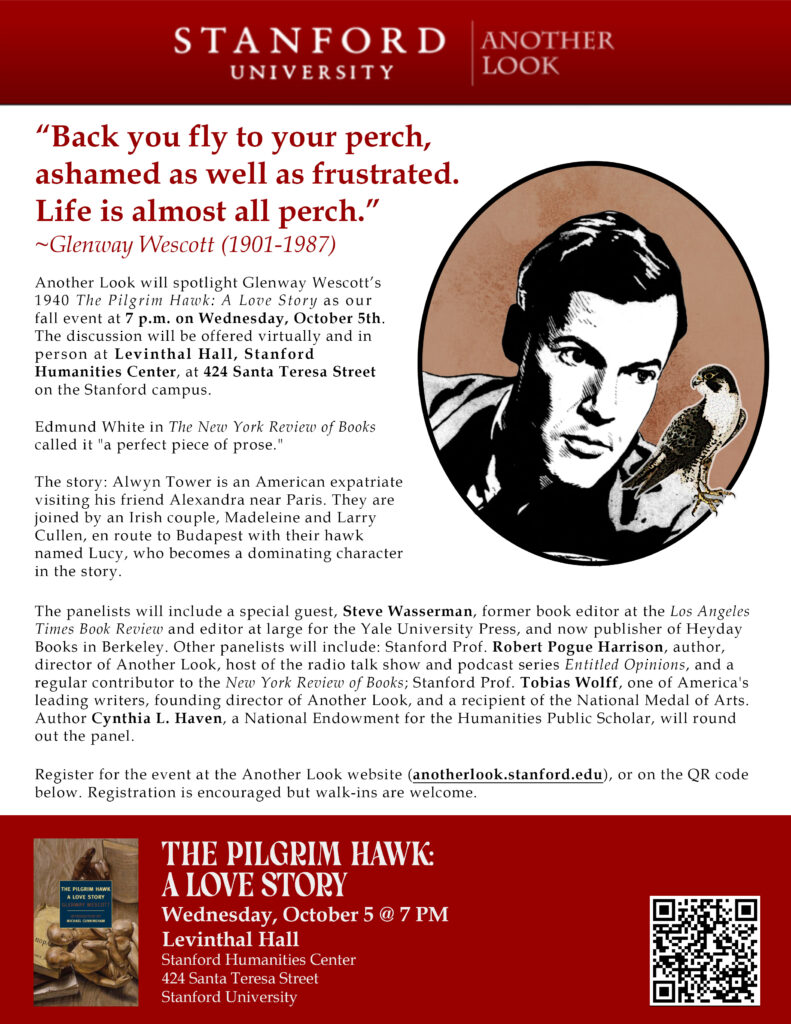
Another Look was launched in November 2012, with William Maxwell’So Long See You TomorrowNow we celebrate our tenth anniversary with another wonderful and too-little-known book, Glenway Wescott‘s 1940 novella The Pilgrim Hawk: A Love Story (NYRB Classics)The event will take place at 7 p.m. on Wednesday, October 5, at Levinthal Hall in the Stanford Humanities Center, 424 Santa Teresa Street, on the Stanford campus. The event will also be livestreamed. Come celebrate our tenth with us! 

Registration is encouraged, but walk-ins are always welcome. Register here – or on the QR code on the poster below.

The Book

The Pilgrim Hawk: A Love Story traces a single afternoon in a French country house during the 1920s. Alwyn Tower, an American expatriate and sometime novelist, is staying with a friend outside Paris when a well-heeled Irish couple drops in — with Lucy, their trained hawk, a restless, sullen, disturbingly totemic presence. Lunch is prepared, drink flows, and the story that unfolds is both harrowing and farcical.

Novelist Michael Cunningham in his introduction calls the book “murderously precise and succinct.” Critic and author Susan Sontag said, “The ever-astonishing Pilgrim Hawk belongs, in my view, among the treasures of twentieth-century literature, however untypical are its sleek, subtle vocabulary, the density of its attention to character, its fastidious pessimism, and the clipped worldliness of its point of view.”


The Panelists

The panelists will include a special guest, Steve Wasserman, former book editor at the Los Angeles Times Book Review and editor at large for the Yale University Press, and now publisher of Heyday Books in Berkeley. Other panelists will include: Stanford Prof. Robert Pogue Harrison, author, director of Another Look, host of the radio talk show and podcast series Entitled Opinions, and a regular contributor to the New York Review of Books; Stanford Prof. Tobias Wolff, one of America’s leading writers, a founding director of Another Look, and a recipient of the National Medal of Arts. Author Cynthia L. Haven, a National Endowment for the Humanities public scholar, will round out the panel.

The Venue

Some of you may remember that Levinthal Hall is where Another Look began a decade ago. You’re right! Our audience attendance outgrew that venue in 2015, and we moved to a larger space. However, now we are offering virtual as well as in-person attendance, which allows us to return to our former home. We will announce how to register for the virtual event in our next email, as we are still finalizing arrangements.

Parking

Metered parking spaces are available along Santa Teresa Street. Parking is free after 4 p.m. Free parking is also available on the lot adjacent to the Stanford Humanities Center after 4 p.m.

How to get the book

Books are available at Kepler’s Books in Menlo Park (650-324-4321) and Books Inc. at Town & Country in Palo Alto (650-321-0600). We’d recommend calling first to make sure a book is waiting for you. Books are also available at Amazon and at Abebooks. If all else fails, you can order directly from the publisher here.

Our October 5 event is sponsored by Stanford Continuing Studies, the Stanford Humanities Center, and the Division of Literatures, Cultures, and Languages.

Literature, the real world, and Milton’s “tremendous creative energy”

September 10th, 2022
Share
Fruitful forays into the world of Milton

I have been reading Barbara Lewalski’s excellent biography, The Life of John Milton (Blackwell, 2000) – so what a surprise to find that she has a former protégé at Stanford – Prof. Roland Greene, director of the Stanford Humanities Center.

Greene: he’s an inspiration, too

Here’s an excerpt from his appreciation for his “beloved mentor and colleague” over at Stanford’s Arcade. The article, “The Critical Horizon of Barbara K. Lewalski,” was written some time after the scholar’s death on March 2, 2018. He opens with her early 1953 article “The Authorship of Ancient Bounds,” about the provenance of an unsigned Puritan tract. Then on to the great Puritan poet, the subject of her first book in 1966, Milton’s Brief Epic: The Genre, Meaning and Art of Paradise Regained:

More than fifty years on, it is still the best thing ever written on Paradise Regained, but at this distance one is struck by how carefully Lewalski draws the horizons of her scholarship: that is, the sense of what this work is ultimately about. In a blog post called Misplaced Horizons in Literary Studies, I have written about the drawing of horizons in criticism and the perspectives that contribute to them, and how (especially now, as our common enterprise seems less and less urgent to the rest of the academy, let alone the public) we have to see the making of a horizon as a statement of values: is the horizon the real world, or intellectual history, or the Bible and its influence, with literary texts inside that horizon as perspective? Or is literature itself the horizon, with all of these things inside it as perspective? It is the latter kind of project, I argue, that has met certain parochial customs and rewards of our discipline while pulling us away from the intellectual life of other disciplines—because historians, philosophers, social scientists, and others simply do not see literature as a valuable horizon in relation to the real world.” He writes that Lewalski “broaches Biblical poetics as a guiding concept or a horizon. Suddenly the limitations of genre as a horizon are plain, and while that term continues to play an important role as a contributing perspective, from here on it is nearly always controlled by Lewalski’s more powerful and original concepts of Biblical and Protestant poetics that permit her to chart the flow of ideas and figures into and out of seventeenth-century literature.”

Stanford's Roland Greene remembers an important mentor, Miltonist Barbara Kiefer Lewalski
An unforgettable mentor

“Lewalski’s later work, notably three distinguished monographs, builds on this foundation, but the definitive moment in her scholarship is the passage through the first three books to 1979. A year later, she left Brown University, where she had taught since 1956, for Harvard, and remained there until her retirement in 2015. I had the privilege of knowing her as my teacher and adviser in my undergraduate years at Brown and then a few years later as my colleague at Harvard. For many of us, Barbara at Brown was her essential phase, in which her approach was still being formed in conversation with … peers such as [Earl] Miner, who became my Ph.D. adviser. By contrast, Barbara at Harvard in the 1980s and nineties was an eminence who embodied a settled method, a then somewhat old-fashioned historical scholarship that stood apart from the fashion for the New Historicism of the time. In the Brown years, moreover, she was younger (not yet fifty when I first knew her) and more informal, and her human existence took place in Providence, where she lived until the end of her life, as it never did in Cambridge. I can see Barbara in shabby Horace Mann House at Brown in about 1977, wearing casual clothes she would never appear in at Harvard, sitting at the head of the seminar table with one leg tucked under her and reciting in a brassy, colloquial tone: “Busy old fool, unruly sun, / Why dost thou thus / Through windows and through curtains call on us?” As I told my students a few days after Barbara’s passing, I’ll always hear certain poems in her voice. Maybe our voices that survive resonantly in the memories of students are as powerful as those in our criticism; or maybe these voices are somehow the same. I believe Barbara found her voice in those early books and in the Brown era.”

Read the whole thing here.

West Side Story: a movie review and Girardian analysis in 18 tweets. You’ll thank me and save $13.69.

September 3rd, 2022
Share
It’s splashy, anyway. Photo by Niko Tavernise/Twentieth Century Studios.

Saturday night is usually the night people go to the movies. But it’s a Labor Day weekend, so you have two more nights to head out to your local movie theater.

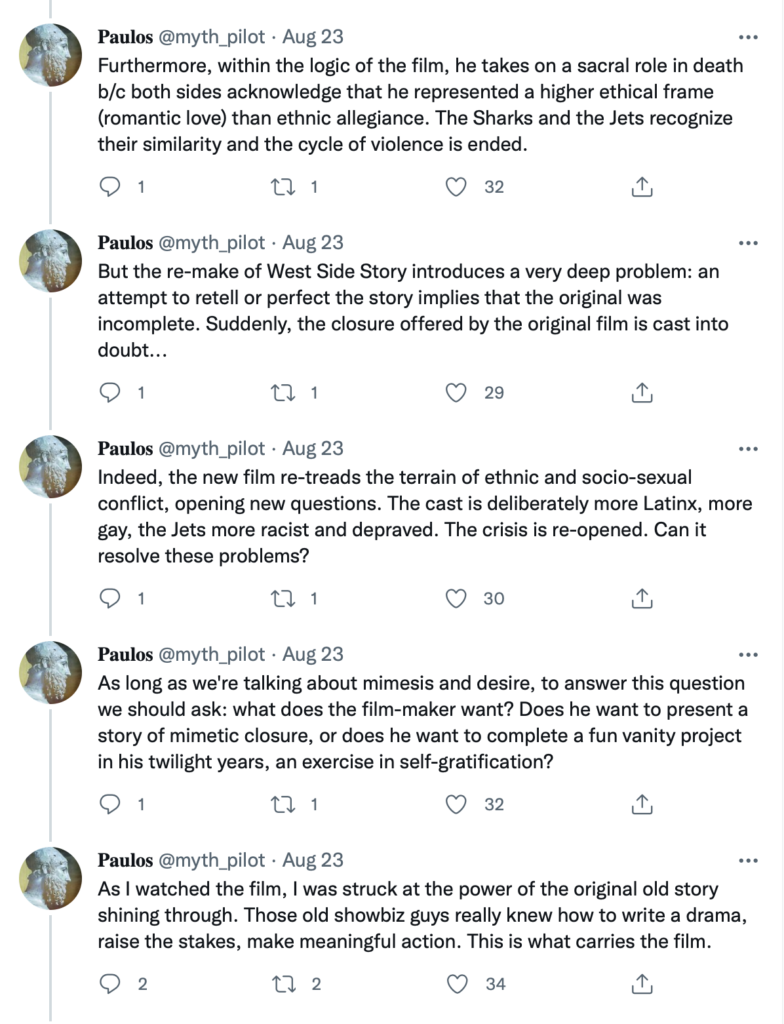
Here. We can save you about $13.69 in AMC ticket prices. We have a review below of the new (okay, not so new) Steven Spielberg‘s West Side Story, and it’s a stinker. The review comes to us courtesy of “Paulos “(handle @myth_pilot) on Twitter. He describes himself as an “interpreter of dreams” – which is kind of what a movie reviewer does.

Here goes:

Tyler Cowen interviews the Book Haven, and “Czesław Miłosz: A California Life” is up for a book award!

August 29th, 2022
Share

Last week I received some great news for me – and some terrific news for Czesław Miłosz: A California Life (Heyday Books), too! We’re both finalists for the Northern California Book Awards, in the non-fiction category (I am definitely non-fiction; so is the book). And that’s an honor, too, whatever happens at the event!

So join all of us celebrating on Sunday, September 11, 2022, 2:00 pm, when the 41st annual Northern California Book Awards recognize the best published works of 2021 by Northern California authors and California translators state-wide, presented by the Northern California Book Reviewers, Poetry Flash, and San Francisco Public Library, with community partners Mechanics’ Institute Library, Women’s National Book Association-San Francisco Chapter, and Pen West. Book sales and signing will take place in the lobby of Koret Auditorium at the San Francisco Public Library on Larkin Street.

The event is free and open to the public. And I’ll be signing books, too!

More good news: I have an interview with economist Tyler Cowen of Marginal Revolution fame (we wrote about his interview with Ted Gioia here.) Go to the podcast here. It’s been getting lots of traction on Twitter. Check that out, too.

Tyler has done lots of interviews – I’m #157. Collect the whole set here.

So lots to celebrate all around, as summer slowly winds to a close.

Celebrate the summer while it lasts: Milton’s Paradise isn’t lost at all in Chalfont St. Giles!

August 20th, 2022
Share

I’ve written about the Milton Cottage, John Milton‘s only surviving residence in the world, here and here. And I’ve also written about Stanford’s one day-long celebration fourteen years ago, to coincide with the poet’s 400th birthday by reading Paradise Lost, here.

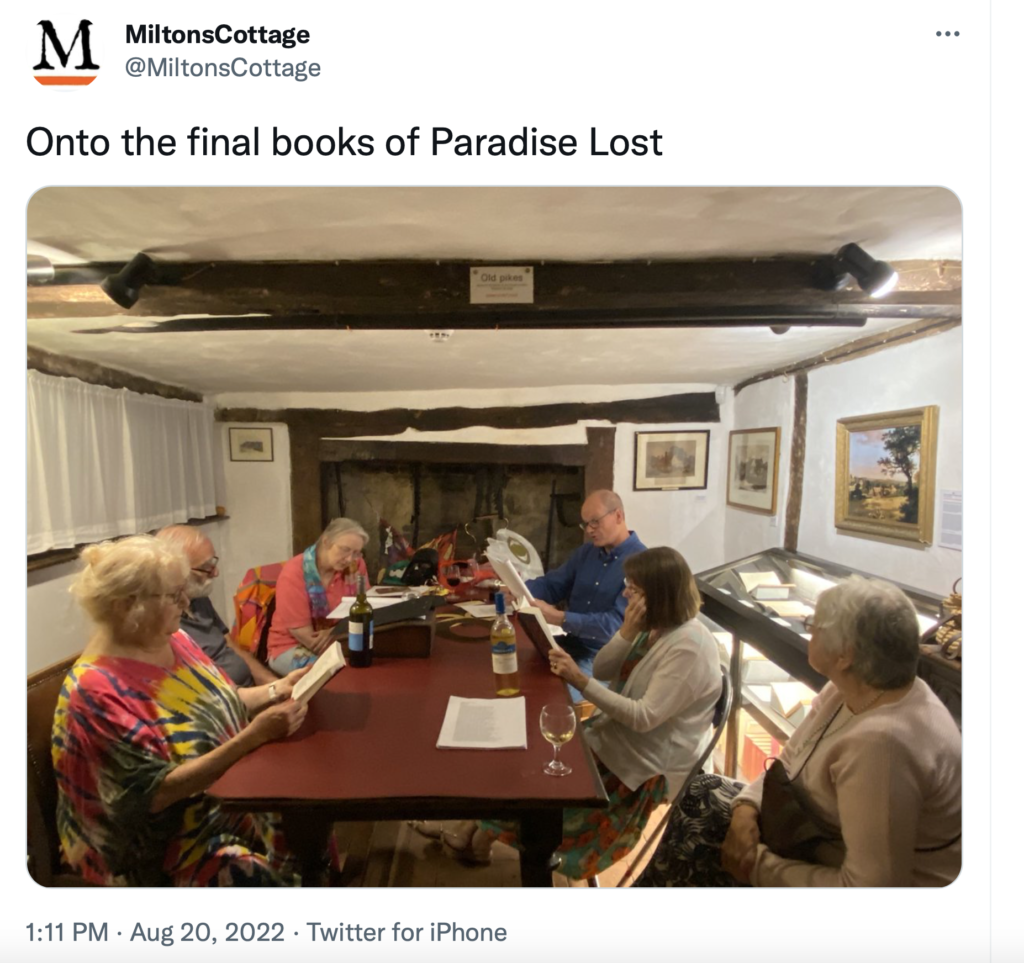
But why not just celebrate the season in beautiful Buckinghamshire? Paradise wasn’t lost at all today in Chalfont St. Giles, where Milton had a short sojourn in 1665-66. Milton fans gathered in the cottage to read Paradise Lost, beginning to end, all 10,550 lines of it, and commemorated the event on Twitter (@miltoncottage). And now we share it with you – the morning, afternoon, the evening, when they finished the last lines fortified with a few glasses of wine, as Adam and Eve are expelled from Eden:

Some natural tears they dropt, but wiped them soon;
The world was all before them, where to choose
Their place of rest, and Providence their guide:
They, hand in hand, with wandering steps and slow,
Through Eden took their solitary way.

“Come and join us!” they call. Don’t we wish?

And an update this morning:

Poet Tomas Venclova in the LARB: “Whatever else, now speak. There is nothing more real.”

August 17th, 2022
Share

The Lithuanian poet Tomas Venclova, one of Europe’s leading poets, has been a correspondent of mine for many years – since, in fact, the Czesław Miłosz centenary celebrationsl in Kraków, 2011, where we met. I have to admit I haven’t been a very good one. Tomas comes from the era of letters – I come from the era of the Tweet. Nonetheless, I treasure him and his emails, whenever we exchange them. (I’ve written about him here and here and here, among other places.)

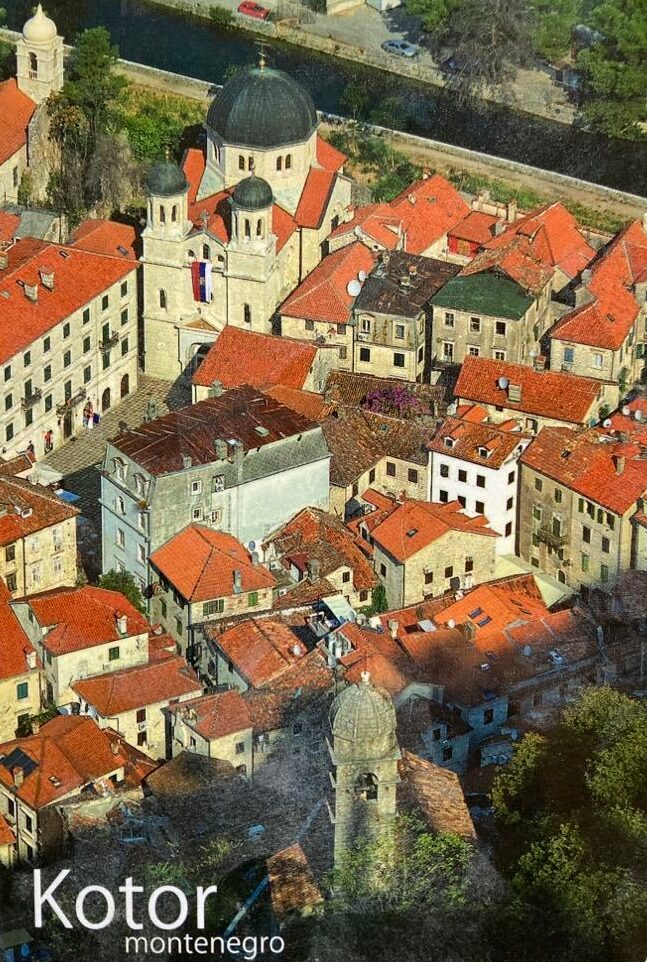
Sometimes I’d get a postcard or two when he was vacationing in Kotor, Montenegro, one of his favorite cities. Two of them have been pinned to my dresser mirror for ages, so I thought I’d share them with you, along with a short note about Kotor on a third.

The streets of Kotor, on a postcard

I’ve always been eager to make Tomas Venclova better known outside Europe, so I was pleased to mediate the correspondence that brought two of his most recent poems into English and to the West, with the help of poet and translator Ellen Hinsey. They’re in the a recent edition of the Los Angeles Review of Books here.

From the introduction, written by his translator Rimas Uzgiris:

“A human rights activist and an outspoken opponent of the Soviet regime — having spent, thanks to that, almost half his life in exile — Venclova has remained a cosmopolitan humanist, a skeptical lyricist whose poetry is guardedly hopeful. He holds tight to his ethical convictions — especially the sanctity of the individual life — and to the beautiful image, the music of the line, the logic of a complexly developed thought.”

The first poem “On Both Sides of Alnas Lake,” recalls the lake where the young Czesław Miłosz used to swim. It is set in Montenegro, on the Bay of Kotor, with its Venetian fortifications dating from the 15th century).

The second poem, “Before the Fort,” also recalls Kotor:

Before the Fort

Whatever else, speak. Verse hardly holds what is pressed
Over time into the hardening clay of consciousness.
There, we find contrasts of colors and fine detail,
The ocean’s gleam, shame, wonder, and our travail.
Maybe after death. But the plane rolls down the runway.
Maybe when you won’t exist. But a sentence has no fate.
Over the horizon’s line, by the switchback — a medley
Of roofs. The citadel casts its shadow by Gurdich Gate.

Greet the scorched grasses, whose dry clumps lock up
The stretch of bay where nameless towns of stone
Age and decay. Thunderstorms slip along the strand
On the other side of the well-burnished slope.
Clouds. An untamed motorboat stirs the current alone
And from bay bottom raises Mediterranean sand.
Now, in the darkening mirror, you don’t meet you.
A lamp, a keyboard, a dictionary. That much came true.

On the windward side of storms, at Europe’s deaf edge,
Where you’ve been taken by fate or divine caprice,
You will lodge in darkness, as others have found a place
Beyond horizon’s brushstroke or the switchback’s ledge.
The keyboard flickers, a presence hovers that you but feel.
The mirror fades. Age enfetters the fatigued body alive.
You can’t begin from the start, no matter how you strive.
Whatever else, now speak. There is nothing more real.

Read the whole thing in the Los Angeles Review of Books
here.


<<< Previous Series of PostssepNext Series of Posts >>>