On the Rushdie attack: “The illiterate cannot be allowed to dictate the rules of literature.”

August 13th, 2022

Share
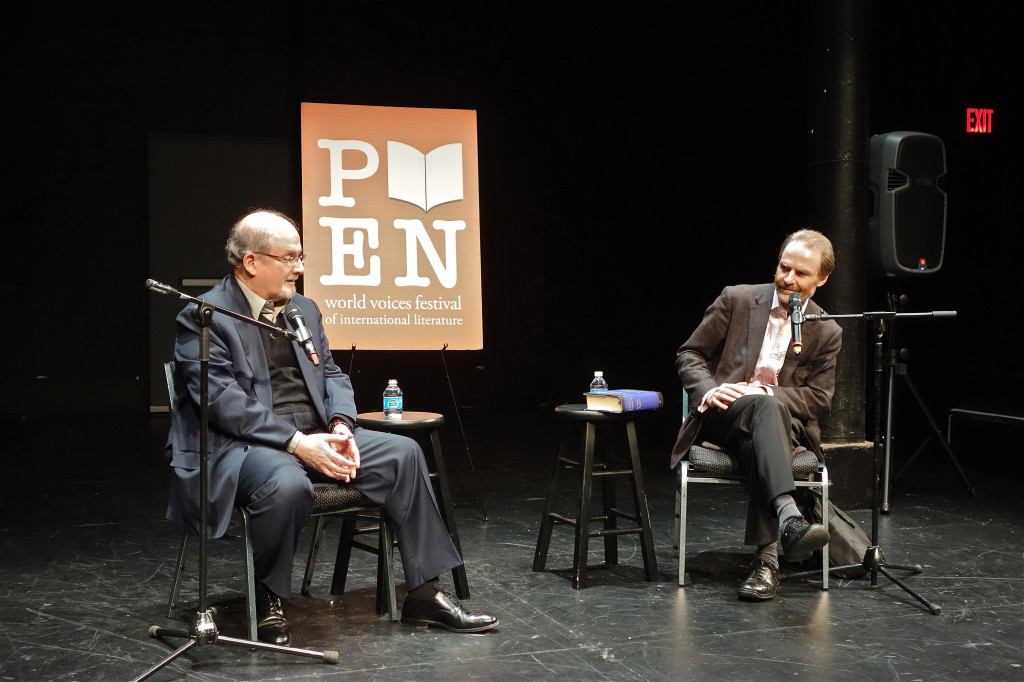
Salman Rushdie in conversation with Timothy Garton Ash in 2014. (Photo: Zygmunt Malinowski)

Last night’s Twitter feed was dispiriting. A surprising number of tweeters from the Middle East came out of the woodwork to pray for the death of Salman Rushdie, who was attacked yesterday. Even many Americans didn’t seem to understand that “free speech” protects speech that you don’t like or find offensive. That’s the point. Other speech doesn’t need protection.

Douglas Murray posted “The Best Response to Salman Rushdie’s Stabbing” over at The Spectator. You can read the whole thing here. An excerpt:

Sontag: No surrender

In his 2012 memoir – Joseph Anton – Rushdie wrote about the fatwa years. The book is a detailed chronicle of all the people who let him down: the MPs who promised support and then whipped up mobs; the political figures of left and right who said that while the Ayatollah may have caused an offence so had the novelist; the authorities who allowed Muslims in Bradford and others on television to call for a British subject´s murder with impunity.

But it is also a chronicle of the people who supported him, the friends who stood by him and the public figures who stood up for him. One of them was the American writer Susan Sontag, who helped organise a public reading of Rushdie´s work in New York. As Sontag said, the moment called for some basic ‘civic courage’. It is striking how much of that civic courage has evaporated in recent years. Today no one would be able to write – much less get published – a novel like The Satanic Verses. Perhaps nobody has tried. From novels to cartoons a de facto Islamic blasphemy law settled across the West in the wake of the Rushdie affair. The attack today will doubtless exacerbate that.

So apart from willing, wishing or praying for Rushdie´s recovery, the only other thing that can be done now is to display that civic courage that Sontag called for three decades ago.  The Satanic Verses is a complex but brilliant novel. It includes an hilarious and devastating reimagining of the origins of the Quran. I hope that people will read it, and read from it, more than ever. Because what happened in New York today cannot be allowed to win. The illiterate cannot be allowed to dictate the rules of literature. The enemies of free expression cannot be allowed to quash it. The attacker should get exactly the opposite of the response he will have hoped for. Not just hopefully a failure to silence Rushdie, but a failure to limit what the rest of us are allowed to think, read, hear and say.

Read the whole thing here.

Update on August 13, from Google: “The Satanic Verses reached No. 1 in contemporary fiction on Amazon’s best-sellers list on Saturday, in the wake of the stabbing attack on the author the day before.

From Rushdie’s friend: “Always support free speech, especially speech we hate. Otherwise there’s no hope at all.”

August 12th, 2022
Share
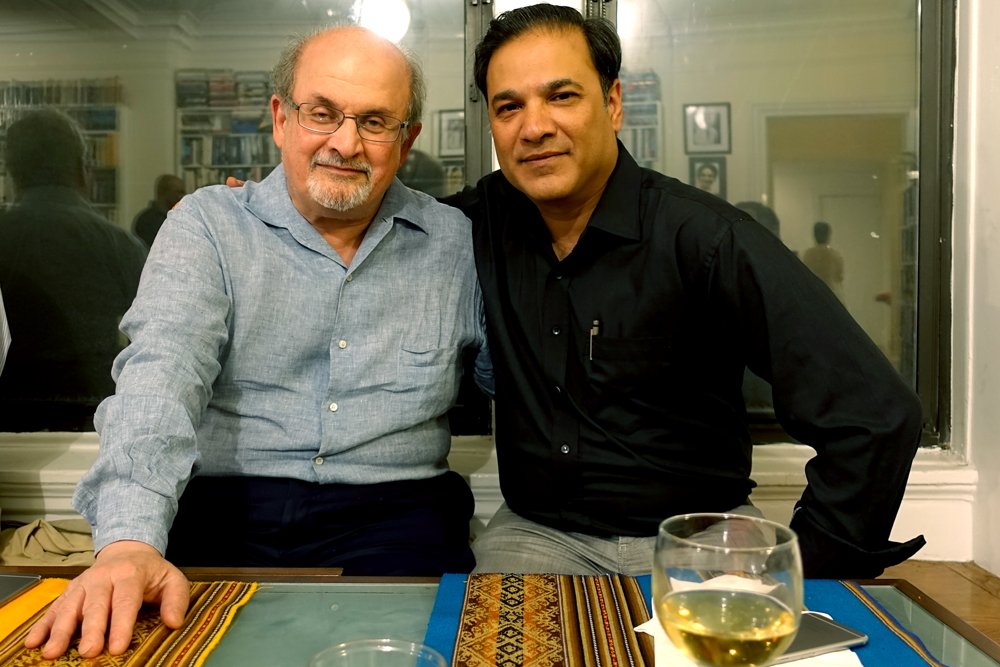
Salman Rushdie and Abbas Raza, at his the latter’s home in northern Italy.

For most of us, Salman Rushdie is only a name in the news, a man famous for his books and his marriages. To some of my friends, including Abbas Raza, founder of 3QuarksDaily (we’ve written about it here), he is more than that. Rushdie is a personal friend, and a friend of his extended Pakistani family.

Hence, Karachi-born Abbas Raza wrote on Facebook today about the attempted murder of the renowned Indian writer: “He is in critical condition with much blood loss. Apparently an artery in his neck was severed. I hope he comes back from this roaring. Let us all, in this dangerous moment, renew our commitment to always supporting free speech, especially speech we hate. Otherwise there’s no hope at all.”

On 3QD, he remembered Valentine’s Day 1989, when the fatwa was issued. In a 3QD post, he wrote: “… I knew in my gut that this was the opening salvo in what would become a massive internationalization of an Islamic war on freedom of speech and expression. After all, the government of Iran was threatening and planning to murder a British citizen, and even encouraging other Britons to murder him by putting a bounty on his head, with the enthusiastic approval of a large proportion of Muslims everywhere.

“And although, thank goodness, Rushdie remains safe, the Islamists have largely been winning this war since. They have successfully intimidated a very large number of writers and artists and journalists and film-makers all over the world into silence (and many live in exile because of threats to their safety), and within Muslim countries they have in addition used blasphemy laws to persecute their enemies and basically make any discussion of religion impossible.

“All this while religious apologists continue to proclaim to CNN and the BBC that their religion stands only for peace. Tell that to the tens of thousands of victims of religious violence in Pakistan alone. “Oh, the number of extremists is very small; most Muslims are peace-loving people.” The number of actual terrorists is always small. The problem is that too great a proportion of Muslims sympathize with these people, which is why it is impossible to eliminate them. Let us stop fooling ourselves with this nonsense. People need to stand up for free speech unequivocally, and against this barbarity, and especially Muslims need to. The battle must be joined now, in every way possible.”

Postscript from Abbas Raza: “I have written something about Salman Rushdie every year on Valentine’s Day since 1989, so for 33 years now. Here is what I wrote most recently: ‘Oddly enough, Valentine’s Day has become inextricably conflated in my mind with Khomeini’s fatwa against Salman Rushdie. I can clearly remember where I was on this day in 1989: at my desk in the U.S. Department of Labor just off the mall in Washington, D.C., where I was working as a young engineer. I was shocked and dismayed to hear the news and revolted by the murderous threat issued by Khomeini. Of course, things have only gotten worse with religious bigots responsible for killing hundreds of thousands of people in the quarter century since that day. One can be thankful for Salman’s continued safety but, at least in my estimation, the damage done to free expression in the arts has been immense. I know for a fact (because they have told me) that writers practice a kind of self-censorship in the aftermath of the Rushdie affair because they do not wish to be killed. Sad. But happy Valentine’s day!’ I hope he will make it through this fine. But the world will still remain a darker, scarier place than it was yesterday. And free speech is under attack everywhere now.”

The comforts of artisanal toast and single-source coffee are finite. Try the humanities.

August 6th, 2022
Share
Zena Hitz: seeking silence and contemplation in a noisy and confused world

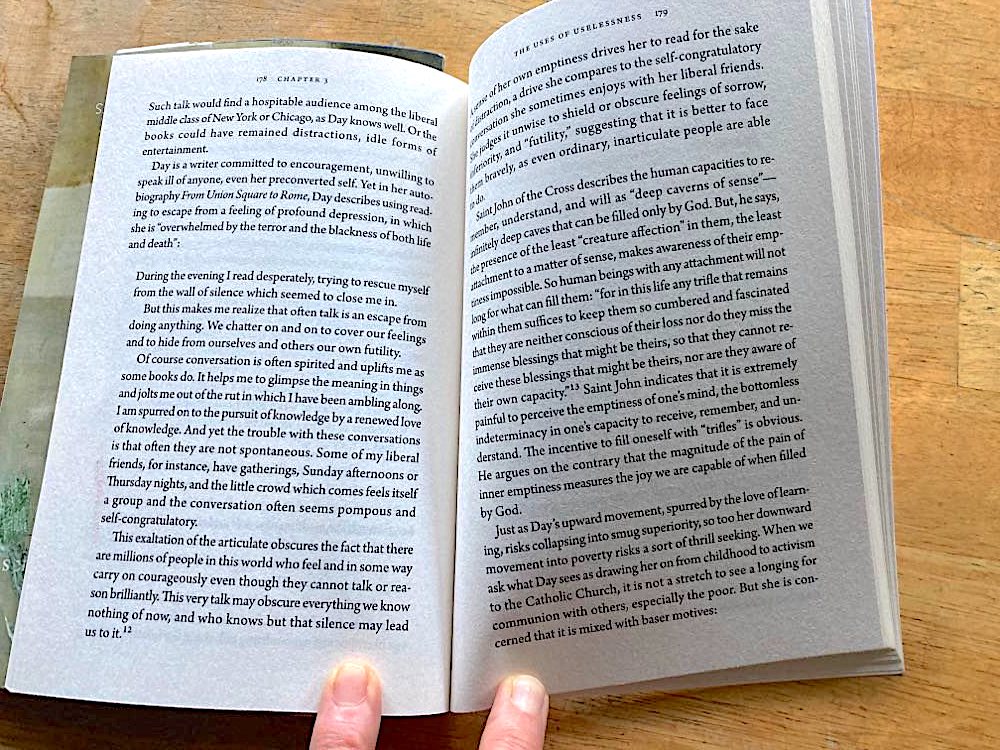
“The exaltation of the articulate obscures the fact that there are millions of people in this world who feel and and in some way carry on courageously even though they cannot talk or reason brilliantly. This very talk may obscure everything we know of now, and who knows but that silence may lead us to it.”

So writes Zena Hitz, author of Lost in Thought: The Hidden Pleasures of an Intellectual Life (Princeton University Press). It’s one of many thoughtful and brilliantly expressed ideas her quest for contemplation and connection in an increasingly fragmented, superficial, overloaded, and technological world.

What more beautiful defense of the humanities is there than this? “If intellectual life is not left to rest its splendid uselessness, it will never bear its practical fruit.” According to Stanley Fish, it’s an ancient thought, “but one that must be relearned, especially at times like ours when a passion for social justice is the new idol to which disinterested contemplation is being sacrificed.”

Here’s another passage, chosen almost at random, about how the fruits of contemplation are being suborned when social climbing appropriates intellectual terroir.

“As Pierre Bourdieu argued in Distinction, matters of taste and culture enforce social boundaries; it is part of their nature to indicate social status. But if there is nothing else to intellectual life, it is only sophisticated pleasure held in place by whatever supports a high-status lifestyle, then it cannot change us. It remains a form of entertainment rather than a means of self-examination or personal transformation. Nor can it be a refuge when the conditions for wealth and comfort collapse, or if the institutions that support us in our lifestyles fall apart, or if we fail to meet their conditions, or if we are the victims of dramatic political or economic change. (Would artisanal toast or single-source coffee be such a refuge?)

“The enemies of intellectual life are not simply yokels enmeshed in practical tasks who cannot understand sophisticated forms of inquiry. A real yokel, as we’ve seen, is not a simple rustic but someone who pursues wealth and status no matter the cost. We are ourselves the yokels. Inordinate desires for wealth and status are easier for the intellectually inclined to see when they are sought by those outside intellectual life, like Strepsiades [in Aristophanes‘s Clouds]. They are far more difficult for us to discern when they become deeply bound up with a specifically intellectual mode of being. The love of learning becomes fused with the love of wealth or status when we view intellectual pursuits as a way to join a superior race of beings, whether that is a higher economic class or an elite superior still.”

More praise: “Miłosz’s deeply fertile relationship with the United States, and the landscape and culture of California in particular, has not been fully appreciated.”

August 2nd, 2022
Share

From J. Elliot’s August substack newsletter: an excellent paragraph of praise for Czesław Miłosz: A California Life:

Cynthia L. HavenCzesław Miłosz: A California Life. Having already read Andrzej Franaszek’s excellent Miłosz biography, the broad outlines of the poet’s time at U.C. Berkeley—where he lived for four decades before returning to Poland in his final years—were familiar to me. But Haven argues, persuasively, that Miłosz’s conflicted but deeply fertile relationship with the United States, and the landscape and culture of California in particular, has not been fully appreciated. There, he saw his original naive view of the American continent as a realm of pure natura, in contrast with the Sisyphean nightmare of Europe trapped in History, slowly unravel as he grappled with his adopted home’s complexities and contradictions. Seemingly providentially, the Californian anti-humanist poet Robinson Jeffers appeared then as a near-perfect interlocutor and foil for Miłosz’s particular fixations: his constant wrestling with the source of evil in the world and in himself; his alternating worship of and suspicion of Nature; his ambivalence over the redeemability of humanity; his hunger to locate a synthesis of change and eternity in art; and his exile from his native tongue and the political struggles of his homeland, which all at once isolated him, filled him with resentment and shame, challenged and deepened his spirituality, and ultimately elevated his work to the world stage.

Coming attractions: “René Girard: All Desire Is a Desire for Being” will be out with Penguin Modern Classics next spring!

July 28th, 2022
Share

Proud to show off my new anthology: René Girard: All Desire Is a Desire for Being, published by Penguin Modern Classics in London. The cover illustration below features Pablo Picasso‘s 1933 etching, “Sculpteur Avec Son Modele, Sa Sculpture Et Un Bol D’Anemones” (Sculptor with His Model, His Sculpture, and a Bowl of Anemones).

René Girard would have loved the cover, I think. He knew Picasso during that magical summer of 1947, when René and his friends launched the Avignon Festival. (The actor Jean Vilar joined later, and the festival became known for its theater, not the art exhibition that started it.) René shared many fond memories of Picasso with me. A few of them are in remembered in Evolution of Desire: A Life of René Girard:

It was all heady stuff for the two footloose young men. “My friend and I were in a state of continuous mimetic drunkenness at the thought of being involved in such important cultural events. I remember going to [Pablo] Picasso’s painting studio in Paris, on the Quai des Grands Augustins, and picking out twelve paintings with my friend and others, which we then took down to Avignon in a little truck,” said Girard. “I also remember mishandling the Blouses roumaines, which was quickly repaired”—fortunately, because the festival offered no insurance for the masterpieces loaded onto trucks. It took a month for the duo to gather the twelve paintings from Picasso, Henri Matisse, Georges Braque, and also works by Marc Chagall, Paul Klee, Max Ernst, Wassily Kandinsky, and others for the exhibition.

In Palo Alto, Girard looked around his comfortably large living room, and waved his arm to indicate the space—the art impresario Zervos, he said, had “three times that full of famous paintings of the twentieth century.” He and his friend Jacques, he added, “were quite seduced by that.”

Into this war-torn and threadbare country, the superstars arrived: “Picasso came to Avignon during the summer, in his chauffeur-driven car. He complained humorously but loudly that there was no advertising for the exhibition along the road between Paris and Avignon.”

He had a hidden motive, according to Girard: he wanted to make sure that Matisse and Braque had given the same number of paintings, and ones of equal importance and value. For Girard, watching the painters jostle for supremacy, or at least parity, was another early lesson in mimetic rivalry.

Picasso spent two months among them, and pulled out his easel and paints while in Avignon. “My impression was that he was a very clever man—and because of that, he was a lot of fun,” he said. “Picasso was kidding all the time.” In keeping with the spirit of rivalry, Georges Braque came to spend a month among the Avignonnais, too.

Who started the Avignon Festival? Girard whimsically credits neither Zervos nor Vilar, but rather the poor, little-known Spaniard, on his way to Paris before either of the world wars: “It is possible that the original idea for the exhibition came from Picasso himself, who enjoyed talking about his first visit to Avignon. It was on his way from Spain, when he first came to Paris.

He stopped at the Castle of the Popes to see it and, being very poor, he had offered to paint the concierge’s portrait for five francs. The offer was rejected. It was Picasso’s desire at the end of his life to have his last exhibition in the Castle of the Popes, and that is what happened.”

It’s especially an honor for me to publish with Penguin Modern Classics. I became aware of the series in my early days at the University of Michigan, when I picked up the Selected Poems of my professor, the late Nobel poet Joseph Brodsky, with its startling purple-and-green cover (see it here).

Boris Dralyuk’s “My Hollywood” in the TLS: “microscopic close-ups of experience.”

July 25th, 2022
Share
Poet Boris Dralyuk…

Boris Dralyuk‘s My Hollywood (Paul Dry Books) continues to get high praise (we wrote about it here and here), this time in the Times Literary Supplement. The critic is the eminent poet Rachel Hadas (we’ve written about her here), writing: “The formal panache and ingenuity that make My Hollywood so pleasurable to read also serve to heighten its poignant blend of celebration and elegy.'”

An excerpt:

My Hollywood, Boris Dralyuk’s debut collection of poems, is so thematically coherent, so satisfying as an achieved gesture and mood, that it is easy to overlook just how multidimensional Dralyuk’s art is. While admiring the integrity of the collection as a whole, we can appreciate the minute details that stand out – “No molds or lasers, just the human touch”, as “The Minor Masters” has it. Or can we only take in the pattern of the whole when we have studied the details of Dralyuk’s craft? However we approach them, these poems reward close attention.

… and poet Rachel Hadas

Some lines offer almost microscopic close-ups of experience. Looking at old LPs in “Universal Horror”, the poet notices that “Motes build tract housing in the grooves of vinyl”. “Plants in Pots”, a couplet dedicated to the late Samuel Menashe, shares Menashe’s compressed wit and fondness for wordplay: “Calm captives, inch by inch, they make their flight, / and reach the window, bent on seeing light”. In “Notation” the view is closer still: “I was the tangled sheet / still clinging to your feet, / holding your ankles bound”.

Dralyuk’s imagery is consistently precise and unexpected, especially when it comes to technology. Thus, “A crow clacks in the branches overhead, / like a projector slowly going dead” (“Aspiration”); memories are “like VHS tapes after years of viewing / and spooling backwards to the sweetest spot” (“Bargain Circus”). In “Babel at the Kibitz”, “ACs burr and wheeze like old hasidim”.

The whole thing behind an inevitable paywall here.


<<< Previous Series of PostssepNext Series of Posts >>>