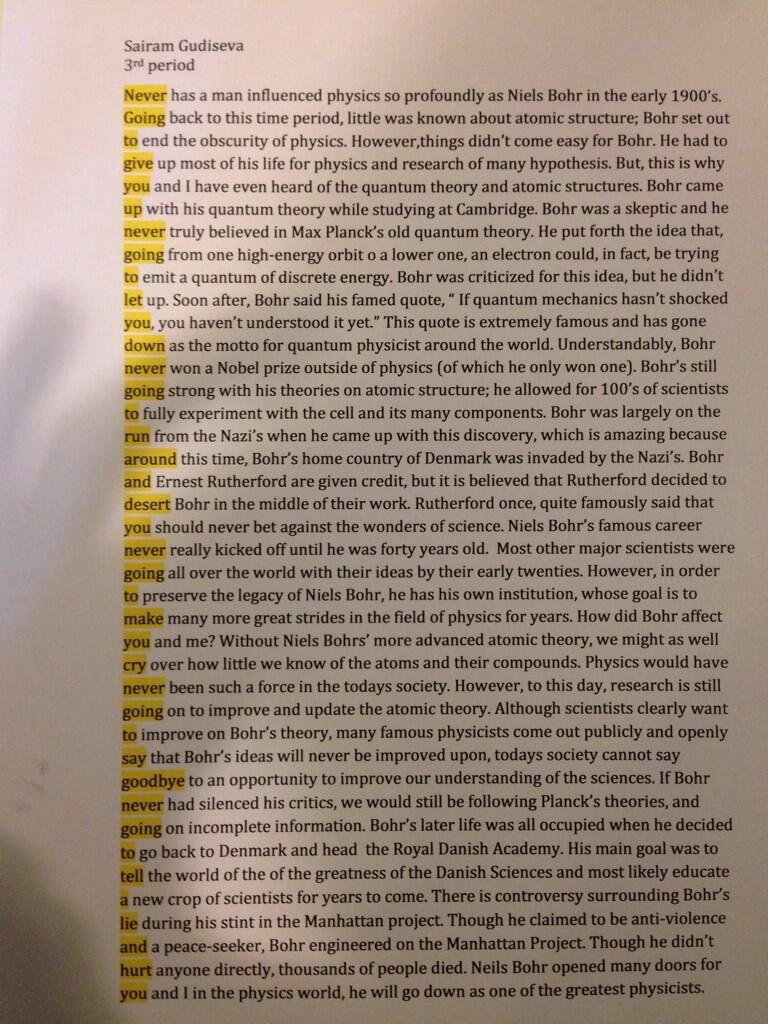
Love in the oddest places…

January 18th, 2014
Share

Bd527o5IQAAnHd5.jpg-large

p.s. You’ve been Rickrolled!

Postscript on 2/12:  Credit where credit is due. Yahoo News outed the author of this prank: “Even more impressive, the essay on scientist Niels Bohr actually makes perfect sense. It’s hard enough to write a physics essay, but we don’t even want to think about how much time it took student Sairam Gudiseva to “rickroll” his teacher.”  The site (here) defines rickrolling this way: “Going back years, rickrolling is a term for getting victims to watch Rick Astley when they least expect to. Sometimes, during a boring video, the merry prankster will cut to Astley a few minutes in and let his melodic rock crash over you like the rushing tides of the Pacific Ocean, so gentle, so free.”

Congratulations Sairam. Hope you aced it!

“It’s our time. It’s our humanity. We have to be part of it too.” Philip Roth on George Plimpton

January 17th, 2014
Share
George_Plimpton,_1987

Plimpton escaping his glamor in 1987 (Photo: MDC Archives)

My only interaction with George Plimpton, the legendary founder of The Paris Review, occurred about a dozen years ago.  I was aware that I was dealing with a “famous person,” but he didn’t seem to be … that is, he wasn’t acting as if he considered himself to be a grand person with me only a fly on his schedule. The matter at hand was Sven Birkerts‘s interview with Joseph Brodsky, which I planned to republish in Joseph Brodsky: Conversations. Apparently, there were several versions and we were sorting them out.  I can’t remember how the issue is resolved, and I can’t remember precisely the conversations, except I refer to them in my later correspondence, so I know they must have happened.

brodsky2Hence, I was interested to read Philip Roth‘s treatment of Plimpton in Exit Ghost. The words, of course, are embedded in a work of fiction, and come from the mouth of the elderly writer Nathan Zuckerman, who is returning to New York City in 2004, after 11 years of seclusion in the Berkshires. He is shocked to learn of his colleague’s death, in his sleep at age 76, the year before – and he is doing some late-life wrestling with his own mortality, too. In Roth’s novel, Plimpton ingenuously winds his way into the last 50 pages, and accounts for some of the most moving passages in the book. Here’s one such passage, though not his final word on the subject:

George escaped his glamour without losing his glamour, only further enhancing it in autobiographical books seemingly driven by self-deprecation. Climbing into the ring with [boxer] Archie Moore he was simply practicing noblesse oblige in its most exquisite form – a form, moreover, that he had invented. When people say to themselves “I want to be happy,” they could as well be saying “I want to be George Plimpton”: one achieves, one is productive, and there’s pleasure and ease in all of it.

Nobody on such casual good terms with the mighty and the accomplished and the renowned, nobody so in love with the excitement of deeds and words, for whom the suffering that is mortality seemed so remote, nobody with as many admirers as George had, with as many attributes as George had, nobody who could speak to anyone and everyone as easily as George did … On I went, thinking that the closest George would ever come to dying would be to simulate it in an article for Sports Illustrated.  …

ExitghostHow could George be dead? I kept coming back to that. George’s having died a year ago made everything absurd. How could that happen to him? And how did what happened happen to me for these past eleven years? Never to see George again – never to see anyone again! I did this because of that? I did that because of this? I defined my life around that accident or that person or that ridiculously minor event? How outlandish I seemed, and all because, without my knowing it, George Plimpton had died. Suddenly my way of being had no justification, and George was my – what is the word I’m looking for? The antonym of doppelgänger. Suddenly George Plimpton stood for all that I had squandered by removing myself as forcefully as I had and retreating onto Lonoff’s mountain, to seek asylum there from the great variety of life. “It’s our time,” George said to me, his singular voice ringing with its spirited confidence. “It’s our humanity. We have to be part of it too.”

Ivy Low Litvinov: surviving Stalin … and D.H. Lawrence, too

January 14th, 2014
Share


litvinov-18

Ivy Low Litvinov and friends in the U.K. …before it all began. (Joseph Freeman Papers, Hoover Institution Archives)

“It is one of the wonders of the age that Ivy survived to die a natural death,” wrote American diplomat and historian George Kennan in a 1989 letter. Dying in one’s bed wasn’t the usual exit from Joseph Stalin‘s Russia, and Ivy Low Litvinov, as the wife of the genocidaire’s foreign minister Maxim Litvinov, wasn’t a likely candidate for a natural end. Yet she lived in Moscow with their children until 1972, when she returned to the U.K. The recipient of Kennan’s letter, the Book Haven’s own Elena Danielson, Hoover Institution archivist emerita, tells this and other tales about the British author in the current Sandstone & Tile here (beginning on p. 18):

new-unnamed2

(Photo: Joseph Freeman papers, Hoover Institution Archives)

“In November 1943, Ivy was traveling from Washington to Moscow and showed up, without warning, at the Stanford Library. She wanted to read a collection of original letters by her friend, British novelist D.H. Lawrence, in what was then known as the Felton Library. The research at Stanford was Ivy’s refuge in a dangerous time. In 1939, her husband had been dismissed as foreign minister and disgraced by Stalin, only to be recalled to active duty in 1941, when the Nazis invaded the Soviet Union. He served as Stalin’s ambassador to Washington for a crucial year and a half, from December 1941 to spring 1943. He and Ivy arrived in the U.S. on December 7, while the Japanese were bombing Pearl Harbor. The Litvinovs, especially Ivy, were wildly popular guests in Washington and New York in 1942. She lunched with Eleanor Roosevelt and dined with Marjorie Merriweather Post, one of the wealthiest women in America. By 1943, however, Maxim – again in political difficulties – was abruptly recalled from Washington to Moscow and an uncertain fate.”

Still, she had a few dreamy days at the Stanford Library, where she recollected her loving, and stormy, history with D.H. Lawrence and his wife Frieda. She wrote in a letter to a friend: “In t. meantime I retire into my literary life and have been reading up on Lawrence & making unexpected discoveries… I went to Stanford University & was shut up for 2 days in t. adorable Felton Library, which has a rich collection of Lawrence being accumulated in the last 12 years, but I t. first person to ask to see it. In his letters found most amusing references to self. All this I have assembled & begun to write article.”

Elena writes, “Ivy may have spent most of her adult life in the Soviet Union, and she went down in history as the wife of Stalin’s foreign minister, but she always viewed herself primarily as Ivy Low, the writer. She was born into an environment where the people closest to her were constantly reading and writing for publication.”  She wrote for The New Yorker, Manchester Guardian, Blackwood’s Magazine, Vogue, as well as two published novels – and she did finally write her article “A Visit to D.H. Lawrence,” which was published in Harper’s Bazaar.  “Ivy’s research on Lawrence at Stanford helped her steady her nerves while awaiting her perilous return to the Soviet Union.”

Hoover acquired her papers, including letters, manuscripts and photos, in 1987 – not far from the D.H. Lawrence collection at Green Library.

It’s a fascinating story – read it here (again, beginning on p. 18).

Why every kid in China knows Mark Twain

January 10th, 2014
Share
mark-twain

Not just a funny guy.

Mark Twain is popular in China – and not only (predictably) for Huckleberry Finn, which has more than 90 different translations into Chinese. A lot of his fame comes from an obscure short story called “Running for Governor,” Twain’s imaginative account of his (fictional) 1870 gubernatorial run in New York.

Amy Qin, who calls Twain the “founder of the American voice,” tells the story in the New York Times hereand says that Twain’s tale of American incompetence, greed, sham, corruption, and lies made the piece required reading for middle school students across China, “along with other short stories that were seen to reinforce the anti-Western, anti-capitalist, socialist education agenda.”

According to literary scholar Guiyou Huang on the Library of America website, “ ‘Running for Governor’ was translated and filtered down into the high school textbooks throughout the country as a model piece of critical realism that exposes the so-called false democracy in a capitalist country. In other words, all high school graduates [in China] know who Mark Twain is.”

Our favorite Twain expert, Shelley Fisher Fishkin inevitably enters into the NYT story (we’ve written about her here and here and here and here, among other places):

“In a speech delivered in 1960 in commemoration of the 50th anniversary of Twain’s death, the eminent Chinese writer Lao She hailed Twain as an ‘outstanding writer of critical realism in the United States’ and a bracing social critic who had been reduced by Americans to a figure who told jokes.

fisherfishkin

She knows everything. (Photo: L.A. Cicero)

“That Twain was until recently remembered more as a humorist than as a satirist or social critic in the United States is not inaccurate, said Shelley Fisher Fishkin, an English professor and expert on Twain at Stanford University.

“’In a sense we threw out the baby with the bath water,’ said Professor Fishkin, citing the imperatives of the Cold War as a major reason for the distortion of Twain’s more serious accomplishments. For much the same reasons that China played up Twain’s social commentary and critiques of imperialism, the United States, she said, played them down. …  today in the United States, more than a hundred years after Twain’s death, many of his critiques of hypocrisy, ignorance and greed — ‘Running for Governor’ included — still ring true. ‘Twain the social critic who uses satire to skewer his society’s foibles is a Twain that is increasingly of value to us today,’ Professor Fishkin said.”

Read the Twain story over here.  Or read the story about the story here.

“The alloy of thought and poetry at a very high temperature”: Bengt Jangfeldt on Regina Derieva

January 8th, 2014
Share

derieva4


Bengt Jangfeldt delivered the eulogy last month at the Stockholm memorial for the Russian poet Regina Derieva, “who in her best poems achieved that true metaphysical quality which, according to T.S. Eliot, is the alloy of thought and poetry at a very high temperature.” I had hoped to get an English copy – but it looks like The Guardian beat me to it. Bengt writes in today’s paper:

corinthian

Her most recent book in English (2011)

Of Russian poets born in the Soviet era, the first to speak seriously about metaphysics was Joseph Brodsky, in whose poetry this alloy occurs quite often. Brodsky called Derieva “a great poet”, stressing that her poems are hers “only by name, only by her craft”.

“The real authorship belongs here to poetry itself, to freedom itself. I have not met anything similar for a long time, neither among my fellow countrymen nor among English-speaking poets.” …

To say that I knew Derieva would be wrong. I translated her poetry into Swedish, and helped her to get Swedish citizenship, and we met on several occasions, though rarely in the last few years. Her means of communication was not through personal contact, but through poetry. According to her husband, I was one of the few people she ever confided in; her main interlocutor was God.

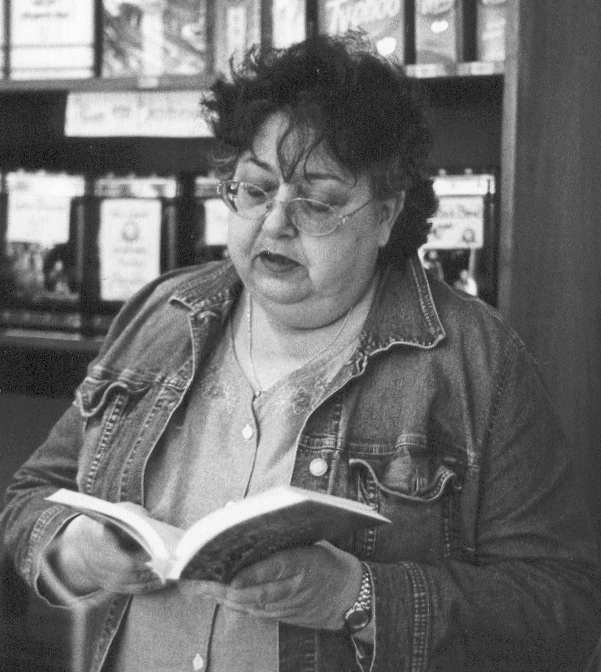
Read the rest here, and I include a poem in my earlier piece on her here.  Out of the photos her husband Alexander Deriev sent me, I liked the one above the best. It looks like someone one might see in a Berkeley bookstore. However, I include the 1972 Karaganda photo he favored below. Apparently, it was a favorite photo of the poet’s as well: “She thought it displayed her wild cat’s inner nature the best. She always, from her early youth, associated herself with a lynx, and her nickname was ‘Lynx.'” In fact, here’s a poem, translated by Daniel Weissbort, that is dedicated “to my Singaporean friends who believed implicitly that I was a lynx.” And the 1973 photo below that, smelling a lilac … I like it, too.

RD_Karaganda_1972-1

derieva5

Division of the spoils: the market for medieval books, page by page

January 7th, 2014
Share
traherne

Remains of the day … the book was almost complete a few years ago. (Photo: Elaine Treharne)

“Sometime in the fourteen-sixties, a private Christian devotional was produced in northern France. Its pages were expertly calligraphed, embellished with gold leaf, and decorated with sprays of blue acanthus, pheasants, swans, peacocks, and dancing villagers. There were seventeen full-page Biblical illustrations. Its final leaves contained an early owner’s translations of a few Latin prayers into medieval French. Such opulent books of hours became prized collectors’ items among the cognoscenti in later centuries, which may be how this one found its way into the private library of a nineteenth-century British collector named Edward Arnold. By this time, it had received a new morocco binding and its illustrations had been touched up, probably by the artist Caleb William Wing. In the nineteen-twenties, Arnold’s estate sold the book to Sotheby’s; it appeared on the auction block again at a Christie’s sale, in 2010, where it sold for twenty-five thousand pounds (then about forty thousand dollars) to an anonymous bidder.

By the time that Elaine Treharne, a medievalist at Stanford, purchased the manuscript from a colleague for seven hundred dollars, in November, it resembled not so much a book as an old, empty wallet. …”

So begins an article in the current New Yorker, Ben Mauk‘s “Scattered Leaves,” featuring one of our favorite medieval scholars … well, to be frank, we have lots of favorite medieval scholars … who’s on a campaign against the lucrative business of ripping valuable books apart and selling them piece-by-piece.  When she saw the devotional above, “I was almost physically sick,” she said. “I could not believe what I had in front of me.”

Read the story that takes us through auction houses and eBay, university lecture halls, and a gallery owner in Leipzig.  It’s here.


<<< Previous Series of PostssepNext Series of Posts >>>