Digging history

July 6th, 2013
Share


hugo3


The problem with most of my gardening efforts is that when I get excited about growing flowers or herbs, I go out and buy some books about the subject, and that satisfies the impulse entirely, and soon it goes away. I rarely get to the messy business of actually digging around in the dirt with my fingernails, what with worms and bugs and all.

belfryThis time I’ve gone so far as to actually get some seeds, thanks to Nora Munro over at The Belfry.  I met Nora through one of my favorite medievalists, Jeff Sypeck, over at Quid Plura.  His link to “où dort la mélancolie” enchanted and intrigued me. Nora is trying to grow as many authentically medieval plants as she can – but the mid-Atlantic weather isn’t helping.  “I still love the flowery fields in mediaeval paintings, and it pleases more than is probably reasonable that this columbine is exactly the same as the ones in Hugo van der Goes‘ Portinari altarpiece of 1476,” she wrote.  Yes, it’s that Portinari family.  The altarpiece was commissioned by Tommaso Portinari, an agent for the Medici bank in Bruges, and he’s somehow related to Dante‘s beloved Beatrice.

Can you see the flowers in the altarpiece above?  I thought you wouldn’t.  Try looking at the photograph from Nora’s garden left.  Then compare with the enlargement from the Portinari altarpiece at right.  Pretty cool.  So I was thrilled when the envelope arrived from Annapolis a few hours ago with … my own seeds.

columbinesNow, I had thought columbines are supposed to symbolize folly, as in the “Columbine” character in commedia dell’arte.  But Nora corrects me: “During the Middle Ages, the flower was associated with the Holy Spirit (columbine < L. columba, dove).  In the Portinari Altarpiece, the detail I linked above with the columbines is in the central panel, as part of a depiction of the nativity, with lilies and irises, both of which were associated with the Virgin.”

The Enclopedia Britannica has yet another version: “The scattered violets indicate Christ’s humility; the columbine flowers represent the seven gifts of the Holy Spirit with which Christ was endowed at birth. The flowers in the albarello (pottery jar) are in royal colours, for Christ was of the royal line of the Israelite King David.”

But the big queston is: will they grow?  I’ll let you know how it goes…

On a warm weekend, Aleta Hayes recalls a beloved brother in a cold climate.

July 4th, 2013
Share
aleta

In memory of…

Happy Fourth of July. It’s going to be a hot, bright weekend of celebrations, sparklers, and firecrackers.  So let me bring up one sparkly firecracker close to home, in our own Stanford neighborhood.

Last weekend was the wind-up of a very busy week of arts events.  At the Roble Studio on Friday, a young woman, stripped bare nekkid to the waist, was being doused with a bucket of water from a ladder.  All in the name of art.  Life-size plastic dummies made out of something that looked like saran-wrap littered the courtyard.  I didn’t know what it all meant, but I was glad to go instead to hear performer Aleta Hayes, founder of the Chocolate Heads Movement Band (and a former student of Robert Wilson), commemorate her peripatetic artist-at-large brother in song and dance.  She’s good at both – so good that it’s hard to look at anything else onstage while she’s on it.

In this case, however, there was no living competition … only a memory and a presence:  “The content for this song-cycle was inspired by the unexpected passing of my dear brother Alan Hayes in February, 2013,” she wrote.  “I find it uncanny and appropriate to perform here in Roble Gym Dance Studio, where he showed up unannounced from Norway last year, to attend a Chocolate Heads Movement Band performance I had choreographed and directed – a surprise to me and my mother. It was the last time we saw Alan.”

Aleta crooned folk tunes from far away, African-American freedom songs, popular music, and a formal piece by (I believe) Purcell.  Interspersed throughout were memories of a beloved, and extraordinary, brother.

When I first got the news, a stranger on the phone said, “Alan’s gone.”

Gone…

Gone where?

But come to think of it, he always did disappear. Like the time our family went to Disney Land and he ran off from us. We found him at the center for lost children, sitting there, happily talking to Minnie Mouse.  At eight, he had checked on his own plane reservations to go with our nanny to Nicaragua and offered his paperboy money to mother and dad to pay for it.

alan2

… a beloved brother.

He was always disappearing.  And just as suddenly, reappearing.

He would appear from nowhere –  carrying armfuls of flowers. Tall ones.  Once, he showed up at my work, to a posh luncheon honoring someone – not me.  He stood there like a prince, brandishing thirty-six Easter lilies, flanked by two huge blonds from Denmark.

Waited until the whole room turned to notice (I was the last).  And I cried like a baby.  Like I had just received the crown.

And he stayed in Norway.  Aleta continued throughout the short less-than-an-hour performance to recall his international life – and the rumors of a son somewhere in Scandinavia that she is going back to find.

I often joke, black people don’t like the cold. Except Alan, who kept house in Oslo, Norway.

What would possess a black man to make his home in ice-cold-dark-longest winter-ever, Norway?

How could a child raised by race people during the civil rights era — mother used to sneak off at lunchtime to sit in at the Woolworth’s counter, and dad was the first black person to cross the color line the University of Missouri Medical school — end up in Lapland, knitting wool sweaters by the fire?

Why would Alan, brought up in sunny California, end up in a place where the sun doesn’t shine – except in July?

He felt free. He said, “I feel free there. I don’t feel free here.”

He shared a house at the top of the ski lift in Slemdal — overlooking the fjords.  At age 22, he had his own table in the best restaurant in town, serving reindeer, medium rare. He had friends, lots of them – blond and loyal. They will tend his grave. Bring flowers on the holidays.

He will stay there – his preferred home – as he did in life.  A free black man in the snow.

(Aleta’s TedX talk below.)


Best commencement talk you didn’t hear last month

July 1st, 2013
Share

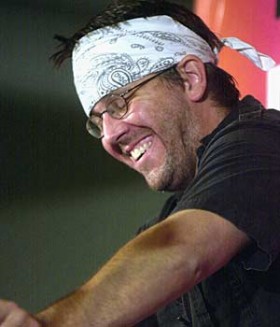
FishHere’s the best commencement address you didn’t hear last month. That’s because David Foster Wallace gave this talk, “This is Water,” at Kenyon College on May 21, 2005.  It only went viral after the author’s suicide in 2008.

An excerpt:

But most days, if you’re aware enough to give yourself a choice, you can choose to look differently at this fat, dead-eyed, over-made lady who just screamed at her little child in the checkout line — maybe she’s not usually like this; maybe she’s been up three straight nights holding the hand of her husband who’s dying of bone cancer, or maybe this very lady is the low-wage clerk at the Motor Vehicles Dept. who just yesterday helped your spouse resolve a nightmarish red-tape problem through some small act of bureaucratic kindness. Of course, none of this is likely, but it’s also not impossible — it just depends on what you want to consider. If you’re automatically sure that you know what reality is and who and what is really important — if you want to operate on your default-setting — then you, like me, will not consider possibilities that aren’t pointless and annoying. But if you’ve really learned how to think, how to pay attention,then you will know you have other options. It will actually be within your power to experience a crowded, loud, slow, consumer-hell-type situation as not only meaningful but sacred, on fire with the same force that lit the stars — compassion, love, the sub-surface unity of all things. Not that that mystical stuff’s necessarily true: The only thing that’s capital-T True is that you get to decide how you’re going to try to see it. You get to consciously decide what has meaning and what doesn’t. You get to decide what to worship…

wallaceBecause here’s something else that’s true. In the day-to-day trenches of adult life, there is actually no such thing as atheism. There is no such thing as not worshipping. Everybody worships. The only choice we get is what to worship. And an outstanding reason for choosing some sort of God or spiritual-type thing to worship — be it J.C. or Allah, be it Yahweh or the Wiccan mother-goddess or the Four Noble Truths or some infrangible set of ethical principles — is that pretty much anything else you worship will eat you alive. If you worship money and things — if they are where you tap real meaning in life — then you will never have enough. Never feel you have enough. It’s the truth. Worship your own body and beauty and sexual allure and you will always feel ugly, and when time and age start showing, you will die a million deaths before they finally plant you. On one level, we all know this stuff already — it’s been codified as myths, proverbs, clichés, bromides, epigrams, parables: the skeleton of every great story. The trick is keeping the truth up-front in daily consciousness. Worship power — you will feel weak and afraid, and you will need ever more power over others to keep the fear at bay. Worship your intellect, being seen as smart — you will end up feeling stupid, a fraud, always on the verge of being found out. And so on.

Here’s the good news:  You don’t have to have a college diploma to do all this.

A downloadable pdf of the talk here.  Youtube video below:


Czesław Miłosz: “Literature is a great vanity fair.”

June 30th, 2013
Share

rubensIt’s Czesław Miłosz‘s birthday today.  He would have been 103.  Somehow it didn’t seem right to write of anything else on this anniversary.  A friend, Artur Sebastian Rosman, asked me about a passage in the Nobel poet’s Native Realm.  Naturally, I couldn’t find it – somewhere in the house there is a monster who has eaten all the books I cannot find.  But I did find A Year of the Hunter, his 1987-88 diary that is addictive and easily digestible in small chunks – I have penciled passages and post-its all through the volume.

Here’s a page on vanity – no particular reason, except it was a theme he returned to more than once, and was marked in my book by a thick Verizon bill:


I have always thought that consciousness is therapeutic. That is, that it avoids repetition of what has once been assimilated, even to the extent that it is possible to ward off death, since we are conscious of the repetitive nature of death. This proves that my mind was mythologizing and childlike. How many printed pages have been devoted, for example, to human vanity! It has been analyzed this way and that, and to no avail; those who are most conscious of its subterfuges yield to it and lay themselves open to the mockery of their fellows who are clever at tracking down the faults of others, but not their own.

miloszVanity is one of the chief comic seasonings of the human spectacle; if one were to take away vanity and take away sex, not much would be left of natural, so to speak, humor. Maybe Eros is vain, and all vanity is erotic? Now my imagination suggests a treatise on mirrors. On a vast number, thousands, of mirrors, and on the faces that have looked at themselves in those mirrors. Teenage girls and mature women, the combing of hair, hour-long sessions thinking about noses, chins, curls, necklaces, and earrings, how I look today, how will he see me today, whether this dress is sufficiently flattering. Mirrors ought to retain at least a storehouse of glances left behind by all those beings, but there is not a trace. And then men! Predatory – conquering nostrils, overpowering sideburns, a look of irresistable male power, the preening of roosters.  It is easy to laugh; only we ourselves were once him and her.

hunterOther types of vanity; for example, authorial vanity … In old age, vanity seeks confirmation of our existence. That is, an intelligent essay or a book about our poetry reminds us that we did exist; after all, we did write – the consciousness of which, despite what one might think, is definitely not present at all times.

birthday cakeLiterature is a great vanity fair; just the sight of it evokes empty laughter and dread. The ranks of people who write poems, novels, plays grow with every year, but hte hopes of those who aspire to the profession are mostly deceptive, and among those who are published, the majority strut about in vain. What do they want? To be liked. Eros, just as in front of the mirror.


Party hats for Big Brother: Utrecht celebrates Orwell’s birthday

June 28th, 2013
Share
utrecht

Party games! Where’s Waldo? Can you find the hat?


The city of Utrecht celebrated George Orwell‘s 110th birthday on Tuesday, the 25th, with unusual panache, thanks to two guys over at FRONT404, who decorated the surveillance cameras at the city center.  What better way to celebrate the author of ‘1984’, which describes a dystopian future society where the populace is constantly watched by the surveillance state of Big Brother? Kind of like ours. 

utrecht3“By putting these happy party hats on the surveillance cameras, we don’t just celebrate Orwell’s birthday. By making these inconspicuous cameras that we ignore in our daily lives catch the eye again, we also create awareness of how many cameras really watch us nowadays, and that the surveillance state described by Orwell is getting closer and closer to reality,” Thomas voor Hekke and Bas van Oerle wrote on the project’s website.

“There was of course no way of knowing whether you were being watched at any given moment. How often, or on what system, the Thought Police plugged in on any individual wire was guesswork. It was even conceivable that they watched everybody all the time. But at any rate they could plug in your wire whenever they wanted to.” – George Orwell, 1984

See the rest of the photos at Front404 here.  And a hat tip to Jim Erwin for turning me on to this celebration.


Are there better ways to defend the humanities? Peter Wood thinks so.

June 27th, 2013
Share
gerbera

If a petal falls in the forest, does anyone hear?

The disses continue to roll in for the American Academy of Arts and Sciences’ Heart of the Matter, a 61-page report, plus appendices, defending the humanities, and attempting to cajole Congress into opening its wallet.

I just watched the video (it’s below). I agree with Peter Wood, president of the National Association of Scholars, over at Minding the Campus, that the beautifully produced video is … well, a bit lightweight.  He writes:  “I have to wonder how carefully thought-out The Heart of the Matter is.  If the goal was merely to perform some old songs from the songbook, or to twirl the lasso around in lasso tricks, I guess these bland formulations will do.  But it would have been nice to see an intellectually more serious effort.  The humanities haven’t existed forever.  They are a division of human inquiry and teaching that grew out of a particular tradition.  Humanistic learning was, for many generations, deemed essential for the man who sought to enter public life, and it was also taken as the indispensable grounding for the worthy life of a free individual.”

Here’s my own gripe: the film opens with  actor John Lithgow explaining that the humanities are the “beautiful flower” at the end of the STEM (science, technology, engineering, and math).  Huh?  Is, say, the history of the Stalinist purges somehow secondary and subsidiary to the newest widget?  This does nothing to challenge the notion of the humanities as the poor, slightly dotty cousin of the “real” sciences.  You know, the ones that get you a “real” job.

Wood takes on both the written report and the accompanying video:

wood

He wants more.

With a piano softly playing Christian Sinding‘s Rustles of Spring in the background and a camera exploring the petals of a yellow gerbera, Lithgow continues, “Without the blossom, the stem is completely useless.”  Cut to George Lucas, Rustling Spring pianissimo: “The sciences are the how and the humanities are the why.” Cut to the Milky Way with Lucas’s voiceover, segueing to architect Billie Tsien, “The measurable is what we know and the immeasurable is what the heart searches for.”

The video portion of the Heart of the Matter is beautifully produced, as I suppose one might expect from a commission that included Ken Burns as well as George Lucas.  But it is, I suspect, not terribly persuasive.  It comes across as the high-minded extolling high-mindedness and perhaps thinking a little too well of themselves for their act of generosity.

After enumerating several other problems with the report, he concludes.

But that’s just a petal falling from the “beautiful flower.”  The video, with Rustles of Spring tinkling underneath the somber voices of Yo-Yo Ma, Earl Lewis, David Brooks, Kwame Anthony Appiah, Sandra Day O’Connor, etc. is little more than a parade of balloons but it has the charm of well-picked metaphors.  The report, alas, has not even that.

Is there a better way to promote the humanities?  I am inclined to think the humanities thrive when the humanists are self-evidently offering good and important work.  The humanities decline when they descend into triviality.  The answer to a nation skeptical of these disciplines is not more balloons, nor better metaphors, or even better-crafted reports.  It is better work.

See what you think of Wood’s argument here.  And don’t forget to watch the video below:


<<< Previous Series of PostssepNext Series of Posts >>>