Black coffee, and a couple poems for the road

July 15th, 2013
Share
fields

Poet and coffee.

We don’t usually think of poetry when we think of Tikkun, but maybe we should.  The “magazine dedicated to healing and transforming the world,” according to  its website, just published Kenneth Fields‘s poem, “Black Coffee at Noon,” early this month here.  Ken kindly allowed us to publish it on the Book Haven pages. (Thanks, Ken!)

Black Coffee at Noon

by Kenneth Fields

Black coffee at noon with fellow sufferers.
The bleak cups squeak in our hands.  So do the chairs.
We listen, fidget, smile, occasionally weep
In this ancient ritual of bitterness, joy,
And irritation.  We learn everyday the same
Text for the sermon:  Our compulsion, our need
Push us apart and hold us here—the cup
Ephemeral foam, the grounds at the bottom, the drink
Inside circling the translucent vessel, our fragile
Lives jittery with the freedom of pilgrimage.

.

coffeeThe magazine also published Chana Bloch‘s “Night Stop” in March here, and Christian Wimans “Wartime Train,” after Hungarian poet and essayist Sándor Csoóri, here. Lots of traveling poems.

National Medal winner Ernest Gaines: “spare eloquence … with a classic dimension”

July 13th, 2013
Share
Gaines

Wheelchair-bound author at the White House ceremony earlier this week.

Another local connection with this year’s National Medal of Arts recipients: former Stanford Stegner Fellow Ernest Gaines is the only novelist on the National Medal of Arts list this year – he already received the National Medal for the Humanities in 2000.  (Looking at past recipients, poets and novelists seem to be awarded regularly in both categories. How many are awarded both?) The government language is characteristically bland and generic:  he “is recognized for his contributions as an author and teacher. Drawing deeply from his childhood in the rural South, his works have shed new light on the African-American experience and given voice to those who have endured injustice.”

A_Lesson_Before_Dying_novelWell, yes, one could say that.  One could also say, as Marcia Gaudet of the University of Louisiana’s Ernest Gaines center did: “His literature is based on memory of the past, and it’s somewhat different from that of many African-American writers of the mid-20th century, who based their work on erasure of that past and moving their characters to Northern urban settings. Gaines was one of the first to go back and look at what the hardships were.” Or as William Styron wrote about Gaines’ last book, A Lesson Before Dying. “This is a painful story told with spare eloquence, and the resonance it creates long after one’s reading gives it a classic dimension.”

Gaines was born 80 years ago on the River Lake Plantation near the small town of Oscar, in Pointe Coupee Parish, Louisiana. According to the Academy of Achievement:

His ancestors had lived on the same plantation since slavery, remaining after emancipation to work the land as sharecroppers. Gaines and his family lived in the houses, much expanded, that had once served as slave quarters. His parents separated when he was eight; the strongest adult influence in his childhood was a great aunt, Augusteen Jefferson, crippled from birth, who crawled from kitchen to the family’s garden patch, growing and preparing food, and caring for him and for six of his brothers and sisters.

“I was raised by a lady that was crippled all her life but she did everything for me and she raised me,” he wrote. “She washed our clothes, cooked our food, she did everything for us. I don’t think I ever heard her complain a day in her life. She taught me responsibility towards my brother and sisters and the community.”

The account goes on:

The only school for African American children in the district was conducted in a single room of the black church. School was open for less than half the year; from the age of nine, Ernest Gaines and the other children were sent to labor alongside their elders in the fields, harvesting vegetables and cotton. Pointe Coupee Parish offered no public high school to its black citizens. For three years, Gaines attended St. Augustine’s School, a segregated Catholic school in the parish seat at New Roads, Louisiana.

“What I miss today more than anything else – I don’t go to church as much anymore – but that old-time religion, that old singing, that old praying which I love so much. That is the great strength of my being, of my writing,” said Gaines.

His family moved to Vallejo when he was 15, and his stepfather sent him to the public library to keep him out of trouble.  That was the perfect place for him.  He fell in love with books, especially those 19th century Russian novels that tell of the feudal tradition that continued in the countryside.  Why did no one tell of the equivalent stories of the life of African Americans in the rural South? A writer was born.

Eventually, he became a Wallace Stegner Fellow in Creative Writing Program at Stanford. He wrote The Autobiography of Miss Jane Pittman, A Gathering of Old Men and A Lesson Before Dying. The last received a National Book Critics Circle Award for Fiction in 1993 – the same year he received a MacArthur Foundation “genius grant.”

He lives in Louisiana, in a great house that he and his wife built on land that was once part of River Lake Plantation, where his ancestors labored for generations.

See NEA “Big Read” video below:

Malala on “the importance of pens and books”

July 12th, 2013
Share

Today is the day the kids took over the U.N. – first time ever, and about time, if the Malala Yousafzai’s address is representative.  You can read about it here and  here.  Said the inimitable Jim Erwin: “Heard an interview on radio from … a 13 year old from Uganda. She was so succint and direct in her answers that the BBC interviewer seemed a bit flummoxed.”  The lead speaker is the girl known around the world simply as “Malala,” the Pakistani student who was shot by the Taliban for going to school, and for advocating that other girls do the same.

It’s also her sixteenth birthday – to which we can only add our birthday salutations, and can think of no better present the Book Haven can give on the occasion than the full text of her speech below, along with the youtube video above (courtesy of Al Jazeera).  Here goes:

In the name of God, The Most Beneficent, The Most Merciful.

Honorable UN Secretary General Mr Ban Ki-moon,

Respected President General Assembly Vuk Jeremic,

Honorable UN envoy for Global Education Mr Gordon Brown,

Respected elders and my dear brothers and sisters:

Today, it is an honor for me to be speaking again after a long time. Being here with such honorable people is a great moment in my life.
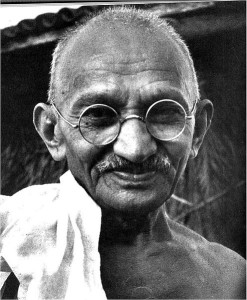
Gandhi

An inspiration…

I don’t know where to begin my speech. I don’t know what people would be expecting me to say. But first of all, thank you to God for whom we all are equal and thank you to every person who has prayed for my fast recovery and a new life.

I cannot believe how much love people have shown me. I have received thousands of good wish cards and gifts from all over the world. Thank you to all of them. Thank you to the children whose innocent words encouraged me. Thank you to my elders whose prayers strengthened me.

I would like to thank my nurses, doctors and all of the staff of the hospitals in Pakistan and the UK and the UAE government who have helped me get better and recover my strength. I fully support Mr Ban Ki-moon the Secretary-General in his Global Education First Initiative and the work of the UN Special Envoy Mr Gordon Brown. And I thank them both for the leadership they continue to give. They continue to inspire all of us to action.

Dear brothers and sisters, do remember one thing. Malala Day is not my day. Today is the day of every woman, every boy and every girl who have raised their voice for their rights. There are hundreds of human rights activists and social workers who are not only speaking for human rights, but who are struggling to achieve their goals of education, peace and equality.

Thousands of people have been killed by the terrorists and millions have been injured. I am just one of them.

So here I stand…. one girl among many.

I speak – not for myself, but for all girls and boys.

I raise up my voice – not so that I can shout, but so that those without a voice can be heard.

Mother_Teresa_with_the_Medal_of_Freedom_1985

Another inspiration (Mother Teresa, not the Reagans)

Those who have fought for their rights: Their right to live in peace. Their right to be treated with dignity. Their right to equality of opportunity. Their right to be educated.

Dear friends, on the 9th of October 2012, the Taliban shot me on the left side of my forehead. They shot my friends too. They thought that the bullets would silence us. But they failed.

And then, out of that silence came thousands of voices. The terrorists thought that they would change our aims and stop our ambitions but nothing changed in my life except this: Weakness, fear and hopelessness died. Strength, power and courage was born. I am the same Malala. My ambitions are the same. My hopes are the same. My dreams are the same.

Dear sisters and brothers, I am not against anyone. Neither am I here to speak in terms of personal revenge against the Taliban or any other terrorist group. I am here to speak up for the right of education of every child. I want education for the sons and the daughters of all the extremists, especially the Taliban.

I do not even hate the Talib who shot me. Even if there is a gun in my hand and he stands in front of me, I would not shoot him. This is the compassion that I have learnt from Mohammed, the prophet of mercy, Jesus Christ and Lord Buddha. This is the legacy of change that I have inherited from Martin Luther King, Nelson Mandela and Muhammad Ali Jinnah.

This is the philosophy of non-violence that I have learnt from Gandhi Jee, Bacha Khan and Mother Teresa. And this is the forgiveness that I have learnt from my mother and father. This is what my soul is telling me: be peaceful and love everyone.

Dear sisters and brothers, we realize the importance of light when we see darkness. We realize the importance of our voice when we are silenced. In the same way, when we were in Swat, the north of Pakistan, we realized the importance of pens and books when we saw the guns.

Malala-Yousufzai

Happy Sweet Sixteen!

The wise saying “the pen is mightier than sword” was true. The extremists are afraid of books and pens. The power of education frightens them. They are afraid of women. The power of the voice of women frightens them.

And that is why they killed 14 innocent medical students in the recent attack in Quetta. And that is why they killed many female teachers and polio workers in Khyber Pukhtoon Khwa and FATA. That is why they are blasting schools every day. Because they were and they are afraid of change, afraid of the equality that we will bring into our society.

I remember that there was a boy in our school who was asked by a journalist, “Why are the Taliban against education?” He answered very simply. By pointing to his book he said, “A Talib doesn’t know what is written inside this book.” They think that God is a tiny, little conservative being who would send girls to the hell just because of going to school.

birthday cakeThe terrorists are misusing the name of Islam and Pashtun society for their own personal benefits. Pakistan is peace-loving democratic country. Pashtuns want education for their daughters and sons. And Islam is a religion of peace, humanity and brotherhood. Islam says that it is not only each child’s right to get education, rather it is their duty and responsibility.

Honorable Secretary General, peace is necessary for education. In many parts of the world, especially Pakistan and Afghanistan, terrorism, wars and conflicts stop children to go to their schools. We are really tired of these wars; women and children are suffering in many parts of the world in many ways.

In India, innocent and poor children are victims of child labor. Many schools have been destroyed in Nigeria. People in Afghanistan have been affected by the hurdles of extremism for decades. Young girls have to do domestic child labor and are forced to get married at an early age. Poverty, ignorance, injustice, racism and the deprivation of basic rights are the main problems faced by both men and women.

Read the rest of this entry »

The movie: President Obama honors National Medal winners

July 11th, 2013
Share
ryan

Yayyyyy Kay!

Yesterday we wrote about the National Medal for the Humanities winners.  And today we have pitchas.  Here’s Kay Ryan, looking spiffy, accepting the award at the White House ceremony.

But wait a minute!  We hadn’t mentioned the National Medal for the Arts yet … or rather we did, because George Lucas and Tony Kushner were in fact winners of the arts medal, not the humanities medal.

jennyJust to sort everything out, here’s the complete list for both:

2012 National Medal of Arts: Herb Alpert, Lin Arison, Joan Myers Brown, Renée Fleming,  Ernest J. Gaines, Ellsworth Kelly, Tony Kushner, George Lucas, Elaine May, Laurie Olin, Allen Toussaint, and the Washington Performing Arts Society, Washington, DC.

2012 National Humanities Medal: Edward L. Ayers, William G. Bowen, Jill Ker Conway, Natalie Zemon Davis, Frank Deford, Joan Didion, Robert Putnam, Marilynne Robinson, Kay Ryan, Robert B. Silvers, Anna Deavere Smith, Camilo José Vergara.

Another familiar face is buried behind the “Washington Performing Arts Society”:  President and CEO Jennifer Bilfield (not Jenny Bellfield, as the subtitle says)  accepts the award on behalf of the organization in photo at right – you can read more about the society here.

But bleccchhh… some of the bland clichés that were offered to presumably reward excellence and innovation in the texts!  Robinson writes about “universal truths about what it means to be human.” The Washington Performing Arts Society has “inspired generations of young performers to follow their passion” – and follow their bliss, too, I’ll bet.  Silvers, co-founder of the New York Review of Books, “elevated the book review to a literary art form.”  So what about Edmund Wilson, Randall Jarrell, and a few others writing well before the NYRB launch in 1963?

We have the pitchas, but we also have the movie.  Kay accepts the award from President Obama at 28.05 below.  Jenny is at 20.42.

National Humanities Medal: New honors, familiar faces – including Kay Ryan!

July 10th, 2013
Share
"Witty and accessible," for sure. (Photo L.A. Cicero)

“Witty and accessible,” for sure. (Photo L.A. Cicero)

Yesterday (or was it the day before?) we wrote about California as a literary epicenter.  What could be more timely, then, than the announcement that Marin poet Kay Ryan is among those who will receive the National Humanities Medal this year?  (We’ve written about her oh, here and here and here and here.)  Here’s what Steve Moyer at the NEH said about the Pulitzer Prize winner, MacArthur Fellow, and former U.S. poet laureate:

Her work is accessible and witty, marked by mordant humor and word play, but with serious intent and long-lasting impact on readers. “I want something to get done in a poem,” she said recently in a telephone interview. “I want to know something I didn’t know.” Her use of what she has termed recombinant rhyme is one of her defining characteristics. Her tightly woven verse (lines are sometimes no more than two or three syllables) can ponder a philosophical conundrum, crystallize an irony, or hold up for brief yet piercing examination the opposing poles of a contradiction. Poet and editor J. D. McClatchy has said of Ryan’s work, “Her poems are compact, exhilarating, strange affairs, like Satie miniatures or Cornell boxes.” …

Ryan, born in San Jose, California, in 1945, grew up in towns in the San Joaquin Valley and the Mojave Desert, where she was something of a class clown and from childhood had a “rapaciousness for language.” Her father worked as a ranch hand, an oil driller, and a prospector on a chromium claim. He died when Ryan was nineteen, prompting “After Zeno,” an unsentimental meditation on lives that overlap until the day when suddenly, they no longer do. The four-stanza poem begins, “When he was / I was. / But I still am / And he is still.” After positing questions about time and plurality, the poem—her first—concludes, “There’s no sense / In past tense.”  …

Surprisingly, Ryan says she reads little poetry, fiction, or history, opting instead for the “belle lettrists,”—essays on literature by Italo Calvino, Milan Kundera, Vladimir Nabokov, and Joseph Brodsky. She prefers not to read fellow poets because, as she slyly puts it, “Like eucalyptus trees, they poison the soil beneath them so nothing else can grow there.” Ryan has other reading tics. She doesn’t like electronic reading devices, she chuckles, because she feels compelled to physically deface a book by taking notes in the margins.

Kushner, too.

Kushner, too.

And the future of poetry? “It will change platforms maybe, but I don’t worry about poetry or people reading poetry. It will survive because it’s pleasurable and is the most expedient method for certain kinds of exchange.”

It’s always pleasant to see friends’ names on the list … or even acquaintances.  I’ve interviewed playwright Tony Kushner before, in an article about his former mentor, Carl Weber.  It was a fun interview, though it took eons to schedule through intermediaries.  Another famous Californian, George Lucas, will be awarded, as will playwright Anna Deavere Smith and author Joan Didion will also be awarded, and Robert B. Silvers (of New York Review of Books fame).

Other winners include: Edward L. Ayers, William G. Bowen, Jill Ker Conway, Natalie Zemon Davis, Frank Deford, Robert Putnam, Marilynne Robinson, and Camilo José Vergara.

The awards ceremony will take place … tomorrow!

California as “the epicenter for literary wars”

July 8th, 2013
Share
DanaGioia

California boy.

Not all of us took to California naturally – I wrote about Czesław Miłosz‘s difficult adjustment to the West Coast here.  But some of us were born to the place:  Dana Gioia, for example, was born in gritty little Hawthorne outside L.A., and even during his long years as chairman of the National Endowment for the Arts, he kept his enchanting Santa Rosa home.  Since August 2011, he’s been the Judge Widney Professor of Poetry and Public Culture at the University of Southern California. We never thought we’d see him in academia – in California or anywhere else.

The spring issue of The Los Angeles Review was dedicated to him.  I know, I know, it’s summer now, but I’ve just gotten round to reading the Q & A he did with the review’s nonfiction editor Ann Beman – plus, I’m including his poem about California in August, so in a sense, I’m early.

The last part of the interview discusses a favorite theme of his – California literature.  (Check out his earlier controversial essay “Fallen Western Star” here). But California as “the epicenter of literary wars”?  Who knew?

From the interview:

A.B.:  When you think of a journal such as The Los Angeles Review that tags itself as “Divergent West Coast Literature,” what do you envision?

D.G.:  I envision a journal that approaches West Coast literature as it really is rather than how outsiders imagine it. California, for instance, has a far richer and more diverse literature than commonly presented. It contains all sorts of enriching contradictions.  Competing aesthetics exist side by side. The state has been the epicenter for most of the literary wars that have been fought for the past century.  Out of these battles have emerged all sorts of major trends and genres – naturalism, multiculturalism, science fiction, hard-boiled detective fiction as well as the beat movement, language poets, and new formalists.  I would love to see a journal that embraced the notion of West Coast culture as a dialectic rather than a consensus.

A.B.: What is Los Angeles’s literary legacy? What do you see as literary L.A.’s future?

D.G.:  Los Angeles has had its richest literary legacy in fiction, especially populist forms of fiction. Contemporary science fiction and detective fiction were essentially invented here.  There has also been a rough and tusantarosa1mble school of naturalism. Our masters have been Raymond Chandler, Ross Macdonald, Ray Bradbury, Richard Matheson, Robert Heinlein, Octavia Butler, John Fante, Budd Schulberg, Charles Bukowski, and Joan Didion.  (Most of these writers were not taken seriously initially.)  L.A. was also a place that tranformed writers who came from the Europe or the East – authors such as Aldous Huxley, Christopher Isherwood, F. Scott Fitzgerald, Nathaniel West, and Thomas Pynchon. For poetry, L.A. has often labored under the shadow of San Francisco.  Our greatest poet, Robinson Jeffers, did not emerge as a major talent until he had lived sequestered in Carmel for many years.  Things have begun to change recently.  It seems to me that L.A. is on the verge of a great poetic period.  Perhaps The Los Angeles Review can play a part in that efflorescence.

A poem elsewhere in the issue seems aimed at those of us who never quite got the hang of California, but who, somewhere along the way, became Californians anyway. We are legion.

California Hills in August

I can imagine someone who found
these fields unbearable, who climbed
the hillside in the heat, cursing the dust,
cracking the brittle weeds underfoot,
wishing a few more trees for shade.

An Easterner especially, who would scorn
the meagerness of summer, the dry
twisted shapes of black elm,
scrub oak, and chaparral, a landscape
August has already drained of green.

One who would hurry over the clinging
thistle, foxtail, golden poppy,
knowing everything was just a weed,
unable to conceive that these trees
and sparse brown bushes were alive.

And hate the bright stillness of the noon
without wind, without motion,
the only other living thing
a hawk, hungry for prey, suspended
in the blinding, sunlit blue.

And yet how gentle it seems to someone
raised in a landscape short of rain –
the skyline of a hill broken by no more
trees than one can count, the grass,
the empty sky, the wish for water.


<<< Previous Series of PostssepNext Series of Posts >>>
