
@#$%! Shakespeare at his worst, and Melissa Mohr’s short history on old curses

July 27th, 2013

Share
Harumph.

Watch your tongue, sir.


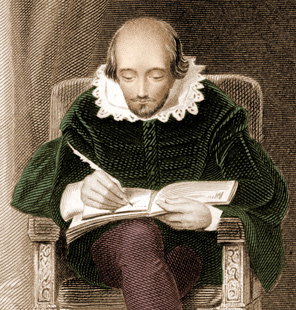
Thou bawdy, motley-minded rudesby!

Thou brazen, raw-boned canker-blossom!

Thou art a sottish, clay-brained nut-hook!

Thou prating, paper-faced pantaloon!

Thou art a waggish, horn-mad dogfish!

Thou art a hideous, eye-offending, hedge-pig!

Thou vacant, lean-witted manikin!

Who knew this was William Shakespeare at his rudest?  According to the high school English teacher who runs the blog Marginalia, “I gave my students a list of his oaths and insults, garnered from the body of his plays, [which] shows a predilection for double entendres, sexual flaws, and short jokes. … Upon examining this list, my students were immediately struck by the lack of anything explicit. I had told them that Shakespeare could be quite foul, when he chose, and there was a collective disappointment when the list failed to provide them with anything particularly R-rated. It wasn’t until I began to help them weed through the euphemisms and sift through the language that they began to get a picture of the breadth and scope of Shakespeare’s curses. The average tenth-grader will probably not be aware that to call someone ‘raw-boned’ is to imply that the person in question has been having so much sex that they feel literally raw. They will not know that in Shakespeare’s day, the word ‘nothing’ also meant ‘no thing,’ ‘thing’ meaning penis, making nothing sort of a euphemism for the female genitalia. Thus, when Hamlet tells Ophelia that nothing is a fair thought between a maid’s legs, he’s obliquely referencing her vulva. And what, then, do you suppose is the real meaning of the title Much Ado About Nothing?”

HolyScoverIf you’re into antique obscenity, you might also want to check out Melissa Mohr‘s Holy Sh*t: A Brief History of Swearing – or at least John McMurtries review of it in today’s San Francisco Chronicle.  She studies the evolution of swearing from the Romans to today.  “Swearing is like the climate — it goes through cycles,” she claims.

“Ordinary people didn’t know Latin; women didn’t know Latin (with few exceptions, including Queen Elizabeth I); children didn’t know Latin. This made the language particularly suitable for talking about things you didn’t want the majority of people to understand — dangerous things such as sex.”

“In the Middle Ages, the equivalent of modern obscenity was not ‘foul words,’ but oaths. … Vain swearing [such as ‘by God’s bones’] was medieval obscenity, carrying all the power of the public utterance of taboo topics that defines obscene words.”

I take issue with her claim about the rarity of Latin – all the children in the Tudor household learned it, including Queen Elizabeth’s half-sister Mary and her cousin Lady Jane Grey, in addition to the males (Catherine of Aragon, Henry VIII‘s well-educated first wife, certainly spoke it too, and his last, Catherine Parr).  Thomas More‘s household learned it.  I expect most children in the aristocratic households learned enough to fake it.  Presumably Petrarch didn’t write most of his work in Latin because he thought it would be kind of an inside joke.  And that’s just off the top of my head. Certainly it was the language of church and law, which already includes a lot of churchmen (and churchwomen, such as nuns) and lawyers, and I bet the people sitting in the pews had picked up a little along the way, though what they picked up on Sundays was not likely to include useful curses.

But “vain swearing” accounts for a lot of obscure curses, such as Shakespeare’s oft-repeated  “Zounds!”

Shirley Jackson’s “The Lottery” – it wasn’t as easy as she claimed.

July 24th, 2013
Share
ShirleyJack

Between the playpen and the frozen vegetables? Not.

We missed June 27, the official day Shirley Jackson‘s “The Lottery” takes place.  It’s a counterpart to Bloomsday earlier in the month, on June 16.  You know the story:  In a small-time American town, citizens gather every year to implore an unnamed force to grant a good corn harvest. The citizens draw slips of paper from a wooden box to select a victim for human sacrifice. A young mother draws the losing card, and is stoned to death by the community.  The end.

Hundreds of letters poured into the New Yorker when it was first published in 1948.  What did the story mean?  According to her husband, the literary critic Stanley Edgar Hyman, “she consistently refused to be interviewed, to explain or promote her work in any fashion, or to take public stands and be the pundit of the Sunday supplements. She believed that her books would speak for her clearly enough over the years.”

That’s not quite true.  She told the San Francisco Chronicle a month after the story was published:  “Explaining just what I had hoped the story to say is very difficult. I suppose, I hoped, by setting a particularly brutal ancient rite in the present and in my own village to shock the story’s readers with a graphic dramatization of the pointless violence and general inhumanity in their own lives.”

Don't say I didn't warn you.

Don’t say I didn’t warn you.

And how was the story written?  According to Jackson, speaking at a lecture, “I had the idea fairly clearly in my mind when I put my daughter in her playpen and the frozen vegetables in the refrigerator and, writing the story, I found that it went quickly and easily, moving from beginning to end without pause. As a matter of fact, when I read it over later I decided that except for one or two minor corrections, it needed no changes, and the story I finally typed up and sent off to my agent the next day was almost word for word the original draft.”

The single change was a request from the  New Yorker editor who reviewed the first draft, who asked “that the date mentioned in the story be changed to coincide with the date of the issue of the magazine in which the story would appear, and I said of course.”

That’s not quite true, either.  William Brennan‘s article in Slate, which came out last month in time for Lottery Day, corrects the record, after he made a trip to the Library of Congress, which holds Jackson’s records.  You can read the list of his discoveries in “How Shirley Jackson Wrote ‘The Lottery'” here.

Here’s something I didn’t know.  Jackson wrote The Haunting of Hill House, which was adapted in the Robert Wise film The Haunting, with Julie Harris and Claire Bloom.  Scared the bejeebers out of me when I was an imaginative little kid. I’ve refused to go to horror movies ever since.

Peter Carroll’s poems, Rodin’s hero, and an old and dicey part of town

July 22nd, 2013
Share
2013-07-21 20.47.08

“Know Knew Books” … a funky Palo Alto landmark that keeps late hours.

The bookstore called “Know Knew Books” is something of a Palo Alto institution. Located at 415 California Avenue, it’s in the center the city’s “second downtown.” However, California Avenue was the equivalent of Main Street in the defunct town of Mayfield, which was swallowed into Palo Alto years ago. The story is much more interesting than I had known.  From the Palo Alto wiki:

2013-07-21 20.42.13

A familiar face…

The town of Mayfield, centered in what is now the California Avenue business district, predated Palo Alto by some 40 years, being established in 1855. …

Senator [Leland] Stanford, after he decided to turn his horse farm into a university, met with Mayfield leaders in 1886 to discuss his plans for the university. He told them that his university would need a nearby town for its needs, and Mayfield was the closest town. But, he added, he didn’t like the dozen saloons that had given Mayfield a somewhat unsavory reputation and suggested that they be closed.

The saloon owners won out, their establishments remained open, and Stanford went on to build his university and encourage the development of a new town, Palo Alto, north of Mayfield. Stanford thought so highly of Mayfield that he locked the gate from Escondido Road into Mayfield and kept it locked until 1913.

Symbolically and realistically cut off from Stanford, Mayfield suffered while its upstart neighbor, Palo Alto, prospered. When the Mayfield city officials finally outlawed the saloons in 1905, the town’s reputation improved. As Palo Alto and Mayfield started growing toward each other, talk began of annexation.

I didn’t know I lived in such a dangerous part of town, with such a dicey history.  But there are you are.  Who knew?

At any rate, if you duck into Know Knew Books’ doors after dinner (it’s usually open pretty late), you’re likely to pet a dog or two, sit on a well-worn couch, chat with the bearded, 60s aficiando proprietor, and hear, perhaps, a recording of the Broadway version of Hair.   “Know Knew Books” sells used books, regularly features fantastic sales, and usually has “going out of business” signs in its window (long story) – and sometimes it has poetry readings, too.

Am I imagining things?

Am I imagining things?

It did last night, when historian and poet Peter Neil Carroll read from his two collections of poetry, A Child Turns Back to Wave: Poetry of Lost Places (2012) and Riverborne: A Mississippi Requiem (2008).  I’d met him a few months ago at “A Company of Authors” – I chaired the panel he participated in, called “The Power of Poetry.”  In his poems, Peter explores “the idea of “place” as a state of mind. He won this year’s Prize Americana for Poetry from the Institute for the Study of American Popular Culture – I remember that part from the introduction I gave him.

It was a genial reading, well attended by a couple dozen people.  After his 45-minute reading, however, it was open mic night – so, not feeling well, and I stepped out into the cool air of a Palo Alto July and headed home, a few blocks away. During the reading, his face had haunted me.  I knew I’d seen him somewhere before even our meeting last April.  Then it clicked.  I’d seen him on the Stanford Quad.  Rodin’s Burghers of Calais.  Does he look like Jean d’Aire?  See what you think.  Oh well, it’s hard to see the resemblance in when he’s smiling, as he is in my Droid photo.  (And Mayfield is like Calais … and Leland Stanford is like Edward III…)

Meanwhile, here’s a poem from last year’s collection, which he read at the moment I pulled up a chair at the reading:

MEDICINE WHEEL, WYOMING

What else could they do in deep darkness
but study the stars, stitch light into stories?

The holy ones spurning food and sleep
step into trance to seek prophecy or luck.

The same lure brings saints and fools
to kneel at the rim, tie gifts to the wire—

herb pouches, bundles of sticks sewn
in purple string, feathered arrows.

A buffalo skull leans on a ring of stones.
Cloudless, blue simmering light pours

as if liquid.  The eyes fill with tears.
In time the wind shreds every prayer.

In stillness, the body locates its fear—
being turned, falling from the planet.

A hawk hangs, circling, wings dizzying.
I look down to see sun mirrored on a stone,

lift the red, iridescent jewel, warm in hand,
place it on a white rock—afraid to say why.

Our birthday card for Petrarch: “his deepest torments are shockingly foreign”

July 20th, 2013
Share
petrarch1

Where would we be without both of them?

sainte-claire-avignon

Met and buried here.

Happy birthday, Francesco Petrarca (a.k.a. Petrarch), born this day in 1304. What better way to celebrate the Tuscan poet’s birthday today than with this Venetian painting, circa 1510, which portrays him with the lady who rejected him in life, Laura de Noves? She rebuffed him for good reason; she was married with children at the time of their first meeting.  As Samuel Maio writes in his foreword to A.M. Justers translations, published by Birch Brook Press (2001), it was “a longing intensified by the cultural, religious, and moral fates that have deemed her unreachable. Perhaps this is the reason for our age’s attraction to Petrarch, that his deepest torments are shockingly foreign and mysteriously antiquated compared to our culture’s insistence on immediate (if not satisfactory) gratification of our every whim and concupiscent impulse.”

But I have become intrigued with both figures for other reasons, for I am in love with Avignon.

That small Provençal city is where the poet first encountered Laura.  She was born in Avignon during the Babylonian Captivity, when the city was the hub of Western Christendom.  Petrarch summed their relationship this way:

Laura, illustrated by her virtues and well-celebrated in my verse, appeared to me for the first time during my youth in 1327, on April 6, in the Church of Saint Claire in Avignon, in the first hour of the day; and in the same city, in the same month, on the same sixth day at the same first hour in the year of 1348, withdrew from life, while I was at Verona, unconscious of my loss…. Her chaste and lovely body was interred on the evening of the same day in the church of the Minorites: her soul, as I believe, returned to heaven, whence it came.

Plaque_dépossée_sur_la_façade_du_Couvent_Sainte-Claire_Avignon_by_JM_RosierOr, as he expressed it in his Canzioniere, in Juster’s translations:

Love, just when hope,
the yield from all my faith, had bloomed,
I lost the one whose mercy I assumed.

She died at the age of 38 in the year 1348, on April 6th, another Good Friday, and 21 years to the hour that Petrarch first saw her.  One biographer wrote that we know little about her except that she possessed great beauty. I rather doubt we know even that. I’ve known too many men to see extraordinary charm in ordinary faces, and enough of a Jungian to know that we project much of ourselves into the beloved. I suspect he saw in her, as his father’s chum Dante saw in another woman: grace and dignity and proportion and (let’s hope) a profound spiritual dimension that made her worthy of attention, though not inclined to be silly if she was ever aware of the rapture she had inspired. 

Recalling, perhaps, the Paschal associations with their meeting and her death, Petrarch wrote:

justerHe did not grace Rome when he came to Earth,
but chose Judea, for above all traits
it pleased Him to exalt humanity.

And so to show that He appreciates
both nature and my Lady’s place of birth,
a village sun becomes his legacy.

So let us celebrate both today, in the remaining hours of the day.  Were it not for her, we would not have Petrarch’s Canzoniere – and without the Canzoniere, I doubt we would be remembering this day with quite so much veneration.

Need to lift your spirits? Try this summer’s Importance of Being Earnest

July 19th, 2013
Share
wilde

A love-hate relationship. Here, the hate phase. (Ruth Marks, Don DeMico, Jessica Waldman)

It’s been a dispiriting week of news, with tragedies, disasters, outrages, crime.  In that sense, I suppose, it’s not so different from any other week.  Can anything lift our spirits nowadays?

Try showing up at the Piggott Theater sometime between now and August 11 for the Stanford Summer Theaters production of Oscar Wilde‘s The Importance of Being Earnest.  Under the clever and skilful direction of Lynne Soffer, the production sparkles and snaps.  I think it may be the all-round best show I’ve seen by the summer repertory yet – for ensemble performance, for set design, for costumes, and more.

Oscar_Wilde_portrait

He’s watching.

I have to admit I approached the theater with trepidation.  I’ve seen the 1952 classic performance with Dame Edith Evans as Lady Bracknell, and Joan Greenwood, Michael Redgrave, Dorothy Tutin, Michael Denison, and Margaret Rutherford, so my standards are unreasonably high.  The timing for Wilde’s wonder piece must be perfect – otherwise it’s like a soufflé left in the oven for a minute too long.

Of course, not all the performances were perfectly spot-on, but the esprit of the cast who clearly enjoyed working with one another made up for any minor flaws, and the euphoria carried into the opening-night reception afterwards.

Here’s what the Stanford Summer Theater’s founder and artistic director, Rush Rehm, wrote in the evening’s program:

As Wilde famously wrote, “The comic spirit is a necessity in life, a purge to all human vanity.” We need that spirit more than ever, as we face the daunting challenges that lie ahead. If I listed them all here, you’d just have to laugh … or give up the ghost.  …

I have been passionately in love with this play since I first ran into it as an undergrad quite a while ago. I found its wit and brilliance of language a perfect fit with the hollowness of the world it attempts to expose, and that truth resounds to this day.

Wilde, himself, believed in “living as an art” and has filled this play with characters who share that love to the nth degree.  While they are all richly “extended characters,” we trust that bringing them alive truthfully and radiantly is all that Mr. Wilde would wish of us. As my old acting teacher, Bill Hickey, used to say, “There is no size to truth.”

Get tickets quickly here. It’s likely to sell out fast.

As a warm-up, watch Dame Edith Evans grill Michael Redgrave in the clip below:

How a small U.S. publisher pipped the U.S.S.R.

July 16th, 2013
Share
Arabella

Like mother…

Some time ago we posted about the fall event at the University of Michigan commemorating Carl Proffer and Ardis, the publishing house he co-founded with his wife (and MacArthur “genius” fellow) Ellendea Proffer.  Ardis published the best Russian literature in an era when the Soviet government wouldn’t.  The film we included in that post ended with the youngest of their four children, Arabella Proffer.

Arabella grew up be an artist, and has a blog called Arty Farty.  In a recent post, “A Little Bit About Ardis,” she describes how she’s currently preparing videos for the conference. Some of them feature such writers as Lev Razgon and Emma Gerstein – and one is her own interview with her mum, talking about Ardis in 1999.  It begins:

“When we started Ardis, we never saw our readers. We saw our writers, the people we were publishing, but we didn’t come in contact with our real readers. The people who got the smuggled books in their hands in Siberia, for example.  The people who took copies of Nabokov and Bulgakov and Brodsky to the Ukraine, for example. We knew our little worlds in Leningrad and Moscow, where all the writers were and the people connected to them. They were very excited about what we were doing, but of course these weren’t exactly the people we were doing it for. And we met those people only a couple times in our life – Carl only once, unfortunately…”

Watch the rest here:


<<< Previous Series of PostssepNext Series of Posts >>>