Joseph Brodsky: “betrayal invites you to descend”

May 15th, 2013
Share

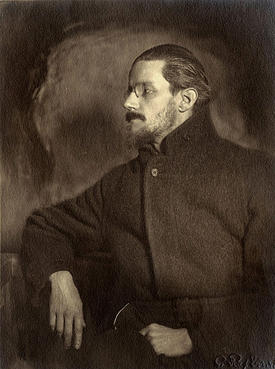
As you might have gathered, I’ve been somewhat backlogged of late.  Tonight, however, I was working on an interview transcript and checking a reference, when I ran across this passage in Joseph Brodsky‘s essay, “Collector’s Item,” in On Grief and Reason.  It seemed like the good thought to share with Book Haven readers tonight, on a day when the news has been full of lies and spies and betrayal (like every other day)…

brodsky3

Back in the U.S.S.R. … at about 24

When I was twenty-four, I was after a girl, and in a big way. She was slightly older than I, and after a while I began to feel that something was amiss. I sensed that I was being deceived, perhaps even two-timed.  It turned out, of course, that I wasn’t wrong, but that was later.  At the time I simply grew suspicious, and one evening I decided to track her down. I hid myself in an archway across the street from her building, waited there for about an hour, and when she emerged from her poorly lit entrance, I followed her for several blocks.  I was tense with excitement, but of an unfamiliar nature. At the same time, I felt vaguely bored, as I knew more or less what I might discover. The excitement grew with every step, with every evasive action I took; the boredom stayed at the same level.  When she turned to the river, my excitement reached its crescendo, and at that point I stopped, turned around, and headed for a nearby café.  Later I would blame my abandoning the chase on my laziness and reproach myself, especially in the light – or, rather, in the dark – of this affair’s denouement, playing an Actaeon to the dogs of my own hindsight.  The truth was less innocent and more absorbing.  The truth was that I stopped because I had discovered the nature of my excitement.  It was the joy of a hunter pursuing his prey. In other words, it was something atavistic, primordial.  This realization had nothing to do with ethics, with scruples, taboos, or anything of the sort. I had no problem with conferring upon the girl the status of prey.  It’s just that I hated being the hunter.  A matter of temperament, perhaps?  Perhaps.  Perhaps had the world been subdivided into the four humors, or at least boiled down to four humor-based political parties, it would be a better place. Yet I think that one’s resistance to turning into a hunter, the ability to spot and to control the hunting impulse, has to do with something more basic than temperament, upbringing, social values, received wisdom, ecclesiastical affiliation, or one’s concept of honor. It has to do with the degree of one’s evolution, with the species’ evolution, with reaching the stage marked by one’s ability to regress. One loathes spies not so much because of their low rung on the evolutionary ladder as because betrayal invites you to descend.

 Postscript on 5/16:  A comment from John Adams over at “Gentle Rereader” who writes:

The year that Brodsky pursued his double-agent in love, 1964, “Meditations on the Literature of Spying” questioned the public interest in espionage fiction.  No need to resort to microfilm anymore, as The American Scholar republished the essay five years ago and has kept it up with this permalink:  http://theamericanscholar.org/meditations-on-the-literature-of-spying/

The author sometimes wrote under the code name “Roger du Béarn,” but in this instance used his own name and plain-text style.  A sample:  “To know in advance that everything and everybody is a fraud gives the derivative types what they call a wry satisfaction. Their borrowed system creates the ironies that twist their smiles into wryness. They look wry and drink rye and make a virtue of taking the blows of fate wryly. It is monotonous; I am fed up with the life of wryly.”

How Estonia sang its way to freedom

May 13th, 2013
Share

 A few days ago we wrote about Estonian bard Friedrich Reinhold Kreutzwald while bumping along on a train in Massachusetts here. That prompted colleague Lisa Trei to forward us her own recent article about the film The Singing Revolution (we wrote about it here).  A slightly shorter version of the article was published in the Stanford Post-Soviet Post here –  the entire piece is below.

singingrevolution

Estonia’s song festival – 25,000 onstage

The Singing Revolution,” a critically acclaimed documentary about Estonia’s non-violent struggle for freedom, tells the remarkable story of how a small nation used its cultural heritage to survive and, ultimately, defeat the Soviet empire.

Producer and Director Jim Tusty said he made the film because the story of how Estonia used its choral tradition to persevere during Soviet rule is largely unknown. “It’s David beating Goliath without even using a slingshot,” he said. “I just felt it was a great story to be shared with the world.”

Tusty and his wife and partner, Maureen Castle, first heard about the ‘singing revolution’ when a chance encounter in 1999 led the couple to teach filmmaking for three months in Tallinn, the capital of Estonia. The phrase refers to the period from 1987-91 when Estonians used non-violent resistance to challenge and, ultimately, break away from Soviet rule.

The couple, both experienced television program and commercial producers, wanted to learn more. “We were blown away,” Tusty said. When they returned to teach in Estonia in 2001, they decided to make what would be their first feature-length film. Tusty is of Estonian descent but does not speak the language and was not raised in the Estonian-American émigré community, which actively lobbied for independence during the Soviet occupation. Instead, Tusty said, he was attracted by the story’s intrinsic and dramatic value. “We did not make the film as a patriotic duty to Estonia,” he said.

sovieteraposter

Soviet-era poster for the festival

Nevertheless, key funding for the film came from Stanford philanthropists Walter P. Kistler and his Estonian wife, Olga Ritso Kistler, as well as Steve Jurvetson, a Silicon Valley venture capitalist of Estonian descent. Many members of the émigré community also backed the project.

“The Singing Revolution” focuses on the ‘Laulupidu’ or Song Festival, which brings together community choirs and dancers from across Estonia to Tallinn every five years. For two days, up to 30,000 singers perform on an open-air stage before an audience of tens of thousands. Since its establishment in 1869 during Estonia’s first national awakening, the Song Festival has played a critical role in maintaining the country’s cultural identity, particularly during the half-century Soviet occupation. Even today, the festival continues to bring together more than 10 percent of Estonia’s population. When 140,000 Estonians sing together, as they did during the most recent festival, the intensity is palpable, Tusty said.

The filmmaker uses the backdrop of the 2004 Song Festival to frame the complicated narrative of the groups that vied to lead Estonia during its struggle for freedom. “We did not think it was just Peter, Paul and Mary singing on a hill and then all the tanks left,” Tusty said. “But we were naïve about the contentiousness among the independence groups within Estonia.”

posterThe film features interviews with the leaders of the three main groups—the Popular Front, which supported autonomy within the Soviet Union; the Heritage Society, which focused on cultural and historical nationalism; and the radical Estonian National Independence Party, which was led by anti-communist dissidents. Tusty’s task was to weave together a compelling narrative for a world audience that each group within the country would accept as fair and representative.

Tusty showed rough cuts of the film three times to the leaders of each group separately. “Not too many people challenged the facts, but they challenged the spin on the facts,” he said. “The first cut had a lot of comments. But to everyone’s credit, they didn’t just say everything they did was right and everything the other groups did was wrong.” By the time the third cut was completed, the reviewers agreed the story was fair.

“The Singing Revolution” premiered on Dec. 1, 2006, at the Black Nights Film Festival in Tallinn. Tusty said the Estonian audience was skeptical at first—after all, an American was telling their nation’s story. But he recalls that the audience soon relaxed and watched the 90-minute film.

When the documentary ended, the Tustys received a 15-minute standing ovation—a rare display of emotion in a society that values circumspect and personal reserve. Tunne Kelam, a founding member of the Estonian National Independence Party, described it as, “A healing film.” Arnold Rüütel, the last chairman of the republic’s Supreme Soviet who became president of independent Estonia, shook Tusty’s hand. “Overall, the reaction of Estonians has been positive,” Tusty said. “I think people liked it because it provided a window into the country for outsiders.”

Read the rest of this entry »

The Great Gatsby and the Roaring 20s: “There was a feeling that it couldn’t really last. And it didn’t.”

May 10th, 2013
Share
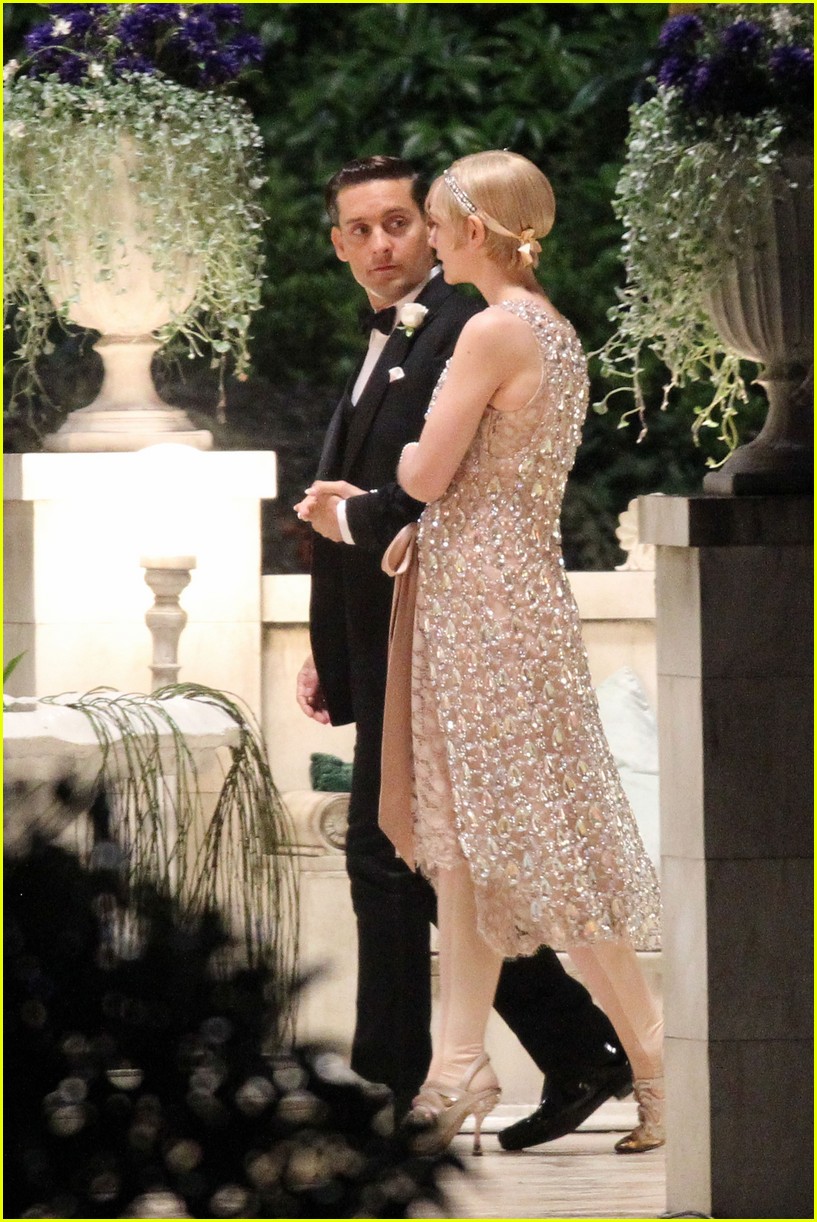
Exclusive - On Set of 'The Great Gatsby'

Tobey Maguire and Carey Mulligan in “The Great Gatsby”

Cynthia Haven:  Two novels from the same year.  One ends with marriage, the other with death – the comic and tragic sides of an era. Can you give us a little of the historical context that would help us understand the 1920s?

Gavin Jones:  The decade began in turmoil, with the end of World War I and with a mood of socialist revolution in the air. It ended with the Stock Market crash of 1929.

It was very much a boom time.  A time of intense competition as well.  In a way, American society began to look like it does today in the twenties.

Business became a kind of religion. By the end of the twenties, over 40 percent of the world’s manufactured goods came from the U.S.  The U.S. became an enormous global power during this decade.

Mass advertising campaigns began to dominate people’s lives.  The most famous advertisement was for Listerine. Its slogan has become a cliché: “Always a bridesmaid, never a bride.” In other words, halitosis was pitched as the cause of people’s social failure.

The salesman became a key figure.   Fitzgerald’s father had been a salesman for Proctor and Gamble, and was sacked when Fitzgerald was 12.  Fitzgerald described it as the central crisis of his youth, and became very interested in male failure in his writings.

Henry Ford became the cultural hero of this new business culture.  He claimed to make a new car every 10 seconds.  The road began to take over from the railroad.  There were 23 million cars in 1929, up from 7 million in 1919.  Perhaps the most important development was rise of the closed car.  It led to all sorts of new freedom – it provided a space where young people could become free from parental supervision.
yellowrolls

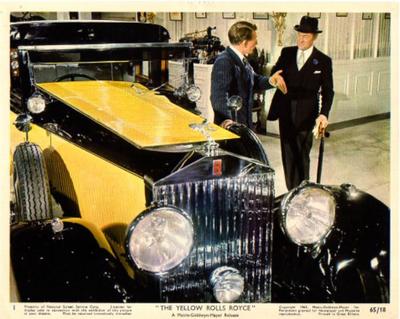
Rex Harrison in 1964’s “The Yellow Rolls Royce”

Haven:  Much like the internet has created a new social space today.

Jones:  Kind of like that, yes.  It’s a good comparison.

Haven:  I remember a rather so-so movie about the era, The Yellow Rolls Royce, written by the playwright Terence Rattigan.  The plot turned on an illicit affair that took place in the car of the title.

Jones:  Religious figures and social leaders saw the car as “a house of prostitution on wheels,” according to one judge.  It was a huge cultural shift to suddenly have all of these automobiles buzzing around society.

Haven:   And wasn’t there a yellow car in The Great Gatsby?

Jones:   The authorities are able to track Gatsby down because of his yellow car.  Initially all cars were black.  By the mid-20s, however, new finishing processes for cars led to a rainbow of colors.

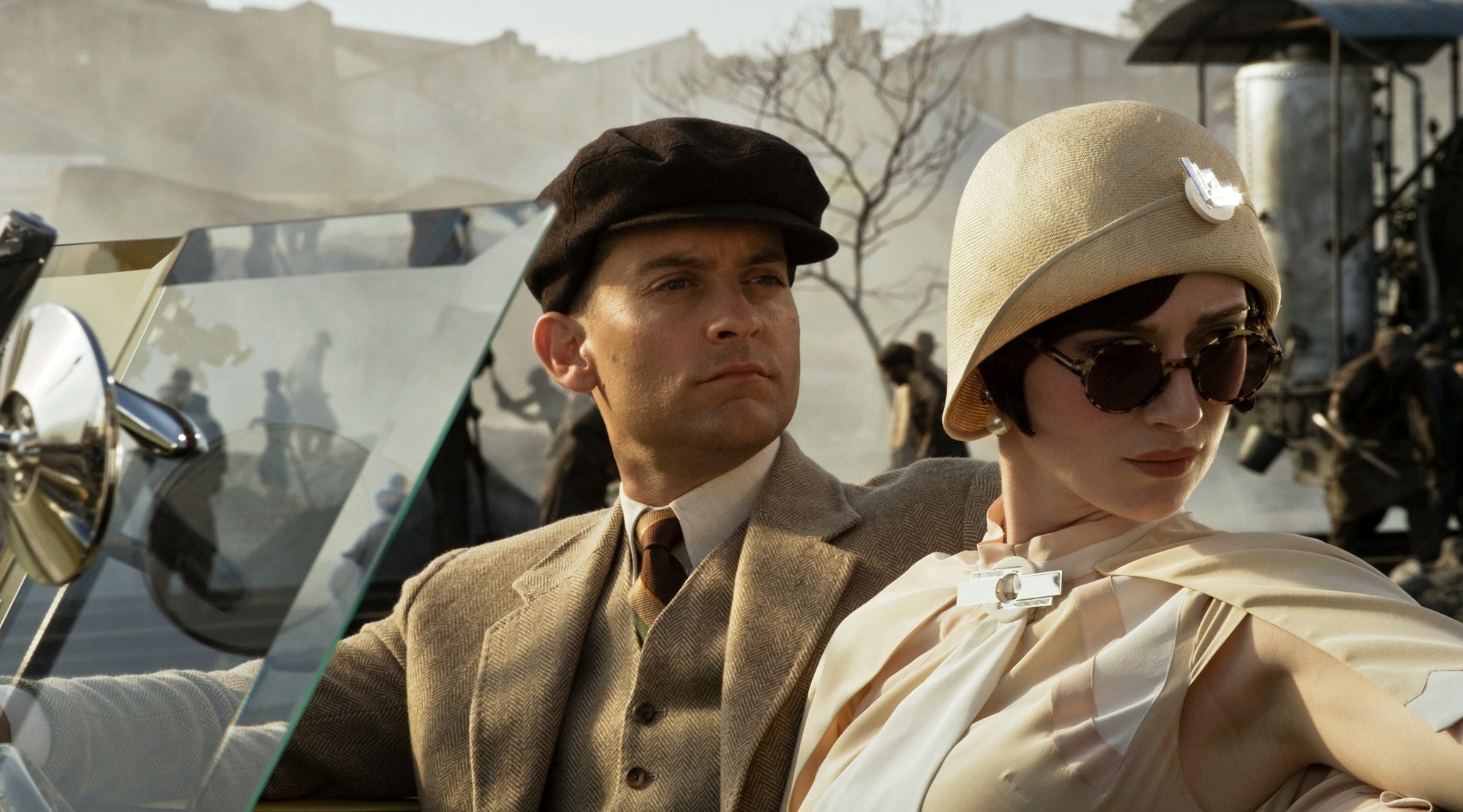
THE GREAT GATSBY

Tobey Maguire and Elizabeth Debicki in “The Great Gatsby”

HavenThe Great Gatsby ends with a car accident.  Oddly, the era marks the beginning of the car accident, and car fatalities, as a commonplace occurrence.

Jones:  It is very much a new thing.  It’s the emergence of modernity.  These novels describe a certain kind of modernity in which the fate of humans is intertwined with machines.  You can see it just the role of the accident – people are very much more prone to accident rather than intention.  There’s a loss of agency with the growth of industrial power.

Meanwhile, a self-conscious, isolated intellectual class came to the fore in America: H.L. Mencken was a huge figure.  Debunking popular myths was a popular pastime in the era, so intellectuals like Mencken would criticize bankruptcy of mass culture.

Haven:  Even as they accelerated its destitution…

Jones:  There was great disillusionment with the institutions of society and with human culture more generally.

Haven:  It was a time of transition for African Americans, too, with a massive migration from south to north.

Jones:  Harlem becomes a center—a “race capital,” as it was described.  Elite whites became fascinated with black culture and Louis Armstrong became a household name.  African American music began to flow into American households, thanks to the radio.

While it was a time of sharing racial culture, it was also a decade of racism.  The Ku Klux Klan became national and political power in 1920s – particularly in the Midwest and California.  It had 4.5 million members by 1924.

Yet Fitzgerald describes it as an apolitical time.  Politics didn’t matter in 1920s, he writes.  It was all about a certain kind of thoughtless mass culture.

Haven:  With all the upheaval, it must have felt like the end of the world for many people.

Jones:  There was a kind of apocalyptic sense in 1920s, that it was all going to end.  There was a feeling that it couldn’t really last.  And it didn’t.

People became nostalgic very quickly.  By 1930, Fitzgerald was writing about the Twenties like it was another life.  Like the 1960s were, for many people.

Haven:  Crime is under the glittering surface of both novels.  Gatsby’s wealth is supported by bootlegging, crime syndicates, and gambling.

Jones:  Organized crime reaches unprecedented levels, mostly because of Prohibition and the trade in illegal booze. Al Capone controlled revenue from alcohol to the tune of $60 million a year.  Protection rackets become a kind of institution in 1920s.

Haven:  In a sense, the drug culture today doesn’t really compare with the booze scene then.  Our drug scene seems to lack the folly and exuberance.

Jones:  Drugs are more of a subculture today.  Alcohol was really the fuel of an elite culture in the 1920s.  The connotations were much more positive – it represented a certain kind of nonconformity. There was a cachet, even heroism attached to it.  While at Princeton, I knew professors who still had martinis at lunch, and still thought they had a kind of allure. Gin became the most popular drink in the 1920s.

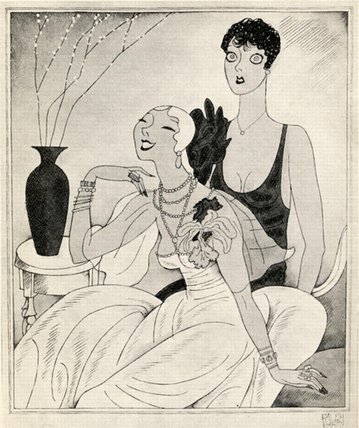
Haven:  In Gentlemen Prefer Blondes, Lorelei and Dorothy represent a new kind of woman, launching out on their own without male protection – and getting as much as they can while committing as little as they can.

Jones:  The flapper was an iconographic figure. These young women smoked defiantly and drank publicly in speakeasies.  Women were also entering labor force in increasing numbers.

Haven:  Women could drink, and vote, and … what about sex?

Jones:  People were obsessed with sex in the Twenties.  The Freudian gospel began to take hold and enter the popular culture.  Sex was seen as a central force in human development – sex explained it all! Terms like inferiority complex, sadism, masochism, the Oedipus Complex entered the language in the twenties.

Premarital sex becomes much more common.  Divorce becomes much more common.  You get what Fitzgerald called the “problem of younger generation,” which was a crucial flashpoint in the Twenties.  The younger generation was Fitzgerald’s great theme.

Movies came to emphasize the body, and kissing – “hot love,” popular confession magazines thrived.  Intense dances developed in the 1920s, emphasizing speed and close bodies, almost falling out of control.  Rudolf Valentino was widely promoted for his lovemaking skills.  Flesh-colored stockings, sleeveless dresses, short skirts: more flesh was on show.   Also, silk and rayon underwear replaced cotton, clinging closer to the skin, showing off the boyish figures that were popular then.

Haven:   America has been described as the land of social dislocation and class anxiety.  In America, money makes the difference between being “upper class” so to speak, and “lower class” – and money says goodbye as often as it says hello.  Certainly social anxiety and insecurity underlie The Great Gatsby, and in a sense, Gentlemen Prefer Blondes, too, the story of a hick-town girl toasting champagne with the upper crust.

Jones:  That’s right.  Fitzgerald describes it as a nervous, violent decade.  Things were almost spinning out of control, and people were rising and falling quickly.  There was great social insecurity, a sense that civilization was in crisis.  That attitude takes root after World War I.  It was a time of fragmentation, in which the certainties of the 19th century were no more.  The Evolutionary Gospel began to take hold, religious faith was increasingly questioned by science.  The backlash: Protestant fundamentalism began in the 1920s.

Haven:  Two world wars.  Two very different reactions.  America reacted to the First World War with wildness and abandon, to the second with domesticity and conformity.  Why the difference?

Jones:  Perhaps it’s because the U.S. became involved much later in World War I.  A general intellectual pessimism about civilization after World War I perhaps signaled the problems that hadn’t been fully resolved.

Europe had been bled dry by that first war.  In England and France, a whole generation of young alpha males had been taken out, a generation is missing.

Haven:  Both books show us the same moment of time from different perspectives – but the superabundance wasn’t worldwide.  Europe was recovering from a catastrophic world war – even Lorelei comments on postwar hardship in Germany.  Yet Evelyn Waugh’s Brideshead Revisited still shows a Twenties esprit in its portrayal of the era.

Jones:   The situation was much more extreme in U.S.  More money, I think – although we should note that, farmers didn’t prosper in rural America.  In general, however, the sudden rise of business was such a huge force, generating so much enormous wealth.  By contrast, England was declining by the 1920s – it as a colonial and industrial power.

Haven:   So what’s the takeaway?  What do these two novels have to tell us today?

Jones:  I think it’s important to understand all the contradictions that came into play in 1920s, because we’re still living with them.

Haven:  The end of the Industrial Revolution is usually placed at the end of World War I, with its emphasis on machinery and invention – and yet it continued.

Jones:  The Industrial Revolution was the beginning of it all.  What changes is the shift toward consumption.  Everything started to shift from production to consumption.  Both of these novels show the moral pitfalls inherent in consumerism.

[link]

“Fate keeps on happening”: “Another Look” book club takes on Anita Loos’s 1925 Gentlemen Prefer Blondes on May 28

May 8th, 2013
Share

It’s that time again:  The third event in the “Another Look” book club will take on Anita Loos‘s Gentlemen Prefer Blondes – that’s right, Marilyn Monroe was not the first Lorelei Lee.  Loos invented the ditzy flapper in her bestselling 1924 book.  The short novel was such a hot ticket that it went through 20 printings in the first year.  Now is your turn to have a crack at it.  (Earlier events are here and here – and you can read more about the event at the Another Look website.)

My Stanford Report story (also online here):

loos-book

Frontispiece to 1925 novel (Courtesy the Anita Loos Estate)

Edith Wharton called Anita Loos’ Gentlemen Prefer Blondesthe great American novel” and declared its author a genius. Winston Churchill, William Faulkner, George Santayana and Benito Mussolini read it – so did James Joyce, whose failing eyesight led him to select his reading carefully. The 1925 bestseller sold out the day it hit the stores and earned Loos more than a million dollars in royalties.

Anita Loos, whose novel Gentlemen Prefer Blondes will be the topic of Stanford’s Another Look book club’s gathering on May 28.

Everyone, of course, has heard of Gentlemen Prefer Blondes, but the short novel’s fame was eclipsed by the 1953 movie of the same name, starring Marilyn Monroe and Jane Russell. Once the bombshell blonde vamped “Diamonds Are a Girl’s Best Friend,” the effervescent Jazz Age novel became a shard of forgotten history. Who has taken the send-up novel seriously since?

Stanford’s “Another Look” book club would like to restore the balance. The book club launched by the English/Creative Writing Department is taking on the comic masterpiece at 7:30 p.m. on Tuesday, May 28, in the Stanford Humanities Center’s Levinthal Hall. “Another Look” is a gift to the community – the event is free, open to the public, with no reservations required.

The evening will be moderated by the English department’s Hilton Obenzinger, well known for his “How I Write” series of conversations with authors (available on iTunes here); he will be joined by English Professor Mark McGurl and Assistant Professor of English Claire Jarvis.

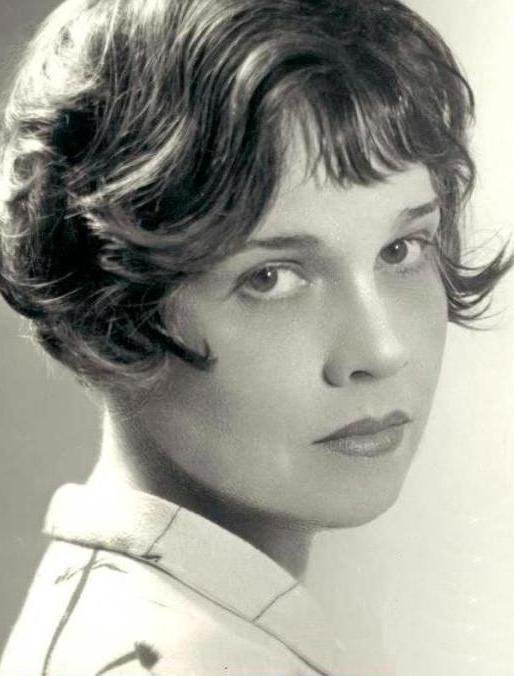
loos4

Not a blonde. (Photo: Anita Loos Estate)

Clearly, this spring will make the 1920s roar again. Beginning May 1, Gavin Jones, chair of the English Department, will discuss F. Scott Fitzgerald’s The Great Gatsby, a cautionary tale of the American Dream, at the Stanford Alumni Association’s Book Salon. Also, a major motion picture of The Great Gatsby, starring Leonardo DiCaprio, opens in theaters on May 10. But while Gatsby, published the same year as Gentlemen Prefer Blondes, takes a grander, tragic look at the era, Loos revels in the pure nuttiness of two gold-diggers taking on New York City and Europe. Its story is told in a flapper’s diary, with spelling and grammatical errors and verbal tics intact:

A gentleman friend and I were dining at the Ritz last evening and he said that if I took a pencil and a paper and put down all of my thoughts it would make a book. This almost made me smile as what it would really make would be a whole row of encyclopediacs. I mean I seem to be thinking practically all of the time. I mean it is my favorite recreation and sometimes I sit for hours and do not seem to do anything else but think. So this gentleman said a girl with brains ought to do something else with them besides think. And he said he ought to know brains when he sees them, because he is in the senate and he spends quite a great deal of time in Washington, d. c., and when he comes into contract with brains he always notices it.

Winston_Churchill

He read it.

Thus begins Loos’ story of two upbeat, fly-by-night con artists, Lorelei and her sidekick Dorothy. “Lorelei and Dorothy create a carnival wherever they go. They create moral havoc,” writes Regina Barreca in the introduction to the Penguin edition, comparing Loos’ creation to Shelley‘s Frankenstein. “They are powerful for the same reason Shelley’s monster is powerful: They have nothing to lose.”

Obenzinger said the sequel But Gentlemen Marry Brunettes takes on a darker tone – drugs, prostitution, exploitation and organized crime make their appearance. But Loos’ Gentlemen Prefer Blondes takes nothing seriously, putting the stereotypic ditzy blonde on the map and immortalizing the era’s new woman, able to vote, smoke, dance and drink. “Lorelei is the female Huck Finn of the flapper era,” said Obenzinger.

“She is naive, shrewd and seemingly unaware as she exposes the absurdities and pretensions of boom-time capitalism,” he said. “It’s a hilarious send-up of new social dynamics, particularly the idea that women could get rich too through sexual manipulation.”

joyce

So did he.

Loos was no Lorelei, however. She said she would “always pass up a diamond for a laugh.” She was born in Sisson, now Mount Shasta City, and grew up in San Francisco and San Diego. Much of her life story is to be taken with a grain of salt: trusted sources place her birth in 1888, 1893 or 1889. Each time she recalled receiving her first paycheck, she was younger, eventually claiming she started her professional writing career at 12. She was, in fact, 24. She also claimed to have written Gentlemen Prefer Blondes while still in her 20s. Not so; she was in her late 30s.

More reliably, she had five decades as a New York playwright, a novelist, a short story writer and one of Hollywood’s most respected and prolific screenwriters. But nothing captured the zeitgeist like Gentlemen Prefer Blondes.

H.L. Mencken, with whom she had a flirtatious relationship, triggered her most famous novel after he briefly turned his attentions to an undistinguished blonde. “Could her power, like that of Samson, have something to do with her hair?” Loos asked.

Mussolini_biografia

Il Duce read it.

“I wanted Lorelei to be a symbol of the lowest possible mentality of our nation,” she wrote of the book that was first published serially in Harper’s Bazaar. Mencken became a fan: “This gay book has filled me with uproarious and salubrious mirth,” he wrote in a review. “It is farce – but farce full of shrewd observation and devastating irony.”

Lorelei scribbles in her diary, “I mean champagne always makes me feel philosophical because it makes me realize that when a girl’s life is as full of fate as mine seems to be, there’s nothing else to do about it.” But is Lorelei really as dumb as she sometimes seems?

She is in control of her destiny. She gets her guy, she gets good times, she gets the diamond tiara she craves, she even dances with the Prince of Wales – and there’s plenty of champagne along the way.

***

The “Another Look” book club focuses on short masterpieces that have been forgotten, neglected or overlooked – or may simply not have received the attention they merit. The selected works are short to encourage the involvement of Bay Area readers whose time may be limited. Registration at the website anotherlook.stanford.edu is encouraged for regular updates and details on the selected books and events.


New York City in 62 hours: revisiting old memories, making new ones

May 6th, 2013
Share

I spent a whirlwind 62 hours in New York City, but they were “cherce.”  Fortunately, photographer (and friend) Zygmunt Malinowski was on hand to document some of the highlights, and has kindly allowed the Book Haven to feature them.

First, I spoke at a commemorative event for Krzysztof Michalski, the founder of Vienna’s Institut für die Wissenschaften vom Menschen, where I was Milena Jesenská Fellow a few years ago.  “Democracy is Controversy Plus Solidarity: In the Absence of Krzysztof Michalski” was sponsored by the Austrian Cultural Forum and the Polish Cultural Institute, in conjunction with the P.E.N. Festival in New York City.

The panel left to right:  Alfred Gusenbauer, former prime minister of Austria;  literary historian and author Irena Grudzinska Gross of Princeton;  Andreas Stadler, director of the Austrian Cultural Forum; Marci Shore of Yale author of The Taste of Ashes: The Afterlife of Totalitarianism in Eastern Europe, and Humble Moi…

2_foto_©_zygmunt_malinowski-1

Whoops!  There’s someone missing from this line-up.  Same cast of characters, but below you can also see Yale’s Timothy Snyder, author of Bloodlands (and Marci Shore’s husband) at far right.

3_foto_©_zygmunt_malinowski-1

Next, some of us who met for the Czesław Miłosz centenary in New York City two years ago decided to celebrate a reunion.  What better place than the famous Russian Samovar, a longstanding mecca for the Russian literati (and other Slavs … and non-Slavs)? The place was a familiar haunt for Joseph Brodsky, a friend of Miłosz’s.

The Russian Samovar’s legendary proprietor Roman Kaplan appeared toward the evening – he’d founded the hang-out with Mikhail Baryshnikov and he’d also been an especially close friend of Brodsky’s.  No sooner did he find out about my association with the Nobel poet than he pulled me into the corner seat, where Joseph Brodsky had usually held court, and a photo with the (by then) glassy-eyed Moi was snapped.  Glassy-eyed, but nevertheless … stepping into a page of New York cultural history.

1_foto_©_zygmunt_malinowski_

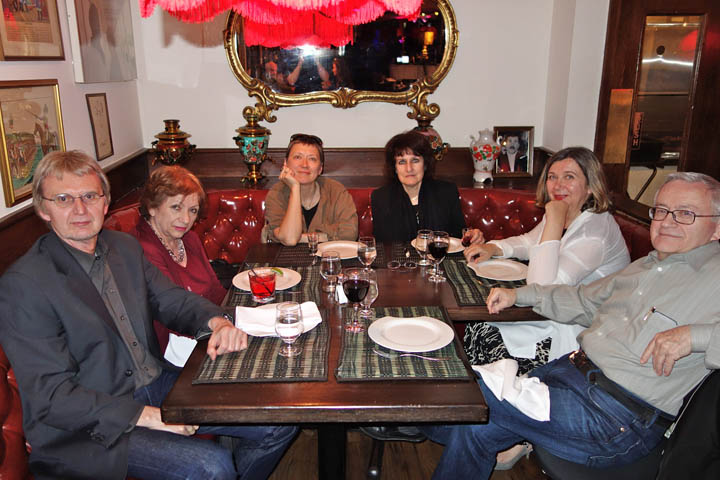
Finally, here’s the whole reunion crew.  This is the only photograph in the group that is not by Zygmunt, because that’s him at far left, looking gravely into the camera (in the mirror you can see the mystery guest photographer’s arms).  The poet Anna Frajlich is next to Zygmunt, then Alla Roylance, Moi, Izabela Barry, and Władek Zając.  Couldn’t find a better group of people.  And you’d hard-pressed to find a better dinner, beginning with vodka infused with horseradish, cranberries, and lemon (you can read about them at the Paris Review here) continuing with Georgian and traditional Russian dishes, and finishing with samovar tea with jam.  Dostoevsky would have approved entirely.

web version zygmunt malinowski archives-1

After the panel discussion, we ended at the residence of U.N. Ambassador Martin Sajdik.  Risotto with white spargel, a perfectly chilled white wine from the Kamp River region, quince schnapps, and plenty of Mozartkugeln.  Can’t top that … but ohhhhh, I wish I could find that brilliant Austrian wine here, but the ambassador, rightly known as a connoisseur, told me the American market likes its wines a little more fruity, a little less delightfully sharp – you have to go to Vienna to get these.  As good an incitement as any, should you need one.

Here’s Roman Kaplan reading Joseph Brodsky’s poems in the commemorative corner:


Thinking nice thoughts about Estonia…

May 5th, 2013
Share

2013-05-01 13.23.46So here I am, bumping along a train outside Boston, after a harrowing day of travel from New York City.  It makes one wish to be far, far away … somewhere like Estonia.

I’ve been thinking about Estonia because a friend in Tallinn sent me a colorful Estonian scarf last week, with some Estonian chocolates in a tin with some of the national highlights, via a conscientious Stanford faculty courier.  It was a kind present, from a kind man … who seems to come from a rather kind nation.  (I wrote about its president here).

The chain of associations inevitably led me back to the fascinating documentary about Estonia’s “Singing Revolution” I wrote about some time ago in a post titled “This is the story of how culture saved a nation,” here.   One comment from the film, in particular, intrigued me – an Estonian remarked that the difference in the national identity is signaled by Estonia’s very different national hero. In England, for example, St. George slays the dragon. Most national legends feature some kind of warrior or conqueror.  But Estonia’s hero is the Barn-Keeper, who waits and watches for his moment, and achieves through sagacity rather than through feats of derring-do.

behemoth

Literary black cats: Behemoth

You can find Friedrich Reinhold Kreutzwald‘s “The Courageous Barn-Keeper” here.  I’m told Kreutzwald is something of the national bard, the author of several books of folk tales.  I finally read this story on this train, feeling like I was on a dangerous journey myself:

Hereupon he took from his bosom a chain woven of fine gold thread, as thick as a shoe-string, which he handed to the barn-keeper, and then vanished, as if he had sunk into the ground. A tremendous crash followed, as if the earth had cloven asunder beneath the barn-keeper’s feet. The light went out, and he found himself in thick darkness, but even this unexpected event did not shake his courage. He contrived to grope his way till he came to the stairs, which he ascended till he reached the first room, where he had boiled his porridge. The fire in the hearth had long been extinguished, but he found some sparks among the ashes, which he succeeded in blowing into a flame. …

Kreutzwald-köler

Estonia’s bard

One character, in particular, caught my attention: “a large black cat with fiery eyes dashed through the door like the wind and rushed up the stairs.”  When the story promised, “We will afterward make it so tame that it cannot hurt anybody again,” I had hoped for a non-violent, happy ending for the feline, in keeping with the Singing Revolution.  Alas, it is a promise broken.

It is not the only famous black cat to come out of Eastern Europe.  Think of the nefarious cat Behemoth in Bulgakov’s The Master and Margarita.  I can’t remember what kind of end Behemoth comes to, but as the owner of a 17-pound black cat myself (not quite the size of Bulgakov’s invention) I hope for the best.

Don’t believe me about the kindness part?  Try watching this short clip for the documentary, “The Singing Revolution,” if you missed it before:


<<< Previous Series of PostssepNext Series of Posts >>>