
“Corduroy-vested academics” and others consider Mary Jo Bang’s Inferno

August 19th, 2012

Share
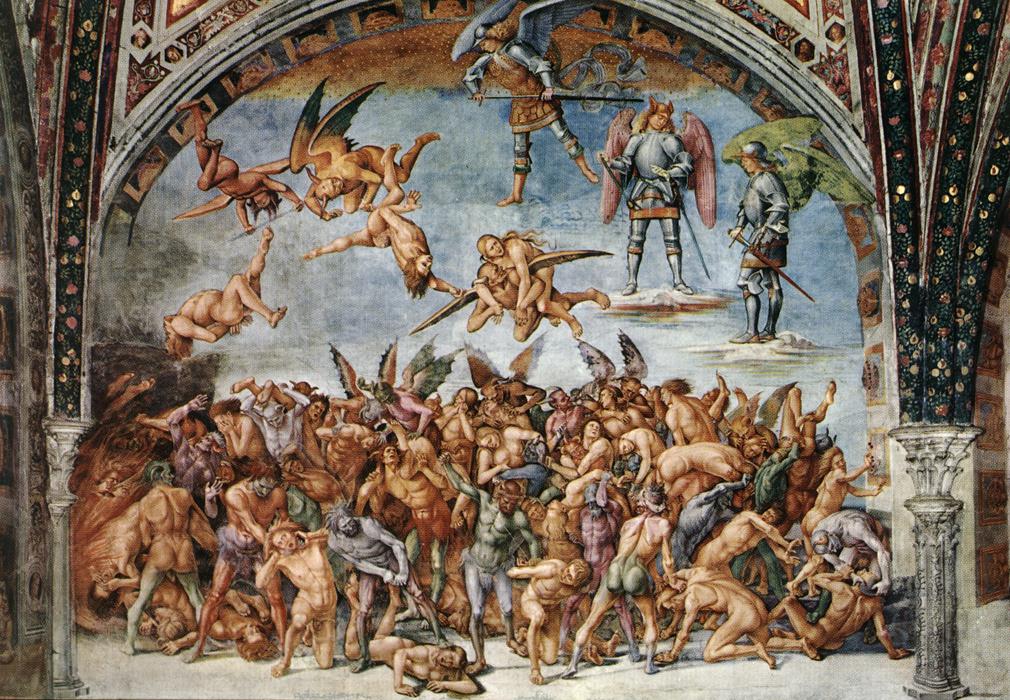
Luca Signorelli's masterpiece in Orvieto Cathedral

.

Stopped mid-motion in the middle
Of what we call a life, I looked up and saw no sky –
Only a dense cage of leaf, tree, and twig. I was lost.

                                                                 –  Canto I, Inferno (trans. Mary Jo Bang)

I’d heard a bit of the  current buzz over Mary Jo Bang‘s new free-verse, free-wheeling translation of Dante‘s Inferno, published by Graywolf Press.  The commentary I’ve read to date seemed bemused, mostly admiring.  However, Vanity Fair‘s Elissa Schappell warns me that “Bang’s Inferno already has some corduroy-vested academics tugging on their beards with indignation and beetle-browed translators jabbing at their eyes with pencils.”  She offers more hepped-up writing than she does insight about the “thrillingly contemporary translation of the first part (the juiciest part) of Alighieri’s 14th century poem…”  Why is the Inferno considered “the juiciest part”?  Anna Akhmatova kept Doré’s engravings of it on the walls of her Fontanka apartment – but then, she was living in Soviet Russia, a place where the Inferno had a special resonance.  I’ve always taken a shine to the hopeful, redemptive, and comparatively underrated Purgatorio.

I also read  Alexander Nazaryan‘s “What Fresh Hell is This?” in the New York Daily News.  He admits that Bang  “does sacrifice some of the musicality of the original,” but defends her choices:  “Bang has sacrificed some of the faithfulness to Dante’s rhyming structure (which sounds too much like sing-song in English, anyway) and has ditched many, though not all, of Dante’s allusions, in order to preserve something more important: Dante’s meaning.”

Ummm… A good translation of Dante’s terza rima shouldn’t sound like “sing-song,” and I don’t see why I should be restricted to a bread-and-water poetry because some modern readers can’t handle meter.  Poetry, after all, is supposed to be “memorable speech,” and not just because of what the words say, but the means used to say them. And don’t the allusions illustrate the meaning?

He continues:

Bang’s hell is our culture, the numbing proliferation of texts, images, meanings, interpretations. For her, the perfervid busyness of our culture leads to a deadening akin to spiritual numbness. Hence the allusions to everything from Woody Allen‘s “Crimes and Misdemeanors” to the Boy Scouts to frozen Jell-O to the Hotel California – these are the fragments that have shored up against our ruins, to borrow from T.S. Eliot, who knew a thing or two about Dante, and death, and fittingly appears several times in these pages.

Isn’t “spiritual numbness” the same as deadening and not just “akin”?  Editor, please!  Also, Eliot knew much more than “a thing or two” about Dante.
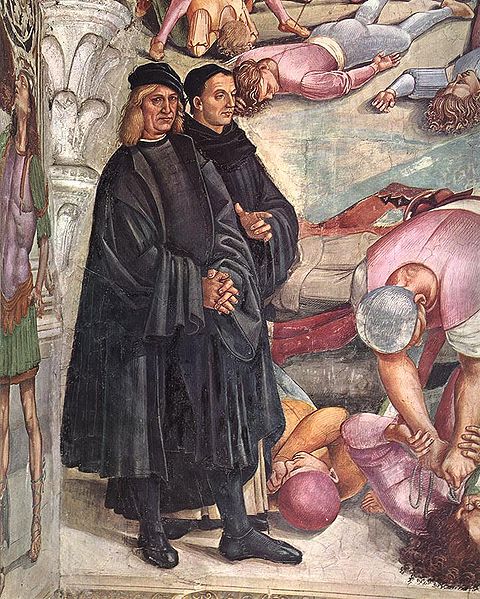
Signorelli’s self-portrait. Fra Angelico has the short hair.

Then David Sanders‘s “Poetry News in Review” in Prairie Schooner alerted me to Arlice Davenport‘s thoughtful and provocative review, A Season in Hell,”  in (of all places) The Wichita Eagle. Davenport begins his review in Luca Signorelli‘s (not Luco, as written in the review) Brizio Chapel in the Orvieto Cathedral, with the artist portraying himself at the Apocalypse, “staring back at us, as if to say: Do you understand the meaning of my masterpiece, that I am painting your destiny here, among the damned and the saved?”

Nazaryan’s review begins: “All translation is modernization. Otherwise, we would have only one Homer, one Cervantes. However subtly, the translator is also an interpolator, making a world far away or long ago familiar to contemporary readers.”  This of course ignores the translation of our contemporaries – do Italo Calvino or Eugenio Montale need “modernization”?  Also, he overlooks the need to triangulate among translations to recapture the achievement of the original.  Similarly, Bang writes:  “Translation is a method of bringing the past back into the present . . . and sharing what is common to all.”

“No, that is history,” Davenport responds. “Translation is not about making the old new, but about creating a spirited equivalency of a literary work in another language.” He continues:

A great translation must contain the original, to be sure, but it must also reshape it into a fresh, artistically integral whole that speaks to the reader directly, powerfully, profoundly in his or her own language. It must enact, in foreign words, the closest approximation of the original it can muster. It must be beautiful, compelling, ensouled.

Translation doesn’t need contemporary bells and whistles to pull this off. It doesn’t need pragmatic theories of art. It genuinely aspires to the heavenly exchange of language, even if it must descend to Hell to get there.

Anything less leaves us feeling cheated, still lost in a dark wood, facing our fears, facing death, facing eternal punishment, and praying for a luminous guide to come our way.

Davenport asks:  Is the spiffy new translation a translation at all?  Then he considers other issues:

As with so many knee-jerk postmodernists, Bang’s poetics hinge on the belief that the “distinction between high culture and popular entertainment has all but ceased to exist.” So she’s free to throw in references to John Coltrane, “South Park,” Emily Dickinson, Andy Warhol, John Wayne Gacy, Stephen Colbert and Woody Allen, whenever it suits her purposes. Her Dante dwells in a pluralist’s paradise, even if he is in Hell.

But to say that contemporary culture no longer recognizes the difference between high and low art is not to say that there is no difference. It simply means that our culture has given up making the effort to sustain the difference. It is (again, ironically) a form of sour grapes.

Let’s look a little closer at Bang’s big idea. Doesn’t the fact that she, an award-winning poet, has to dig 700 years into the past to find a poem worth laboring over ultimately indict the vacuity of contemporary poetry?

Doesn’t her need to focus so intensely on Dante simply reinforce the unshakeable distinction between high and low art? Contemporary poets still idolize the author of “The Divine Comedy” because his grand, celestial achievement overreaches the centuries. His aim is sky high and heart deep: Divine Love and human love, reflected in the radiant visage of Virgil, and fulfilled in the heavenly reunion with Beatrice, his beloved.

Art doesn’t get much higher than that.

I worry about how we review poetry nowadays, and how much reviewers know about poetry at all, and what body of knowledge, experience, and understanding they bring to what they write.  Or do they simply go by their gut?

Postscript 8/20:  From the matchless Jeff Sypeck:  “I find it maddening that in 2012, Vanity Fair can’t provide us with a simple link so we know which ‘corduroy-vested academics’ are supposedly ‘tugging on their beards with indignation’ and which ‘beetle-browed translators’ are ‘jabbing at their eyes with pencils.’ It’s summer, and the book’s was out for a only week when the Vanity Fair blog post went live. Few academics, and certainly not the stereotypes who stumbled into Schappell’s article from early 1950s New England, have even read the book yet.”

Nancy Huddleston Packer: under no one’s shadow

August 17th, 2012
Share

Left to right: Kenneth Fields, Lucille Clifton, N. Scott Momaday and Nancy Huddleston Packer. (Photo: Steve Castillo)

Five years ago, I covered a Stanford event featuring Lucille Clifton, Kenneth Fields, N. Scott Momaday, and Nancy Huddleston Packer.  As so often happens when writing on deadline, the voices played out differently on the keyboard than they did at the event or in my head.

Crackerjack writer

All four were strong presences that night, but Clifton somehow began to dominate the final article, and Packer’s wry voice somehow got short shrift, which I regretted.

When a student asked how the three authors expected to be perceived by these children of the iPod age, Packer replied, without blinking, “I think all of us would like to be perceived as Shakespeare.”

“It’s important for us to look beyond the very moment and find what is lasting,” she added, after the laughter subsided.

Packer is coming to the fore again now, however, with her newly published collection of short stories, Old Ladies.

In an interview today in Palo Alto Online, the professor who headed Stanford’s Creative Writing Department described the effects of beginning her career in the era of Ernest Hemingway:

“It took me five years to be able to use an adjective. It had to be absolutely bare. I’m still not very good with adjectives and adverbs, but I know that it’s OK to use one when you need it,” she said, adding that over time her writing has become richer while retaining a relatively bare style, what she calls “no fancy dancing.”

What does writing look like for an 87-year-old? Pretty much like it always did:

Today her writing schedule isn’t so different from when she was teaching. Her mornings are spent in her study, writing mainly short stories. It can take her anywhere from two months to many years to complete a story.

“I mull over them for a long time. I’m an inveterate rewriter: I rewrite and rewrite. I change ‘a’ to ‘the’ and then to ‘an’ then back to ‘the’ again — just constant tinkering,” she said. Occasionally, she’d like to return to an earlier version, but once she switched to using a computer she lost the ability to retrieve the wadded-up ball from the trash.

There’s another chance to see her:  Try her at a reading and signing at 6 p.m. on Wednesday, October 10, 2012, at the Stanford Bookstore.


“It will change our idea of her”: Is this the grown-up Emily Dickinson?

August 16th, 2012
Share

Is she?  Or isn’t she?

Amherst College Archives and Special Collections have uncovered a new daguerreotype that it figures is the real Emily Dickinson, all grown up.

The Emily we know, at age 16

So far, the evidence tallies in its favor, “including computer work with detailed scans of the original daguerreotypes (1847 and 1859) and an ophthamological report facilitated by Polly Longsworth in March, 2010.”

Certainly the addition of a second sitter of whom there are multiple images in existence helps the case: if one can show that it’s Kate Turner, a known friend of Dickinson, then it increases the chance that the other sitter who looks like Dickinson is Dickinson. One sure point of contention is the clothing: people will note that the dress “Dickinson” wears seems to be out of date for a late 1850s photograph. However, that evidence may be of less significance when one considers the 23-year-old Dickinson’s comment to friend Abiah Root in 1854, “I’m so old fashioned, Darling, that all your friends would stare” (Johnson letter 166).

Kate Scott Turner, who would have visited the poet in Amherst about 1859, seems to match another one found of Kate as a young woman. Anyone with information, fir or agin’ the supposition that this is Emily D., is invited to contact Amherst.

If the daguerreotype is eventually accepted as Dickinson, it will change our idea of her, providing a view of the poet as a mature woman showing striking presence, strength, and serenity. She (whoever she is) seems to be the one in charge here, the one who decided that on a certain day in a certain year, she and her friend would have their likenesses preserved. In fact, even if this photograph is not of Dickinson and Turner, it has still been of use in forcing us to imagine Dickinson as an adult, past the age of the ethereal-looking 16-year-old we have known for so many years.

Oh, you’re wondering which one is Emily?  She’s the one on the left.  Her friend Kate, a recent widow, was in mourning.

Read more here.

Postscript on 9/5:  More photos, more theories, more possibilities here – including the poet Janet Lewis‘s vote.

Gore Vidal’s “piety”

August 15th, 2012
Share

"a one-man great society"

That’s it.  I’m in love with Gore.

No, no, not that Gore.  Gore Vidal. I know, it’s sudden…  I was watching the interview I posted a few days ago.  It uncovered a Vidal I didn’t know existed.  He is moved almost to tears recalling Italo Calvino‘s death.  He, the disdainful mandarin, notorious for his literary fights and insults, humbly drops to one knee before someone he considers his better.  Didn’t know he had it in him:

“I have studied the landscape of literature all my life, and he was the only great writer of my time.”

“Let’s use a word that is often misused – universal.  Where Calvino was, there was literature. Like it or not.”  “He was it. He was the real thing.”

We don’t live in a great time for writers or writing, he said, “but Calvino was a one-man great society.”

“Calvino was there, everyone who knew about him admired him, read him, wrote about him.”

The interviewer, Riz Khan, asks Vidal what passed through his mind at Calvino’s funeral.  The author’s eyes seemed to mist up, as he answered: “When will there be another?  With Italo, I thought literature had died.”

“It was as if a great prince had died. The whole nation went into mourning,” he said in slow, emphatic syllables. “What American or Brit or Frenchman would have that audience in his own country today?”

Vidal was not, apparently, a great fan of the literature of Eastern Europe.  Otherwise, he would have recalled one funeral in 2004 where thousands lined the streets of Kraków.

Czesław Miłosz came to my mind for another reason.  I remembered speaking to the Polish poet about his friend and fellow laureate, Joseph Brodsky, and his description of what Miłosz called the Russian poet’s “piety.”  From my Georgia Review interview a dozen years ago:

There was at a given moment a stable world where we could see, hold on to values that were a reflection of the eternal order of things. Now we are in a flux. This is a very peculiar way of life. … When everything is in flux, revision, it is healthy to have some poets who preserve the feeling of respect.

For me, the value of Brodsky was his sobering effect, and his enormous feeling of hierarchy. He had a great feeling of hierarchy of value in works of art and works of literature.

Brodsky was very sensitive to the sacredness of being. Yes. That’s why I call him pious. I didn’t ask him if he believes in God – you felt in him that openness to the sacred.

“Piety.”  It’s an impressive quality.  And I thought of that as I listened to Vidal speak.  The sense of  “hierarchy of value in works of art and works of literature.”

Khan asked Vidal what impressed him most about Calvino’s character.  Vidal, one short year before his demise, gazed straight ahead as if staring down death: “Truth.”

Watch the video for yourself, here.


How pots of jam saved the Bolshevik revolution

August 13th, 2012
Share

The Bolsheviks were saved by pots of jam from the Britain’s Midlands and lots of Scottish herring, though you would have thought the Baltic Sea was already full of fish.

Last month, Robert Service, author of Spies & Commissars, told an unconventional and riveting story of the Russian Revolution, looking beyond official government documents and examining the worlds of business, journalism, and espionage to see how the West interacted with the new Bolshevik government.

The story he told during the Hoover Archives Summer Workshop focused on some of the lesser known players of the era – such men as Sir Paul Dukes, the accomplished British spy who “rescued princesses, was a master of disguises, and was a very, very modest man.”  The cast of characters also included sometime-diplomat, sometime-spy Robert Lockhart; the dashing Captain George Hill; Sidney Reilly, the notorious “ace of spies”; and the children’s writer Arthur Ransome, “a pro-Soviet British agent” who liked Lenin.

While World War I raged around them, the Western powers needed to know what was going on in Petrograd, said Service, which was “extraordinarily important, especially if Germany won.”

“Both sides were trying in a gingerly fashion to persuade the other to take an indulgent view of it,” said Service.  Hence, although the nations had no formal diplomatic relations, the British prime minister would take lunch with Maxim Litvinov, Lenin’s man in London.

Reilly, "ace of spies"

Over in the fledgling Soviet Union, Trotsky wanted an air force, so he recruited British spy George Hill.  “As you can imagine, he got a lot of information,” said Service.

This delicate choreography ended abruptly in March 1918, when Russia signed a pact with Germany, bowing out of the war.  Western telegraph experts, the precursors of today’s technologists, helped break the code to find out what was happening in Russia.  Meanwhile, Bolsheviks smuggled jewelry to the West to help far-left groups set up Communist Parties in their own countries – unnecessary, from one angle, since “they did it for free, they did it eagerly,” according to Service.

Lockhart – diplomat and spy

At that critical point, the Americans, British, and the French tried to bring down the Lenin-Trotsky government in a coup – the only such attempt by a Western power to do so, said Service – to enable Russia to select a new government more closely aligned with the Allies.

The plan was to be carried out by Reilly and Lockhart (who later downplayed his role), with help from Hill.  It ended when someone else altogether tried to kill Lenin first, triggering a bloody purge.

Reilly escaped.  The lunch-loving Litvinov was arrested in London, and exchanged for Robert Lockhart. “He protested his innocence, but he wasn’t innocent. Very, very far from it,” said Service.

While doing his research in the Hoover Archives, Service found a letter written by Lockhart’s son, Robin, suggesting that his father had cut his tale to fit the times:

“If the question of my father’s relationship with Reilly still exercises anyone’s mind in the F.O., it is clear from his book Memoirs of a British Agent that once intervention in Russia had been decided on in 1918, he gave his active support to the counter-revolutionary movement with which, of course, Reilly was actively working.

“My father has himself made it clear to me that he worked much more closely with Reilly than he had publicly indicated…”

Service (Photo: Ave Maria Mõistlik)

Lockhart, Reilly, Hill, and Dukes (by that time, another spy whose cover had been blown) gathered in London regularly for “Bolshevik liquidation lunches” to “talk down and drink down the Russian Revolution.  Futile?  Perhaps not.  “They formed a lobby to hold a line,” said Service.

Which brings us back to March 1921, when it all changed again, like the twist of the kaleidoscope, with the Anglo-Soviet trade treaty.  That made the U.K. “the first great power to break rank,” said Service. “Washington and Paris were infuriated.” Britain made its decision “unilaterally and by stealth.”

“If Woodrow Wilson and Clemenceau were horrified, anti-Bolshevik Russians were even more horrified,” he said.

That also returns us to the Hoover Archives: its papers show that pots of jam started to reach the Soviet Union from the British Midlands, and Scottish herring went directly to Petrograd.

Service said Hoover’s huge food and humanitarian missions in 1919 “probably did save Europe from the Bolsheviks.” But did the Britain save the Bolshevik revolution at a time it might have crumbled?

Happy times – Yalta in 1945

Winston Churchill warned the British government in vain. “He could never convince the rest of the government that a crusade was necessary.” Postwar Britain was wary of conflict, and its parliamentarians jeered,  “‘Where are you going to get the money, Winston?’ England was bankrupt, bled dry.”

Success isn’t everything. “It’s pretty clear now that we value those politicians who saw things clearly, and said what they saw as forcefully as they could,” said Service.

I like the slightly different conclusion described in The Independent, as the Communists become more and more like the bourgeoisie:

The communists began to enjoy the perks of their predecessors. “We lived in grand hotels and he wore fur coats and smoked enormous cigars,” remembered Litvinov’s wife Ivy. The story becomes irresistibly reminiscent of Animal Farm, which ends with the pigs and the humans indistinguishable. By the time of the Second World War, Hill was in Moscow swapping tips on poisons with the head of Stalin’s fearsome security apparatus. And by 1945, Churchill and Stalin were grinning for the photographers at the old palace in Yalta.

That explains why, in the Soviet Union, Churchill is remembered as a Soviet ally. After my Russian friend had gone to sleep, our driver – an ethnic Armenian – told me how Churchill preferred Armenian brandy above all others. I doubted this, but it does show how the old man has become all things to all men.

As an afterthought, the New Statesman recently asked Service a question that brought up the name of another friend and frequent subject in the Book Haven. Can’t resist a mention:

Conquest at work (Photo: L.A. Cicero)

You did a lot of the archival work for this book at the Hoover Institution at Stanford University, which was the domicile of the great British Sovietologist Robert Conquest. Is he someone who has had a particular influence on your work?

I think Robert Conquest [we wrote about him here and here among other places] is one of the great postwar Sovietologists. The British have had an influence on thinking about the Soviet Union out of all proportion to the number of people working in the United Kingdom on the Soviet Union. Conquest certainly wrote one of the great pioneering books, The Great Terror.

Gore Vidal remembering Italo Calvino: “He was the only great writer of my time.”

August 11th, 2012
Share

Gore Vidal's magnificent Mediterranean digs – Calvino was a neighbor.

A few days ago I wrote about Italo Calvino.  I’ve so far neglected the death of Gore Vidal – so many have written so much already I didn’t feel I had anything substantive to add.

Since both writers have been on my mind, it was curious to see their names intertwined in a link (can’t even remember where) that revisited a New York Review of Books article, featuring Vidal’s 1985 recollection of Calvino’s burial in Italy – the two were, in fact, neighbors.

Europe regarded Calvino’s death as a calamity for culture. A literary critic, as opposed to theorist, wrote at length in Le Monde, while in Italy itself, each day for two weeks, bulletins from the hospital at Siena were published, and the whole country was suddenly united in its esteem not only for a great writer but for someone who reached not only primary school children through his collections of folk and fairy tales but, at one time or another, everyone else who reads.

He had first written about Calvino eleven years earlier, in an essay that included the passage: “Reading Calvino, I had the unnerving sense that I was also writing what he had written; thus does his art prove his case as writer and reader become one, or One.” The article caught Calvino’s attention, the two exchanged letters, and finally met.

En route to the burial sans ceremony at Castiglion della Pescáia, Vidal recalled:

As we drove north through the rain, I read Calvino’s last novel, Palomar. He had given it to me on November 28, 1983. I was chilled—and guilty—to read for the first time the inscription: “For Gore, these last meditations about Nature, Italo.” “Last” is a word artists should not easily use. What did this “last” mean? Latest? Or his last attempt to write about the phenomenal world? Or did he know, somehow, that he was in the process of “Learning to be dead,” the title of the book’s last chapter?

What greatness looks like.

What’s surprisingly moving in Vidal’s account is his obvious reverence for the Italian maestro, which assumes the usual form of embroidering a connection to make it more important, more real (“I hold Chichita’s hand a long moment,” he makes sure he tells us as he stands at the graveside with Calvino’s widow).  One would not have expected Vidal to expose himself that way, even inadvertently.  But humility is the sincerest and most difficult form of greatness.

That’s why it’s so dispiriting that Vidal’s fatal flaw persistently surfaces, the one that kept his own work from greatness: Vidal can’t resist the impulse to take an unnecessary and irrelevant swipe at those he holds in contempt, which is almost all of us.  For example, an almost random mention of meeting “the dread physical therapist Ms. Fonda Hayden,” which undermines the piece and should have met a sterner editorial pen.

He also laces his piece with taxonomies of middlebrow, highbrow, lowbrow, along with disdainful (and often unjust) comparisons of, for example, American ways with Continental ways – with the former always risible, provincial, gaffe-prone.  The inclusion of such remarks is predicated on the idea that we give a damn, and gives the impression that we earnestly seek his approval or want to be one of  the toffs.  We don’t. Where was the friend who could have told him these asides immeasurably weaken his writing?   

A more or less random example of passing insult:  “He wants us to see not only what he sees but what we may have missed by not looking with sufficient attention. It is no wonder that Galileo crops up in his writing. The received opinion of mankind over the centuries (which is what middlebrow is all about) was certain that the sun moved around the earth but to a divergent highbrow’s mind, Galileo’s or Calvino’s, it is plainly the other way around. Galileo applied the scientific methods of his day; Calvino used his imagination. Each either got it right; or assembled the data so that others could understand the phenomenon.

But I have seen “highbrows” hold remarkably conventional and conformist views, and I have encountered truly original and iconoclastic lowbrows.  So this isn’t a measure of anything except Vidal’s rather commonplace worship of “science.”

Here’s what Calvino does with related material, in the Charles Eliot Norton lectures that preoccupied him in his final months, and eventually became Six Memos for the Next Millenium:

Overambitious projects may be objectionable in many fields, but not in literature. Literature remains alive only if we set ourselves immeasurable goals, far beyond all hope of achievement. Only if poets and writers set themselves tasks that no one else dares imagine will literature continue to have a function. Since science has begun to distrust general explanations and solutions that are not sectorial and specialized, the grand challenge for literature is to be capable of weaving together the various branches of knowledge, the various “codes,” into a manifold and multifaceted vision of the world.

On the video below, Vidal says: “He was the only great writer of my time.”  This is a great video, thoroughly addictive.


<<< Previous Series of PostssepNext Series of Posts >>>