László Krasznahorkai: “So-called high literature”? Finito.

July 7th, 2012

Share


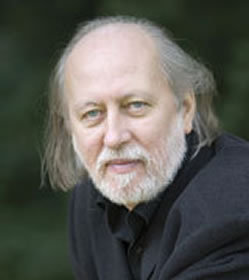
Hungarian writers tend to be a lonely lot – the fruit of their labor is stranded out on the most inaccessible branch of the broad language tree.  Who speaks Hungarian, except those born to it?  Its closest antecedents are Turkish and Finnish, and they aren’t all that close.  Wisely,  László Krasznahorkai divides his time between New York and Berlin, as well as the cosy little village of  Pilisszentlászló,  about half an hour out of Budapest.  That, in addition to the skyrocketing  reputation of his work, has put him in the world’s literary epicenter.
More thoughts on "this rotten world we live in."

After all, Susan Sontag said he is “the contemporary Hungarian master of apocalypse who inspires comparison with Gogol and Melville. W. G. Sebald said, “The universality of Krasznahorkai’s vision rivals that of Gogol’s Dead Souls and far surpasses all the lesser concerns of contemporary writing.”

To my discredit, then, I discovered Krasznahorkai only this year when, in Paris, Daniel Medin shoved a Cahier into my hand.  The short, 39-page work,  Animalinside, was undertaken for the Cahiers Series as part of a collaboration with German painter Max Neumann (we’ve written about the Cahiers series here). For reasons to tedious to get into, the book wound up in a stack of backlogged reading, and I’d only got round to reading it after the interview in the current Quarterly Conversation.

The interview is republished from The Hungarian Review – a publication I regard with gratitude, as its editors allowed me to republish Czesław Miłoszs poem “Antigone,” translated by George Gömöri and Richard Berengarten – the poem, in English, exist only in the journal and An Invisible Rope: Portraits of Czesław Miłosz. It’s not the only reason I read the Q&A with interest, however; it’s lively stuff.

A few excerpts:

Ágnes Dömötör: Many people have the impression that your books are hard to read and to understand. That’s a myth, but don’t you think you’ve got some bad PR?

László Krasznahorkai: You know, the problem is that anything that’s the least bit serious gets bad PR. Kafka got bad PR, and so does the Bible. The Old Testament is a pretty hard text to read; anyone who finds my writing difficult must have trouble with the Bible, too. Our consumer culture aims at putting your mind to sleep, and you’re not even aware of it. It costs a lot of money to keep this singular procedure going, and there’s an insane global operation in place for that very purpose. This state of lost awareness creates the illusion of stability in a constantly changing world, suggesting at least a hypothetical security that doesn’t exist. I see the role of the tabloid press somewhat differently. I can’t just shrug it off and say to hell with it. The tabloid press is there for a serious reason, and that reason is both tragic and delicate.

AD: Suppose someone who has never read anything by you picks up this interview and says: what an interesting guy, which one of your books would you recommend to them? What would be a point of entry to your life’s work?

LK: The Old Testament. The Book of Revelation. Let them choose from my books at random.

AD: How do you relate to your fellow Hungarian writers? Do you ever e-mail one another? Would you tell György Spiró, for instance,‟I liked your last book, Gyuri?” I’m asking because in an earlier interview you seemed to see yourself as an outsider on the literary scene.

Pilisszentlászló ... half an hour away from Budapest

LK: I don’t just see myself as an outsider, I am one. Which doesn’t mean I’m not happy to see colleagues I admire; after all, we share the same fate. But I also worry about them. I worry, for instance, because they’re in literature, something that you can still sell for awhile, but it’s getting harder and harder. This kind of communication is really over and done with. Its disappearance is a rather obvious process; it is happening faster at some points of the world than at others. I’m afraid this kind of literature is not sustainable.

AD: You mean it’s not just the authority of literature that’s finished but literature as such?

LK: The so-called high literature will disappear. I don’t trust such partial hopes that there will always be islands where literature will be important and survive. I would love to be able to say such pathos-filled things, but I don’t think they’re true.

On our tabloids: “The structure of vulgarity is very complex.”  He also talks about apocalypse, and “this rotten world we live in.”  And rock bands?  You can read about his favorite ones, along with the rest of the interview, here.

What does he think about bloggers, such as Humble Moi?  “Recently one blogger suggested that I should be hanged. I immediately put on my space suit, started the engine and went to the moon for a while.”  That puts me in my place.

Meanwhile, here’s what Irish novelist Colm Tóibín said about Animalinside:

Language for Krasznahorkai is a force struggling against the domination of cliché and easy consumption, offering small, well-organized revolts, plotting in upstairs rooms for plenitude and jagged rhythm, arming itself with clauses, sub-clauses and asides, preparing high-voltage assaults on the reader’s nervous system. … The world of his fiction is enclosed and stable, it must be taken on its own terms. … His work is full of menace, but it would be a mistake to read the menace either as political or as coming from nowhere. …


Can we get her to change her mind? A Paris landmark disappears.

July 5th, 2012
Share

It’s too bad, my French friend lamented, that I won’t be in Paris before the end of the month. I could have had a reading for An Invisible Rope, he said.  I could have, should have…but won’t now.

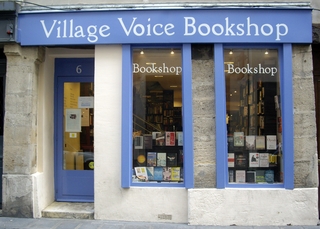
It’s closing. The bookshop that has been a cultural landmark Saint-Germain-des-Près for three decades is shutting its doors forever on July 31.

For the last dozen years, Village Voice on the tiny Rue Princesse has been ranked the best independent literary bookstore in Europe by the British magazine Bookseller.  The store carries about 18,000 volumes at any time – carefully selected, the size of its collection notwithstanding.  It has been a refuge for Anglo-Americans abroad, and for those who love them. But these facts don’t capture of the spirit of the place.

Livia Manera has by far the best tribute on the New Yorker‘s blog, “Page-Turner.”  According to legendary owner Odile Hellier:

“The last two years have been hell,” she told me. “You can blame Amazon.fr; you can blame competition among publishers forced to discount prices. But I can tell you the precise day when I realized it was over for us: April 3, 2010, when Apple launched the iPad. From that day, more and more of our customers begun reading on the tablet. That did it.” …

Some reports on the closing of the Voice fail to mention an important factor in its demise. French publishers, bookstores, and independent booksellers have been able to resist the encroachments of e-commerce, with its steep discounts, and the slash-and-burn pricing policies of big chains (which themselves are falling prey to e-commerce) thanks to a law that fixes the prices of both printed books and e-books—so long as they are French in origin. But bookstores selling foreign books are unprotected.

Antoine Jaccottet told me much the same about these cutthroat practices over coffee last February, during the worst cold snap since … well, since about the time Village Voice opened its doors.  Now Hellier will be focusing on a website presence.

Naturally, everyone has stories to tell in the wake of the sad news – stories about the authors who read there (Michael Ondaatje was the last to read on June 28, from his latest book The Cat’s Table), or about bumping into Susan Sontag combing the shelves.

According to David Galenson writing in the Huffington Post, manager Michael Neal was the soul of the shop. He describes the Englishman’s arrival at Rue Princesse:

Michael Neal was working as an antiquarian bookseller when he came into the Village Voice one day in 1993, and saw a large pile of parcels sitting under the front table. He told Hellier she should move the parcels upstairs, and she replied, “Do it yourself.” He thought that was a good idea, so he did it. He began opening the packages, and that was the start of his career at the shop. He has worked there five or six days a week ever since.

It’s hard to capture the ambiance. Manera tries again:

With the exception of the Village Voice, there is generally little collegial contact between the French literary milieu and English-speaking academics and writers who live in Paris, or come here on sabbatical, or to promote their work in translation. … But when you squeezed into the narrow event space on the Voice’s upper floor, French and international book lovers mingled with Parisian editors and publishers, shared a glass of wine, a new discovery, a heretical opinion, and took the conversation outside to the sidewalk of the Rue Princesse, for another shared pleasure: an unguilty cigarette.

My visits to Paris have been far too infrequent and fleeting – it has only recently become a haunt. Just as I’m getting to know the city, one of the best reasons for being there is disappearing, and will be nowhere to be seen when I return this month in bitter November.


They started more than literary firestorms: Twain, Thoreau meet Smokey the Bear

July 4th, 2012
Share

Fire and the 4th go hand in hand

Traditional 4th of July celebrations involve fireworks, campfires, sparklers, gunfire and cannons, and all sorts of other incendiary tomfoolery.  What better way to celebrate than with the tale of two inadvertent literary firebugs?

Twain scholar Shelley Fisher Fishkin apparently agrees, according to her new post on the Library of America’s “Reader’s Almanac” blog.

Here’s the story:  Through their own naïveté and carelessness, Mark Twain burned 200 acres of forest around Lake Tahoe. He failed to break Henry David Thoreau‘s earlier record of setting 300 acres of his beloved Concord woods aflame.

“Yet each man kills the thing he loves,” wrote Oscar Wilde.  He might have had Twain in mind, for Twain loved Tahoe with a passion that all later lakes failed to arouse.  Italy’s famous Lake Como was as nothing.  The renowned Sea of Galilee was a downright disappointment.  (I understood this completely when I saw the mud puddle called the Jordan River.  Where was the mighty, rolling river of the spirituals?  It occurred to me as I gazed at the sluggish, fetid waters that the slaves had the Mississippi in mind.)

“Three months of camp life on Lake Tahoe,” wrote the dazzled Twain in Roughing It, “would restore an Egyptian mummy to his pristine vigor, and give him an appetite like an alligator. I do not mean the oldest and driest mummies, of course, but the fresher ones.”

America's answer to Como, Galilee

Yet he built a campfire on the shore one autumn day in 1861 and left it unattended while he returned to his boat.  A gust of wind did the rest.

Seventeen years earlier, a stray spark from Thoreau’s campfire started a conflagration.  According to Shelley:

Both writers were struck by the “glorious spectacle” (Thoreau’s words) of the fires they had started; Twain found the “mighty roaring of the conflagration” to be “very impressive.” Neither Thoreau nor Twain showed much remorse for the destruction he had caused. “I have set fire to the forest,” Thoreau wrote in his journal six years later, “but I have done no wrong therein, and now it is as if the lightning had done it.”

Twain, at least, has not been forgiven.

Said Shelley:  “Last week I asked a firefighter at Fallen Leaf Lake, in the Tahoe Basin just south of Lake Tahoe, whether Mark Twain was still persona non grata in the area. He nodded grimly.”

Having fled my own home with suitcases and pets during two wildfires in that part of the world and stayed at home for a third close call, I can understand the firefighter’s umbrage.

Read the whole cautionary tale here.

Stanford writers bag an awful lot of prizes this year

July 3rd, 2012
Share

It’s easy to forget the caliber of the people you are rubbing elbows with every day.  So let me take a moment to blow their collective horn – especially since they’re so humble.  Many of you may have seen the recent New Yorker article about high-tech Stanford’s close relationship with Silicon Valley.  Fewer people, alas, know that it also has one of the top-rated faculties in English and Creative Writing anywhere.

This year has been a banner year.  Stanford and its alums have bagged a Pulitzer, a Ruth Lilly Prize, a National Book Award, a Guggenheim, a presidential awards.   Everything short of a Nobel. Are you listening, Stockholm?

From a piece I wrote recently:

Turning 40 is a landmark for many, and poet Tracy Smith was no exception. She planned to celebrate in style with champagne. But what she didn’t expect was the biggest present ever: her husband told her The New York Timeswebsite had just announced that she’d won this year’s Pulitzer Prize in poetry.The new Pulitzer for Smith, a former Wallace Stegner Fellow at Stanford, is one of several awards that have put a spotlight on Stanford’s top-ranked English Department and its renowned Creative Writing Program– a sometimes overlooked triumph on a campus that more often prides itself on its technological savvy.

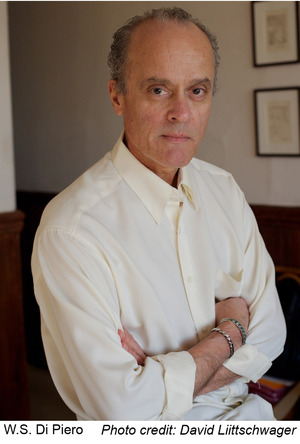
Simone Di Piero, Photo credit: David LiittschwagerPoet W.S. Di Piero got the news that he had won the 2012 Ruth Lilly Poetry Prize on April 1.  “They called me on April Fools Day.  So I had to ask twice if they were serious.  They said it was on the up and up.”

“In the land of poetry it’s a big prize,” said the emeritus professor of English.  His new collection of poetry, Nitro Nights, was published in December, but the $100,000 award honors lifetime accomplishments.

According to Christian Wiman, editor of Poetry magazine, “He wakes up the language, and in doing so wakes up his readers, whose lives are suddenly sharper and larger than they were before. He’s a great poet whose work is just beginning to get the wide audience it deserves.”

Poets weren’t the only ones to get prizes: English Prof. Denise Gigante got a coveted Guggenheim Fellowship, topping a year that had already brought stunning accolades: The Keats Brothers: The Life of John and George, was named a New York Times Notable Book for 2011 and an Editor’s Choice in The New York Times Book Review.

Denise Gigante, photo credit: Raul DiazThe Guggenheim will give her time to work on her new book, The Book Madness: Charles Lamb’s Midnight Darlings in New York, a study of 19th century bibliomania, the formation of important libraries and literary culture in America, and the half-forgotten English essayist Charles Lamb.

“Americans were fascinated with the figures of British poets,” said Gigante.  “Culture was imported from Britain – that’s not true today.  And library-makers were the cultural brokers of the time.”  Her book will be “an experiment in literary critical form,” she said.

Gavin Jones, English Department chair, said, “Denise is the rare scholar with the power to tell a story that’s also the biography of an age and an intellectual culture.”

The list of awards continues:  President Obama awarded Prof. Ramón Saldívar a National Humanities medal in February. (Arnold Rampersad, emeritus professor of English, received the same award a year before.)

The English Department has consistently been at the top of U.S. News and World Report rankings of graduate programs. The creative writing program, which does not confer an MFA, is considered by many to be the best in the country.  Its Stegner fellows form a tight-knit, ongoing society.

Pulitzer prizewinner Smith, at Stanford from 1997 to 1999, said her years at Stanford “pushed me to move towards a mature sense of what I was doing. To be honest, I didn’t know how to do that.”

The program’s focus on moving from manuscript to book “frees you from the person you were as a student and into what you will be as a poet.”

Smith, now an assistant professor at Princeton, was awarded for her collection Life on Mars. The New York Times called her “a poet of extraordinary range and ambition” whose book “first sends us out into the magnificent chill of the imagination and then returns us to ourselves, both changed and consoled.”

Although many may have seen The Descendants, a critically praised film with George Clooney that won two Golden Globe awards (for best picture and best actor in drama), few know it was born in the English Department. Kaui Hart Hemmings, a Stegner Fellow from 2002-2004, was working on the novel while at Stanford.

Jesmyn Ward, photo credit: Adam JohnsonJesmyn Ward became the out-of-nowhere winner of the prestigious National Book Award for 2011 with Salvage the Bones, a novel about a working-class family confronting the disaster of Hurricane Katrina.

Novelist Tobias Wolff said, “One of the great pleasures of teaching in the Stegner program is seeing the manuscripts we discuss in our workshops turn into books, distinguished, remarkable books, and recognized as such by the larger world.”

“Jesmyn Ward’s recent success is but one of too many examples to list here,” said the professor of English.

Eavan Boland, one of Ireland’s leading poets and director of the Creative Writing Program, called it “a stellar year” for the English department – but cautioned that  “our entire focus has to be on the writing and not the recognition. The writing life is an end in itself – that’s what the program stands for.”

“We have many outstanding Stegners who don’t win awards and go on to be significant writers through their commitment to that life and its outcomes.”

For the award-winners, however, the recognition certainly doesn’t hurt: “I’ve done a lot of the research, but the writing needs the fellowship,” said Gigante. “I needed to have this award. The timing seems perfect.”

For Smith, now working on a memoir, the birthday bash was even bigger than she had planned. “A lot of champagne was involved,” said Smith. “It was put to good use, very quickly.”

What will Di Piero do with all the money? “Of course the first thing that came to mind a really hot, fast car.  I don’t own one, so if I’m going to buy one, I should get serious.”

“But in order to buy a car, I need a parking space, and to have a parking space, I should buy a house. And even the Lilly prize doesn’t go far enough to buy a house in San Francisco.”

“Truth is the strongest weapon,” says N. Korean poet Jang Jin Sung

July 1st, 2012
Share

(Photo: Martin Alexander)

One of the more haunting moments in author Adam Johnson‘s interview with Charlie Rose is when he describes the impossibility of the plight of North Koreans – these are “people who have never seen a stop light before; they don’t know how many works,” says the author of the acclaimed Orphan Master’s Son.  As he has pointed out elsewhere, most of the stories we have are from the areas outside the capital. The citizens of Pyongyang have already “made it.”  So what is life like among North Korea’s upper classes?

“The cadres of the past had very traditional mentalities. They are people who lived thinking, “Anything for the party and the General…” The cadres, with the change in generations, started to think about their security. Corruption and self-interest stemmed from that.

In actuality, the North Korean cadres are the first ones to have changed internally. On the outside, they maintain their security by serving the regime, but internally, they will be the first ones to abandon it if the circumstances permit.”

These are the observations of Kim Jong Il‘s favorite state poet,  Jang Jin Sung, who defected in 2004.  He will be attending an international poetry festival during the upcoming London Olympics, from  July 27 to Aug. 12 (Kay Ryan will also attend).  The man who once wrote official poetry for the Workers’ Party newspaper now writes about executions, hunger, and desperate lives, according to an Associated Press article.  In a Daily NK interview four years ago, he said:

North Korea is a country which allowed 3 million people to die during a peacetime period. The fact that the administration still exists is a shameful thing. North Korea is a country which calls the period which produced 3,000,000 starvation victims the “March of Tribulation.” If Hitler was a despot who massacred foreign citizens, Kim Jong Il is a despot who has slaughtered his own people. If this truth is not made known, we cannot find justice.

Jang said he led a privileged life in Pyongyang and once dined with Kim.  He was instructed to avoid looking into the leader’s eyes and instead to stare at his second shirt button. After more contact with Kim, Jang said he soon stopped believing that he was “this godlike leader of this wonderful country.”

He said that poets had a special role to play in the regime:  “Because of the paper shortage in North Korea, poems were the most efficient, economical way to spread propaganda,” he said.

While working in the propaganda ministry, he was able to read South Korean books. He crossed the river to China. Although he was hunted by the North Korea, South Korea found him first (needless to say, he now works under an assumed name). He worked for the South Korean intelligence for seven years before setting up his own online newspaper about North Korea earlier this year.  Now he says “Truth is the strongest weapon.”

A few of the poet’s poems are shown in the video below – but only in Korean.  The soundtrack has a lovely rendition of  Handel‘s immortal cry for liberty, “Lascia Ch’io Pianga,” sung by South Korean singer Jung Se Hoon. Lovely, that is, till the end – I don’t know why they felt the need to junk up the orchestration at the end. (Go here for Cecilia Bartoli‘s interpretation.)

Orwell Watch #21: No, Rush Limbaugh, you are not “literally sick” over SCOTUS

June 30th, 2012
Share

No! He's in the best of health.

Politics, as George Orwell observed, does not bring out the best in us, and certainly not in our use of language.

I try not to go after low-hanging fruit as a general rule, but last week’s ruling on Obamacare seemed to have brought out the worst in everyone.

In this week’s headlines, Rush Limbaugh says he is “literally sick over this Obamacare travesty.” I had heard that he had heart problems before, so naturally I rushed to his website to see if he was in hospital again, all because of the Supreme Court ruling.  I found this instead: “And I can’t tell you how sick I am. I am literally sick over what happened yesterday. I don’t know how else to describe it. Literally sick.”  Then he goes on to explain his political concerns.

No, Rush Limbaugh, you are not literally sick.  You are figuratively sick, at best.  Unless you present me with the tab from the team of paramedics or at least a bill from the pharmacy, I am forced to believe you do not know your Mother Tongue.

The evidence mounts.  A quick search showed that a  few days earlier he said this:  “I don’t believe what is happening in this country. I literally can’t believe it.”  Since not believing what is happening in this country is not a figure of speech or a metaphor, there is surely no figurative meaning to define oneself “literally against.”  Or how about this:  “And it created in me this impression of helpless waifs who literally were screaming with their mouths open unable to do anything” – since the impression is strictly in his own head, literal has no meaning at all.  It is all air, imagination.

Sorry. No!

This abuse, of course, is not limited to Rush Limbaugh. We are coming late and reluctantly to this particular train.  There’s even a website called “Literally Unbelievable: Stories from The Onion as Interpreted by Facebook.”  I searched in vain for evidence that the website had created this title tongue-in-cheek.  Alas, in vain!

As H.W. Fowler writes (while taking the word to task for other sins): “Such false coin makes honest traffic in words impossible.”

My agonies were far from over. No, no, Hillary, not you, too!  Here’s what Hillary Clinton said when she heard about the same ruling: “You know, I haven’t had the chance to read the decision. I literally just heard as we landed that the Supreme Court has upheld the health care law. Obviously I want to get into the details, but I’m very pleased. That’s how I hoped it would turn out.”

She literally heard?  “Just got off the plane,” I suppose, could be considered a figure of speech, though it would be a bit of a stretch.  But hearing is not a figure of speech.  We cannot even give this a reluctant pass.


<<< Previous Series of PostssepNext Series of Posts >>>