Choosing my neighbors in Paris

February 5th, 2012

Share

It's the schnozz that counts...

The airplane left late thanks to last-minute reparations to accommodate Parisian snow, and so I arrived at the Charles de Gaulle late – the airport the chaotic free-for-all I was warned it would be.  I spent what was left of the very cold afternoon exploring the Latin Quarter and settling in – which I was able to do comfortably once I discovered the corner grocery that furnished me with good dark, dark coffee, French cheese, German bread, Belgian endive, almonds, and Pellegrino.

There are a few pleasant literary associations with my digs a block from the Eiffel Tower.  I am across the street … well, kitty-corner, really … from the stately townhouse where Edmond Rostand perished in the 1918 flu epidemic.

“The success of Cyrano de Bergerac was a turning-point in Rostand’s life,” writes Sue Lloyd in her 2003 biography of the writer. “His future was assured but he had to live up to the expectations of the French people… the fame he had set out to achieve from his very first book of poems turned into a crushing burden from which only death released him.”

Home sweet home

I was rather taken with Cyrano de Bergerac‘s overblown romanticism as a young ‘un … to see my schnozz might help you understand the sympatico.

My favorite quote in maturer years: ‎”To joke in the face of danger is the supreme politeness, a delicate refusal to cast oneself as a tragic hero.”

Or how about this one?  “It is at night that faith in light is admirable.” A little more commonplace, perhaps, but even the commonplace is worth remembering in troubled times.

We choose our neighbors, as we choose our ancestors. Can Dante not offer us as much guidance as any father?  As for neighbors, what company do we keep in an idle hour, and what reading is on our bedside table?

So, after scanty airplane fare (my vegetarian order was mishandled; perhaps it’s somewhere in the Atlantic), what could be more French than to be holed up in the busy little café where I had a late-lunch omelette aux champignons and strong coffee, finally getting to Book 2  Stendhal‘s The Red and the Black:

A few minutes later, Julien found himself alone in a magnificent library: it was an exquisite moment. So as not to be taken by surprise in his emotion, he went and hid himself in a little dark corner; from which he gazed with rapture at the glittering backs of the books. “I can read all of those,” he told himself. “And how should I fail to be happy here?”

Suitable words for my visit to the Bibliothèque Nationale de France tomorrow.  May I reprise the words of eminent Polish poet Julia Hartwig on getting a permanent seat at the BnF (courtesy Web of Stories)

Shakespeare around the world in 2012

February 3rd, 2012
Share

We meant to work this whimsical take on worldwide William Shakespeare celebrations into the next Book Haven post on the subject – but this one’s got a time peg, and we’re already nearly 10% through 2012.  As we are shoveling clothes and papers into a suitcase to head for Paris, here’s a few off-the-beaten track ways to celebrate the English language’s premiere Bard this year.

February:  Verona’s “Club di Giulietta” receives and apparently responds to hundreds of letters addressed to “Juliet” of  Shakespeare’s  famous love story.  On Valentine’s Day, the club awards the Cara Giuletta (“Dear Juliet”) prize to the writers of the “most compelling letters” received the previous year.  (See photo at right for Juliet’s balcony.)

March/April:  More locally, San Francisco’s African American Shakespeare Company  (“Envisioning the classics with color.”) finishes its 2011-12 season with a March-April production of Julius Caesar.  According to the website, “this political thriller about life and death political struggles tells us not only about the dead leaders we see etched in stone or live on TV each night, but also about the people who put them in power in the first place.” We wrote about the founding director of company, L. Peter Callender, during a Homeric venture at Stanford.  (In fact, if I’m not mistaken that rather looks like him in the Julius Caesar photo at left.)

April:  Prior to going to Chicago’s “Talk Like Shakespeare Day” on the Bard’s putative birthday on April 23, you might want to check out our post “The Archaeology of Sound” here.

Check the others at the Online Degree website here.


Wisława Szymborska: a feather touch that, for all its lightness, lingers

February 2nd, 2012
Share

Wisława Szymborska is dead at 88.  It’s after 1 a.m., but it wouldn’t seem right to let the night pass without a comment.

In 2008, I had tried persistently to meet the reclusive Nobel poet in Kraków – another story, for another time.  During my return for the Year of Czesław Miłosz last spring, my time had run out too quickly, and now apparently hers has also.

But I did see her briefly last spring, at a rare public appearance at St. Catherine’s Church, a reading where she shared the stage with her friend Julia Hartwig, the Chinese poet Bei Dao, and others.  The formidable figure seemed friendly, frail, exuding warmth and authenticity.  Afterward, she was whisked away through the back, like a rare and delicate doll that must be exhibited, but not touched by the fans who had flooded the medieval church.

Somewhere on a thumb drive I have a photo, but I’ll settle today for the more magical one from the Poetry Foundation website.

According to the New York Times obituary:

Despite six decades of writing, Szymborska had less than 400 poems published.

Asked why, she once said: “There is a trash bin in my room. A poem written in the evening is read again in the morning. It does not always survive.”

When I reviewed her collection Monologue of a Dog for the San Francisco Chronicle in 2005, I wrote this:

Perhaps the reason for the paucity is because it took a long while to edit the “I” out of her poems, which slip in and out of personal identity. The heart-breaking title poem assumes the voice of a dictator’s dog; “Among the Multitudes” considers the wonder of being born human rather than with fins or feathers; another poem ponders her one-sided relationship with plants; “Plato, or Why” asks about the Ideal Being — “Why on earth did it start seeking thrills/ in the bad company of matter? … Wisdom limping/ with a thorn stuck in its heel?”

Or perhaps it’s because, as she has written elsewhere, she has tried to borrow weighty words, and then labored to lighten them. As always with Szymborska, a poet who survived the Nazi and Soviet regimes in Poland, poems of war and dislocation are told with a feather touch that nonetheless, for all its lightness, lingers. “Some People” describes the plight of refugees: “Always another wrong road ahead of them,/ always another wrong bridge/ across an oddly reddish river.”

Szymborska’s lightness is never denial or indifference; it is a subtle means of defiance. Italo Calvino, who praised the literary virtue of leggerezza, which he called the “subtraction of weight,” elaborated: “Whenever humanity seems condemned to heaviness, I think I should fly like Perseus into a different space. … I have to change my approach, look at the world from a different perspective, with a different logic and with fresh methods of cognition and verification.”

The BBC included this poem, the wisest epitaph:

The Three Oddest Words

When I pronounce the word Future,
the first syllable already belongs to the past.
When I pronounce the word Silence,
I destroy it.
When I pronounce the word Nothing,
I make something no non-being can hold.


If you happen to be in Paris next week…join me!

February 1st, 2012
Share

Grisha Friedin, Isaac Babel shared rough neighborhoods and a longing for literature

January 31st, 2012
Share

I was in the U.K. when Grisha Freidin gave his talk in the “How I Think About Literature” series last fall, but Isaac Babel‘s biographer sounds characteristically feisty in Luke Parker‘s account:

 “What is the difference between what I write and what Babel wrote? The difference is I have footnotes,” says Gregory Freidin, Professor of Slavic Languages and Literatures and expert on Russian writer Isaac Babel. “What we do here is falsifiable. What he does is not falsifiable. You don’t like Babel, write your own.”

Babel in 1920

A little background on Grisha from my article two years ago:

As a teenager in the mid-1960s, Gregory Freidin moved with his family to a rough side of Moscow, to what he described as a neighborhood notorious “for its Jewish thieves, counterfeiters and dealers in stolen goods.” He had entered “the Jewish underworld.” In short, the Soviet kid discovered Isaac Babel’s world.

Freidin is now perhaps the world’s foremost scholar on Babel, the Russian-Jewish short story writer, playwright and journalist. He is throwing a spotlight on the writer who described the horrors of war and the gangsters of Odessa with trademark irony and acute observation. 

Grisha’s lifelong exploration of literature was fueled, as described in Parker’s account, by the longing for that “other story” which “he had suspected, even in his Stalinist childhood, might exist outside the walls of his Moscow tenement”:

This “other story” fuelled his search for the wellsprings of literature’s affective power – a power that in 1962 erupted with the publication of Solzhenitsyn’s One Day in the Life of Ivan Denisovich. Although a “pretty thin book, a long short story really,” nonetheless “it for a moment outweighed the Kremlin and the mighty Soviet state.” Ivan Denisovich permitted millions publicly to mourn the victims of the Gulag, forcing the Kremlin into a tactical show of penance before the people: a Soviet civil society had been born, producing an effect “greater than 9/11.” It was to explain events such as these, showcasing literature’s moments of extraordinary power, that Grisha turned in his work to the fields of cultural anthropology, the sociology of religion, and psychoanalytic theory.

You can read a short account of the talk here.  Or, for that matter, you can read Grisha talking about his  enthusiasm for Babel in my account here:

“He created archetypal stories about modern Jewish childhood, about intellectuals and violence, the violence that accompanied Russia’s transition to modernity and the revolution in which Russia’s Jews were both uplifted and victimized,” said Freidin. …

“Babel is a writer who forces you to confront yourself,” said Freidin. “Babel makes art out of unsettling your point of view by irony. You have to follow his game and test your own ability to follow his ironic twists and turns.”

The violence in this pacifist writer continues to fascinate Freidin: “He was probably, to my mind, the greatest writer to portray violence, as it were, without judgment – and at the same time show its horror, and beauty, and the great pleasure people get from violence, while somehow sneaking in his pacifism as well.”

Or, for a third option, watch my video interview with Grisha below:


Sir Walter Scott’s Ivanhoe: Did they take out the “J” word, too?

January 30th, 2012
Share

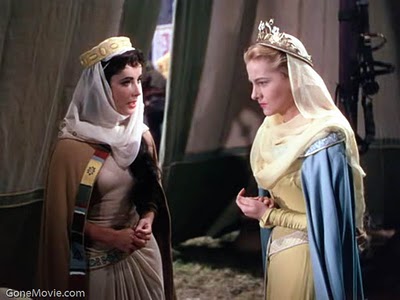
Liz Taylor and Joan Fontaine: 'scuse me, who's the heroine here?

Some time ago, we launched a firestorm about the controversial new edition of Mark Twain’s Huckleberry Finn that eliminates the “n” word altogether.

Now Sir Walter Scott‘s Ivanhoe is taking a thumping.  Apparently, modern readers find the 1819 novel, set in 12th century England, too ponderous and verbose.

According to an article in the Telegraph, a Scottish professor, David Purdie, has solved the problem with a pair of scissors:  he spent 18 months snipping it from 179,000 words to a mere 80,000:

While Prof. Purdie has retained the antiquated writing style used by Sir Walter, he has taken out the swathes of punctuation which extend the novel.

He said: “Very few people read Scott these days because he’s long and wordy and difficult for the modern ear and modern attention span.

“In the early 19th century, a comma was placed after every phrase, which makes it tedious reading.

Eliminating commas, however, does not account for cutting it down to less than half.  Last time I checked, commas didn’t count as words.

Some have questioned whether the book is so close to death that it needed this kind of life-saving surgery. Said, Professor David Hewit of Aberdeen University,  “The idea that Scott is neglected, no, it’s not neglected at all,” he said. “Ivanhoe is being well read.” He said that Penguin editions for the book had sold around 100,000 copies in the last decade, with worldwide sales of around 200,000 copies.

Moreover famous fans of Ivanhoe include Tony Blair, who said it he would take it to a desert island with him, and Ho Chi Minh, who praised medieval gallantry shown in the novel, as channeled by the Victorians.

Purdie appeared to have found an unexpected champion over at Billevesées. Blogger William V. Madison wrote about the novel earlier this month:

The plot that thrilled generations of readers is in constant struggle with Scott’s prose, which is verbose in the extreme. A character may typically take a long paragraph just to tell another to make haste, and my second-hand paperback edition provided very few notes (mostly Scott’s own, along with a thin glossary) to explain obscure terminology. (No attempt was made to explain the constant misuse of participles for past tense: “He sprung forth,” e.g.) Scott lards the story with “poetic” descriptions and song lyrics, and toward the end of the book, when poor Rebecca awaits her doom, Scott meanders off for several scarcely relevant chapters, sabotaging his own suspense. The resolution of the plot, hitherto relatively plausible, depends on one improbable death and an even more outlandish resurrection.

However – surprise! – Madison changes his tune:

In short, modern readers will find the odds stacked against them. And yet the damned thing does work. Almost against my will, I found myself caught up in the story, and this is largely due to Scott’s characterization, which in a couple of cases — notably the Jews, Isaac of York and his daughter — proves quite compelling. We feel so strongly the injustices they suffer that we care about what happens to them.

So much so that Scott complained after the novel was published why Ivanhoe didn’t elope with the Jewish Rebecca, rather than the boring shiksa Rowena.  That was even before the MGM movie that put a luscious Elizabeth Taylor in the supporting role.

It’s a fun read – Madison, I mean, not Ivanhoe (which I managed to read and enjoy as a teenager without too much trouble) – check out the whole thing here.  Madison even answers the eternal question why the evil Templar Brian de Bois-Guilbert doesn’t ravish Rebecca, as he had originally planned. It’s included in a long-lost fragment of the novel here.

Postscript on 1/31:  A belated hat tip to Kevin Rossiter for the Telegraph article.  He put his own p.o.v. succinctly:  “I just object to the idea of making any work of literature ‘more accessible.’  Peter Brown gave a lecture at Stanford a couple of years ago and addressed the question, ‘Why would anyone want want to study late antiquity?’  He used a phrase I like a lot – he said late antiquity had a ‘salutary strangeness.’  I think that’s what great literary works often have, too.  A healthy departure from the unexamined and comfortable.”  See more on Peter Brown of Princeton’s lecture here.


<<< Previous Series of PostssepNext Series of Posts >>>