Roberto Bolaño on Neruda, Kafka, and the abyss

January 19th, 2012
Share

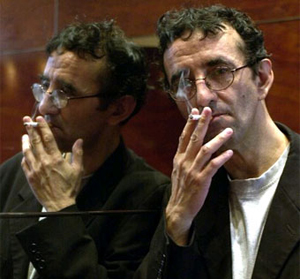
"A certain composure" (Photo: Creative Commons)

After reading my post on Pablo Neruda a few days ago, Daniel Medin sent me this insightful snippet from a Swiss journalist’s  interview of Chilean poet and novelist Roberto Bolaño, in the year before the writer’s death. Neruda is the least of it, really:

Which authors would you number among your precursors? Borges? Cortázar? Nicanor Parra? Neruda? Kafka? In Tres you write: “I dreamt that Earth was finished. And the only human being to contemplate the end was Franz Kafka. In heaven, the Titans were fighting to the death. From a wrought-iron seat in Central Park, Kafka was watching the world burn.”

I never liked Neruda. At any rate, I would never call him my one of precursors. Anyone who was capable of writing odes to Stalin while shutting his eyes to the Stalinist terror doesn’t deserve my respect. Borges, Cortázar, Sábato, Bioy Casares, Nicanor Parra: yes, I’m fond of them. Obviously I’ve read all of their books. I had some problems with Kafka, whom I consider the greatest writer of the twentieth century. It wasn’t that I hadn’t discovered his humor; there’s plenty of that in his books. Heaps. But his humor was so highly taut that I couldn’t bear it. That’s something that never happened to me with Musil or Döblin or Hesse. Not with Lichtenberg either, an author I read frequently who fortifies me without fail.

Musil, Döblin, Hesse wrote from the rim of the abyss. And that is commendable, since almost nobody wagers to write from there. But Kafka writes from out of the abyss itself. To be more precise: as he’s falling. When I finally understood that those had been the stakes, I began to read Kafka from a different perspective. Now I can read him with a certain composure and even laugh thereby. Though no one with a book by Kafka in his hands can remain composed for very long.

Postscript on 1/25:  Thanks to one of our readers, F.H., we have a link for the full interview.  It’s in German, here.

“The final dwarf of you”: late-life poems of Wallace Stevens, T.S. Eliot, and Czesław Miłosz

January 17th, 2012
Share

Crowd-pleaser

It is bitter cold, dropping below freezing in northern California – but still, a standing-room-only crowd gathered tonight to hear Helen Vendler speak on “Wallace Stevens as an American Poet.”

To be honest, the draw for me was Helen, not Stevens.  She was one of the contributors to An Invisible Rope, and we spent some time together in Kraków last spring.  Stevens is not exactly foreign territory, but I’ve never been attracted enough to make deeper excursions into his poetic terrain.

Then Helen quoted from Stevens’s poem, “The Dwarf,” and I eagerly looked up these incantatory lines later when I got home:

Now it is September and the web is woven.
The web is woven and you have to wear it.

The winter is made and you have to bear it,
The winter web, the winter woven, wind and wind …

It is all that you are, the final dwarf of you,
That is woven and woven and waiting to be worn …

"The web is woven and you have to wear it."

The subject of the poet’s approaching winter holds an increasing fascination for me … well, we are all growing older.  But growing older has been a great surprise – the psychological landscape and vantage points of late summer and autumn are not at all what I had been told or had been expecting.

Helen referred to Stevens’ sense of crustiness and limitation, the disillusionment of approaching old age – the horror and defeat of knowing that change is no longer possible.  But was it ever? Was it ever really?

I wonder, now, whether “progress” and “change” is imaginary even in youth – perhaps our sense of change is merely that we cannot yet detect which way the twig is bent.  Later, with 20-20 retrospection, the years have a certain inevitability to them – partly the illusion of rewriting the past to fit what we now know to be true, partly the result of our decisions.  “Choice” may be no more than whether we pull up the weeds or roses from our gardens, and which plants we water.  Even in old age we have the same choices: the decision, for example, of whether to abandon our vices before they abandon us.

So why do we go kicking and screaming as we are dragged through the first snow?  Obviously, age brings with it strange and bitter medicines of its own. T.S. Eliot put it astringently in “Little Gidding”:

"Then fools' approval stings..."

Let me disclose the gifts reserved for age
To set a crown upon your lifetime’s effort.
… the conscious impotence of rage
At human folly, and the laceration
Of laughter at what ceases to amuse.
And last, the rending pain of re-enactment
Of all that you have done, and been; the shame
Of motives late revealed, and the awareness
Of things ill done and done to others’ harm
Which once you took for exercise of virtue.
Then fools’ approval stings, and honour stains.

The final pill at the bottom of the bottle: a quiet self-acceptance – and with it, a welcome humility.  To return to poetry, isn’t it simply a matter of metaphors?  Why do we choose metaphors of old, unbending, twisted trees – isn’t age, at best, more a distillation, like attar?  The loss of distracting imagination and the fantasy of the infinitely wondrous “me,” the increasing laser-like focus on the one or two things one does well, whether it is writing poems or collecting seashells.  And the gratitude for the time to sustain such efforts – an option that was not given to the peers we buried.

Or, again, another metaphor:  why don’t we describe age in terms of botrytis, the rare “noble rot” of the vineyard, that yields the mellow depth and gentle surprise of late-harvest dessert wines?

"That's me."

Surely Czesław Miłosz knew what I am talking about – his late poems reflect the magic and wonderment of this new territory, and the self-surrender of humility –  a final sense of proportion and graceful humor about “the final dwarf.”

In his late poem, “At a Certain Age,” he admits “We wanted to confess our sins but there were no takers.”  After exploring several options, from pets to psychiatrists, he concludes:

Churches. Perhaps churches. But to confess there what?
That we used to see ourselves as handsome and noble
Yet later in our place an ugly toad
Half-opens its thick eyelid
And one sees clearly: “That’s me.”

On the other hand, there’s also his late-life prose poem, “Awakened”:

In advanced age, my health worsening, I woke up in the middle of the night, and experienced a feeling of happiness so intense and perfect that in all my life I had only felt its premonition. . . . As if a voice were repeating: “You can stop worrying now; everything happened just as it had to. You did what was assigned to you, and you are not required anymore to think of what happened long ago.” . . . The happiness on this side was like an announcement of the other side. I realized that this was an undeserved gift and I could not grasp by what grace it was bestowed on me.


Martin Luther King on his day: “Only in the darkness can you see the stars.”

January 16th, 2012
Share

One people, one reality (Photo: Martin Luther King, Jr. Research and Education Institute)

Today is the day set aside to honor Martin Luther King, Jr.  It came upon me quickly – I hadn’t even managed to bake a cake or send cards.  Do I get extra credit for my MLK post of a few days ago about the wording on the civil rights leader’s  memorial?

No matter.  Facebook and Twitter are awash with quotations from King, and somehow that seems a fitter and more dignified way to honor the Baptist preacher on a holiday that falls in bleak mid-January, after post-New Year sobriety has set in.

Two of my favorite newly discovered quotes below (hat tips to Laura Frew and Tess Kincaid):

“It really boils down to this: that all life is interrelated. We are all caught in an inescapable network of mutuality, tied together into a single garment of destiny.  Whatever affects one directly, affects all indirectly. We are made to live together because of the interrelated structure of reality . . . Before you finish eating breakfast in the morning, you’ve depended on more than half the world. This is the way our universe is structured, this is its interrelated quality. We aren’t going to have peace on Earth until we recognize the basic fact of the interrelated structure of all reality.”

-Dr. Martin Luther King, Jr.
1967 Christmas Sermon on Peace


“Only in the darkness can you see the stars.”

― Martin Luther King, Jr.


Adam Johnson on North Korea: one central character, and a supporting cast of 23 million

January 15th, 2012
Share

A maximalist (Photo: Tamara Beckwith)

I wrote about Adam Johnson in 2009, when he said that, for the last four-and-a-half years (he was careful not to say five), he had been working on a novel about North Korea, in which he will “explore ways people manage to be individual under that regime.”

Noting American value for “free-thinking, spontaneity, ingenuity, individuality,” he added, “Over there, spontaneity can ruin your life.” Nonetheless, the novel invites an examination of the propaganda Americans accept on this side of the Pacific.

Frankly, it didn’t sound as exciting as some of his other work, which had led the Chicago Tribune to claim: “Like a squall moving in on a dead-muggy day, Adam Johnson’s audacious work blows the covers off the short story and leaves the genre newly invigorated.”

I was wrong.  His new book, The Orphan Master’s Son, might be his best ever.  According to a story in the Los Angeles Times today:

Like many Westerners, Johnson initially saw Kim Jong Il as a kind of comic-opera figure and Korea’s Cold War-vintage society as a potential wellspring of satiric material. “I must admit that at the beginning the absurdities and the ironies attracted me,” Johnson said …

Not just a pretty face

Several years ago, he started writing a short story inspired partly by Kim Jong Il’s extravagant eccentricity, “his jet skis and his sushi habit, and he has a whole division of girls to pleasure him.” But that Comedy Central scenario changed as the author began to grasp the Orwellian dimensions of the regime’s power and the hopelessness and fear that pervade its citizens’ lives.

“It’s not just the Kim Jong Il bouffant hairdo,” said Johnson … “When I sit down and talk to people about what I discovered about that place … people are horrified about the gulags and the starvation and things like that.” …

“The more dark realities started inhabiting me, and the more I started dreaming about these places, the more really frivolous a lot of my original interests seemed,” Johnson said. “I know it really sounds cheesy, but I did feel a duty to try to tell the stories of people who couldn’t speak for themselves.”

Possibly Johnson’s greatest challenge was trying to infiltrate the inner lives of characters in a country where self-censorship and blending in with the anonymous throng are essential for survival. …

Reading online translations of North Korea’s government-run paper Rodong Sinmun, Johnson said he came to see that in North Korea there is only one central character, Kim Jong Il, and before that his father, Kim Il Sung, “and then there are 23 million secondary characters.”

Read the rest here.  Or read my own story here:

Given the dark and quirky nature of his stories, Johnson is not what one would expect. The inevitable first impression is massiveness – he’s an imposing 6-foot-4 and 265 pounds. But the former construction worker is also urbane, affable, mild-mannered.

Relaxing over his laptop and an iced coffee at the Stanford Bookstore café, Johnson reflects on what distinguishes him from many of his contemporaries: “I’m a maximalist,” he said contentedly. …

Clearly, Johnson is not afraid to whack his readers upside the head: “Why not have a spaceship come into the story? Why not?” To retell an age-old father-son story, Johnson suggested, “put them on an orbiting space station.” Or, better yet, tell the story through two raccoons, he said.

Maya Angelou complained – and stone gives way. Words on MLK Memorial to be fixed.

January 13th, 2012
Share

Just plain wrong. (Photo: Creative Commons)

Remember that cliché?  “It’s practically etched in stone.”  Meaning, fixed, immutable, can’t ever be changed.

Not so, when it comes to the Martin Luther King, Jr., Memorial on the National Mall.

Back in September, Maya Angelou kvetched about King’s words on the statue, saying it made King sound like “an arrogant twit.”  She was right. And she wasn’t alone:  Martin Luther King III told CNN: “That was not what Dad said.”

Here’s what’s one of the inscriptions, placed on one side of the statue says:

“I was a drum major for justice peace and righteousness.”

Here’s what King said on Feb. 4, 1968, two months before he was assassinated, in a sermon at Atlanta’s Ebenezer Baptist Church about a eulogy that might be given in the event of his death:

“If you want to say that I was a drum major, say that I was a drum major for justice. Say that I was a drum major for peace. I was a drum major for righteousness. And all of the other shallow things will not matter.”

According to the Washington Post, Interior Secretary Ken Salazar has given the National Park Service 30 days — because “things only happen when you put a deadline on it” — to consult with the King Memorial Foundation, family members and other interested parties and come up with a more accurate alternative.

“This is important because Dr. King and his presence on the Mall is a forever presence for the United States of America, and we have to make sure that we get it right,” Salazar said.

“Get out the chisel, Washington!” I wrote.  And believe it or not, they did.

We’re in Le Monde today!

January 13th, 2012
Share

Hey, this is kind of cool!  The Book Haven, and Humble Moi, have made it to the pages of Le Monde.  Il commence:

La lecture de la semaine, il s’agit d’un post du blog que Cynthia Haven, critique littéraire, tient sur le site de l’université de Stanford, en Californie. Le titre du post : “Les nouveaux médias sociaux ne sont peut-être pas si nouveaux que ça”.

“Si vous vous sentez submergés par les médias sociaux”, commence Cynthia Haven, “sachez que vous n’êtes pas les premiers dans l’Histoire. Une avalanche de nouvelles formes de communication s’est abattue aussi sur les Européens des 17e et 18e siècles.

Prefer English?  It’s derived from our November 2nd post “Hot new social media maybe not so new: plus ça change, plus c’est la même chose, which describes parallels between our Information Revolution and that of an earlier era.

Read the French take on all this here.  And don’t forget our mention in the New Yorker here.


<<< Previous Series of PostssepNext Series of Posts >>>