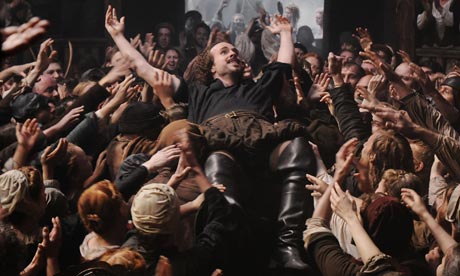
Ruth Kaplan finally got talked into viewing Anonymous, the film about William Shakespeare that is heavy on speculation and very short of facts (we wrote about it earlier in “Shakespeare or the Earl of Oxford? ‘It’s a shame sometimes that dead men can’t sue’ here). She already knew some of the atrocities in advance: for example, the notion thatChristopher Marlowe was devoured with his jealousy of Hamlet. It was, in fact, written seven years after Marlowe was murdered.
“Anonymous also makes unsupported allegations, suggesting, for instance, that Shakespeare never learned to write the alphabet. The film sees conspiracy in unremarkable events: the introduction makes the (dubious) assertion that we have not a single manuscript in Shakespeare’s hand, as if this is proof of a cover-up, as opposed to a norm for texts from that era.”
She’s also disturbed by the portrait of Queen Elizabeth as a hysterical, lovesick cougar, disinterested in the realm she governs. And she’s scornful of the notion that an Elizabethan provincial boy couldn’t read (Elizabethan grammar schools were crackerjack – David Riggs discusses that here.)
A retrograde fantasy?
But what really got her was the retrograde fantasy of an entire era, “its ridicule of the very idea of social mobility. Shakespeare’s desire to raise his social status is represented as vulgar.”
What does it all mean?
So far, she sounds like a lot of people who have seen the movie. Then she adds a wholly different twist:
Social mobility in modern-day America is now at an all time low. The gulf between those who go to college and those who don’t continues to widen. Americans continue to resent women in power, and to resist placing them there: think of the response to Hillary Clinton during her presidential campaign, or look at the US Senate, where only seventeen women serve. As for culture making, in 2010, only 7% of directors of domestic films were women. Despite the progress that has been made, we continue to battle as a nation over how to represent and accord rights to non-straight citizens. As an openly gay German, Roland Emmerich is perhaps an odd director of this portrait of power. Yet his movie not only mirrors the reality of power in our country, it consolidates and perpetuates the heterosexism, misogyny, and class bias that help maintain that reality.
The upshot? “Anonymous may well be the portrait of an age, but it’s not Shakespeare’s.”
My acquaintance with Sven is born of our common ancestry: We are both former students of Joseph Brodsky, which seems to be an enduring bond with a number of his former students the world over (James Marcus is another one, so is Gwyneth Lewis).
Sven was one of the contributors to Joseph Brodsky: Conversations a decade ago – back in the days before he even had his own email account. According to this interview, there’s been progress: “I started writing on a computer maybe 10 years ago. It was not a direct move—I would still do everything longhand, but then instead of typing I would put it in a computer. Now I actually write on a computer.”
Now he’s a changed man. When interviewer Robert Birnbaumasks him about his future writing, if he planning to do something “wild,” he responds that he wants to write something that “makes sense of this utterly transformed world that we are moving around in. That gives it a kind of identifiable voice.”
He wears three hats: editor of AGNI, head of the Bennington Writing Seminars, and author. He says that “in each of those three areas I am feeling seriously embattled. With the journal, for example, I feel we are fighting an action in the face of diminished attention, and that wasn’t the feel of it when there was more action on that front. With the teaching I really feel like, ‘Boy we have to keep this enterprise alive,’ to keep communicating a buzz around serious writing. Who knows what’s going to happen? So it becomes a rear-guard mission there, too. And with my own writing: definitely.”
I’ve often been criticized (usually by those who live with me) for the size of my library. Sven managed to formulate the explanation I could never quite manage:
RB: [Umberto] Eco reportedly has a library of 50,000 volumes. I asked him if they are catalogued—which they are not. Nonetheless, he knows where they all are. I asked if he read all of them. He hadn’t but said he had gotten something from all of them.
SB: Yeah, I would sign off on that. I have an unorganized library, but it’s much smaller. Same thing. I find that with me it’s not whether I have read something as much as it has survived my repeated attempts to get rid of it.
RB: (laughs)
SB: And if it has… Things that survive hold such a charge of your own sense of promise about yourself—which is valuable. Or it’s that they hold information that you know according to some obscure scheme is going to become important to you. I think the books that go unread are so important. If I got up and looked at my library and everything was a book I’d read, to me that would be like reading tombstones. I love the agitation, left and right—“Oh yeah, oh yeah.”
RB: I got rid of my vinyl albums. I should do that with books—what an albatross.
SB: Oh yeah. You need your ruins around you.
RB: That would require an enlarged sense of history.
SB: Right, and you have a visibly presented record both of your hopes and your failures. (laughs) It’s all there, kind of mapping you.
Sven is concerned about the role of the book review today, and the disappearance of book review sections … well, aren’t we all? Birnbaum doesn’t appear to “get it” – it’s not so much about the “middlebrow” reader, as it is about supporting a general culture where every educated person participates in literature, if only as a reader. As I’ve often said, as a writer for the Washington Post Book World or the erstwhile Los Angeles Times Book Review, my ideal reader was someone thumbing their way to the stock market page, becoming intrigued by my review, and buying a volume of poetry or essays. Maybe even forgetting the Dow Jones altogether.
RB: It’s not a contradiction but there is a kind of conflict that faces people who create—much of your world is not real. The real world is when you go to the grocery store or gas station. And then you deal with people who are attuned to scrambling to pay their bills and not the wonders of the creative enterprise. And I feel artists and writers have given up on those people, and there is something self-fulfilling about that attitude. Why did newspapers cut their book sections?
SB: It was largely economics.
RB: To cut features that a loyal core of the circulation read? Why would I go to the newspaper if they didn’t write about what I care about?
SB: That’s true, too. …
RB: Anyway, what is the reviewing engine about today? I joined the NBCC just to see what critics in the aggregate think their mission is.
SB: My sense is what has fallen out in a big way is the great middle that used to be occupied by the dozens and dozens of critics and reviewers you could have named some years ago. They were writing for a host of papers that paid a certain kind of attention to books. And those are the places that have disappeared or are shrinking. … And now, because of this shrinkage, the reviews editors of those places are desperately playing catch up, saying “We have to do something with this because it’s such a highly-touted book.” What doesn’t get attention is the spectrum—not even the B-list, all those quirky books that are not even going to sell 5,000 copies.
RB: Doesn’t it strike you that as a consequence the [book] awards are looking at books from tiny publishers …
SB: Sure. This situation is probably giving them extra permission to look harder there. They are picking books that in a different order of things should have gotten enough attention so that they wouldn’t seem strange when they were put forward. But because of this great void in the middle no one’s ever heard of them, or they’ve been reviewed once or twice.
His mission, as he sees it:
SB: Sure. The question is whether we live in a culture and psychological climate that is made up of people who feel there is a reason to play the game or else made up of a lot of people who have given up. I’d prefer the former.
RB: Conscious people are more affected than unconscious people.
SB: Absolutely.
If this post looks long, the whole tamale weighs in at over 7,200 words. You can read it here.
I only had one middling disagreement with him, when he defends the writer’s craft and the life-of-the-mind thusly: “People don’t think that sitting utterly inert in front of a screen is as hard as laying bricks. They think, ‘Well he’s doing nothing. But that guy over there is sweating.’”
Some coal-miner working 12-hour days underground would love to exchange his lot for “sweating” in front of a computer screen. We should never forget it.
By the by, the interview alludes to being “part 3” of an interview – but I didn’t find parts 1 and 2 online. But I did find this from Sven, and it’s absolutely priceless in the era of the tweet: “Concentration is no longer a given; it has to be strategized, fought for. But when it is achieved it can yield experiences that are more rewarding for being singular and hard-won. To achieve deep focus nowadays is also to have struck a blow against the dissipation of self; it is to have strengthened one’s essential position.”
Postscript on 1/8: Another part of Birnbaum’s interview has been found: Dave Lull sent us this Part 1, from way back in 2003, here. Thanks, Dave!
We all feel a little burned out after New Year’s celebrations, and I’m no exception. So here are some notable literary resolutions to fortify and inspire you for the coming year:
No commas, please
Ben Greenman, author of the short story collection What He’s Poised to Do: “I want to reread all the Emily Dickinson poems, in order, at a slow enough rate that I understand them but a fast enough rate to keep it exciting. It’s not as easy at it sounds. And I also plan to think about why, in a time of reduced attention spans, short stories aren’t getting more traction.”
Elissa Schappell, author of the short story collection Blueprints for Building Better Girls: “It’s the Russians. It’s always the Russians. Oh yes, I’ll read the Russians in the summer months. Two summers ago, I developed such a bad case of Tolstoy‘s elbow from hauling around War and Peace I could barely flip through a magazine. The summer before Crime and Punishment doubled as a drinks tray at a lawn party, and when I got spooked staying alone at a friend’s summer house, I kept it by the door as a weapon. This year, however I’m more hopeful–I’m starting, more appropriately, in winter. Beginning tomorrow I’m going to make Anna Karenina my new BFF.”
The Russians are coming
James Hannaham, author of the novel God Says No: “This year I want to figure out why, when an author says the phrase ‘working on a story collection,’ as in ‘I’m working on a story collection,’ everyone in publishing reacts as if they have instead heard the phrase ‘molesting several children.’ And I will continue to pray for the demise of e-books, or at least the demise of the stupid fear that they will replace printed books.”
Richard Lange, author of the 2013 novel Gather Darkness (Mulholland): “I’m going to reread Moby Dick, Crime & Punishment, and The Scarlet Letter. Every time I go back to books that I loved as a kid, I learn more about myself as a writer now.”
Marisa Silver, author of the short story collection Alone With You: “Read more poetry. Use fewer commas.”
Meanwhile, Dave Barry reviews 2011: “It was the kind of year that made a person look back fondly on the gulf oil spill”:
Multiple committees, strongly held views
This was a year in which journalism was pretty much completely replaced by tweeting. It was a year in which a significant earthquake struck Washington, yet failed to destroy a single federal agency. …
But all of these developments, unfortunate as they were, would not by themselves have made 2011 truly awful. What made it truly awful was the economy, which, for what felt like the 17th straight year, continued to stagger around like a zombie on crack. Nothing seemed to help. …
As the year wore on, frustration finally boiled over in the form of the Occupy Various Random Spaces movement, wherein people who were sick and tired of a lot of stuff finally got off their butts and started working for meaningful change via direct action in the form of sitting around and forming multiple committees and drumming and not directly issuing any specific demands but definitely having a lot of strongly held views for and against a wide variety of things. Incredibly, even this did not bring about meaningful change. The economy remained wretched, especially unemployment, which got so bad that many Americans gave up even trying to work. Congress, for example.
It’s the sixth day of Christmas, by my count, and my friend Elaine Ray has sent me a post from her blog, entitled “Langston Hughes, my father, Joseph Stalin and Jesus”, discussing a rather anti-Christmas poem by Harlem Renaissance poet Langston Hughes, and a 1940 article objecting to the poem written by her own father, the New York Age columnist Ebenezer Ray.
In an article in Poetry magazine, Hughes biographer Arnold Rampersad noted that during the most difficult days of the Great Depression, Hughes “had composed some of the harshest political verse ever penned by an American. These pieces include Good Morning Revolution and Columbia, but above all, Goodbye Christ. Here the speaker of the poem ridicules the legend of Jesus in favor of the radical reality of Marx, Lenin, ‘worker,’ ‘peasant,’ ‘me.’”
What struck me about the poem was … hadn’t I read this before? It sounded awfully familiar. My search for the poems Vladimir Mayakovsky, the gifted and misguided bard of the Bolshevik Revolution, in my ancient edition published by the USSR’s Progress Books, led to an unsuccessful household excavation.
So I tried google instead.
My nose hadn’t led me astray. In fact, Hughes translated Mayakovsky. The Communist writer Louis Aragon had offered his guidance to the American poet, and give an indication of how Hughes may have interpreted the Russian’s legacy.
Hughes’s choice of a literal translation for Mayakovsky was, in part, the result of his decision to heed Aragon on how to translate the peculiarities of the Russian master.
... Ebenezer Ray
Aragon most likely hand-delivered his advice for explicitly Western translators to Hughes when the two crossed paths in Paris. His advice offers both a justification for Aragon’s own literal translation of Mayakovsky, and a prescription for future translators. He urges that they forsake the reproduction of the formal elements of Russian poetry in the interest of preserving the totality of Mayakovsky’s revolutionary message and spirit for the purpose of its infusion into Western Europe:
Oui, le poèmes de Maiakovsky sont rimes. Mais allez comparer la rime française, et je ne dirais pas la rime russe, mais la soviétique! Tout un nouveau langage, le langage d’une nouvelle vie, des mots qui n’ont jamais été usés par les rabacheurs poétiques, jetés du jour au lendemain à la disposition du lyrisme. [….] De plus, la rime de Maiakovsky toujours imprévisible, souvent complex, faites de plusiers mots, tient peut-etre advantage du jeu de mots que de la rime.
Yes, Mayakovsky’s poetry rhymes. But let’s compare French rhyme, and not Russian rhyme, with Soviet rhyme. An entirely new language, the language of a new life, composed of words that were never used by old, tired poetics, which should not be thrown out because of a thirst for lyricism. [….] Moreover, Mayakovsky’s rhyme, always unexpected, often complex, is perhaps more concerned with word play than rhyme.
The photo: During the historic 1957 desegregation of a Little Rock high school, a journalist Will Counts took a photograph that captured the moment – young black student Elizabeth Eckford headed for school, and her tormentor, Hazel Bryan.
David can’t recall how old he was when he first saw the iconic photograph. “I could no more tell you than I could when I first saw the picture of the little boy in the Warsaw ghetto with his hands up. You just know you’re changed once you see it,” he told CNN. “These are images that haunt you for the rest of your life.”
David, actually, had his beginnings as a Michigan Daily photographer rather than a journalist, back in the days when I was a cub reporter (and before he went on to Stanford Law School). He was a gifted photographer himself, so it’s no surprise he was so deeply affected by the photo. Then he saw another.
When he visited the Arkansas high school over a decade ago, he saw a picture of the two women reconciled. “I realized this was the same Elizabeth and Hazel, only they were grown up and they were friendly. … I thought, as any journalist would, how did we get from the first picture to the second? And why didn’t I know anything about it? How had these two archetypal racial antagonists buried the hatchet? How could that be? So that’s what made me curious enough to start looking into it.”
The reconciliation between the women wasn’t permanent – they are no longer speaking – but their complex bond endures.
Somehow on my travels I missed the launch of David’s book, so I’m coming a bit late on the scene. Of course I’d read his earlier story, “Through a Lens, Darkly,” which was published in Vanity Fair in 2007.
Giving the book a plug now is a bit like rolling a rock downhill. When you’ve gotten blurbed Bill Clinton, you don’t need a boost from me: “The iconic image of Elizabeth and Hazel at age fifteen showed us the terrible burden that nine young Americans had to shoulder to claim our nation”s promise of equal opportunity. The pain it caused was deeply personal. … We all need to know about Elizabeth and Hazel.”
There’s an idiom about how the first person through the wall always get hurt most. Does this kind of oversimplification help us understand Elizabeth Eckford?
I think she was the most vulnerable of the Nine [African-American students], and it is a great pity that she was the one who happened to show up there first. She had a certain predisposition, a certain kind of sensitivity, that some of the other of the Nine didn’t have. She’s an absolutely extraordinary woman, and her sensitivity is part of her extraordinariness.
Did it really take seven years for Hazel to even speak with you?
Hazel got bad vibrations from me that first time we met. She thought that I was paying more attention to Elizabeth than I was to her. And Hazel had read up on the history of the civil-rights movement, particularly the origins of the N.A.A.C.P., and she knew that historically Jews and blacks had been allies. From what I said and how I acted, she thought that Elizabeth and I would become natural partners at her expense. It had never occurred to me that Hazel might react this way. I had thought, quite naïvely, that the white woman would feel more comfortable with me than the black woman would.
Over those seven years, this was still becoming an article?
Yes. I made several more trips to Little Rock, realizing that Elizabeth’s story was plenty complex. When the story appeared on Vanity Fair’s Web site, in September 2007, to coincide with the 40th anniversary, Hazel read it and I think she was touched by some of the things Elizabeth said about her. And she could see that I wasn’t yet another writer who’d come along either to ignore her or trash her—that, even though she hadn’t cooperated with me, I still tried to be fair to her. From that moment on, Hazel made herself available to me.
That day in 1957 defined Elizabeth and Hazel in drastic ways. Which of these two women did it define more?
Hazel. I think that Elizabeth had a kind of stoicism, a kind of depression, a kind of sensitivity that was exacerbated by what happened to her. But Elizabeth’s life was going to be troubled no matter what. As I say in the book, that picture is really more of Hazel than it was of Elizabeth: she is the dominant figure in it, literally at its center. Hazel is the one who will go to the grave knowing that the image will be part of civilization as long as civilization endures. Hazel hasn’t gotten over the fact that, despite all the good deeds she has done, her plea for forgiveness wasn’t granted and her sincerity was doubted. Hazel got it from all sides. So she’s retreated, and it will be very hard to coax her out of her shell, though I hope that for her sake, and Elizabeth’s, it happens someday.
People want so badly for this story to have something like a happy ending. What does it say about America that this happy ending never materialized?
I think it says something about American naïveté that we think it should have materialized, and about American impatience over the fact that it hadn’t. This would be a much bigger story, a more newsworthy story, if it had materialized. Then Oprah would be talking about it again. And the fact that it hasn’t yet makes it less interesting to people, when that fact is, it should make it more interesting to people because it’s real.
So it’s very stirring – movies get made of unrealistic, completely implausible situations like The Help, but not vexing real-world situations like this one. And that’s very sad. Revisionism is much more popular, much more marketable, than reality. You can walk out of the theater eating your popcorn and feeling happy. I wanted there to be a happy ending to this story, but I felt it wasn’t my role to stage manage a happy ending when there wasn’t. …
What did writing this book teach you about racism and race relations?
It just reminded me of how complex they are, I guess, and how heavy the hand of history is on us still, and how omnipresent America’s racial legacy remains. There’s no such thing as ‘post-racial,’ and all these problems are still lurking. They’ve just gone a bit beneath the surface. They’re not as bad as they once were, but there’s still a long way to go. I write all my books trying to figure out the kind of person I am, how I would behave in those circumstances and these books give me a chance to ponder that.
When Christopher Hitchens died this month, I thought immediately of Robert Conquest and his wife, Elizabeth, who were close friends of the renowned journalist and author. Believe it or not, Hitchens used to spend a good deal of time in Palo Alto – his wife’s family, as I recall.
No, Bob did not have anything he wanted to share publicly in memoriam; he is not of the “sharing” generation who tweets his thoughts. But there’s plenty else that is public.
Britain’s Standpoint is printing ten poems from Bob’s new book of light verse: Blokesongs and Blokelore from Old Fred, which will be out from the U.K.’s Waywiser Press in May. You can read them here.
Here’s the nasty truth: I’ve never been attracted to “light verse.” Limericks are lost on me. I’ve never, really, seen the point. But Bob Conquest has devoted years to them, and it occurred to me that the silly poems are a necessary release from his groundbreaking historical work on the effects of Communism in Russia and Eastern Europe – the work that earned him an Order of Merit from Poland in 2009.
Maybe it’s not a coincidence that, at almost the same moment Standpoint published the new poems, theDaily Beast published Bob’s analysis of the current crisis with the Russian anti-Putin protests following the Dec. 4 elections.
The upshot of the article: “The present regime may have abandoned the compulsive economic ideologies of the Communist past, but it has not developed anything like an open society.” It comes down to a peculiar relationship to truth:
Honored in 2009
After the disaster of collectivization [1929–33], the leadership had two options: either to admit failure and change policy—perhaps even to relinquish total power—or to pretend that success had been achieved. Falsification took place on a barely credible scale, in every sphere. Real facts, honest statistics, disappeared. History, especially that of the Communist Party, was rewritten. Unpersons vanished from the official record. A spurious past and a fictitious present were imposed on the captive minds of the Soviet people. To focus solely on the physical manifestations of the Communist terror—the killings, the deportations, the people who were driven to suicide—would be to overlook the larger context: what Boris Pasternak called “the inhuman reign of the lie.” Until Gorbachev came to power, the country lived a double existence—an official world of fantasy, grand achievements, wonderful statistics, liberty, democracy, all juxtaposed with a reality of gloom, suffering, terror, denunciation, and apparatchik degeneration.
When lies become part of the national fabric, the result was a thoroughly corrupted society:
Sakharov nailed it. (Photo: RIA Novosti)
Sakharov described the problem in the late 1970s: “A deeply cynical caste has come into being, one which I consider dangerous (to itself as well as to all mankind)—a sick society ruled by two principles: blat [a little slang word meaning ‘you scratch my back and I’ll scratch yours’], and the popular saw: ‘No use banging your head against the wall.’ But beneath the petrified surface of our society exist cruelty on a mass scale, lawlessness, the absence of civil rights protecting the average man against the authorities, and the latter’s total unaccountability toward their own people or the whole world.”
The Soviet bureaucracy’s reaction to the 1986 Chernobyl disaster demonstrated what Sakharov had been talking about. As David Remnick later noted in The New Yorker, it was typical of the regime that plant director Viktor Bryukhanov, on being told that the reactor’s radiation was millions of times higher than normal, replied that the meter was obviously defective and must be thrown away. Deputy Prime Minister Boris Shcherbina rejected a suggestion to order a mass evacuation. “Panic is worse than radiation,” he said.
So what’s changed in 2011? As everywhere, technology makes certain lies untenable:
Russians are used to electoral fraud. There were never any expectations that the Dec. 4 elections would be carried out with complete honesty, any more than Russia’s past votes were. But this time, instances of ballot irregularity were recorded by mobile devices and then posted on the Internet, to which more than 40 percent of Russians now have access. Outrage—and calls to protest—flashed from computer to computer. Political discourse is thriving in blogs, tweets, posts to Facebook, uploads to YouTube—challenging the regime’s old-media monopoly on news and opinion.


 Ruth Kaplan finally got talked into viewing Anonymous, the film about William Shakespeare that is heavy on speculation and very short of facts (we wrote about it earlier in “Shakespeare or the Earl of Oxford? ‘It’s a shame sometimes that dead men can’t sue’ here). She already knew some of the atrocities in advance: for example, the notion that Christopher Marlowe was devoured with his jealousy of Hamlet. It was, in fact, written seven years after Marlowe was murdered.