Who is the most compelling Satan in world literature? Take your pick.

November 13th, 2021

Share
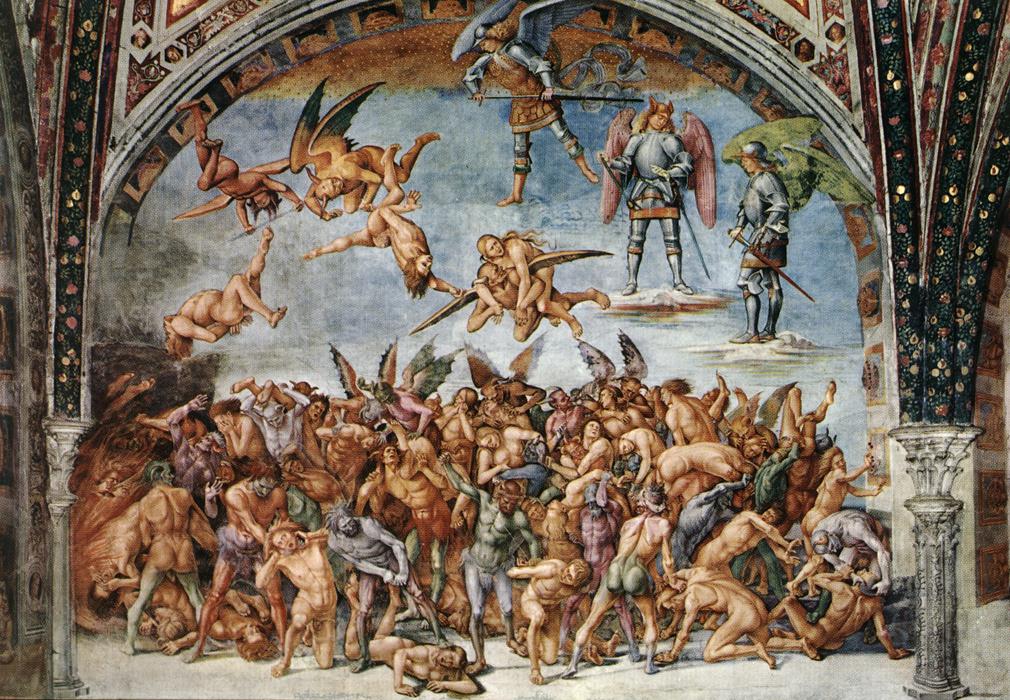
A one-way ticket: Luca Signorelli’s masterpiece in Orvieto Cathedral

Who is the most magnetic bad guy in world lit? BigThink comes up with a number of candidates here. The article considers several for the personification of evil: Dante‘s Satan, Goethe‘s Mephistopheles, and Bulgakov‘s Woland in Master and Margarita. Perhaps you can come up with a few names of your own.

From the unsigned article:

“In her book, The Origins of Satan, religious historian Elaine Pagels argues that Satan did not become a true antagonist to God until the 1st century. Looking to unite the Jewish followers of Christ during their relentless persecution at the hands of the Roman Empire, Gospel writers adopted an us-versus-them narrative that depicted their oppressors as incarnations of the Devil himself.”

The eternal skeptic on the side of the…

“As the personification of evil — be it mindful or mindless — Satan soon began appearing in nonreligious writings. Placing this larger-than-life figure outside of the scriptures in which he was first introduced, these storytellers not only influenced our thoughts on the nature of sin, but also taught us a thing or two about the religious institutions that have claimed to protect us from it.”

But it looks like BigThink will plump for Lucifer in Paradise Lost.

From the unsigned article:


Lucifer, the antagonist of John Milton’s epic poem Paradise Lost, is often considered as one of the most striking characters in all of British literature. As far as depictions of Satan in modern media are concerned including the titularly titled Netflix show as well as series such as Breaking Bad and Peaky Blinders, Milton’s version of the character – mobile and full of personality – has proven to be far more influential.

As with Dante, Milton’s poetic genius was so great that he was essentially able to add his own chapters to a religious narrative that had been passed down for centuries. In the poem, he attempts no less than to offer an alternative version to the book of Genesis, built around the theme of “Man’s disobedience, and loss thereupon of Paradise.”

Spending considerable time and effort on developing the personal motivations behind Lucifer’s rebellion, Milton speaks concretely about things the Divine Comedy had only hinted at. Milton’s take on the character likewise wants autonomy, but this desire is made to seem all but pathological. “Better to reign in Hell,” this Lucifer famously speaks, “than to serve in Heaven.”

The Satan found in Paradise Lost became especially popular among western readers. Writing for The Atlantic, editor and literary critic Ed Simon proposed that this particular iteration had an “independent streak that appeals to the iconoclasm of some Americans.” His need for freedom, even if it would lead to chaos and suffering, perfectly matched the spirit of a developing capitalist economy.

Read the whole thing here.

George Bernard Shaw salutes Albert Einstein in a 1930 film clip

November 2nd, 2021
Share

Today marks the 71st anniversary of George Bernard Shaw’s death, at age 94 in 1950. What better way to honor him than posting this short video, filmed at the Savoy Hotel in London, England on 27 October 1930. In less than two minutes, the Irish playwright wittily honors another Nobel winner, physicist Albert Einstein in a short speech. (With a hat tip to Neil Silberblatt.)

A Halloween poem from Czesław Miłosz

October 31st, 2021
Share

I’ve been on the road, giving talks for Czesław Miłosz: A California Life at the University of Chicago, San Francisco’s legendary City Lights Bookstore, and soon at the University of California, Berkeley. Now I’m camped out at Harvard for a few days. I’ll post links and photos soon.

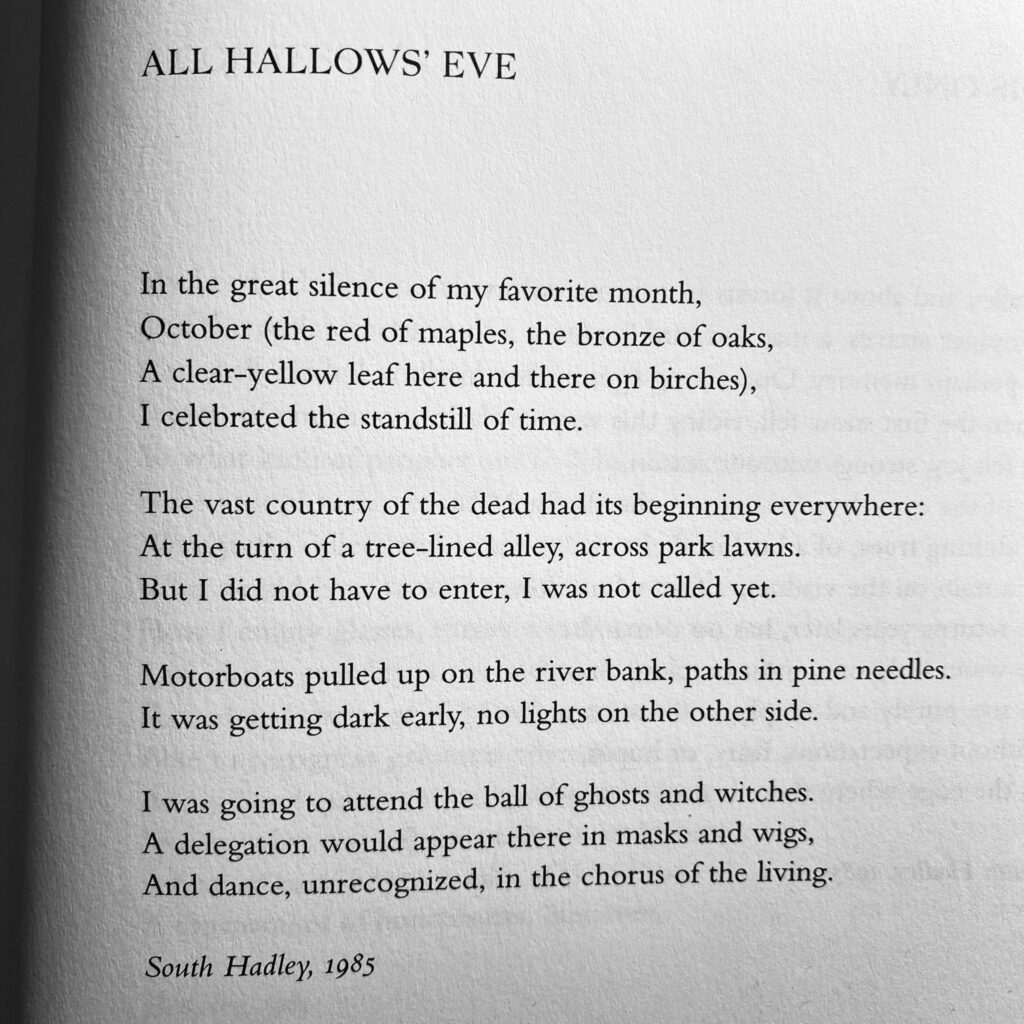
Meanwhile, here’s a timely poem from the subject of my book, Czesław Miłosz, which comes to me courtesy NEA fellow Jim May on Twitter. The poem written in South Hadley. No doubt the Polish poet was visiting his friend and fellow Nobelist Joseph Brodsky.

Postscript on 10/31 from Stanford Prof. Grisha Freidin: “Exile, multiplied by another poet’s exile, by the melancholy season, by the Styx-like river, with the other shore still shrouded in darkness… Note absence of self-pity. Quintessential Czesław.”

When your life appears in fiction: Molly Fisk and her Uncle John Updike

October 25th, 2021
Share
What are the boundaries? Are there any?

The current Harper’s Bazaar features a literary memoir by poet Molly Fisk. We’ve written about her before, here and here. I’ve known the poet for two decades – but I didn’t know she was the niece of novelist and short story writer John Updike. She describes the experience in “John Updike, His Stories, and Me.” You can read it here. It begins:

In December 1984, my father died at the Ghirardelli theater during a morning showing for backers and friends of the movie On the Edge, which stars creepy Bruce Dern as a long-distance runner. This was my father’s fourth heart attack. His friends described him laughing near the film’s end, and then hearing a sigh. When he was discovered unresponsive in his seat as the lights came up, that famous line was called out: “Is there a doctor in the house?!” There were four, but none of them could save him. He was 56.

At that point, my father, Irving, didn’t have any money. He wasn’t a backer, but he knew the director and was often on the fringes of various deals, cinematic and otherwise, “putting people together” and going out to lunch. Payment was largely theoretical.

For our family, losing this witty, charming, impossible man was like having the sun plucked out of a solar system. We, the remaining planets, careened randomly for a long time. I was 29 and going to business school, mostly because I hoped that it would help me understand him.

The borderlands of life and art.

Almost exactly three years after my dad’s death, a short story by Uncle John appeared in The New Yorker called “Brother Grasshopper.” Everyone who knew me and my family knew that my uncle was John Updike. He married my mother’s older sister, Mary, when they were in college, and we Fisks spent every summer back East in Ipswich or Vermont or on Martha’s Vineyard with the Updikes. Each couple produced four children at regular intervals, so we had nearly parallel cousins. If you’ve read Couples or The Maples Stories, you know the general scene: beaches, chaos, shucking corn, tennis and cocktails, adultery. There were the usual family spats now and then, but as a child, I always thought of the four adults as good friends.

Read the whole thing here.

Stanford’s “thought warrior”

October 22nd, 2021
Share
He listens to dead voices

Not many Americans read The Australian, the leading national newspaper Down Under. It’s a shame – they’re going to miss Janet Albrechtsen’s excellent profile of the man who has been called America’s leading humanist, born in what may be Homer’s birthplace – Izmir, Turkey. Stanford’s Professor Robert Pogue Harrison, a leading Dante scholar (we’ve written about him lots on the Book Haven), has taught literature at Stanford for almost three decades. His books include The Dominion of The Dead, where he explores how the living maintain a connection with those we’ve buried, and Juvenescence, where he considers how we are growing younger culturally, losing a very necessary reciprocity with our past.

Albrechtson writes: “Harrison is not part of the splurge of political podcasts waging war with the left or the right. One of the original long-form podcasters, before the word was born, Harrison started recording his meandering interviews, called Entitled Opinions, in 2005 in what he calls the catacombs of Stanford University’s radio station KZSU. He chooses “catacomb” deliberately. This is where, as he tells his listeners, new religions are born, his being ‘the persecuted religion of thinking.’”

A couple excerpts from the article:

Dead voices are writ large in Harrison’s life and work. He is concerned that the genius of innovation and change, now at speeds not seen over the course of human history, is breaching our connection with the wisdom of the past. “Genius liberates the novelties of the future, (and) wisdom inherits the legacies of the past, renewing them in the process of handing them down,” he writes in Juvenescence.

Harrison is too cool to be a ­curmudgeon. He recognises that being young is positive. “It’s ­vibrant, it’s energetic, it’s creative,” he tells me.

“But if we forget our cultural age and pretend like we’re children, then it’s really dangerous. And when you lose your cultural memory and connection with the past and with the dead voices that speak from the deep past, then you also, I think, lose the sources of rejuvenation. You can either rejuvenate or you can juvenilise. I don’t know how we can go forward into the future viably without a solid kind of foundation in the past.”

A radical kind of guy

Harrison draws on Dante to explain the dynamic synergy between genius and wisdom. “Dante in the Middle Ages is in a deeply Christian society, and he becomes the first person to write a Christian epic in the first person singular. That was very radical. That was very new. That opened up a whole new genre for the future. But he did not just invent it like Silicon Valley start-up companies say they are all about innovation. He found his way into the new possibilities of a Christian epic by the systematic study of Virgil, and with Virgil, the epic tradition that came from Greek and Roman sources,” he says.

He points to the same intellectual synergy between genius and wisdom when the Founding Fathers created a new nation. “Thomas Jefferson used to translate the Greek Bible into Latin and the Latin Bible into Greek when he was in high school. President Garfield, a century later, when he wanted to amuse his friends … he would take two pencils (one in each hand) and write Greek and Latin letters – sentences – at the same time.

“The framers of the American constitution … would go back and pour over the annals of the history of Rome and where Carthage went wrong. The whole new nation of America, the new republic, was thought up very deliberately by this constant persistent reference to antiquities and its models of the future.”

***

Translated Greek, Latin as a kid

He laments that education, especially the humanities, is deliberately trouncing dead voices. And he is unsurprised that humanities degrees at Australian universities have been penalised by a fee hike by the government.

He blames a cynical crusade over the past few decades where the humanities have become “more of a deconstructive enterprise rather than a reconstructive one. If we, the teachers, are the first ones to put into the tribunal all of the white males that represent the tradition, and invariably, when you put them in the tribunal, almost all of them are going to be indicted and proclaimed guilty, then it’s not unusual that governments should say, ‘Why should we fund a dead story?’”

What is a humanist? Obviously, Harrison is one. I’m not going to attempt a definition, but I will describe a characteristic. A humanist is someone who explores, explains, and inhabits literature, or philosophy, or history, or any of the other explorations are the essence civilization and human endeavor. They do this not (or at least not only) self-interested motives – a degree, a tenured appointment, a prize, or prestige as a PBS commentator – but because it is the world they inhabit, one that they wish to carry into the future by offering at least a single perishable link in an unbroken chain – not only for humanity’s sake, but also because it is their own lifeblood.

Read the whole thing here, if you can evade the paywall.

Ta-daa! “Czesław Miłosz: A California Life” is becoming a reality.

October 12th, 2021
Share

Czesław Miłosz: A California Life (Heyday Books) will be out at last on October 19. And Miłosz’s life is a California life, despite the barred “l”s in the poet’s name that stumped so many Americans and marked him as part of “the other Europe,” the half-continent that had been behind the Iron Curtain for much of his life. Hence, his American byline became Milosz, not Miłosz. (Incidentally, the diacritical signifies, in Polish, that the “ł” is pronounced like a “w” … and Polish “w”s are pronounced like “v”s.)

The Nobel poet spent more time in California than any other place during his long 93-year life. He wrote poems about the California landscape, engaged with our culture, and taught generations of students at UC-Berkeley. Some of those students became eminent translators of his work.

The Golden State is truly a state of mind as well as a place, and I was intrigued by how he embraced the land and its people – psychologically, intellectually, and as a poet. I was interested in portraying the California that sinks into us, that we never fully understand, no matter how long we live here – not the media cliché that conceals it. And I wanted to tell the story of the man who had escaped from Stalinist Poland by a miracle, and discuss his great, and often unacknowledged, good fortune to land here among us, where the poet of what he called “an unheard-of tongue” could become a poet of world renown. In California, he could champion Polish poetry, bringing poets such as Zbigniew Herbert into English and publishing the landmark History of Polish Literature and Postwar Polish Poetry. After an initially rocky reception in the United States, he lived for decades on idyllic Grizzly Peak, a literary landmark for Poles today, though little known outside Berkeley.

California Magazine named one the top picks for the fall (see below). And the current Publishers Weekly has a great review: “’The irony is that the greatest Californian poet… could well be a Pole who wrote a single poem in English,’ suggests journalist Haven (Evolution of Desire) in this detailed biography of Czesław Miłosz (1911–2004). California was crucial to Miłosz’s life and work, Haven argues, and notes that the Polish poet had a complicated relationship with the U.S.: ‘He longed for America yet loathed it, too.’” 

It concludes: “Much has been written about the poet, and Haven finds new ways into his life […] her examinations of the influence of place on his poetry are insightful. Fans of Miłosz’s work should give this a look.”

As the Mamas and the Papas warbled, “California dreamin’ is becoming a reality.”


<<< Previous Series of PostssepNext Series of Posts >>>