Poetry jumps species: Koko the Gorilla turns 40, announces and judges a poetry contest

July 4th, 2011

Share

Will cats be next? Can a poem incorporate a purr?

Haiku as a poetry form has become international. Now it’s taken a step beyond that – it’s jumping species altogether.

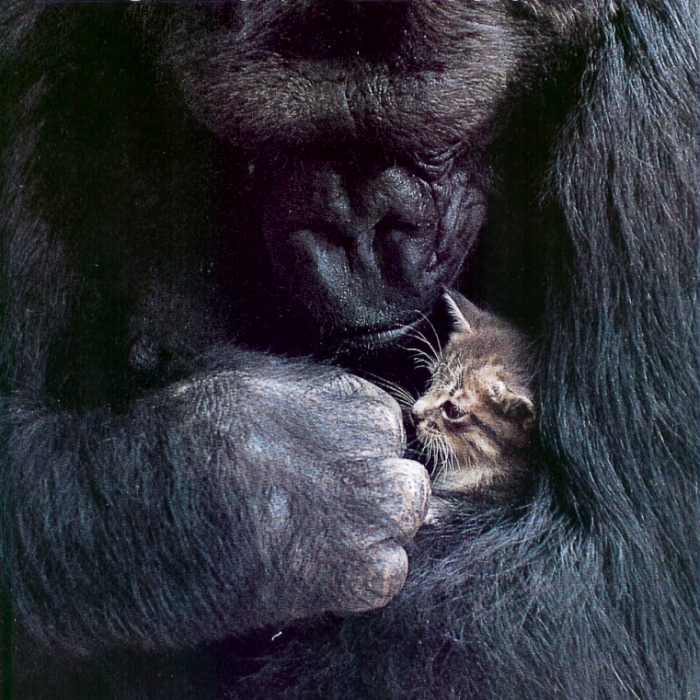
Today marks the 40th birthday of Koko the Gorilla. To celebrate, she announced a twitter-based poetry contest.

She also judged it.

The winning poem was announced today:

Gentle lady ape
Nimble fingers share her thoughts
Teaching us to love

The winner, in this case the twitter-user met314, gets an “fine art reproduction” of an original painting – also by Koko – titled “Love.”

Second prize for TanyaOsterman:

When I was little
Koko showed me that humans
Did not really know

Third prize for KokoLove40:

Art by Koko

Signing love polite
Koko’s gifts of heart and mind
Change the world for good

Honorable mention for coda1229:

Koko is our own
Example of life’s beauty
She shows we are one

The contest defined the haiku form as 17 syllables total, with three lines of 5-7-5 syllables, “expressing your birthday wishes to Koko,” and submitted via a tweet @kokotweets account with the hashtag #kokohaiku in the message. “Each line of the Haiku poem must be separated by period, comma or slash mark.”

Third prize

Well, that’s a minimalist understanding of haiku, which was as exactingly rule-bound as chess – in fact, more so.  And the rule about punctuation is a new one on me – presumably they meant to preempt mindless enjambment.

I recently spoke with a Japanese scholar, Steven Carter, who expressed the cheering, disconcerting, and dispiriting effect of the universality of haiku. We now have baseball haiku, pregnancy haiku, redneck haiku – you get the picture.

As Tom Stoppard, whose birthday was yesterday, by the way, claimed:  ‎”Skill without imagination is craftsmanship and gives us many useful objects such as wickerwork picnic baskets. Imagination without skill gives us modern art.”  Somehow haiku has become the self-esteem form to assign to elementary classes, which is both a good and bad thing.  In any case, Koko’s haiku-writing fans had to be 18 to participate in the contest.

Second prize

Animals reading and critiquing poetry, of course, sends us into a whole new arena.  I wonder if they’ll be better than some of the current lot.  It’s possible.  Like haiku, the bar isn’t high.

Koko not only speaks American sign language, she is able to share jokes, create and name works of art, and even read written words – not bad, for a gorilla purchased more or less at random from the San Francisco Zoo.  The mind boggles, really, at the implications.

Whatever. Picture of Koko and birthday here.  Picture of Koko enjoying a book on the same link.  Send a birthday message to Koko here: koko@koko.org Subscribe to Koko’s email newsletter here. And donate to the Gorilla Foundation here, to “help Koko save her species” – because Koko is, as well as writer, reader, connoisseur, critic, and artist, a humanitarian … or should we say gorillarian?

Happy birthday, Koko.

Perhaps I ought to send a reputable translation of Bashō?

Postscript on 7/6:  My interview with Steve Carter on “haikumania” is online today, here.

Orwell Watch #12: There is no faculty lounge. Get over it.

July 3rd, 2011
Share

Yesterday I read a denunciation of a book that “speaks only to those who spend their lives in coffeehouses in university towns or faculty lounges.”

Where is this place?  I have been a denizen of the great Stanford University, off and on, for over a quarter-century.  I have been a guest or visitor at many other universities, many of them also great.  I have never seen such a place.

“Lounge” has such a 1950s, 1960s resonance – it conjures images of cocktails, cigarettes, and turquoise leatherette chairs.

I did a quick Google search and found these phrases:

  • “Obama’s administration has become more of a faculty lounge than a…”
  • “Yet, contrary to the banal-cliché-loving media and faculty lounge crowd, ‘this tough economy’ is not at the root of our evils…”
  • Swollen with the clichés of the Arab Spring. …. or 1922, because 1967 is, as the faculty lounge left see it, the moment when the Israeli…
  • The reason it is “too important to fail”, to repeat the cliché  work a whole lot better in the faculty lounge than they do in reality,

Was there ever a faculty lounge?  After high school, that is?  It has the feel of high school, where overworked teachers of math, science, art, and English might club together to kvetch during the long, tedious day.  Given specializations in higher ed, I can’t imagine a mechanical engineering prof having the same haven as a James Joyce scholar or a psychology statistician.

In my search, I found this support for my reservations close to home, on Critical Mass, (not the same site as the National Book Critics Circle blog of the same name):

Patriotprof:  … Yet I’m sure there’s one of my Veterans of Foreign War chapters somewhere within reach where you might present yourself and remonstrate with some of my comrades over their adherence to “mindless cliches” and “uncritically held” patriotism. It might be an enlightening, even spiritually enlightening experience for you to desert the academic cloister, classroom, and faculty-lounge wing chair on a lark and bring your evident spirit of opposition to bear in probably unfamiliar territory. …

Eveningsun: As for ad hominems, I was referring to the bit about how it might be a “spiritually enlightening experience for [me] to desert the academic cloister, classroom, and faculty-lounge wing chair.” Before making a statement like that, you really ought to get to know someone well enough to know whether it’s even remotely true. Hell, we don’t even have a faculty lounge. [Emphasis mine]

Please everyone.  Stop talking about faculty lounges.

No one goes there to have a smoke anymore.  No one smokes.

Orwell Watch: Collect the whole set!

Orwell Watch #10:  Literary criticism, or cut-and-paste?

Orwell Watch #9:  “I take full responsibility for…”

Orwell Watch #8: “I know you’re disinterested in this, but…”

Orwell Watch #6: “Like” and the culture of vagueness

Orwell Watch #5: Before we shoot off our mouths again…

Orwell Watch #4: Jared Loughner: Madman, terrorist, or both?

Orwell Watch #3: Please. No “gifting” this Christmas.

Orwell Watch #2: Murder in Yeovil

Orwell Watch #1: Paul Krugman vs. George Orwell. (Hint: Orwell wins.)

Update on 7/5:  The quotable medievalist Jeff Sypeck, as usual, was quick to respond: “Good cliché catch, Cynthia. Considering what a broad, sluggish target university life is, the whole ‘faculty lounge’ quip shows that a writer has no recent, direct knowledge of academia and thus no clue where to aim his fire.”

But he spoke too soon.  Twelve hours later he sent me this Amazon link for Naomi Schaefer Riley‘s The Faculty Lounges: And Other Reasons Why You Won’t Get the College Education You Pay For.  The publishers couldn’t find a turquoise leatherette chair – they should have waited for my post – but they found a genuine leather armchair, another cliché. “Apparently, it’s a stand-in for ‘tenure,'” says Jeff. The faculty lounge lives on in legend, if not reality.

No love lost: “authors are some mean mofos”

July 2nd, 2011
Share

Hank James, zat you?

A few weeks ago, we wrote a few words on famous feuds between authors.

What better way to follow up than with nasty letters authors wrote on each others’ work?  I read flavorwire’s post on the topic some time ago, which excerpted a longer column from The Examiner here, with a Part 2 here.  It seems like as a good a way as any to begin the holiday weekend.

Take this one:

Wyndham Lewis on Gertrude Stein: “Gertrude Stein’s prose-song is a cold black suet-pudding. We can represent it as a cold suet-roll of fabulously reptilian length. Cut it at any point, it is the same thing: the same heavy, sticky, opaque mass all through and all along.”

As one commenter, Dave, concluded:  “Authors are some mean mofos.”

Instead of resnipping the earlier lists, however, I decided to raid the suggestions from readers.

No eraser

Ben Jonson on Shakespeare:  “I remember the players have often mentioned it as an honor to Shakespeare that in his writing, whatever he penned, he never blotted out a line. My answer hath been, ‘Would he had blotted a thousand.”

Baudelaire on Voltaire: “I grow bored in France – and the main reason is that everybody here resembles Voltaire … the king of nincompoops, the prince of the superficial, the anti-artist, the spokesman of janitresses, the Father Gigone of the editors of Siècle.”

H.G. Wells on Henry James: “A hippopotamus trying to pick up a pea.”

Ahem...

Louis-Ferdinand Céline on D.H.Lawrence’s Lady Chatterley’s Lover: “600 hundred pages for a gamekeeper’s dick, it’s way too long.”

As far as potty-mouth goes, try this one:  Stephen Fry on Dan Brown‘s The DaVinci Code: “Complete loose stool water. Arse gravy of the very worst kind.”

William Hazlitt about his good friend Coleridge: “Everlasting inconsequentiality marks all he does.”

Then there’s a Jane Austen pile-on:

Mark Twain:  “Just the omission of Jane Austen’s books alone would make a fairly good library out of a library that hadn’t a book in it.”

Charlotte Bronte‘s criticism is less snarky, more an excellent Romantic era critique of the preceding era’s Classicism:

"A Chinese fidelity..."

“. . . anything energetic, poignant, heartfelt, is utterly out of place in commending these works; all such demonstration the authoress would have met with a well-bred sneer . . . She does her business of delineating the surface of the lives of genteel English people curiously well; there is a Chinese fidelity, a miniature delicacy in the painting: she ruffles her reader by nothing vehement, disturbs him by nothing profound: the Passions are perfectly unknown to her; she rejects even a speaking acquaintance with that stormy Sisterhood; even to the Feelings she vouchsafes no more than an occasional graceful but distant recognition; too frequent converse with them would ruffle the smooth elegance of her progress. Her business is not half so much with the human heart as with the human eyes, mouth, hands, and feet; what sees keenly, speaks aptly, moves flexibly, it suits her to study, but what throbs is the unseen seat of Life and the sentient target of death–this Miss Austen ignores, she no more, with her mind’s eye, beholds the heart of her race than each man with bodily vision, sees the heart in his heaving breast. Jane Austen was a complete and most sensible lady, but a very incomplete, and rather insensible (not senseless) woman . . .”

Ceallaig‘s perceptive comment from an intelligent heart:  “My question is: if Mark Twain hated Jane Austen why does he say ‘every time I read it?’ Wouldn’t once have been enough? Ditto Noel Coward‘s slam on Oscar Wilde: ‘Am reading more of …’? as if the first dose wasn’t sufficient? I’m sure most of these slams were meant to be witty, and I agree with a number of them, but … wit used for the sake of nasty doesn’t work for me.”

Ellis: "a mean shallow stupid novel"

Then I found this interesting post, from bibliokept. David Foster Wallace on Bret Easton Ellis.  I leafed through Ellis’ Less Than Zero in the Stanford Bookstore a couple decades ago, and found it ugly and depraved.  I haven’t read Wallace at all, and have been put-off by his super-celebrity status, which, morbidly, seemed to accelerate with his 2008 suicide – until I read this excerpt from an interview:

“I think it’s a kind of black cynicism about today’s world that Ellis and certain others depend on for their readership. Look, if the contemporary condition is hopelessly shitty, insipid, materialistic, emotionally retarded, sadomasochistic, and stupid, then I (or any writer) can get away with slapping together stories with characters who are stupid, vapid, emotionally retarded, which is easy, because these sorts of characters require no development. With descriptions that are simply lists of brand-name consumer products. Where stupid people say insipid stuff to each other.

Wallace: "In dark times..."

‘If what’s always distinguished bad writing—flat characters, a narrative world that’s clichéd and not recognizably human, etc.—is also a description of today’s world, then bad writing becomes an ingenious mimesis of a bad world. If readers simply believe the world is stupid and shallow and mean, then Ellis can write a mean shallow stupid novel that becomes a mordant deadpan commentary on the badness of everything. Look man, we’d probably most of us agree that these are dark times, and stupid ones, but do we need fiction that does nothing but dramatize how dark and stupid everything is?

“In dark times, the definition of good art would seem to be art that locates and applies CPR to those elements of what’s human and magical that still live and glow despite the times’ darkness. Really good fiction could have as dark a worldview as it wished, but it’d find a way both to depict this world and to illuminate the possibilities for being alive and human in it. You can defend Psycho as being a sort of performative digest of late-eighties social problems, but it’s no more than that.”

I’d say it’s considerably less.

Bibliokept‘s thoughtful consideration of Ellis versus Wallace definitely worth a thoughtful read.

Happy 100th birthday, Czesław Miłosz!

June 29th, 2011
Share

“The River Neman, not far from its mouth on the Baltic Sea, is fed by several smaller tributaries flowing from the north, out of the very heart of the peninsula. It was on the banks of one of these tributaries, the Niewiaża, that all my adventures began…”

Nobel laureate Czesław Miłosz (6/30/1911-8/14/2004), Native Realm

I had the great good fortune in May to visit Czesław Miłosz's birthplace in the rural Lithuanian village of Šeteniai. And yes, it is as idyllic as he said it was. I took this photo with my Droid on the former family estate, overlooking the river. The fishers called out to ask if we had permission to photograph them. Yes, one of us shouted back, there was a journalist in the group. They laughed, thinking it was a joke.


Quick! Steve Silberman needs help. Authors please advise.

June 29th, 2011
Share

Help!

Steve Silberman just signed a book contract.  That’s the good news.  The bad news:  “It’s one thing to work up a 4000-word magazine feature and another to sit down and write a 100,000-word book,” he wrote.

Silberman said he was “scared out of my wits that the two decades of journalism that have led up to this project have not prepared me to write a good book. I wake up at 3 a.m. staring into the darkness, wondering if I’ll have the skills, discipline, and inner resources to pull it off.”

The obvious answer:  write another article.  And he’s done it, on PLoS Blogs here.

He asked 23 fellow writers a question: “What do you wish you’d known about the process of writing a book that you didn’t know before you did it?”

From John Tarrant:  “Ideas don’t come from anywhere identifiable, so I’ve come to trust that they will be given. This is along the lines of not whipping the donkey.”

Seth Mnookin wrote:  “I tried, not always successfully, to start each day with some discrete goal I wanted to accomplish: write 200 words, or get through a certain amount of research, or conduct two interviews, or whatever. If I set out to spend a day “writing,” that would be so overwhelming I’d end up just farting around online all day instead of starting the climb the mountain.”

I liked three from Cory Doctorow:

·  “Write when the book sucks and it isn’t going anywhere. Just keep writing. It doesn’t suck. Your conscious is having a panic attack because it doesn’t believe your subconscious knows what it’s doing.”

·  “Stop in the middle of a sentence, leaving a rough edge for you to start from the next day — that way, you can write three or five words without being “creative” and before you know it, you’re writing.”

· “Write even when the world is chaotic. You don’t need a cigarette, silence, music, a comfortable chair, or inner peace to write. You just need ten minutes and a writing implement.”

Basil Wasik offered praised outlines:  “This is a basic piece of advice, but it can’t be overstated when you’re trying to go from magazine-length to book-length writing: hone your outline and then cling to it as a lifeline. You can adjust it in mid-stream, but don’t try to just write your way into a better structure: think about the right structure and then write to it. Your outline will get you through those periods when you can’t possibly imagining ever finishing the damn thing — at those times, your outline will let you see it as a sequence of manageable 1,000 word sections.”

And this one, from Paula Span, is actually true: “You already know what you need to know to do this.  The fact is, my 60,000-plus-word book was pretty much like writing 8 to 10 long-form pieces.  I didn’t do it differently, in terms of research or writing or rewriting.  My existing skills were perfectly adequate to the task; yours will be too.  It took me 2.5 years but then, I was teaching and freelancing at the same time; had I focused solely on the book, it probably would’ve taken 18 months.  So you will make your deadline, even if your book is longer and more complex.

Finally, from August Kleinzahler:  “When my self-disgust reaches critical mass I seem to be ready to go.”

Read the rest here.

And if any of you authors have some thoughts to add, I’d love to hear them.

Bei Dao: “Each language keeps the secret code of a culture”

June 28th, 2011
Share

Reading at St. Catherine's Church, Kraków (Photo: Droid)

In an early poem, Bei Dao wrote, “freedom is nothing but the distance/between the hunter and the hunted.”

All too true, as he soon found out.

Protesters once shouted his poems in Tiananmen Square, and after his exile (he had been in Berlin during the 1989 uprising), he continued to write in Scandinavia, the U.S., and France.  He now teaches at the Chinese University of Hong Kong, since the government allowed his return to the PRC a few years ago.

At last month’s Czesław Miłosz Festival in Kraków, he participated in a panel called “Place of Birth” with Lithuanian Egidijus Aleksandravičius, English Timothy Garton Ash, and Polish Irena Grudzińska Gross, hosted by Italian Francesco Cataluccio.  Although some of the estrangements from native realms were more voluntary than others, the team discussed their sense of displacement from homeland.

But the most haunting words of the evening belonged to Bei Dao:  “It’s mysterious. Why do we think about birthplace, mother tongue, the origin of life?” he asked.  And then he gave his answer.

“Each language keeps the secret code of a culture,” he said.

“China is unified by a written language,” he said.  “The local accent keeps their secret, keeps their code.”  That’s what he cherishes, and that is what the world is most at risk of losing.

His words returned to me today as I read an unusually eloquent McClatchy Newspapers article, “Silenced Voices,” by Tim Johnson:

Some linguists say that languages are disappearing at the rate of two a month. Half of the world’s remaining 7,000 or so languages may be gone by the end of this century, pushed into disuse by English, Spanish and other dominating languages.The die-off has parallels to the extinction of animals. The death of a language, linguists say, robs humanity of ideas, belief systems and knowledge of the natural world. Languages are repositories of human experience that have evolved over centuries, even millennia.

“Languages are definitely more endangered than species, and are going extinct at a faster rate,” said K. David Harrison, a linguist at Swarthmore College in Pennsylvania and the author of the book When Languages Die. “There are many hundreds of languages that have fewer than 50 speakers.”

Language is an invisible triumph of humanity, and its disappearance brings only silence.”It’s not as flashy as a pyramid, but it represents enormous human achievement in terms of the thought and effort that went into it,” said Daniel Suslak, a linguistic anthropologist at Indiana University…

Miłosz knew this:  This is why Miłosz wrote in Polish throughout his 40 years of exile in California, said the Chinese poet.

In 1999 at Stanford (Photo: L.A. Cicero)

Bei Dao was born in 1949 in Beijing.  “As Chairman Mao declared the birth of the People’s Republic of China from the rostrum in Tiananmen Square, I was lying in my cradle no more than a housand yards away. My fate seems to have been intertwined with China ever since,” he wrote in the festival’s 100-page companion book. “I received a privileged, but brief, education. I was a student at the best high school in Beijing, until the Cultural Revolution broke out in 1966.  All the schools were closed, and three years later I was assigned to work in the state-run construction industry.”

In those harsh circumstances, at the age of 20, the young construction worker began to write at a site in the mountains more than 200 miles from Beijing.

During the conference session, he recalled visiting his dying father in a brief respite from exile, but Beijing was a disappointment:  “It was not my city anymore.”

“The Chinese people do not know how to rebuild,” he said, praising the preservation of Venice and Florence.  The Chinese, by contrast, “build like Las Vegas – very, very ugly buildings.”

Left to right: Francesco Cataluccio, Bei Dao, Timothy Garton Ash, Egidijus Aleksandravičius, Irena Grudzińska Gross (Photo: my Droid)

“We were drawn by the concept of progress from the West and from Marxism.  Progress became the canon for Chinese people. There was more attention on GDP and new buildings.  Materialism and consumption destroyed Chinese culture.”

At Stanford over a decade ago, he remarked, “I don’t have a motherland now.”

“Someone recently said to me that I am like a man to whom the whole world has become a foreign country, and I like that.”

But things change, in our heads as well as in the world.

Detroit, the notorious city of my birth, is now as much a gutted ruin if it had been destroyed by enemy mayhem – which in a sense it had been.  And as some of the speakers mourned their lost homes, I wondered if they were actually mourning the passage of time as much as they were exile and upheaval.

Political exile is poignant, but disguises a more inexorable reality: We are exiles in time as well as in space.  Both are excruciatingly transient.


<<< Previous Series of PostssepNext Series of Posts >>>