The Poles throw a party: postcard from Kraków

May 9th, 2011
Share

Jagiellonian University's Collegium Novum

When the Poles throw a party – they don’t settle for half-measures.  And what better occasion than the Czesław Miłosz centenary?  This is easily the most lavish, labor-intensive, high-class shindig of its kind I’ve ever attended.

We’re not just talking about the obvious:  swag bags with books and DVDs; Miłosz pencils, pens, and t-shirts; Miłosz’s signature on the dinner napkins, and just about everywhere else.  It’s not only the stunning setting at Jagiellonian University, one of the oldest universities in Europe.

Collegium Novum's Assembly Room

Everyone is here:  Derek Walcott, Bei Dao, Thomas Venclova, Adonis, Natalia Gorbanevskaya, and Adam Michnik are among the luminaries – but only among. There are many more.

Queen Jadwiga's portrait watches over us

Though the Book Haven has been relatively silent lately, obviously I have not been idly eating bonbons.  Or at least, not only. This conference at the university’s Collegium Novum and the “Miłosz Pavilion” has pretty much been running me ragged – and the Milosz365 festival continues into the weekend and next week.

And organizers Jerzy Illg, publisher of Znak, and Aleksander Fiut, Miłosz scholar, have bags under their eyes …  Well, they’re not the only ones.

Consider this a down payment.  More later.

Postscript on 5/14:  Walcott’s a no-show, nobody knows why, though a pleasant, vague letter was read by Jerzy Illg at one of the events.  I understand this is not the first time Walcott has bailed.

On heroes: Irena Sendler, Phil Zimbardo, Kendall Fielder

May 8th, 2011
Share

I arrived in Kraków yesterday – or perhaps today, I’m not smart enough to untangle the time differences.  I spent a good part of the afternoon reacquainting myself with old haunts and half-familiar streets. The city is awash with images of its native son, John Paul II, who was beatified on May 1. Photographs are in windows, banners on the streets, and large biographical displays mark two sites I’ve passed so far.

May 1 was also the national screening of PBS’s In the Name of Their Mothers, about Irena Sendler and the women of Żegota, who saved 2,500 Jewish children from certain death during the Holocaust. I’ve written about it here and here and here and here.  Alas, I doubt the film got much attention; it unexpectedly vied with President Obama’s announcement of the killing of Osama bin Laden. I strongly suspect the latter event got the upper hand. But May 1 is significant for other reasons.

My lighter airplane reading was Irena Sendler: Mother of the Children of the Holocaust. I didn’t hold out much hope for this modest, yet reasonably expensive ($40) book with the clumsy title – but the newly translated biography-of-sorts by Anna Mieszkowska is so far the only work that exists in English. Fortunately, the book so far has proven much better than my subdued expectations. For one thing, a good deal of it is written by Sendler herself, from letters, memoirs, and recollections she left behind.

A spider or a Rorschach test?

So what else is May 1? It is also marks the celebration of Divine Mercy this year – a custom instituted by the late pope, who, in another mysterious link, died on the eve of the Polish visionary whose writings caused the celebration.

The event is linked with Sendler, too.  From Mieszkowska’s book:  

A period of mass executions began at Pawiak Prison. Every morning the cell doors opened, and those called out never returned. “I once found a small, damaged picture with the words ‘Jesus, I trust in You!’ I hid it, and had it with me all the time.”

The footnote to this text says: “This picture, which she described as the most valuable object in her life, Irena posted in a letter (describing its history but not leaving a return address) to Pope John Paul II during his first visit to Poland.”

Skinner: Kind of a hero herself

Somewhere I heard the story that the pope returned it to her later, and she gave it back to him, and it’s in a museum somewhere. I can’t remember.

Mary Skinner, the filmmaker behind In the Name of Their Mothers (and kind of a hero herself) told me the image was a signal the women of Żegota sent to each other and left for each other – sometimes just to buck themselves up.

Turning away from the dark side

In any case, I keep the image in my wallet, reminding myself of their example, and not to be such a sissy. When a member of the Polish literati saw it, he acted as if I had shown him a spider. Well he asked.

All this links with a current Science article about Phil Zimbardo’s work on heroes – that’s right, Zimbardo of the infamous Stanford Prison Experiment. His latest work explores the basic idea that “anyone can be a hero,” he said.

At age 78, he has reinvented himself as a social entrepreneur, leading a new project that will attempt to turn the Stanford Prison Experiment and other studies of the dark side of the human psyche into a force for good. Last year, Zimbardo founded the Heroic Imagination Project … “Our ambition is to seed the world with heroes,” Zimbardo says.

A different kind of military hero

He’s putting his money where his mouth is:

“This is my new mission in life,” he says. He chipped in $30,000 of his own money to start the project and has since raised nearly $250,000 more from other donors. He’s considering auctioning off some of his art and wine collections. “I grew up in abject poverty in the South Bronx,” Zimbardo says. Now that he has nice things, he says he’s willing to give them up if that’s what it takes. Zimbardo seems to have thrown himself wholeheartedly into the challenges of his grand new experiment – and the shot at redemption. “It’s rescued my career from being Dr. Evil to being Dr. Good,” he says.

Some other good stuff he’s done is here.

At one point, Phil was asking for examples of heroes. I suggested Irena Sendler, of course. I also suggested someone I’m proud to consider a relation: my grandfather-in-law Brigadier General Kendall Fielder, who resisted the orders for the confinement of Japanese Americans in Hawaii.  (He was also the highest ranking officer exonerated after Pearl Harbor.)

G'night from Kraków and Wawel

Greg Robinson, who has written about him in two of his books about the Japanese internment, explained heroism this way:  “You never know who will have a moment of grace, and under what circumstances.”

Ah, I hear Wawel Cathedral tolling midnight …  in the which reminds me I’m in Kraków…

Michel Serres: “Old Europe, what ignorant ruling class is killing you?”

May 5th, 2011
Share

One of France's most prominent intellectuals – an inconnu in America (Photo: L.A. Cicero)

Few people in the U.S. know Michel Serres – and it’s too bad.  He’s one of two immortels we are lucky to have on hand at Stanford; René Girard is the other member of the elite Académie Française.  Heaven knows René is not well enough known  in the U.S., either – I’m told that I was the first to review any of his books in the mainstream press a year or two ago, a record that, to my knowledge, remains unchallenged.  Shocking when you consider that both are among France’s best known public intellectuals – Michel even has a regular radio spot (and a blog, too – it’s here).  I wrote about him two years ago here.

So I was pleased to see this article from last month on Adbusters, for his new book Malfeasance: Appropriation Through Pollution?, published a few months ago by Stanford University Press. In it, Michel has developed “a unified theory of pollution,” and has written “the first truly philosophical work of the mental environmentalist movement.”  I didn’t know there was such a movement, but here goes:

“Let us define two things and clearly distinguish them from one another,” Michel Serres writes, “first the hard [pollutants], and second the soft. By the first I mean on the one hand solid residues, liquid gases, emitted throughout the atmosphere by big industrial companies or gigantic garbage dumps, the shameful signature of big cities. By the second, tsunamis of writings, signs, images, and logos flooding rural, civic, public and natural spaces as well as landscapes with their advertising. Even though different in terms of energy, garbage and marks nevertheless result from the same soiling gesture, from the same intention to appropriate, and are of animal origin.”

One of the most amazing and admirable things about this amazing and admirable man is his relentless, disciplined, and systematic approach to writing.  As I wrote here:

The observant may notice that, although Serres speaks extemporaneously, in front of him is a pile of typed pages. They are not notes but full lectures. He writes about 40 pages between classes, so it is all fresh in his mind when he speaks. Occasionally during his lecture he will pause, flipping through a dozen pages to catch up to his spoken words.

For the last few years, each course he has taught has turned into a book; for example, this year’s Écrivains, savants et philosophes font le tour du monde. This spring’s class—not surprisingly, perhaps, on writers and writing—is slated to be another book.

I’d heard his last year’s class discussed waste, garbage and feces – I didn’t know what he made of it.  As it turns out, his new book, Malfeasance, is a “passionate rallying cry.” It is the second form of pollution that concerns him most.

“It makes me suffer so much that I need to say it over and over again and proclaim it everywhere; how can we not cry with horror and disgust confronted with the wrecking of our formerly pleasant rural access roads into the cities of France? Companies fill the space now with their hideous brands, waging the same frenzied battle as the jungle species in order to appropriate the public space and attention with images and words, like animals with their screams and piss. Excluded from those outskirts, I no longer live there; they are haunted by the powerful who shit on them and occupy them with their ugliness. Old Europe, what ignorant ruling class is killing you?”

(Oh, oh, oh! I did a very rare English interview with him on video – don’t miss it here. I’d embed it if I could, but I can’t … so I won’t.)

Martin Luther King quote goes viral: Fake? Not really…

May 3rd, 2011
Share

His quote ... kind of

This quote went viral on the internet, following the killing of Osama Bin Laden:

‎”I mourn the loss of thousands of precious lives, but I will not rejoice in the death of one, not even an enemy. Returning hate for hate multiplies hate, adding deeper darkness to a night already devoid of stars. Darkness cannot drive out darkness: only light can do that. Hate cannot drive out hate: only love can do that.”

Penn Jillette:  Not him

Penn Jillette: Not him

The citation was attributed to Martin Luther King, Jr., but a number of people came forward to debunk it.  A Salon article attributed the quote to famous magician Penn Jillette. Megan McArdle of The Atlantic wrote, “Out of Osama’s Death, a Fake Quotation is Born.” But when I (silly me) posted the quotation on my Facebook page and heard about kerfuffle, I found someone who indeed attributed the quote to MLK’s 1963  Strength to Love.

Who better to ask than Clay Carson and the folks at Stanford’s Martin Luther King, Jr., Research and Education Institute, home of the King Papers Project?  The crackerjack editorial team responded within minutes.

Here’s the real quote, from “Loving Your Enemies,” in Strength to Love:

The mysterious Ms. Dovey

“Returning hate for hate multiplies hate, adding deeper darkness to a night already devoid of stars. Darkness cannot drive out darkness; only light can do that. Hate cannot drive out hate; only love can do that. Hate multiplies hate, violence multiplies violence, and toughness multiplies toughness in a descending spiral of destruction.”

“Mangled to a meme in less than two days,” concludes McArdle in a follow up piece.  Ground Zero for the brouhaha is Jessica Dovey, a 24-year old Penn State graduate who now teaches English to kids in Kobe, Japan.  Her Facebook page had the King citation, introduced with her own musings.  The quotation marks got lost in a tweet.

But thanks, Jessica, we like the thought.

Big on quotes himself

Postscript:  Just got an email of clarification from Tenisha Armstrong of the King Institute:

Just to follow up: I have not been able to substantiate the first part of the quote, but that doesn’t mean King did not say it. I did find a King quote that expresses a similar sentiment:

“This story symbolizes something basic about the universe. It’s meaning is not found in the drowning of a few men, for no one should rejoice at the death or defeat of a human being.” King, draft of Chapter VIII in Strength to Love, “The Death of Evil upon the Seashore,” in Papers 6:507.

The published version of the quote was a little different: “The meaning of this story is not found in the drowning of Egyptian soldiers, for no one should rejoice at the death or defeat of a human being.” King, “The Death of Evil upon the Seashore,” in Strength to Love.

There!

Postscript on 3/5:  The previously unknown Jessica Dovey, with a photo taken from her Facebook page,  gets a Q&A in The Atlantic here.  Of all things.

Postscript on 3/5:  Stan Szczesny commented on John Donne‘s famous “No Man Is an Island” passage from his sermons in the comments section below.  Tenisha Armstrong of the MLK Institute’s editorial team replied with the following:

Quotable John

Thanks, Stan. Your rememberance of this apt quote by John Donne reminds me of how frequently King quoted from Donne’s work. The Donne quote you posted is from “Meditations XVII” (1624). In King’s 1960 sermon, “The Three Dimensions of a Complete Life,” a version of which King had preached as early as 1954, he discusses how everybody is “tied in a single garment of destiny, caught in an inescapable network of mutuality, where what affects one directly affects all indirectly.” Of Donne, King says:

“Strangely enough I can never be what I ought to be until you are what you ought to be, and you can never be what you ought to be until I am what I ought to be. This is the way the world is made; I didn’t make it that way, but it’s like that. And John Donne recorded it years ago and placed it in graphic terms: ‘No man is an island, entire of itself; every man is a piece of the continent, a part of the main.’ And then he goes on toward the end to say: ‘Any man’s death diminishes me because I am involved in mankind. Therefore never send to know for whom the bell tolls; it tolls for thee.’ Only by discovering this are we able to master the breadth of life.”

Quote from Volume 5 of The Papers of Martin Luther King, Jr., “Threshold of a New Decade,” January 1959-December 1960, p. 577.

Irena Sendler’s story, “In the Name of Their Mothers” on PBS tonight! Interview with filmmaker Mary Skinner, Part 4

May 1st, 2011
Share
"Has he not read his Bakhtin? Has he not read, well, anything?" (Photo: L.A. Cicero"

The young Sendler

Finalement!  The final installment of my interview with California filmmaker Mary Skinner, the mastermind behind In the Name of Their Mothers, which airs tonight on PBS (10 p.m. on KQED for Bay Area viewers – and the film shows tomorrow in Boston).  The occasion is a perfect one: today, May 1st, is Holocaust Remembrance Day.

In the Name of Their Mothers is a documentary film about the Polish social worker Irena Sendler, who saved 2,500 Jewish babies and children from the Warsaw Ghetto and almost certain death at Treblinka. (Check local times here, and you can buy the DVD here.)

I’ve written about Irena Sendler before, here and here.

Skinner in Warsaw

This interview took place following a Stanford screening of the film on October 28, 2010.  Part 1, with a trailer for the film, is here.  Part 2, with a youtube video featuring an interview with Irena Sendler, is here. Part 3 is here.

For Part 4, the questions are all from the audience:

Q: From the start of this journey to the end of the film, what were the surprises for you?

Man of Żegota: Władysław Bartoszewski

MS: Oh, that’s an interesting question. I started out thinking, “This is going to be a one-year project. One woman managed to smuggle 2,500 babies out of the ghetto, and I’m going to get that interview and it’s over.”

The shocking thing was how elaborate and how expansive this whole network of women was, and how complex. The matter of saving a child’s life was not so much getting them out of the Ghetto. The children could walk out of the Ghetto. It was it was feeding them and protecting them from the Germans and from blackmailers and getting the right paperwork for them. It was the whole bureaucratic nightmare that they had in a German-run social services department where they had to keep on reporting to the Germans. They also had to report what they were up to back to the government-in-exile.

Woman of Żegota: Magda Rusinek

So there was all this paperwork. Every time I was writing another proposal to try to raise money for this film I was thinking, Irena Sendler did it, I can do it.

That was a big part of it. The paperwork. It was all this doctoring and foraging and sending the papers and reporting and fighting to get more stipends and then hiding and then tricking this guy into telling the Germans. They had a lot of double-booking going on, and they all had to keep the code. The Germans had no idea, absolutely no idea what they were doing.

Q: There was a film made a few years back, The Courageous Heart of Irena Sendler.

MS: I applaud the makers of that film for casting someone like Anna Paquin, who drew an audience to the film. I thought that the betrayal of the Ghetto was very good, very realistic, and the conflicts of this young social worker trying to convince mothers to part with their children. Obviously, I had gotten deeper into the story and so I knew that there were more elements to it that weren’t depicted in film, but I really applaud that film. I thought was it was quite authentic for a Hallmark movie, and I was really glad that 11 million watched it.

Hero in hiding: Adolf Berman

MS: I found it fascinating the way these women worked together, but there were some wonderful men who were part of this underground counsel to aid the Jews – people like Władysław Bartoszewski. Once again, Polish and Jewish resistance workers who were collaborating – people like Adolf Berman, who was who was living in hiding in Warsaw. He was responsible for identifying a lot of the parents who were willing to let their children go and putting them in touch with the network that could help them. There were some very brave, noble men that were part of this team as well.

Q: It’s still very hard to understand the brutality of the S.S. Where does it come from? Is it in some particular DNA strand?

MS: It’s not like Germans marched into Warsaw and said, “We’re here to annihilate the Jews.”

The first thing they did is they got rid of all the leadership in Warsaw and they said, “You know, these people are all our enemies. The mayor of Warsaw, the leadership within Warsaw, they were their enemies. So the people say, “Well, that’s war. Right.”
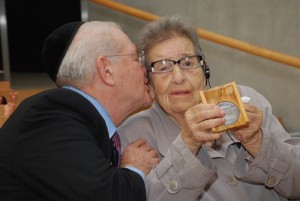
Magda honored by Yad Vashem ... and the boy she saved

Next, they start to say, “You know, the Jews have always wanted to govern themselves. We’re going to do them a favor. We’re going to let them all live in one place together and they can make their own rules. You just keep us apprised.” So the first couple of months of the Ghetto’s existence, they slowly moved people into one section of the city. Then they established the Jewish Council and the Jewish police force – they’re doing deals with the leadership of this group.

Jewish leaders were killed in early 1939 pogroms as well. They got rid of the Jewish leadership of the city. Some of them fled to the Soviet Union. So then, the public figured, “Well, they told us what they’re doing is they’re letting people be self-governing. It’s a separatist program. It’s apartheid. I guess we know and understand.”

Anna Paquin as Irena Sendler

Then the next thing we hear is that the people in the Ghetto are sick, and we’re going to do you a favor and not let you go into that area, because we don’t want you getting typhus. So then the population can’t see what’s happening behind the wall. And then you have the new external circumstances of less and less food as the German Army ran out of food.

So you ask, how could a Weimar soldier do this? Well, the Weimar soldier now has lost his buddies, he’s hungry, he’s been told these people are infested with typhus, and this is the only practical solution to this situation.

So then it starts to feel little bit like some contemporary things I’ve read about.

There were different types of people in the German army. There were people who were already brutal maniacs that were recruited for the S.S. and further trained to be brutal maniacs. Then there were simple German soldiers.

The way that Germans conducted themselves in Warsaw was they didn’t go into the Ghetto. For a long time, they ordered him Ukrainian conscripts to do a lot of the dirty work, they ordered Jewish police to do things, in exchange for supposedly … Everybody had to have a job, a livelihood. They told the people they deported, “We’re not deporting you, we’re giving you a loaf of bread and some margarine and jam and you’re going to a nice place to work, and you’re getting out of his ugly city.”

So even if the German soldiers, the simple Weimar soldiers, thought that that’s what was going on. You see how it gets more and more desperate.

It starts at the moment at which you objectify a human being. Which is to say, “That human being has no economic value and that human being does.” Then you’re in trouble. It proceeds from there. But it’s not like it started on Day One.

There were different kinds of German soldiers. And there were even some who helped Irena Sendler.

You can hear the entire October 28 interview with Mary Skinner – complete with slamming doors and the chiming of Stanford’s Bell Tower – here.


Irena Sendler’s story, “In the Name of Their Mothers” on PBS May 1: Interview with filmmaker Mary Skinner, Part 3

April 30th, 2011
Share

May 1st is Holocaust Remembrance Day – it is also the national premiere of PBS’ In the Name of Their Mothers, a documentary film about the Polish social worker Irena Sendler, who saved 2,500 Jewish babies and children from the Warsaw Ghetto and almost certain death at Treblinka. (Check local times here, and you can buy the DVD here.)

I’ve written about Irena Sendler before, here and here.

This is the third part of a 4-part interview, which took place following a Stanford screening of the film on October 28, 2010.  Part 1, with a trailer for the film, is here.  Part 2, with a youtube video featuring an interview with Irena Sendler, is here.

Incidentally, there’s an article here this week in JWeekly, “Modesty is the M.O. for Polish heroine Irena Sendler.” An excerpt from Sendler herself:

“I could not have achieved anything were it not for that group of women I trusted who were with me in the ghetto every day and who transformed their homes into care centers for the children,” she declared. “These were exceptionally brave and noble people.”

She continued, “As for me, it was simple. I remember what my father had taught me. ‘When someone is drowning, give him your hand.’ And I simply tried to extend my hand to the Jewish people.”

CH: Why did people in the Polish resistance keep quiet about their work after the war?

The Allies basically ceded Poland to Stalin. It was his war booty in exchange for having given up 30 million Russian lives to overthrow Hitler. When Stalin took over, he installed a puppet government. People who had been participating in the Polish resistance were perceived to be enemies of the state because they were for a free and independent Poland.

Sendler's beloved Warsaw – a carefully reconstructed city

Most of the leaders of the Polish resistance were caught tortured and executed in these mock trials.  Many others were suspected of being friends with people in the resistance or part of the resistance or knowledgeable in any way or having socialized with somebody in the resistance. They could be summoned in and interrogated and their lives could be made miserable. People like Magda Rusinek – her father had been a minister in the interwar government.

It wasn’t until 1989, really, that the stories really started coming out.

CH: Is this is part of why the Irena Sendler was reluctant to speak with you? She’d been silent for so long.

MS: Definitely. After several hundred years of occupation and not being allowed to speak Polish, the Polish people had become very good at running underground universities and doing clandestine work and using codenames and keeping each other’s secrets.

Hidden Jewish children at a Polish covent, 1943 (Photo: 2B Productions

Many of these women said, “Oh, we knew this stuff from our grandmothers,” because their grandmothers had been using these techniques against the Russians before 1918, so they all knew how to do messages and swallow pieces of paper and hide things behind their ears. Or how to do secret meetings and how to tip each other off – if you’re being watched, tip the flowerpot over so that everyone else in the resistance knows, “don’t go near that house, it’s been burned.” All these techniques they had learned from their parents, from their mothers. They were using them as part of this network against the Nazis and they all used codenames.

One said, “We didn’t know, and we didn’t want to know what each others’ real name was, where each other lived, who each other’s parents were, what each other’s profession was before the war.”

This kind of code didn’t just go away after the war ended, because then they were experiencing another totalitarian regime, the Soviet one, and so people who were just good eggs like Sendler just kept trying to do social work and not get anybody in trouble.

That’s how she spent the rest of her life. So to go on TV and talk about real children and real names and tell real stories is really difficult for her – and difficult for anyone who had done this work.

Question from the audience: “I’m going to assume that most of the parents didn’t survive. What happened to the children who were being protected in these homes and orphanages after the war?”

MS: Most of the children’s biological parents did not survive, true. The Jewish committee in Warsaw was run, in the months and years immediately following the war, by Adolf Berman, who had been Irena Sendler’s colleague. He had been responsible for gathering up all of this information, not only for children, but for all Jews living in Poland.

Pawiak Prison, where Sendler was tortured

They were receiving quite a bit of humanitarian aid at that point, because people were starting to find out what actually happened to these people. Sendler and Jadwiga Piotrowska turned a lot of their information over to Adolf Berman and then he was responsible for trying to figure out ways for all remaining Jewish children in Poland to be identified and to be reunited with their families of origin, if possible, and if not possible, to be sent to Israel.

CH: One question I had from the film: She was talking about the children who didn’t speak a word of Polish, children who only spoke Yiddish. How on earth they hide the children who couldn’t speak Polish?

MS: The purpose of the safehouses was to spend a little bit of time with them before they were moved to the next place. One of Hanna’s jobs was to sit with the children and to sing Yiddish songs with them, and gradually to teach them a few words of Polish. The purpose of these emergency care centers – and it was part of this whole social work system that they had evolved before the war – was to calm the children down and to start to teach them aenough words of Polish so that they could say the right thing if they were interrogated by a German soldier.


<<< Previous Series of PostssepNext Series of Posts >>>