When Jean Renoir died: how the Los Angeles Times got an obituary from Orson Welles. Steve Wasserman tells the tale.

August 6th, 2021

Share
“The honor of the paper was at stake.”

It’s a pleasure, always, to have a guest piece from my former Los Angeles Times Book Review editor … whoops! now he’s head of Heyday Books and my very own publisherSteve Wasserman. Here’s what he wrote remembering the occasion of the 1979 death of the eminent film director, screenwriter, actor, producer and author Jean Renoir.

Here’s the story of how the Los Angeles Times finagled an obituary from Orson Welles.

My old friend Peter Biskind, Hollywood historian extraordinaire, has rescued from Henry Jaglom‘s jumbled closet the hours upon hours of table-talk Jaglom recorded during his years of lunches with Orson Welles. As I hoovered up these edited transcripts of the higher gossip, I thought fondly of my own encounter with Welles – an encounter that would lead to irregular meals (and something of a friendship) with the great man at his favored table at “Ma Maison.”

The story begins with the death of Jean Renoir in Beverly Hills in early 1979. I was then deputy editor of the Los Angeles Times Sunday Opinion section. The Times, in its infinite wisdom, had consigned news of Renoir’s demise to an AP wire story buried on page nineteen of the Sunday paper. I was beside myself with unhappiness. Here was one of the great directors of the twentieth century, dying in our backyard, as it were, banished to an ignominious squib on the paper’s inside pages instead of being ballyhooed prominently on the front page.

He deserved better than “an ignominious squib.”

The honor of the paper was at stake, I felt. We needed to act immediately to commission a proper piece, honoring Renoir’s life and legacy, to publish in the next Sunday’s paper. Only Orson Welles, I felt, could do right by Renoir. But how to contact him? I knew only that Welles made a habit of eating lunch every Wednesday at “Ma Maison,” but I would need his piece, should he agree to write it, by Wednesday, or Thursday at latest, in order to make the Sunday paper. I remembered that Welles had some years before been the voice of the Paul Masson Winery, intoning “no wine before its time.” I called the winery and was referred to an ad agency in New York and was, in turn, given the name of Welles’s Manhattan agent. I rang and explained my purpose.

“So you want to reach Orson Welles, do you? Well, a lot of people want to reach him. Listen, kid, here’s what I’ll do. I’m gonna give you his office number. It’s a local number. Area code two-one-three. You’re unlikely to reach him, but if you do, will you do me a favor? Will you tell him to call his agent, for cryin’ out loud?”

I dialed the number. It rang and rang and rang. Finally, the receiver was slowly lifted off its cradle and what can only be described as an extraordinarily fey voice drawled hello. It was Welles’s assistant. I asked to speak to Welles. “I’m sorry, but Mr. Welles isn’t in.” “Do you expect him back soon?” “I do not know when he’ll be back. You see, Mr. Welles almost never comes in.” “Might I leave a message?” “Yes, if you must,” the voice said in tones of great exasperation. “But do understand that when Mr. Welles deigns to come into this office, he very often sees the stack of messages piled high on the desk and he sweeps them to the floor.”

The next morning, I got to work early. Already at my desk was my boss, Anthony Day, editor of the paper’s editorial pages. He was clutching my phone. “Yes, yes. I see him now, just coming in.” Cupping the receiver, he looked at me and stammered, “Steve, it’s. . .it’s Orson Welles. For you!”

I got on the horn and heard, in his inimitable voice, “Mr. Wasserman, this is Orson Welles. I did not know until I received your kind message that my great and good friend, Jean Renoir, had passed away. What, pray tell, would you have me do?”

I told him of the embarrassing and all but invisible notice that Renoir’s death had occasioned in the paper and that we had an obligation to do what we could to remove the stain of shame. Would he write a piece?

“So you want to reach Orson Welles, do you?”

“How long? How about two-hundred-fifty words?” he offered. Given the length of Renoir’s life and his considerable achievement, I said a thousand might be better.

“Let’s split the difference and agree to five hundred.”

As for deadline. . .he boomed, “I know, I know: You needed it yesterday.”

“For you, Mr. Welles, the day after tomorrow would be fine.”

As for compensation … he cut me off: “Let us not sully art with talk of money. I count on you to do the right thing. You will do that, won’t you?”

I said I’d do my level best.

Wednesday came and went. No piece. We were keeping space open on the front page of the Opinion section. By noon on Thursday, we began to sweat. My phone rang. It was Gus, the paper’s receptionist-cum-security guard who manned the front desk in the paper’s art deco lobby, worthy of The Daily Planet, at the center of which slowly revolved a globe boasting national boundaries not redrawn since the collapse of the Austro-Hungarian Empire. A man saying he was from Mr. Welles’s office was waiting for me.

I hurried down. And there, greeting me, was an apparition straight out of Sunset Boulevard. A man, kitted out in livery, replete with leather driving gloves, handed me a manila envelope, bearing Welles’s piece.

As I walked slowly up the stairs to my second-floor office, I read what Welles had written. It wasn’t five hundred words; it was nine pages, 2,000 words, typed double-spaced on an Underwood Five typewriter, and edited in Welles’ hand with a blue felt tip pen, the last page of which bore his signature. Every sentence had oxygen in it. The lede was unforgettable: “For the high and mighty of the movies a Renoir on the wall is the equivalent of a Rolls Royce in the garage. Nothing like the same status was accorded the other Renoir who lived in Hollywood and who died here last week.”

The essay was perfect, all about the uneasy intersection of art and commerce and, as I read it, I realized it was, of course, as much about Welles himself as it was about Renoir. It was about the trials and tribulations of neglected genius. It was, in a way, a kind of manifesto, a credo of artistic aspiration and principle.

The ending, too, was a doozy: “I have not spoken here of the man who I was proud to count as a friend. His friends were without number and we all loved him as Shakespeare was loved, ‘this side idolatry.’ Let’s give him the last word: ‘To the question “Is the cinema an art?” my answer is “What does it matter?. . .You can make films or you can cultivate a garden. Both have as much claim to being called an art as a poem by Verlaine or a painting by Delacroix. . .Art is ‘making.’ The art of love is the art of making love. . .My father never talked to me about art. He could not bear the word.'”

There was nothing to edit. Only to publish it as written. It was the last piece Welles ever wrote. It appeared in the Los Angeles Times on Feb. 18, 1979. I kept the signed original manuscript. It is among my most treasured possessions. That and the memory of the meals we later shared in the years before his death in 1985.

What would public literary criticism and scholarship mean? What would it look like?

August 1st, 2021
Share
Hot from the presses!

The subject is dear to my heart: the importance of literature in our everyday lives, as an additional lens to recognize, interpret, and understand the world we see around us. I’ve written about it here and here, among other places.

Editor extraordinaire: Rosemary Johnsen

Rosemary Johnsen is of the same mind: “Literary criticism has the potential not only to explain, but to actively change our terms of engagement with current realities.” She is Professor of English, Associate Provost, and Associate VP of Academic Affairs at Governors State University in University Park, Illinois. (She’s also the author of Contemporary Feminist Historical Crime Fiction – more on that here.)

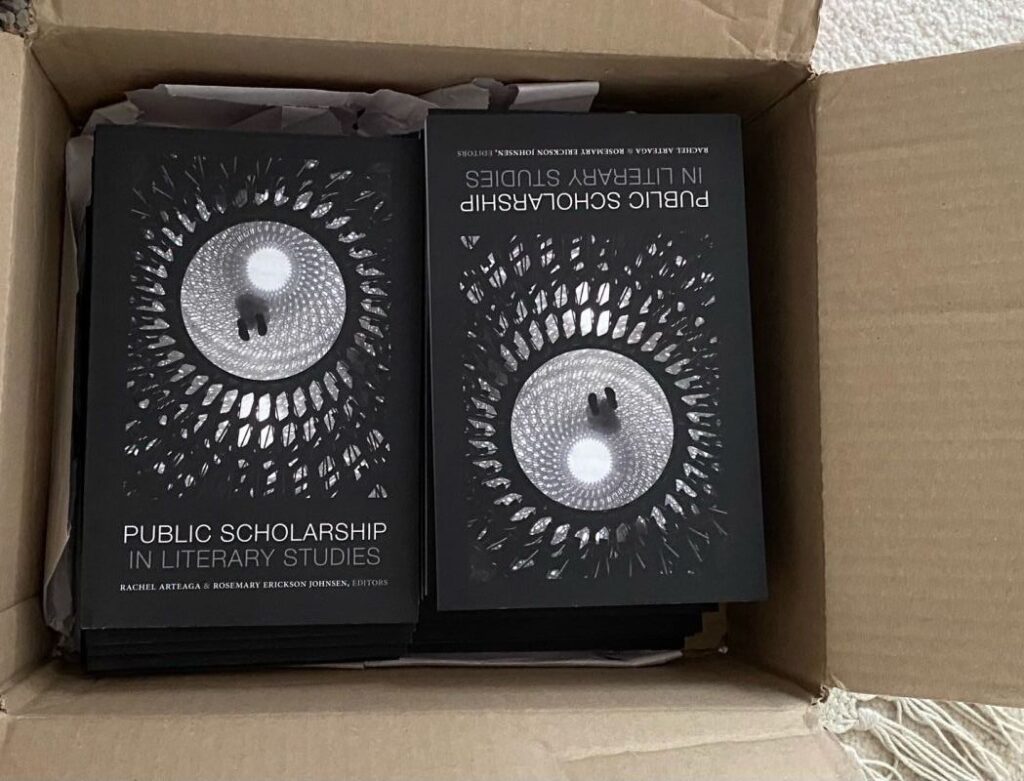
She joined forces with kindred spirit Rachel Arteaga of the University of Washington’s Simpson Center for the Humanities. Arteaga writes that she was inspired by a 2009 Daedalus article on the future of the humanities. What would public literary scholarship mean? What would public literary criticism look like? The result result of their partnership is a book, co-edited by both: Publish Scholarship in Literary Studies, just out with Amherst College Press. The book is available at Amazon here. Or you can get the book via open access here.

My humble self was invited to contribute, and so I did, with an essay titled “What Lasts,” discussing my own work with The Book Haven, Another Look, and Entitled Opinions. In the conclusion to the volume, Johnsen says the chapter “demonstrates the impact of her work, grounded in the practices of literary criticism.” Let’s hope so. I try. My position statement in the book:

Rachel Arteaga: Asking important questions

“The task of making the case for literature, and the humanities more generally, has never been more urgent. Great literature is endless. Nevertheless, it has become the province of a shrinking coterie who prefer solitary insight to Snapchat, something with a metaphysical bite rather than bytes. Quo vadis? Some years ago, the Polish poet Adam Zagajewski outlined one option for the future during our interview: ‘We’ll be living in small ghettos, far from where celebrities dwell, and yet in every generation there will be a new delivery of minds that will love long and slow thoughts and books and poetry and music, so that these rather pleasant ghettos will never perish— and one day may even stir more excitement than we’re used to now.’ It may come to that. I’ll opt for a less exclusive option: we may still learn to make a persuasive case for literature to a wider public, opening the essential world of literature across lines of class, race, and ethnicity.”

The book also tips its hat to the National Endowment of the Humanities for its creation of a “Public Scholars program,” in its “long-term commitment to encourage scholarship in the humanities for general audiences,” Johnsen notes. (Careful Book Haven readers will remember I am one of the program’s recipients; I wrote about that here.)

From Johnsen’s conclusion:

“The power of literature to enrich and inform understanding is well known to literary scholars. Increasingly, however, that foundational truth is disregarded or actively attacked. Literature, like much of the humanities, is often spoken of as a luxury or, even worse, as useless. Bringing literary study into the realm of public scholarship can help counter those misperceptions, working both individually and collectively to restore some confidence in what we do as scholars of literature. Public scholarship becomes the means to share what literary scholarship offers, but also to chip away at the presence of anti-intellectualism in contemporary society. Our ability to serve as intermediary between text and audience—the kinds of work we routinely do in our classrooms and at campus events— positions us to contribute beyond campus and our scholarly communities and to learn from the perspectives and insights available from those who do not inhabit our campuses. Public scholarship often takes forms recognizably similar to teaching and learning, but it can also serve as advocacy. We need that now more than ever.”

What do you do when a hitman comes to your home? Ask Luke Burgis. It happened.

July 22nd, 2021
Share

One of the more astonishing stories in entrepreneur Luke Burgis‘s new book, Wanting: The Power of Mimetic Desire in Everyday Life – and there are many – is his unexpectedly moving tale about his interlude with a hitman. “My e-commerce company was flailing after a buyout deal fell through thanks to the Great Recession. I’d already maxed out my credit to keep the company afloat while I figured out next steps.” He concocted a “debt triage” plan. Fyre pharmaceutical wasn’t on it the shortlist.

An excerpt about what followed:

Even his dog was scared.

My decision to exclude Fyre Pharmaceutical from my list of priority payments would have been different had I known that the company’s founders were rumored to have connections with organized crime, that they were said to be involved in gun trafficking, and that one of my competitors mysteriously vanished after crossing them. 

I had interacted with Dave three times before. The first was an unpleasant phone call during which he informed me that my payment was late; offended, I snapped back with a full-throated defense of my excellent payment history. The second was an unannounced visit to my office, where he confronted me and told me that he wasn’t a patient man; he threw a pair of dice on my desk and left. The third was when he showed up at a local bar during Sunday football—no idea how he’d known I was there—and told me that he “means what he says” while beating one of his fists against his palm like he was tenderizing meat; the bouncers escorted Dave out. As he left, he made the figure of a pistol with his thumb and forefinger, and pointed it at me. 

This was now the fourth visit from Dave, and I didn’t know what it meant. 

He seemed different this time. He began with small talk. He asked me how I was doing. He commented on the weather. Is this how it goes? I wondered. Was it the happy-go-lucky backslapping before a guy gets whacked on The Sopranos?

I bumbled nervous replies. I stood taking up as much space in the front door as I could to prevent my dog Axel, who was standing behind me, hair on end, from slipping out. Dave was standing too close, seeming like he wanted to slip in. 

He drew even closer and lowered his voice. “Can you please, um, quick handle this bill by Monday morning so I don’t have to … come back?” He spoke quietly, calmly, and courteously while he twisted one of the gaudy rings on his left hand. 

There was no way that I could pay him that soon. 

Before I had a chance to respond, he continued: “I hear you’re having a big company barbecue here tomorrow night.” 

It was true. I hosted a monthly party at my house with rolling invitations to people at my company. This time, though, I had invited everyone. I worried that it might be our last rendezvous if things didn’t turn around. 

But how did Dave Romero know about it? 

“Mind if I come?” he asked. 

It didn’t seem like a question. I was growing increasingly confused and nervous. I just wanted Dave off my porch. “No, I mean yeah, sure, people start showing up at seven, you can stop by.” The words came out of my mouth. I’d never refused a request to come to one of my parties—certainly not to anyone’s face. I didn’t know how. 

And now I had invited a hitman into my home.

Read the rest of the story over at Arc Digital here.

William Kennedy’s long-ago Smith Corona. Postscript from the author: “I loved all those machines, but I now view them as marvelous sculptures.”

July 20th, 2021
Share
William Kennedy’s ancient manual typewriter – on loan. (Photo: Roger Winkelman)

William Kennedy has been called the “Bard of Albany” – and the city returns his love. Most recently, it did so via a display at the Albany airport terminal, part of the Albany Book Festival. The Irish-American author kindly loaned his vintage 1930 L.C. Smith and Corona typewriter for the occasion. (If you’re a Boomer who doesn’t think that’s a big deal, a manual typewriter is one of the star exhibits for today’s students visiting Stanford’s Green Library. They keep looking for the “on” switch.) We’ve written about vintage typewriters and the authors who owned them before, here.

This particular typewriter came from his mother, and Kennedy wrote the first five novels of his renowned Albany cycle on it. In particular, he wrote Ironweed on it, and that’s the book that brought him a Pulitzer Prize and a National Book Award. The photo with the typewriter was taken in 1950, when he would have been 22 – only two years older than the typewriter – and a budding reporter at the Albany Times Union.

Some of you will remember I interviewed Bill for the Los Angeles Review of Books “‘At the Mercy of My Passions and Opinions’: A Conversation with William Kennedy” – and some of you attended Another Look’s recent event for his book, Billy Phelan’s Greatest Game.

Our roving ambassador in Albany last week was Roger Winkelman, the technical wizard and reliable deity who produces videos and podcasts for Another Look’s literary offerings. He managed to take a few quick photos for the Book Haven. He also took a quick partial shot (below)of a poster from the 2019 onstage discussion with Director Francis Ford Coppola, as the two discussed their work together on the 1984 film The Cotton Club, which the pair co-wrote. (Read more about it here.)

That was all Roger had time for. Then our man in Albany hopped on a plane and headed back home for Stanford.

Update: A quick correction from Richard Polt of The Classic Typewriter Page (more on that later) about the make of William Kennedy’s typewriter – maybe it’s not an 1930 L.C. Smith after all: “The typewriter Kennedy is using in the photo is not this one; it has a rounded top, whereas the L. C. Smith’s top is flat. It looks like a Royal KMM.”


Update on July 29: Not so fast! I contacted Bill Kennedy himself for a definitive reply. Here’s what he said today:

“Richard Polt is correct that the typewriter I’m using in the 1949 photo is not an L.C. Smith, and he’s probably also correct that it’s a Royal, though I don’t really remember. I never had any particular admiration for that machine the way I did for my LCS,  Our city editor (the photo is from my first job, assistant sports editor of the Glens Falls NY Post Star, number two man in a two-man department) had an Underwood of similar vintage and that was vastly superior to Royals and LCSs alike. The Underwood was built for speed, and I recall being clocked typing 125 words a minute on one when I was in the army.  I loved all those machines, but I now view them as marvelous sculptures
.”

Director Coppola, author and screenwriter Kennedy (Photo: Roger Winkelman)

“At home that was sacred – I had to speak Spanish.” Dominican/American poet Rhina Espaillat remembers a bilingual childhood

July 14th, 2021
Share

Bilingual spirit

Rhina P. Espaillat was born in the Dominican Republic. Her family left the troubled Caribbean island state during the period when dictator Rafael Trujillo slaughtered thousands. Her father and uncle were already in Washington as diplomats, and could not return to the Dominican Republic. It would be years before the family was reunited in the U.S. Her first poems were published in Ladies Home Journal when she was in high school.

In this interview for Plough, she recounts her bilingual upbringing and how she taught poetry in New York City schools, She has translated Robert Frost and Richard Wilbur into Spanish – but I appreciated her discussion of Sor Juana Inés de la Cruz, whom she calls the first great poet of the continent.

The occasion for the interview: Plough is launching a new poetry competition, the Rhina Espaillat Poetry Award. Plough’s poetry editor, A. M. Juster, a poet who knows a thing or two about translation himself, conducted the interview with the poet, who turned 89 this year. An excerpt:

One of your most popular poems is called “Bilingual/Bilingüe.” Could you tell about its inspiration and evolution?

Poet Juster conducts the interview

That poem came out of reality in the apartment of my parents, where I was permitted to speak English outside the door, but not inside; my father wanted me to be bilingual. He said, “She’s got to be part of the world, so Spanish in here, English out there.” I used to come home from school and say, “Let me tell you what the teacher said today,” and he would say, “No, no, mi hija, dímelo en español, en castellano.” I would say, “I want to tell you exactly the way she said it,” but he was very firm. At home that was sacred – I had to speak Spanish.

So “Bilingual/Bilingüe” sort of fell together – it had to have a little Spanish in each of the couplets, but by the end the Spanish no longer has parentheses around it: by that time we’re joined in it.

Tell people about Sor Juana.

Sor Juana is one of my saints. I adore her because she was so daring, so smart. In seventeenth-century Mexico, it was not a good idea for a woman to be that smart because she was surrounded by guys who thought that women should have a place in the kitchen. She didn’t want the kitchen. She became a nun not because she had a tremendously powerful calling, but because she wanted her privacy. She wrote a great many religious pieces that are outstanding, and she did her duties as a nun, of course. But she also wrote the most passionate love poetry.

Vain? Not likely.

She wrote Latin poetry too, which is much harder to compose because the prosody is so different.

But she did it. What’s more, she even wrote poems in Nahuatl. She studied philosophy and music and science; she was far ahead of her time.

The Inquisition got so annoyed with her that it sent word through one of the archbishops that she had better be very careful because she was becoming vain – by that they meant she published her poetry. They frightened her and said, “The only way you are going to get through this safely is to get rid of your scientific instruments and all your books.”

So she got rid of everything. She got into her old clothes, took care of sick nuns, then promptly got sick herself and died in her forties.

The other Cruz is Saint John of the Cross, Juan de la Cruz, and I adore him. What he did was to write, quite literally, love letters to God because in his poems he becomes the soul, which of course has to be female. The soul in his poems is always a woman very much in love with her husband who misses him all of a sudden. It’s absolutely enchanting.

Read the whole thing here.

“I want what she’s having.” London lauds a new book on the nature of our wanting.

July 5th, 2021
Share
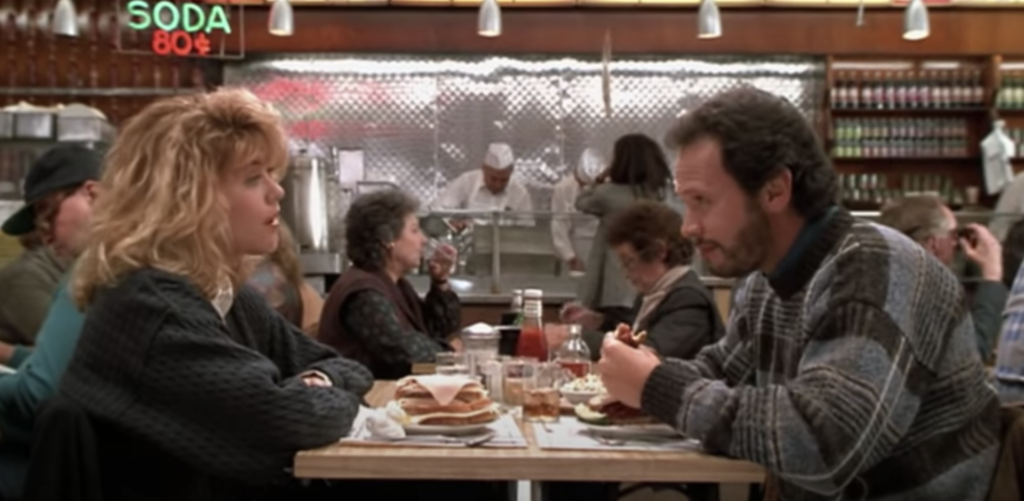
The movie that inspired the meme: “When Harry Met Sally”

We want what others want. It’s a law as old as mankind, going all the way back to Eden. It was the subject of René Girard‘s corpus, and the French theorist’s work inspired Luke Burgis’s new book Wanting. “Movements of desire are what define our world. Economists measure them, politicians poll them, businesses feed them,” he writes.

René Girard began with literature, and moved to anthropology, religions, history, and more. Burgis brings his lens to a new domain: the world of entrepreneurship, of business, of technology, of international finance. Christina Patterson writes about it her review, “I Want What She’s Having” in the Times of London review yesterday.

From The Times review:

The key issue, he says, is “What do you want?” and “What have you helped others want?” The answer shapes our lives and our life satisfaction, but we are, he argues, fighting some strong tides. Powerful figures have always changed our desires. Now we don’t just have PR Svengalis and the influence of peers and celebrities such as, say, the Kardashians. We have the tech giants stoking our desires every time we glance at our phone. And the cycles of “thin desires” they are generating are creating division and stress.

Burgis is open about his key ideas coming from Girard, but he fleshes them out witty stories, personal anecdotes and research that bring them alive. His prose is punchy. His anecdotes are entertaining. There are even witty cartoons.

Writing from an entrepreneur’s perspective

It concludes:

It isn’t “Celebristan”, the world of celebrities and influencers, we have to worry about, he says. It’s “Freshmanistan”, the world of models from inside our lives who can drive us to destructive cycles of envy, exhaustion and distress. We should learn, he says, to pursue our “thick desires”, like Sébastien Bras, the chef who asked to be removed from the Michelin guide because he wanted to see more of his family and do things his way.

“Part philosophical tract, part self-help guide, Wanting is a thought-provoking book. It’s also a deeply moral one. Like many Silicon Valley entrepreneurs, Burgis wants to create a better world. The ideas he presents, and his suggestions for action, seem to offer a more realistic hope than most.

Read the whole thing (warning: paywall) here. And you can read an excerpt from the book, “The Joy of Hate Watching” here.


<<< Previous Series of PostssepNext Series of Posts >>>